Uncertainty surrounding US tariff policy supported safe-haven buying, with gold consolidating at high levels awaiting guidance from PPI.
2026-02-27 10:33:13
Spot gold (XAU/USD) found buying support around $5190 in early Asian trading on Friday and rose slightly. The main driver of the gold price rebound was uncertainty surrounding US trade policy.
US President Trump stated that he will impose a uniform 15% tariff on imported goods after the Supreme Court overturns the previous reciprocal tariff framework. Meanwhile, US Trade Representative Jamison Greer indicated that tariffs on several countries could be raised to 15% or even higher in the coming days.
 Repeated policy signals have increased market concerns about the outlook for the global trade environment. Against this backdrop, gold, as a traditional safe-haven asset, has once again attracted capital inflows. Historical experience shows that when policy paths are unclear or the macroeconomic environment presents high volatility risks, funds tend to allocate to gold to hedge against systemic risks.
However, the temporary easing of geopolitical tensions has exerted some downward pressure on gold prices. Omani Foreign Minister Badr al-Busaiidi stated that the negotiations between the United States and Iran in Switzerland had made "significant progress," and that the two sides would continue talks on the nuclear issue next week after internal consultations. Negotiations will resume technically in Vienna.
If tensions between the US and Iran continue to ease, safe-haven demand may decline marginally, thus limiting the upside potential for gold. From a macro perspective, market attention is focused on the upcoming US January Producer Price Index (PPI) report.
Economists expect the January PPI to rise 0.3% month-on-month, lower than the previous 0.5%; the year-on-year increase is expected to be 2.6%, lower than the previous 3.0%. If the data is higher than expected, it could strengthen expectations that the Federal Reserve will maintain interest rates or even extend the high-interest-rate cycle. Since gold does not generate interest income, high interest rates often diminish its attractiveness.
Conversely, if PPI data is moderate or lower than expected, it could alleviate concerns about policy tightening, thus providing further support for gold prices. The current gold market is characterized by a complex interplay of three variables: trade policy uncertainty provides safe-haven support, easing US-Iran relations limit gains, and inflation data determines the direction of interest rate expectations. Short-term fluctuations will revolve around data releases.
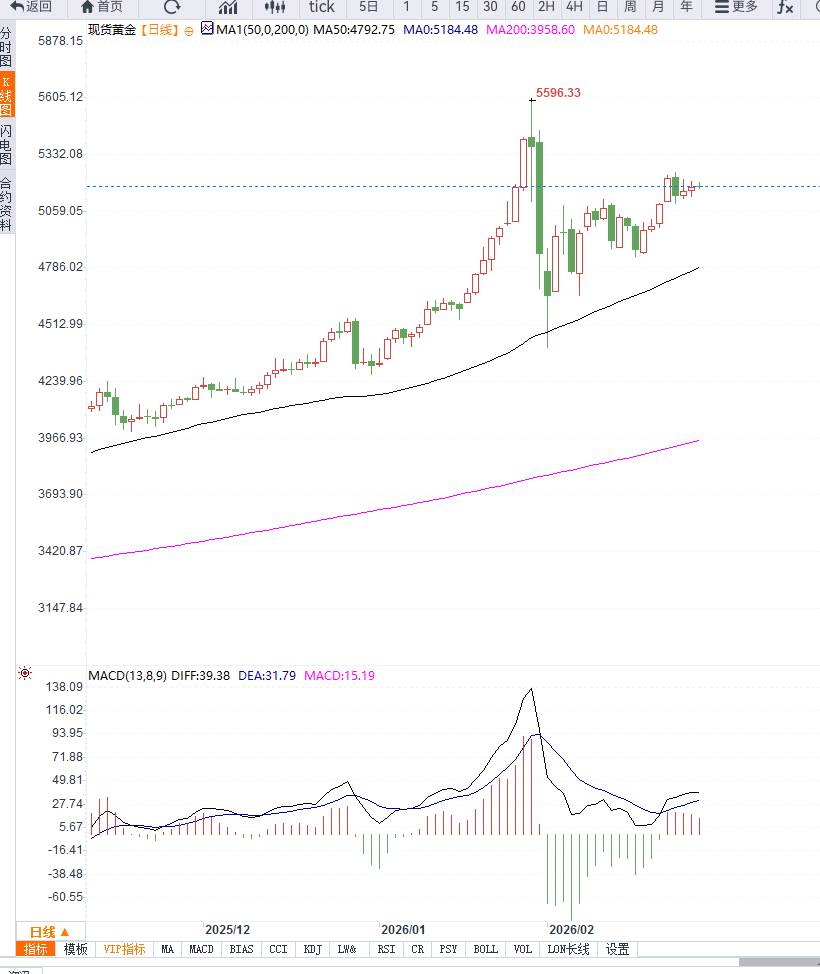
From the daily chart, gold maintains a high-level consolidation pattern, with prices remaining strong above $5,100. The moving average system is still in a bullish alignment, but the slope is slowing down, indicating that the upward momentum is weakening. The RSI is around 60 and has not entered the severely overbought zone, suggesting that the bulls have not yet become overheated.
Key support levels are at $5,150 and the psychological level of $5,100. A break below these levels could test the $5,050 area. Short-term resistance is around $5,220, and a break above this level could lead to a retest of the psychological level of $5,300.
The four-hour chart shows that the price is running within an upward channel, with short-term support at $5170 and resistance in the $5215-$5220 range. If the PPI data triggers a breakout with increased volume, the price may see a one-sided upward trend of $30-$50. The overall structure is still bullish but has entered a high-level consolidation phase.
Editor's Note:
The current gold price movement is fundamentally driven by the interplay between "policy uncertainty" and "interest rate path expectations." Repeated pronouncements on tariff policies have boosted safe-haven demand, but if geopolitical tensions ease significantly, gold's upside potential will be limited. The true key to determining the short-to-medium-term trend remains US inflation data and the direction of interest rate expectations.
During periods of high-level consolidation, gold prices have become significantly more sensitive to data releases. If the PPI is moderate, gold prices may break upwards; however, if inflation picks up again, short-term downward pressure will increase rapidly. It is crucial to focus on market pricing changes after the data release, rather than short-term disturbances from a single news item.
US President Trump stated that he will impose a uniform 15% tariff on imported goods after the Supreme Court overturns the previous reciprocal tariff framework. Meanwhile, US Trade Representative Jamison Greer indicated that tariffs on several countries could be raised to 15% or even higher in the coming days.
Repeated policy signals have increased market concerns about the outlook for the global trade environment. Against this backdrop, gold, as a traditional safe-haven asset, has once again attracted capital inflows. Historical experience shows that when policy paths are unclear or the macroeconomic environment presents high volatility risks, funds tend to allocate to gold to hedge against systemic risks.However, the temporary easing of geopolitical tensions has exerted some downward pressure on gold prices. Omani Foreign Minister Badr al-Busaiidi stated that the negotiations between the United States and Iran in Switzerland had made "significant progress," and that the two sides would continue talks on the nuclear issue next week after internal consultations. Negotiations will resume technically in Vienna.
If tensions between the US and Iran continue to ease, safe-haven demand may decline marginally, thus limiting the upside potential for gold. From a macro perspective, market attention is focused on the upcoming US January Producer Price Index (PPI) report.
Economists expect the January PPI to rise 0.3% month-on-month, lower than the previous 0.5%; the year-on-year increase is expected to be 2.6%, lower than the previous 3.0%. If the data is higher than expected, it could strengthen expectations that the Federal Reserve will maintain interest rates or even extend the high-interest-rate cycle. Since gold does not generate interest income, high interest rates often diminish its attractiveness.
Conversely, if PPI data is moderate or lower than expected, it could alleviate concerns about policy tightening, thus providing further support for gold prices. The current gold market is characterized by a complex interplay of three variables: trade policy uncertainty provides safe-haven support, easing US-Iran relations limit gains, and inflation data determines the direction of interest rate expectations. Short-term fluctuations will revolve around data releases.
From the daily chart, gold maintains a high-level consolidation pattern, with prices remaining strong above $5,100. The moving average system is still in a bullish alignment, but the slope is slowing down, indicating that the upward momentum is weakening. The RSI is around 60 and has not entered the severely overbought zone, suggesting that the bulls have not yet become overheated.
Key support levels are at $5,150 and the psychological level of $5,100. A break below these levels could test the $5,050 area. Short-term resistance is around $5,220, and a break above this level could lead to a retest of the psychological level of $5,300.
The four-hour chart shows that the price is running within an upward channel, with short-term support at $5170 and resistance in the $5215-$5220 range. If the PPI data triggers a breakout with increased volume, the price may see a one-sided upward trend of $30-$50. The overall structure is still bullish but has entered a high-level consolidation phase.
Editor's Note:
The current gold price movement is fundamentally driven by the interplay between "policy uncertainty" and "interest rate path expectations." Repeated pronouncements on tariff policies have boosted safe-haven demand, but if geopolitical tensions ease significantly, gold's upside potential will be limited. The true key to determining the short-to-medium-term trend remains US inflation data and the direction of interest rate expectations.
During periods of high-level consolidation, gold prices have become significantly more sensitive to data releases. If the PPI is moderate, gold prices may break upwards; however, if inflation picks up again, short-term downward pressure will increase rapidly. It is crucial to focus on market pricing changes after the data release, rather than short-term disturbances from a single news item.
- Risk Warning and Disclaimer
- The market involves risk, and trading may not be suitable for all investors. This article is for reference only and does not constitute personal investment advice, nor does it take into account certain users’ specific investment objectives, financial situation, or other needs. Any investment decisions made based on this information are at your own risk.