The Bank of Japan appoints a dovish new board member, the yen continues to weaken, and the dollar index struggles amid tariff turmoil, the Middle East powder keg, and inflationary risks.
2026-02-28 11:04:44
In the first week after the Chinese New Year holiday, global currency markets faced a complex mix of uncertainties. On Friday (February 20), the U.S. Supreme Court ruled that President Trump's tariff measures, based on the International Emergency Economic Powers Act, were illegal, a ruling that directly overturned the existing trade framework. Subsequently, Trump invoked Section 122 of the Trade Act of 1974, announcing a 10% tariff on all imports from all countries and authorizing a 150-day period to explore other legally feasible tariff measures. He also warned countries that "playing tricks" would face even higher tariff penalties.
A White House official revealed that the United States began imposing a new 10% temporary global import tariff on Tuesday (February 24), but the Trump administration is working to raise the rate to 15%. This policy shift has exacerbated international confusion. Japan has demanded that the United States ensure its treatment under the new tariff regime is no less favorable than under existing agreements, while the European Union and the United Kingdom have also expressed their desire to maintain existing agreements. China's Ministry of Commerce issued a statement urging the United States to abandon unilateral tariff increases and expressing its willingness to hold a new round of trade consultations with the United States. U.S. Trade Representative Greer stated that Trump plans to visit China in the coming weeks and currently has no intention of raising tariffs on Chinese goods. These shifts in tariff policy have not only confused market participants but, intertwined with the tense situation between the United States and Iran, have further amplified uncertainty.
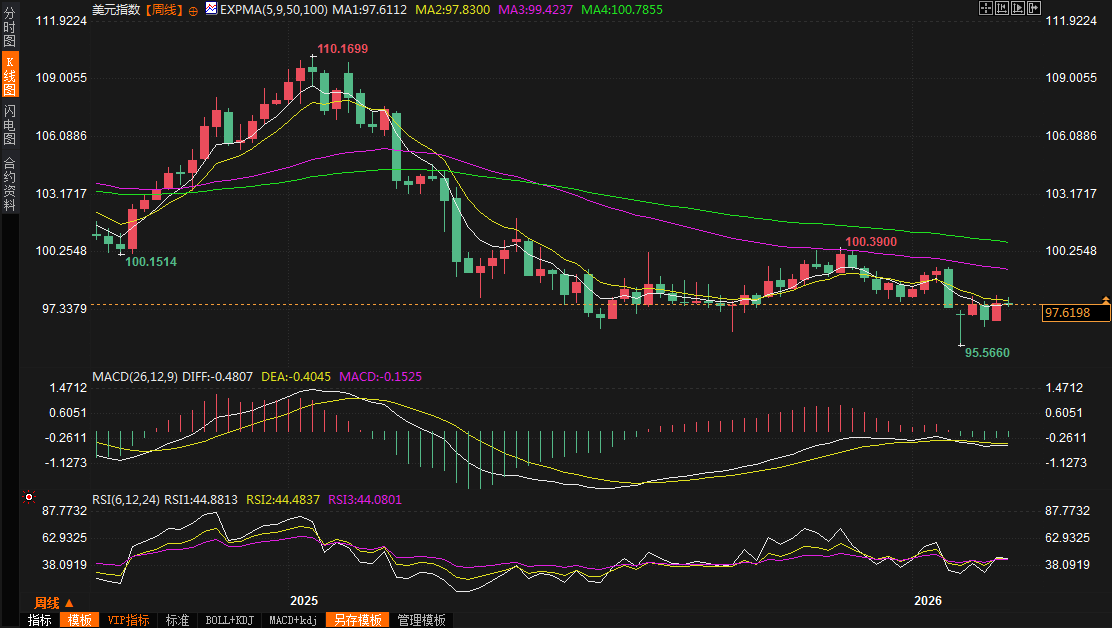
The US dollar traded in a volatile but generally stable manner this week, rising 0.5% for the month to close at 97.62. Several Federal Reserve officials believe there is no immediate need to adjust monetary policy, but Governor Milan advocates for a 1 percentage point rate cut this year. The market widely expects the Fed to weigh higher inflation against labor market risks and maintain interest rates unchanged at least until June.
Sarah Ying, Head of FX Strategy at CIBC Capital Markets, points out that there is considerable debate in the market regarding the impact of further tariffs on the US dollar: on the one hand, more aggressive tariffs could push up inflation, reducing the likelihood of further interest rate cuts by the Federal Reserve, thus supporting the dollar; on the other hand, increased uncertainty could trigger de-dollarization risks, putting downward pressure on the dollar. TD Securities analysts emphasize that the risk of a weaker dollar remains in the coming quarters, and the resilience of the US economy may not reach the level of "exceptionalism." Against the backdrop of robust global growth, low interest rates, and fiscal buffers, this will benefit risk assets but be detrimental to the dollar.
(US Dollar Index Weekly Chart)
The euro rose slightly by 0.2% against the dollar this week after European Central Bank President Christine Lagarde said that policymakers expect inflation to stabilize at the 2% target level in the near term, leading the market to expect the ECB to maintain its policy stability.
The pound held steady against the dollar on Friday, remaining stable for the week but down 1.5% for the month, ending a three-month winning streak. This was mainly due to continued dovish sentiment from the Bank of England, with traders believing there was an 83% probability of an interest rate cut in March. Bank of England Governor Bailey stated that a rate cut in March was possible, but the latest data showed that service price inflation, which the central bank closely monitors, did not fall as expected, and domestic political risks remained the main driving factor.
The Australian dollar was flat against the US dollar on Friday, closing at 0.7113, but rose 0.4% for the week, marking its sixth consecutive week of gains. The monthly increase exceeded 2%, and year-to-date, it has risen over 6%, making it the best-performing G10 currency. This was mainly driven by a strong domestic economy fueling expectations of a more hawkish stance from the Reserve Bank of Australia (RBA). However, higher-than-expected January inflation data raised concerns, with the market anticipating an approximately 80% chance of the RBA raising interest rates from 3.85% in May. The Australian dollar rose over 1% against the Japanese yen this week, reaching a 35-year high of 111.47 before closing near 111.04. OCBC currency strategist Sim Moh Siong noted that this year's market focus has shifted from which central banks will cut rates to which will raise rates first, reflecting a change in the macroeconomic situation.
The yen hit a two-week low this week, trading in a narrow range on Friday, but still fell 0.6% overall for the week and 0.84% so far this month. The Japanese government nominated two scholars considered strong advocates of economic stimulus policies to the Bank of Japan's policy board, an appointment that foreshadows greater challenges for the Bank of Japan in raising interest rates in the process of policy normalization.
Japanese Prime Minister Sanae Takaichi has adopted a hands-on approach to monetary policy, expressing reservations about further interest rate hikes during her meeting with Bank of Japan Governor Kazuo Ueda last week, which further weakened the yen. However, the Yomiuri Shimbun reported that Ueda stated the central bank will carefully study the data at its March and April meetings to decide whether to raise interest rates, leaving open the possibility of a near-term rate hike. Hawkish policy board member Hajime Takada called for gradual interest rate increases and expressed concern about the risk of excessive inflation.
Data released by the Japanese government showed that core inflation in the Tokyo area slowed in February, giving consumers a breather but also making it more difficult for the central bank to explain the necessity of further interest rate hikes. David Chao, Global Market Strategist for Asia Pacific at Invesco, described it as a tug-of-war, with the Bank of Japan walking a tightrope, but he still believes the central bank will raise interest rates twice this year, and the yen is likely to be one of the best-performing currencies.
The producer price index (PPI) for final demand rose 0.5% in January, exceeding economists' expectations of 0.3%, while the index also rose 0.5% in December. This data initially boosted the dollar, but the gains subsequently faded as traders closed out positions at the end of the month and before the weekend.
Adam Button, chief currency analyst at investingLive, said the market has deep concerns about the inflation and growth outlook so far into 2026. While inflation is expected to slow, the data has not yet reflected this trend. Chris Low, chief economist at FHN Financial, pointed out that although the PPI increase was dramatic, the main pressure came from the trade services sector, whose calculation method does not reflect real price changes in real time. Apart from this, other sectors showed signs of price stabilization.
The dollar was initially boosted this week by safe-haven buying triggered by concerns over the US-Iran conflict. US President Trump stated he was unhappy with Iran but hoped to reach an agreement with Tehran, while warning that sometimes force must be used. Oil prices rose about 3% on Friday as traders remained wary of potential supply disruptions caused by deteriorating relations between the two countries. However, the foreign exchange market was relatively quiet this week, with traders assessing the impact of geopolitical uncertainties and new tariffs. The US Supreme Court's ruling overturning Trump's emergency tariff order further strengthened checks and balances on presidential power, providing some support for the dollar. City Index market strategist Fiona Cincotta said the dollar is consolidating slightly, seemingly awaiting the next real catalyst.
Next week's economic calendar isn't particularly packed, but the market will be focused on the February jobs report, January retail sales, and the latest indicators for US manufacturing and services. Monday will see the release of the ISM February Manufacturing PMI, Wednesday's ISM Services PMI and ADP employment data, Thursday's weekly initial jobless claims, and Friday's February non-farm payrolls and January retail sales reports. The Federal Reserve is expected to keep interest rates unchanged until at least June, but traders currently anticipate a 62 basis point rate cut by the end of the year due to concerns about a weak labor market.
In summary, the global foreign exchange market at the end of February 2026 presented a complex and volatile landscape, influenced by a confluence of factors including tariff chaos, the US-Iran conflict, and PPI data. While the US dollar achieved a monthly gain, its future trajectory will still depend on geopolitical developments, central bank policy adjustments, and further guidance from economic data. Investors need to closely monitor these catalysts to manage potential volatility risks.
A White House official revealed that the United States began imposing a new 10% temporary global import tariff on Tuesday (February 24), but the Trump administration is working to raise the rate to 15%. This policy shift has exacerbated international confusion. Japan has demanded that the United States ensure its treatment under the new tariff regime is no less favorable than under existing agreements, while the European Union and the United Kingdom have also expressed their desire to maintain existing agreements. China's Ministry of Commerce issued a statement urging the United States to abandon unilateral tariff increases and expressing its willingness to hold a new round of trade consultations with the United States. U.S. Trade Representative Greer stated that Trump plans to visit China in the coming weeks and currently has no intention of raising tariffs on Chinese goods. These shifts in tariff policy have not only confused market participants but, intertwined with the tense situation between the United States and Iran, have further amplified uncertainty.
Geopolitical risks and monetary policy trade-offs exacerbate dollar volatility.
The US dollar traded in a volatile but generally stable manner this week, rising 0.5% for the month to close at 97.62. Several Federal Reserve officials believe there is no immediate need to adjust monetary policy, but Governor Milan advocates for a 1 percentage point rate cut this year. The market widely expects the Fed to weigh higher inflation against labor market risks and maintain interest rates unchanged at least until June.
Sarah Ying, Head of FX Strategy at CIBC Capital Markets, points out that there is considerable debate in the market regarding the impact of further tariffs on the US dollar: on the one hand, more aggressive tariffs could push up inflation, reducing the likelihood of further interest rate cuts by the Federal Reserve, thus supporting the dollar; on the other hand, increased uncertainty could trigger de-dollarization risks, putting downward pressure on the dollar. TD Securities analysts emphasize that the risk of a weaker dollar remains in the coming quarters, and the resilience of the US economy may not reach the level of "exceptionalism." Against the backdrop of robust global growth, low interest rates, and fiscal buffers, this will benefit risk assets but be detrimental to the dollar.
(US Dollar Index Weekly Chart)
Divergence in Major Currency Performance and Central Bank Dynamics
The euro rose slightly by 0.2% against the dollar this week after European Central Bank President Christine Lagarde said that policymakers expect inflation to stabilize at the 2% target level in the near term, leading the market to expect the ECB to maintain its policy stability.
The pound held steady against the dollar on Friday, remaining stable for the week but down 1.5% for the month, ending a three-month winning streak. This was mainly due to continued dovish sentiment from the Bank of England, with traders believing there was an 83% probability of an interest rate cut in March. Bank of England Governor Bailey stated that a rate cut in March was possible, but the latest data showed that service price inflation, which the central bank closely monitors, did not fall as expected, and domestic political risks remained the main driving factor.
The Australian dollar was flat against the US dollar on Friday, closing at 0.7113, but rose 0.4% for the week, marking its sixth consecutive week of gains. The monthly increase exceeded 2%, and year-to-date, it has risen over 6%, making it the best-performing G10 currency. This was mainly driven by a strong domestic economy fueling expectations of a more hawkish stance from the Reserve Bank of Australia (RBA). However, higher-than-expected January inflation data raised concerns, with the market anticipating an approximately 80% chance of the RBA raising interest rates from 3.85% in May. The Australian dollar rose over 1% against the Japanese yen this week, reaching a 35-year high of 111.47 before closing near 111.04. OCBC currency strategist Sim Moh Siong noted that this year's market focus has shifted from which central banks will cut rates to which will raise rates first, reflecting a change in the macroeconomic situation.
The Bank of Japan's policy outlook faces challenges.
The yen hit a two-week low this week, trading in a narrow range on Friday, but still fell 0.6% overall for the week and 0.84% so far this month. The Japanese government nominated two scholars considered strong advocates of economic stimulus policies to the Bank of Japan's policy board, an appointment that foreshadows greater challenges for the Bank of Japan in raising interest rates in the process of policy normalization.
Japanese Prime Minister Sanae Takaichi has adopted a hands-on approach to monetary policy, expressing reservations about further interest rate hikes during her meeting with Bank of Japan Governor Kazuo Ueda last week, which further weakened the yen. However, the Yomiuri Shimbun reported that Ueda stated the central bank will carefully study the data at its March and April meetings to decide whether to raise interest rates, leaving open the possibility of a near-term rate hike. Hawkish policy board member Hajime Takada called for gradual interest rate increases and expressed concern about the risk of excessive inflation.
Data released by the Japanese government showed that core inflation in the Tokyo area slowed in February, giving consumers a breather but also making it more difficult for the central bank to explain the necessity of further interest rate hikes. David Chao, Global Market Strategist for Asia Pacific at Invesco, described it as a tug-of-war, with the Bank of Japan walking a tightrope, but he still believes the central bank will raise interest rates twice this year, and the yen is likely to be one of the best-performing currencies.
Better-than-expected PPI data initially supported the US dollar.
The producer price index (PPI) for final demand rose 0.5% in January, exceeding economists' expectations of 0.3%, while the index also rose 0.5% in December. This data initially boosted the dollar, but the gains subsequently faded as traders closed out positions at the end of the month and before the weekend.
Adam Button, chief currency analyst at investingLive, said the market has deep concerns about the inflation and growth outlook so far into 2026. While inflation is expected to slow, the data has not yet reflected this trend. Chris Low, chief economist at FHN Financial, pointed out that although the PPI increase was dramatic, the main pressure came from the trade services sector, whose calculation method does not reflect real price changes in real time. Apart from this, other sectors showed signs of price stabilization.
Tensions between the US and Iran escalate
The dollar was initially boosted this week by safe-haven buying triggered by concerns over the US-Iran conflict. US President Trump stated he was unhappy with Iran but hoped to reach an agreement with Tehran, while warning that sometimes force must be used. Oil prices rose about 3% on Friday as traders remained wary of potential supply disruptions caused by deteriorating relations between the two countries. However, the foreign exchange market was relatively quiet this week, with traders assessing the impact of geopolitical uncertainties and new tariffs. The US Supreme Court's ruling overturning Trump's emergency tariff order further strengthened checks and balances on presidential power, providing some support for the dollar. City Index market strategist Fiona Cincotta said the dollar is consolidating slightly, seemingly awaiting the next real catalyst.
Future Economic Data and Interest Rate Outlook
Next week's economic calendar isn't particularly packed, but the market will be focused on the February jobs report, January retail sales, and the latest indicators for US manufacturing and services. Monday will see the release of the ISM February Manufacturing PMI, Wednesday's ISM Services PMI and ADP employment data, Thursday's weekly initial jobless claims, and Friday's February non-farm payrolls and January retail sales reports. The Federal Reserve is expected to keep interest rates unchanged until at least June, but traders currently anticipate a 62 basis point rate cut by the end of the year due to concerns about a weak labor market.
In summary, the global foreign exchange market at the end of February 2026 presented a complex and volatile landscape, influenced by a confluence of factors including tariff chaos, the US-Iran conflict, and PPI data. While the US dollar achieved a monthly gain, its future trajectory will still depend on geopolitical developments, central bank policy adjustments, and further guidance from economic data. Investors need to closely monitor these catalysts to manage potential volatility risks.
- Risk Warning and Disclaimer
- The market involves risk, and trading may not be suitable for all investors. This article is for reference only and does not constitute personal investment advice, nor does it take into account certain users’ specific investment objectives, financial situation, or other needs. Any investment decisions made based on this information are at your own risk.