With the US-Iran nuclear negotiations still unresolved, a tariff storm could trigger a global energy crisis, pushing oil prices to a more than six-month high.
2026-02-28 13:46:27
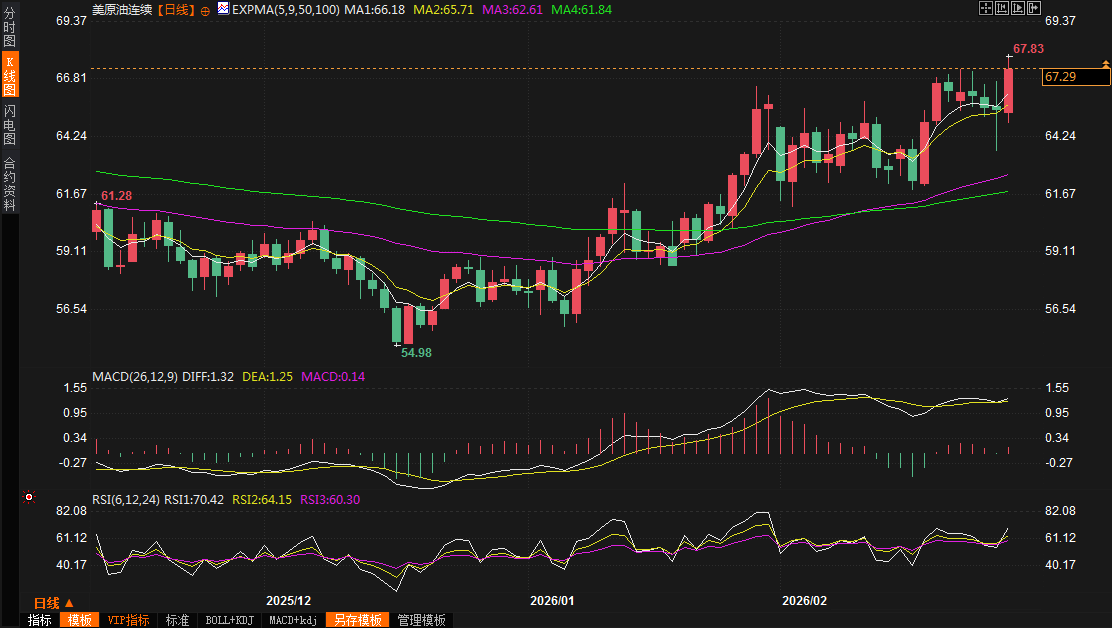
Amidst the rapidly shifting global energy landscape, the international oil market is undergoing a fierce struggle driven by both geopolitics and economic policy. Every development and stalemate in the US-Iran nuclear negotiations directly impacts crude oil futures prices; the sudden escalation of US tariffs has dealt a heavy blow to global trade and energy cost expectations. This week, oil prices fluctuated repeatedly in the first few trading days amidst surging inventories and the ongoing negotiations. However, on Friday (February 27th), prices surged nearly 3%, with US crude oil reaching a near seven-month high of $67.83 per barrel, closing at $67.83 per barrel, a weekly gain of approximately 1.48% and a monthly gain of 2.36%. Brent crude oil also jumped 3% on Friday, reaching a high of $73.52 per barrel, closing at $73.12 per barrel, a weekly gain of approximately 2.15%, and a cumulative increase of 4.8% in February, marking two consecutive months of gains.

The US-Iran nuclear negotiations were undoubtedly the dominant force driving oil price fluctuations this week. Since February 26th, the third round of talks between the US and Iran has been underway in Geneva. Iran has shown unprecedented willingness to make concessions, claiming it is willing to compromise on its nuclear program in exchange for the lifting of sanctions and recognition of its uranium enrichment rights. This initially eased market concerns, with Iran's Deputy Foreign Minister even stating that Tehran was prepared to take any necessary measures to reach an agreement. Oman's Foreign Minister also optimistically noted significant progress in the negotiations, which to some extent alleviated investor concerns about military conflict and helped keep oil prices relatively stable at the beginning of the week.
However, this period of relative calm was short-lived. As negotiations deepened, the United States insisted that Iran achieve zero uranium enrichment and ship all 60% enriched uranium to the United States, leading to a stalemate in the talks. President Trump's remarks on Friday further fueled the fire, expressing disappointment with the progress of the negotiations and warning that "sometimes force has to be used." This statement directly ignited market panic, and the risk of escalating tensions between the US and Iran caused oil prices to surge nearly 3% on Friday, with Brent crude closing at $73.12 per barrel and US crude rising to $67.29.
Analysts point out that this uncertainty has already injected a geopolitical risk premium of $3-4 per barrel into US crude oil prices. If negotiations ultimately break down, the possibility of disruptions to Middle Eastern oil supplies will increase significantly. As OPEC's third-largest oil producer, any unrest in Iran could impact crude oil exports across the entire region, thereby amplifying volatility in the global energy market.
Meanwhile, changes in U.S. tariff policy acted like a time bomb, further exacerbating pressure on the oil market. Earlier in the week, the U.S. Supreme Court overturned a key part of President Trump's tariff plan, which should have brought some stability, but Trump retaliated swiftly, announcing on Saturday that he would raise temporary tariffs on all imports from all countries from 10% to 15%, reaching the maximum legally permissible level. Although U.S. Customs and Border Protection suspended some tariff collection early Tuesday morning, this series of policy reversals has reignited uncertainty among investors and businesses.
Bob Jacob, director of energy futures at Mizuho, said that this tariff uncertainty has not only dragged down the stock market but also directly impacted the oil market, potentially causing catastrophic consequences in the short term. The global oil trade landscape is consequently in turmoil, particularly for the import-dependent US market, where tariff increases mean higher energy costs and the risk of supply chain disruptions.
The EU's response only exacerbated the situation. According to documents obtained by the media, the European Commission will submit a legal proposal on April 15 to permanently ban the import of Russian oil, which will further reshape international oil flow routes.
Against this backdrop, although oil prices fell slightly on Tuesday and Wednesday, the overall pattern of high-level fluctuations remained unchanged. Market traders are closely watching the final direction of tariff policies to assess their long-term impact on oil demand and trade.
Inventory data is another key variable. This week's report from the U.S. Energy Information Administration (EIA) showed that U.S. crude oil inventories surged by 16 million barrels last week, far exceeding analysts' expectations of 1.5 million barrels, mainly due to declining refinery utilization and increased imports. Although this report is considered a bearish factor, UBS commodities analyst Giovanni Stanovo pointed out that its impact on oil prices is limited because the market is currently more driven by geopolitical tensions in the Middle East. The surge in inventories should have depressed oil prices, but concerns about potential supply disruptions from the U.S.-Iran conflict have instead supported the price floor.
The statement from the director of the North Dakota Department of Mineral Resources further corroborated this view. As the third-largest oil-producing state in the U.S., North Dakota's energy industry executives emphasized that the oil industry needs crude oil prices to remain at $70 per barrel to expand production. These supply concerns were amplified as the peak summer oil consumption season approached. The market also awaited the weekly inventory reports from the American Petroleum Institute (API) and the Energy Information Administration (EIA) for further clues. Overall, the negative impact of the inventory data was offset by geopolitical risks, resulting in oil prices remaining largely unchanged on Wednesday, slightly lower after fluctuations on Thursday, but rebounding strongly on Friday, demonstrating the market's extremely high sensitivity to supply disruptions.
Faced with escalating tensions between the US and Iran, OPEC+ has not stood idly by. Sources familiar with the matter revealed that Saudi Arabia has initiated a short-term production and export increase plan to counter potential oil supply disruptions caused by a possible US strike on Iran. The UAE also plans to increase production in April, reflecting proactive intervention by OPEC+ members to stabilize the market.
Furthermore, OPEC+ may consider setting the April production increase at 137,000 barrels per day at its March 1 meeting, ending a three-month pause in production increases. Participating countries include eight oil-producing nations: Saudi Arabia, Russia, the UAE, Kazakhstan, Kuwait, Iraq, Algeria, and Oman. This decision aims to buffer the dual pressures of peak summer demand and geopolitical risks.
Janif Shah, vice president of oil analysis at consulting firm Rystad Energy, pointed out that while the likelihood of immediate war has decreased as negotiations have prolonged, the option of military strike has not been completely ruled out. This makes OPEC+'s production increase plan a key anchor for oil price stability. Dubai oil trader Shohrul Zukhridinov believes that this week's oil sell-off is essentially a market reaction to the elimination of some geopolitical risk premiums, but if OPEC+ fails to respond effectively, oil prices could face greater volatility.
In summary, the international crude oil market struggled this week amidst the suspense surrounding the US-Iran nuclear negotiations, the confusion surrounding US tariff policy, the pressure of surging inventories, and the strategic adjustments of OPEC+. Although oil prices may see a slight pullback in the short term, the risk of supply disruptions will continue to support high levels as long as the situation in the Middle East does not escalate. Looking ahead, if an agreement is ultimately reached in the negotiations, oil prices may experience a rational correction; conversely, if Trump's threats of force materialize, a global energy crisis will be inevitable. Investors need to closely monitor the progress of negotiations and the outcome of the OPEC+ meeting next week to grasp the pulse of this uncertain market.
US-Iran nuclear negotiations: From hope to suspense
The US-Iran nuclear negotiations were undoubtedly the dominant force driving oil price fluctuations this week. Since February 26th, the third round of talks between the US and Iran has been underway in Geneva. Iran has shown unprecedented willingness to make concessions, claiming it is willing to compromise on its nuclear program in exchange for the lifting of sanctions and recognition of its uranium enrichment rights. This initially eased market concerns, with Iran's Deputy Foreign Minister even stating that Tehran was prepared to take any necessary measures to reach an agreement. Oman's Foreign Minister also optimistically noted significant progress in the negotiations, which to some extent alleviated investor concerns about military conflict and helped keep oil prices relatively stable at the beginning of the week.
However, this period of relative calm was short-lived. As negotiations deepened, the United States insisted that Iran achieve zero uranium enrichment and ship all 60% enriched uranium to the United States, leading to a stalemate in the talks. President Trump's remarks on Friday further fueled the fire, expressing disappointment with the progress of the negotiations and warning that "sometimes force has to be used." This statement directly ignited market panic, and the risk of escalating tensions between the US and Iran caused oil prices to surge nearly 3% on Friday, with Brent crude closing at $73.12 per barrel and US crude rising to $67.29.
Analysts point out that this uncertainty has already injected a geopolitical risk premium of $3-4 per barrel into US crude oil prices. If negotiations ultimately break down, the possibility of disruptions to Middle Eastern oil supplies will increase significantly. As OPEC's third-largest oil producer, any unrest in Iran could impact crude oil exports across the entire region, thereby amplifying volatility in the global energy market.
US Tariff Policy: An Amplifier of Economic Uncertainty
Meanwhile, changes in U.S. tariff policy acted like a time bomb, further exacerbating pressure on the oil market. Earlier in the week, the U.S. Supreme Court overturned a key part of President Trump's tariff plan, which should have brought some stability, but Trump retaliated swiftly, announcing on Saturday that he would raise temporary tariffs on all imports from all countries from 10% to 15%, reaching the maximum legally permissible level. Although U.S. Customs and Border Protection suspended some tariff collection early Tuesday morning, this series of policy reversals has reignited uncertainty among investors and businesses.
Bob Jacob, director of energy futures at Mizuho, said that this tariff uncertainty has not only dragged down the stock market but also directly impacted the oil market, potentially causing catastrophic consequences in the short term. The global oil trade landscape is consequently in turmoil, particularly for the import-dependent US market, where tariff increases mean higher energy costs and the risk of supply chain disruptions.
The EU's response only exacerbated the situation. According to documents obtained by the media, the European Commission will submit a legal proposal on April 15 to permanently ban the import of Russian oil, which will further reshape international oil flow routes.
Against this backdrop, although oil prices fell slightly on Tuesday and Wednesday, the overall pattern of high-level fluctuations remained unchanged. Market traders are closely watching the final direction of tariff policies to assess their long-term impact on oil demand and trade.
A tug-of-war between surging inventories and supply concerns
Inventory data is another key variable. This week's report from the U.S. Energy Information Administration (EIA) showed that U.S. crude oil inventories surged by 16 million barrels last week, far exceeding analysts' expectations of 1.5 million barrels, mainly due to declining refinery utilization and increased imports. Although this report is considered a bearish factor, UBS commodities analyst Giovanni Stanovo pointed out that its impact on oil prices is limited because the market is currently more driven by geopolitical tensions in the Middle East. The surge in inventories should have depressed oil prices, but concerns about potential supply disruptions from the U.S.-Iran conflict have instead supported the price floor.
The statement from the director of the North Dakota Department of Mineral Resources further corroborated this view. As the third-largest oil-producing state in the U.S., North Dakota's energy industry executives emphasized that the oil industry needs crude oil prices to remain at $70 per barrel to expand production. These supply concerns were amplified as the peak summer oil consumption season approached. The market also awaited the weekly inventory reports from the American Petroleum Institute (API) and the Energy Information Administration (EIA) for further clues. Overall, the negative impact of the inventory data was offset by geopolitical risks, resulting in oil prices remaining largely unchanged on Wednesday, slightly lower after fluctuations on Thursday, but rebounding strongly on Friday, demonstrating the market's extremely high sensitivity to supply disruptions.
OPEC+'s strategic response: increasing production to buffer potential crisis
Faced with escalating tensions between the US and Iran, OPEC+ has not stood idly by. Sources familiar with the matter revealed that Saudi Arabia has initiated a short-term production and export increase plan to counter potential oil supply disruptions caused by a possible US strike on Iran. The UAE also plans to increase production in April, reflecting proactive intervention by OPEC+ members to stabilize the market.
Furthermore, OPEC+ may consider setting the April production increase at 137,000 barrels per day at its March 1 meeting, ending a three-month pause in production increases. Participating countries include eight oil-producing nations: Saudi Arabia, Russia, the UAE, Kazakhstan, Kuwait, Iraq, Algeria, and Oman. This decision aims to buffer the dual pressures of peak summer demand and geopolitical risks.
Janif Shah, vice president of oil analysis at consulting firm Rystad Energy, pointed out that while the likelihood of immediate war has decreased as negotiations have prolonged, the option of military strike has not been completely ruled out. This makes OPEC+'s production increase plan a key anchor for oil price stability. Dubai oil trader Shohrul Zukhridinov believes that this week's oil sell-off is essentially a market reaction to the elimination of some geopolitical risk premiums, but if OPEC+ fails to respond effectively, oil prices could face greater volatility.
In summary, the international crude oil market struggled this week amidst the suspense surrounding the US-Iran nuclear negotiations, the confusion surrounding US tariff policy, the pressure of surging inventories, and the strategic adjustments of OPEC+. Although oil prices may see a slight pullback in the short term, the risk of supply disruptions will continue to support high levels as long as the situation in the Middle East does not escalate. Looking ahead, if an agreement is ultimately reached in the negotiations, oil prices may experience a rational correction; conversely, if Trump's threats of force materialize, a global energy crisis will be inevitable. Investors need to closely monitor the progress of negotiations and the outcome of the OPEC+ meeting next week to grasp the pulse of this uncertain market.
- Risk Warning and Disclaimer
- The market involves risk, and trading may not be suitable for all investors. This article is for reference only and does not constitute personal investment advice, nor does it take into account certain users’ specific investment objectives, financial situation, or other needs. Any investment decisions made based on this information are at your own risk.