













Gold Trading Alert: Geopolitical Storms Sweep Through, Gold Continues to Flow Out.
2026-03-02 08:20:11
Spot gold opened higher and continued to rise in early Asian trading on Monday (March 2), currently up 1.8% and trading around 5371.
The full escalation of the conflict between the US and Iran has brought risk aversion to its peak in global financial markets, leading to a strong surge in gold as a traditional safe-haven asset.
Last week, spot gold rose 3.12% cumulatively, finally closing at the week's high of $5,281.15 per ounce, a significant increase from the opening price of $5,146.59 at the beginning of the week. Geopolitical risks were the core engine driving the rise in gold prices.
From US President Trump's confirmation of the death of Iranian Supreme Leader Khamenei, to the escalating tensions in the Strait of Hormuz, and the interception of Iranian missiles, a series of events have continuously sent risk signals to the market, driving a large influx of funds into the gold market. Some foreign investment banks have even predicted that if the conflict continues to escalate, the price of gold may hit a record high of $5,800 per ounce.

On Sunday evening, Trump confirmed in a video that Iranian Supreme Leader Khamenei had been killed in a joint US-Israeli strike and announced that military action would continue until the objective was achieved. This "super black swan" event instantly ignited risk aversion in the market.
Risk aversion intensified on Friday, with gold closing at its weekly high, consistent with recent market trends. Friday saw significant market volatility – the US government's withdrawal order from the Middle East, coupled with escalating tensions in the Strait of Hormuz, triggered a surge in gold buying.
US President Trump has stated that the US military has struck hundreds of targets in Iran, including Revolutionary Guard facilities, air defense systems, nine ships, and naval buildings, and that military operations will continue, with the possibility of further US casualties.
Trump called on the Iranian military and police to surrender or face "loss of all protections and even death." The continued advance of the joint US-Israeli military operation has plunged the region into an unprecedented state of tension.
British Defence Secretary John Healy confirmed that two Iranian ballistic missiles were fired toward Cyprus (suspected to be aimed at a nearby US carrier strike group). Although they were successfully intercepted and caused no substantial impact, they highlighted the risk of escalation of the conflict and further stimulated risk aversion in the market.
Meanwhile, tensions in the Strait of Hormuz have become another major risk point. As the "choke point" for the global transport of 30% of seaborne oil and 20% of liquefied natural gas, shipping data shows that more than 200 ships (including oil and gas tankers) have been stranded in the strait and surrounding waters due to security risks, and three oil tankers have been attacked and damaged along the Persian Gulf coast.
Despite Iranian Foreign Minister Araqchi's statement that he had "no intention of closing the Strait of Hormuz," the Gulf Cooperation Council issued an urgent statement emphasizing the need to immediately cease Iranian attacks to ensure supply chain security. The uncertainty in the region continues to support gold prices.
Insurance brokerage firms revealed that war risk insurance rates for ships transiting the Strait of Hormuz are expected to rise sharply by 25% to 50%, with major insurers such as Lloyd's of London even reserving the right to cancel policies within seven days. The surge in shipping safety risks has not only driven up energy prices but has also prompted investors to turn to gold as a safe haven.
Xin'an Fund Management points out that if geopolitical events fundamentally change the economic fundamentals, oil prices will become a key transmission mechanism, and gold, as the "ultimate safe-haven asset," will directly benefit from this cross-market risk transmission.
Most institutions agree that geopolitics will continue to dominate short-term gold price movements and remain optimistic about the future.
Mark Chandler, Managing Director of Bannockburn Global FX, said that gold is expected to rise further as the possibility of a US strike on Iran increases. A break above $5,250 could signal a new push toward $5,500, while the yield on 10-year US Treasury bonds falling below 4% will also provide strong support for gold prices.
Kevin Grady, president of Phoenix Futures & Options, is a long-time bull on gold, believing that the recent pullback is highly constructive: "Markets can't rise in a straight line. The best way to judge the strength of a market is to observe its pullback performance—although gold has encountered some selling pressure, open interest has decreased by 150,000 contracts since January 3, and it started to rebound last week but hasn't reached extremely high levels yet. This pullback is actually building momentum for further gains." Grady emphasized that the core logic driving gold's rise remains unchanged, and $5,200 will be a new starting point for the rise. Strong players are still holding onto their physical gold positions, and gold prices are expected to test higher levels next week.
Some institutions hold a cautious view, believing that the short-term geopolitical-driven rise is unlikely to be sustainable. Senior market analyst Alex Kupzikovich pointed out that although gold has risen for the third consecutive week, in the long term, one should be prepared for a decline in gold prices and increased selling pressure; however, technically, there is still room for a rebound to $5,300.
CPM Group issued a sell recommendation for gold on Friday, predicting that gold prices may pull back to $5,100 next week (first week of March) (stop-loss at $5,275). The firm noted that it had issued a buy recommendation a week ago when gold was trading at $5,082.60, and the target price of $5,225 has been achieved. While gold prices still have upward potential over the next month or so, the risk of a short-term pullback has increased, and it is recommended that very short-term investors either remain on the sidelines or establish short-term short positions.
CPM also warned that if the price breaks through the high of around $5,265 this week, it could trigger short covering and drive a rapid and significant rise in gold prices.
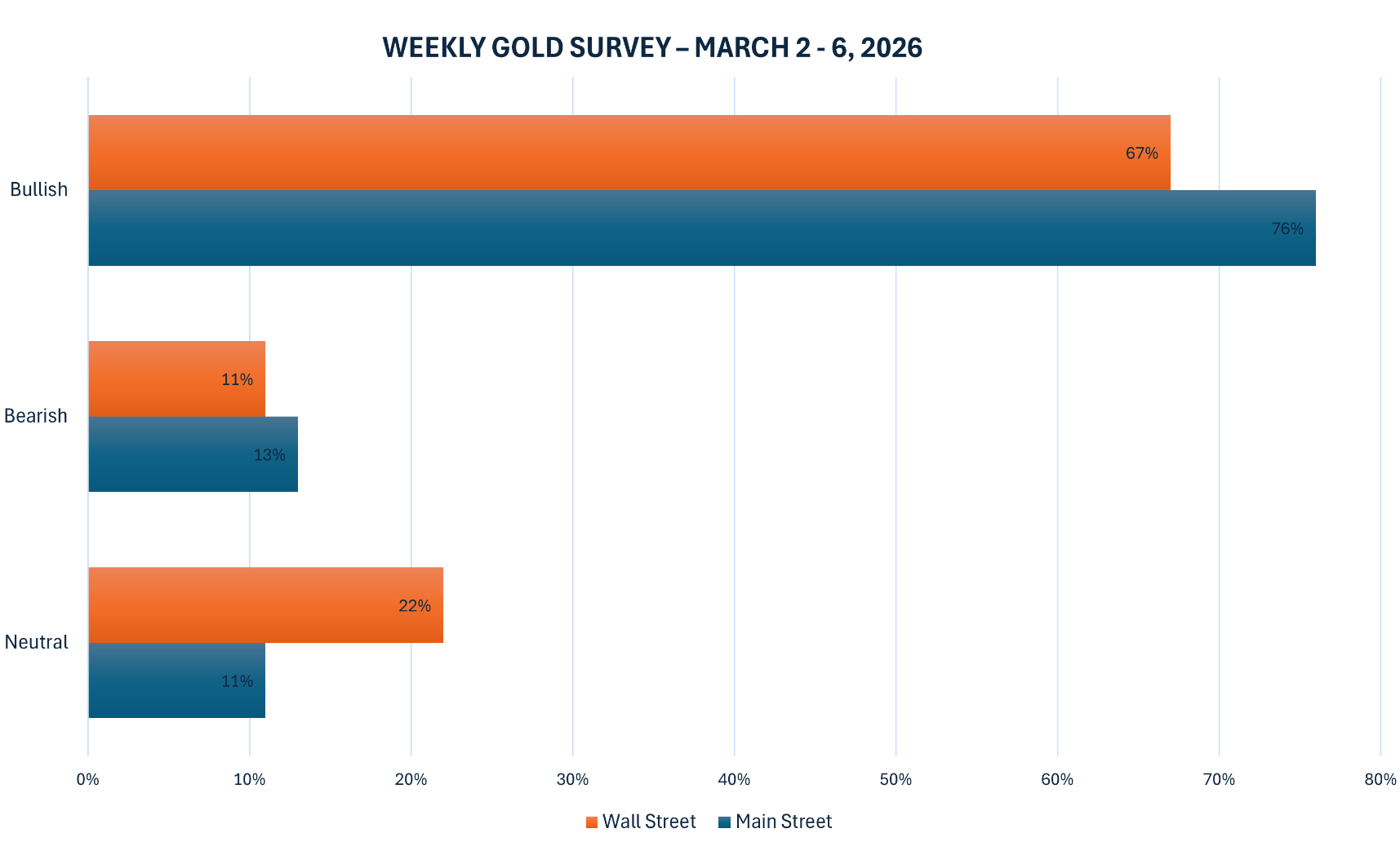
Next week, the market will see several key economic data releases, potentially creating a dual interplay with geopolitical risks. While the data calendar isn't particularly dense, each data point is significant: Monday will see the release of the ISM February Manufacturing PMI; Wednesday will feature the ISM Non-Manufacturing PMI and ADP Non-Farm Payrolls; Thursday will focus on weekly initial jobless claims; and Friday will see the February Non-Farm Payrolls report and January Retail Sales data.
These data will reflect the state of the US economy and thus affect market expectations for the Federal Reserve's policies. Strong data could weaken gold's safe-haven appeal, but given the current high geopolitical risks, the economic data's impact on gold prices may be limited.
Historical data from Xin'an Fund Management also shows that market fluctuations triggered by most geopolitical crises are usually short-lived, with the stock market typically bottoming out in three weeks and recovering in six weeks. However, the safe-haven demand for gold is immediate and continuous, and the progress of the US-Iran conflict will remain the core factor determining the direction of gold prices in the short term.
Summary and Technical Analysis:
In the short term, the ongoing developments in the US-Iran conflict and changes in the situation in the Strait of Hormuz will continue to dominate risk aversion sentiment in the gold market. The $5,300 mark has become the core target of market attention. Crude oil opened more than 12% higher and then saw a price correction, while gold only opened 1.5% higher, suggesting that the market is in an unexpectedly close battle of pricing.
Despite differing opinions among institutions regarding the market outlook, gold's safe-haven appeal will remain strongly supported given the ongoing geopolitical risks. Coupled with the transmission effect of global energy market volatility, even if the US-Iran war progresses faster than expected, gold still has ample trading potential.
The release of economic data next week may cause short-term fluctuations in gold prices, but the main logic at present is geopolitical conflict, the progress of the US-Iran war, and the resulting turmoil in the Middle East and global geopolitical turmoil. However, in the long run, if regional conflicts fail to cool down in time, gold is expected to challenge higher targets of $5,500 or even $5,800. Investors need to pay close attention to the progress of geopolitical events and the breakthrough of key price levels, and do a good job in risk hedging and position management.
Technically, spot gold gapped up at the open but was capped by the middle line of the ascending channel. However, since it is the early Asian session and traders have not yet entered the market during the European and American sessions, gold prices are expected to be pushed up further during the Asian session.
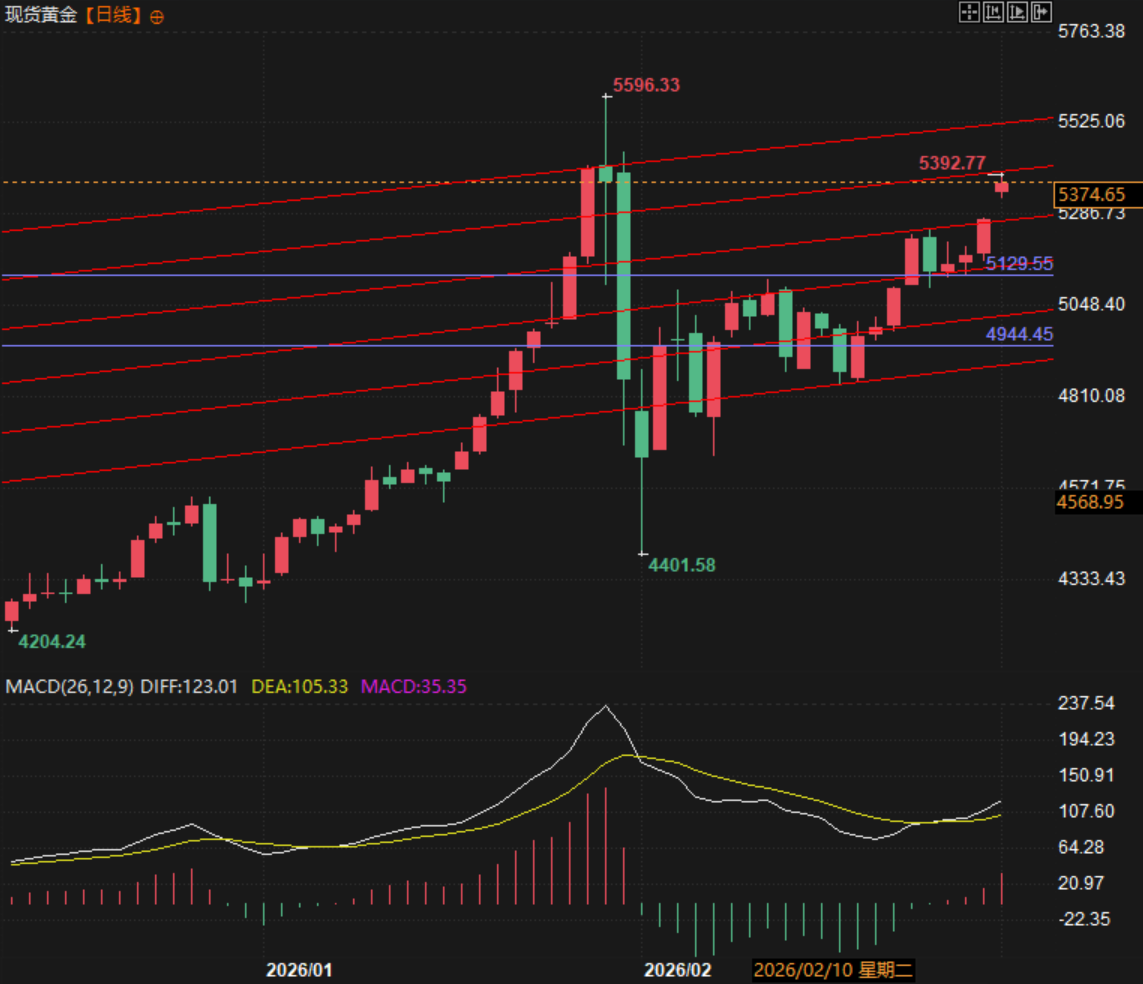
(Spot gold daily chart, source: FX678)
At 8:16 AM Beijing time, spot gold is trading at $5,367 per ounce.
The full escalation of the conflict between the US and Iran has brought risk aversion to its peak in global financial markets, leading to a strong surge in gold as a traditional safe-haven asset.
Last week, spot gold rose 3.12% cumulatively, finally closing at the week's high of $5,281.15 per ounce, a significant increase from the opening price of $5,146.59 at the beginning of the week. Geopolitical risks were the core engine driving the rise in gold prices.
From US President Trump's confirmation of the death of Iranian Supreme Leader Khamenei, to the escalating tensions in the Strait of Hormuz, and the interception of Iranian missiles, a series of events have continuously sent risk signals to the market, driving a large influx of funds into the gold market. Some foreign investment banks have even predicted that if the conflict continues to escalate, the price of gold may hit a record high of $5,800 per ounce.
Breaking news over the weekend triggered the first wave of price increases, with gold quickly breaking through $5,200.
On Sunday evening, Trump confirmed in a video that Iranian Supreme Leader Khamenei had been killed in a joint US-Israeli strike and announced that military action would continue until the objective was achieved. This "super black swan" event instantly ignited risk aversion in the market.
Risk aversion intensified on Friday, with gold closing at its weekly high, consistent with recent market trends. Friday saw significant market volatility – the US government's withdrawal order from the Middle East, coupled with escalating tensions in the Strait of Hormuz, triggered a surge in gold buying.
Geopolitical risks: Multiple events unfold, and demand for safe-haven assets continues to rise.
US President Trump has stated that the US military has struck hundreds of targets in Iran, including Revolutionary Guard facilities, air defense systems, nine ships, and naval buildings, and that military operations will continue, with the possibility of further US casualties.
Trump called on the Iranian military and police to surrender or face "loss of all protections and even death." The continued advance of the joint US-Israeli military operation has plunged the region into an unprecedented state of tension.
Iranian missile interception and obstruction in the Strait of Hormuz further amplify risks.
British Defence Secretary John Healy confirmed that two Iranian ballistic missiles were fired toward Cyprus (suspected to be aimed at a nearby US carrier strike group). Although they were successfully intercepted and caused no substantial impact, they highlighted the risk of escalation of the conflict and further stimulated risk aversion in the market.
Meanwhile, tensions in the Strait of Hormuz have become another major risk point. As the "choke point" for the global transport of 30% of seaborne oil and 20% of liquefied natural gas, shipping data shows that more than 200 ships (including oil and gas tankers) have been stranded in the strait and surrounding waters due to security risks, and three oil tankers have been attacked and damaged along the Persian Gulf coast.
Despite Iranian Foreign Minister Araqchi's statement that he had "no intention of closing the Strait of Hormuz," the Gulf Cooperation Council issued an urgent statement emphasizing the need to immediately cease Iranian attacks to ensure supply chain security. The uncertainty in the region continues to support gold prices.
War risk premiums have skyrocketed, and shipping costs have driven up both energy and hedging premiums.
Insurance brokerage firms revealed that war risk insurance rates for ships transiting the Strait of Hormuz are expected to rise sharply by 25% to 50%, with major insurers such as Lloyd's of London even reserving the right to cancel policies within seven days. The surge in shipping safety risks has not only driven up energy prices but has also prompted investors to turn to gold as a safe haven.
Xin'an Fund Management points out that if geopolitical events fundamentally change the economic fundamentals, oil prices will become a key transmission mechanism, and gold, as the "ultimate safe-haven asset," will directly benefit from this cross-market risk transmission.
Institutional View: Divergence between bulls and bears intensifies; focus on the key $5300 level.
Most institutions agree that geopolitics will continue to dominate short-term gold price movements and remain optimistic about the future.
Mark Chandler, Managing Director of Bannockburn Global FX, said that gold is expected to rise further as the possibility of a US strike on Iran increases. A break above $5,250 could signal a new push toward $5,500, while the yield on 10-year US Treasury bonds falling below 4% will also provide strong support for gold prices.
Kevin Grady, president of Phoenix Futures & Options, is a long-time bull on gold, believing that the recent pullback is highly constructive: "Markets can't rise in a straight line. The best way to judge the strength of a market is to observe its pullback performance—although gold has encountered some selling pressure, open interest has decreased by 150,000 contracts since January 3, and it started to rebound last week but hasn't reached extremely high levels yet. This pullback is actually building momentum for further gains." Grady emphasized that the core logic driving gold's rise remains unchanged, and $5,200 will be a new starting point for the rise. Strong players are still holding onto their physical gold positions, and gold prices are expected to test higher levels next week.
Some institutions hold a cautious view, believing that the short-term geopolitical-driven rise is unlikely to be sustainable. Senior market analyst Alex Kupzikovich pointed out that although gold has risen for the third consecutive week, in the long term, one should be prepared for a decline in gold prices and increased selling pressure; however, technically, there is still room for a rebound to $5,300.
CPM Group issued a sell recommendation for gold on Friday, predicting that gold prices may pull back to $5,100 next week (first week of March) (stop-loss at $5,275). The firm noted that it had issued a buy recommendation a week ago when gold was trading at $5,082.60, and the target price of $5,225 has been achieved. While gold prices still have upward potential over the next month or so, the risk of a short-term pullback has increased, and it is recommended that very short-term investors either remain on the sidelines or establish short-term short positions.
CPM also warned that if the price breaks through the high of around $5,265 this week, it could trigger short covering and drive a rapid and significant rise in gold prices.
Next week's focus: The dual interplay of economic data and geopolitical risks
Next week, the market will see several key economic data releases, potentially creating a dual interplay with geopolitical risks. While the data calendar isn't particularly dense, each data point is significant: Monday will see the release of the ISM February Manufacturing PMI; Wednesday will feature the ISM Non-Manufacturing PMI and ADP Non-Farm Payrolls; Thursday will focus on weekly initial jobless claims; and Friday will see the February Non-Farm Payrolls report and January Retail Sales data.
These data will reflect the state of the US economy and thus affect market expectations for the Federal Reserve's policies. Strong data could weaken gold's safe-haven appeal, but given the current high geopolitical risks, the economic data's impact on gold prices may be limited.
Historical data from Xin'an Fund Management also shows that market fluctuations triggered by most geopolitical crises are usually short-lived, with the stock market typically bottoming out in three weeks and recovering in six weeks. However, the safe-haven demand for gold is immediate and continuous, and the progress of the US-Iran conflict will remain the core factor determining the direction of gold prices in the short term.
Summary and Technical Analysis:
In the short term, the ongoing developments in the US-Iran conflict and changes in the situation in the Strait of Hormuz will continue to dominate risk aversion sentiment in the gold market. The $5,300 mark has become the core target of market attention. Crude oil opened more than 12% higher and then saw a price correction, while gold only opened 1.5% higher, suggesting that the market is in an unexpectedly close battle of pricing.
Despite differing opinions among institutions regarding the market outlook, gold's safe-haven appeal will remain strongly supported given the ongoing geopolitical risks. Coupled with the transmission effect of global energy market volatility, even if the US-Iran war progresses faster than expected, gold still has ample trading potential.
The release of economic data next week may cause short-term fluctuations in gold prices, but the main logic at present is geopolitical conflict, the progress of the US-Iran war, and the resulting turmoil in the Middle East and global geopolitical turmoil. However, in the long run, if regional conflicts fail to cool down in time, gold is expected to challenge higher targets of $5,500 or even $5,800. Investors need to pay close attention to the progress of geopolitical events and the breakthrough of key price levels, and do a good job in risk hedging and position management.
Technically, spot gold gapped up at the open but was capped by the middle line of the ascending channel. However, since it is the early Asian session and traders have not yet entered the market during the European and American sessions, gold prices are expected to be pushed up further during the Asian session.
(Spot gold daily chart, source: FX678)
At 8:16 AM Beijing time, spot gold is trading at $5,367 per ounce.
- Risk Warning and Disclaimer
- The market involves risk, and trading may not be suitable for all investors. This article is for reference only and does not constitute personal investment advice, nor does it take into account certain users’ specific investment objectives, financial situation, or other needs. Any investment decisions made based on this information are at your own risk.

