













Escalating US-Iran conflict threatens to sever the lifeline of oil prices, prompting Wall Street to prioritize safe-haven assets.
2026-03-02 10:18:27
As the conflict in the Middle East escalates dramatically, with the confrontation between Iran and Israel intensifying, shipping through the Strait of Hormuz, a key global energy route, has nearly ground to a halt, posing a serious risk of disruption to approximately one-quarter of the world's seaborne oil trade. Market risk aversion has rapidly increased, injecting a significant risk premium into oil prices. On Monday (March 2nd) during Asian trading hours, US crude oil prices opened more than 5% higher, having previously touched a near nine-month high of $75.33 per barrel, before fluctuating downwards and currently trading around $69.80 per barrel, a daily increase of approximately 4.2%.

The rapidly evolving conflict in the Middle East is significantly increasing investor anxiety, enhancing the appeal of traditional safe-haven assets such as gold and the Swiss franc. The Iranian crisis has brought shipping in the Strait of Hormuz to a near standstill, posing a serious risk of disruption to this crucial chokepoint for approximately one-quarter of the world's seaborne oil trade, further amplifying uncertainty in the energy market.
The Iranian Revolutionary Guard warned ships via radio that "no ships are allowed to pass." Several oil giants and traders have suspended the transport of crude oil, fuel, and liquefied natural gas through the strait, resulting in a sharp drop in ship traffic of more than 70%, with oil tankers stranded off the coast of the Gulf.
Macro traders say all eyes will be on the energy market as global trading fully resumes on Monday. During Monday's Asian session, traders flocked to safe-haven assets: the US dollar index traded around 97.80, up about 0.2% on the day; the Swiss franc strengthened slightly against major currencies; and the Japanese yen remained largely stable. The possibility of prolonged instability in the Middle East and the ripple effects of potentially rising oil prices are providing new reasons for capital flows: reducing equity holdings and shifting to safer assets.
John Briggs, head of U.S. interest rate strategy at Natixis, noted that traders are generally adopting a "haven first, ask questions later" strategy. He said, "The scale of the attack and the intensity of Iran's retaliation exceeded market expectations."
Dave Maza of Roundhill Financial is closely monitoring traffic in the Strait of Hormuz, which carries about a quarter of the world's seaborne oil trade. He stated, "The core risk lies in the Strait of Hormuz, not simply retaliatory action. If shipping remains open, the stock market can absorb the shock; if it's disrupted, anything is possible."
A compilation of opinions from multiple institutions suggests that if the Taiwan Strait remains disrupted for an extended period, oil prices could surge to over $100 per barrel, potentially triggering a more severe supply shock. In the short term, energy stocks, metals, real estate, utilities, and defense sectors are expected to lead the gains, while the consumer sector (especially aviation and retail) will face pressure due to rising oil prices.
Ed Al-Husseini, portfolio manager at Columbia Threadneedle Investments, believes that high valuations in global stock and credit markets make it easier for investors to reduce their risk exposure. Markets were already tense due to changes in US tariff policy, the disruptive impact of artificial intelligence, and pressures on private lending. Al-Husseini said, "No one can accurately predict the extent of de-risking at this point."
Barclays strategists warn against rushing to buy the dip. Ajay Rajadyaksha, global research chairman, points out that investors are accustomed to geopolitical crises subsiding quickly, but this conflict could last longer and involve US casualties, strikes against the Iranian leadership, and disruptions to traffic in the Strait of Hormuz . “The current risk-reward ratio is not attractive. A buying opportunity might arise if the S&P 500 falls by more than 10%, but now is not the time.”
Kevin Gordon, head of macro research and strategy at Charles Schwab, said that a sustained rise in oil prices could trigger short-term inflation panic, which in turn could impact the stock market. However, he cautioned investors to distinguish between "front-page risk" and "earnings risk": if the conflict does not have a substantial impact on economic growth or corporate profits, the negative reaction in the stock market may be relatively short-lived.
Amundi's chief investment officer, Vincent Motier, predicts that oil prices could rise by 5%-10% in the short term, US interest rates will fall, gold will rise, and the stock market will decline slightly by about 1%. This also provides a reasonable reason for profit-taking in markets that are at historically high levels.
Wells Fargo emerging markets strategist Brendan McKenna points out that this shock will push emerging markets further down. "Iran's response is unprecedented, the Strait of Hormuz is effectively closed, and US-Israeli cooperation against Iran is more aggressive. Coupled with already high valuations and holdings in emerging markets, a sell-off is likely in the early stages of the conflict."
Gregory Faranello, head of U.S. interest rates at Amerivet Securities, believes that military action against Iraq could last for several weeks but will not be prolonged. Given the past four years of range-bound trading in U.S. Treasury yields, there is still room for yields to fall if safe-haven demand persists. Ultimately, yields will still be driven by Federal Reserve policy and economic fundamentals, and this action will not change the fundamentals of the U.S. economy.
Overall, the market is currently in a state of high uncertainty. The actual navigation conditions in the Strait of Hormuz will be a key variable determining the short-term market direction. Investors need to closely monitor energy price trends and their transmission effects on global growth, inflation, and monetary policy, and carefully weigh the risks between safe-haven demand and potential rebound opportunities.
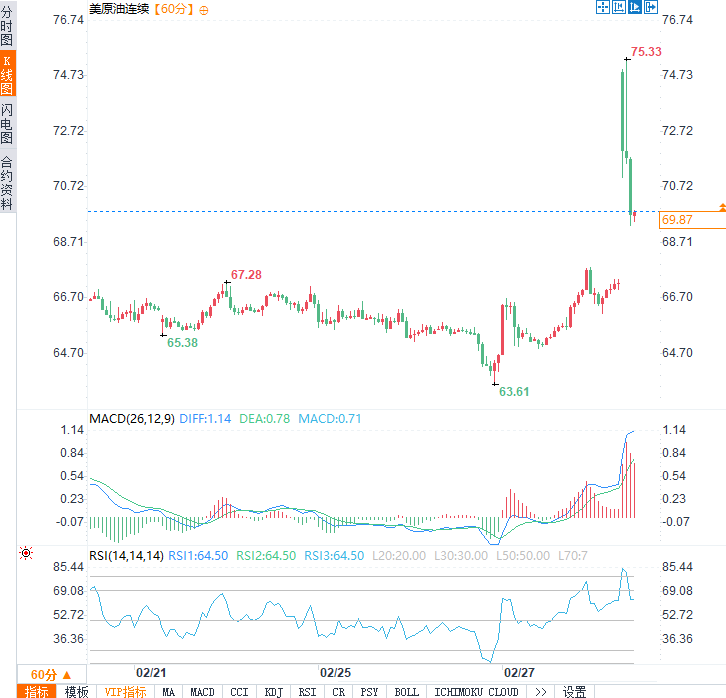
(US crude oil hourly chart, source: FX678)
At 10:17 Beijing time, US crude oil futures were trading at $69.84 per barrel.
Conflict escalates sharply: Shipping in the Strait of Hormuz faces the risk of disruption.
The rapidly evolving conflict in the Middle East is significantly increasing investor anxiety, enhancing the appeal of traditional safe-haven assets such as gold and the Swiss franc. The Iranian crisis has brought shipping in the Strait of Hormuz to a near standstill, posing a serious risk of disruption to this crucial chokepoint for approximately one-quarter of the world's seaborne oil trade, further amplifying uncertainty in the energy market.
The Iranian Revolutionary Guard warned ships via radio that "no ships are allowed to pass." Several oil giants and traders have suspended the transport of crude oil, fuel, and liquefied natural gas through the strait, resulting in a sharp drop in ship traffic of more than 70%, with oil tankers stranded off the coast of the Gulf.
Market's immediate reaction: Safe-haven assets flood in, energy prices soar.
Macro traders say all eyes will be on the energy market as global trading fully resumes on Monday. During Monday's Asian session, traders flocked to safe-haven assets: the US dollar index traded around 97.80, up about 0.2% on the day; the Swiss franc strengthened slightly against major currencies; and the Japanese yen remained largely stable. The possibility of prolonged instability in the Middle East and the ripple effects of potentially rising oil prices are providing new reasons for capital flows: reducing equity holdings and shifting to safer assets.
John Briggs, head of U.S. interest rate strategy at Natixis, noted that traders are generally adopting a "haven first, ask questions later" strategy. He said, "The scale of the attack and the intensity of Iran's retaliation exceeded market expectations."
Key Throat Risk: The Strait of Hormuz Determines Market Direction
Dave Maza of Roundhill Financial is closely monitoring traffic in the Strait of Hormuz, which carries about a quarter of the world's seaborne oil trade. He stated, "The core risk lies in the Strait of Hormuz, not simply retaliatory action. If shipping remains open, the stock market can absorb the shock; if it's disrupted, anything is possible."
A compilation of opinions from multiple institutions suggests that if the Taiwan Strait remains disrupted for an extended period, oil prices could surge to over $100 per barrel, potentially triggering a more severe supply shock. In the short term, energy stocks, metals, real estate, utilities, and defense sectors are expected to lead the gains, while the consumer sector (especially aviation and retail) will face pressure due to rising oil prices.
Vulnerability Amid High Valuations: Accelerated Risk De-escalation
Ed Al-Husseini, portfolio manager at Columbia Threadneedle Investments, believes that high valuations in global stock and credit markets make it easier for investors to reduce their risk exposure. Markets were already tense due to changes in US tariff policy, the disruptive impact of artificial intelligence, and pressures on private lending. Al-Husseini said, "No one can accurately predict the extent of de-risking at this point."
Barclays strategists warn against rushing to buy the dip. Ajay Rajadyaksha, global research chairman, points out that investors are accustomed to geopolitical crises subsiding quickly, but this conflict could last longer and involve US casualties, strikes against the Iranian leadership, and disruptions to traffic in the Strait of Hormuz . “The current risk-reward ratio is not attractive. A buying opportunity might arise if the S&P 500 falls by more than 10%, but now is not the time.”
The potential cascading effects of oil prices, inflation, and the Federal Reserve's path
Kevin Gordon, head of macro research and strategy at Charles Schwab, said that a sustained rise in oil prices could trigger short-term inflation panic, which in turn could impact the stock market. However, he cautioned investors to distinguish between "front-page risk" and "earnings risk": if the conflict does not have a substantial impact on economic growth or corporate profits, the negative reaction in the stock market may be relatively short-lived.
Amundi's chief investment officer, Vincent Motier, predicts that oil prices could rise by 5%-10% in the short term, US interest rates will fall, gold will rise, and the stock market will decline slightly by about 1%. This also provides a reasonable reason for profit-taking in markets that are at historically high levels.
Wells Fargo emerging markets strategist Brendan McKenna points out that this shock will push emerging markets further down. "Iran's response is unprecedented, the Strait of Hormuz is effectively closed, and US-Israeli cooperation against Iran is more aggressive. Coupled with already high valuations and holdings in emerging markets, a sell-off is likely in the early stages of the conflict."
Overall Outlook: A Cautious Trade-off Amidst High Uncertainty
Gregory Faranello, head of U.S. interest rates at Amerivet Securities, believes that military action against Iraq could last for several weeks but will not be prolonged. Given the past four years of range-bound trading in U.S. Treasury yields, there is still room for yields to fall if safe-haven demand persists. Ultimately, yields will still be driven by Federal Reserve policy and economic fundamentals, and this action will not change the fundamentals of the U.S. economy.
Overall, the market is currently in a state of high uncertainty. The actual navigation conditions in the Strait of Hormuz will be a key variable determining the short-term market direction. Investors need to closely monitor energy price trends and their transmission effects on global growth, inflation, and monetary policy, and carefully weigh the risks between safe-haven demand and potential rebound opportunities.
(US crude oil hourly chart, source: FX678)
At 10:17 Beijing time, US crude oil futures were trading at $69.84 per barrel.
- Risk Warning and Disclaimer
- The market involves risk, and trading may not be suitable for all investors. This article is for reference only and does not constitute personal investment advice, nor does it take into account certain users’ specific investment objectives, financial situation, or other needs. Any investment decisions made based on this information are at your own risk.

