Attacks on oil tankers in the Strait of Hormuz disrupt supply, triggering a global oil crisis?
2026-03-03 13:19:35
Against the backdrop of escalating conflict between the US, Israel, and Iran, a series of attacks in the Strait of Hormuz have become a global focus. These incidents not only highlight the direct threat of geopolitical tensions to energy security but also raise widespread concerns about disruptions to international oil supplies. Video footage taken with mobile phones shows ships engulfed in flames and billowing black smoke, a scene that serves as a stark warning of the fragility of global oil trade. This article will provide a detailed analysis of the events, the current state of shipping in the Strait, oil price dynamics, geopolitical impacts, and the responses of international organizations, ultimately exploring the potential long-term consequences of this crisis.
The Strait of Hormuz, a narrow waterway connecting the Persian Gulf and the Arabian Sea, is a crucial passage for global oil and liquefied natural gas transportation, and its strategic importance is self-evident. On March 1st, a dual-purpose oil and gas carrier named "Skylight" became one of the targets of an attack. This 7,600-ton vessel was located north of the Omani port of Hasab, near the narrowest point of the strait, where the channel is only 3 kilometers wide, making it an easy bottleneck for an attack.
Reports indicate that three civilian vessels were attacked in the region that day, while U.S. Central Command announced it had struck a nearby Iranian naval frigate. These incidents, intertwined in a chaotic situation, underscore the intensity of the conflict and its potential disruption to civilian shipping.
Following the outbreak of the conflict, shipping activity in the strait quickly came to a standstill. According to an analysis of data from the MarineTraffic website, at least 150 vessels, including numerous oil and gas tankers, have anchored nearby awaiting further instructions.
This large-scale ship docking indicates that the shipping industry is facing unprecedented pressure. While reports contradict each other regarding whether Iran has officially announced the closure of the strait, a de facto barrier to passage has already been created. Experts point out that the strait remains technically open; however, high insurance costs have become a major obstacle preventing ships from risking crossing.
Amena Bakr, Head of Middle East and OPEC+ Research at Kpler Trade Intelligence, emphasized at a webinar that international oil companies are advising against using the strait precisely because insurance costs have soared to unaffordable levels. She further explained that genuine panic will only spread rapidly once headlines emerge about "strait closures and oil supply disruptions." Currently, this extreme scenario has not yet occurred, but shipping disruptions have already had a substantial impact on global supply chains.
The global benchmark Brent crude oil price surged by as much as 10% on March 1, reflecting the market's sensitive reaction to supply disruptions. Many analysts believe that oil prices will rise further if the conflict continues.
In an interview, Ajay Parmar, Director of Energy and Refining at ICIS, predicted that oil prices could approach $100 per barrel, or even break through that level in the event of a prolonged disruption to the Strait of Hormuz.
In contrast, Bakr took a more cautious stance, comparing the current conflict to the brief 12-day standoff in June 2025. In that incident, oil prices briefly touched $80 before quickly falling back, largely due to prior warnings from all sides; the conflict seemed more like a carefully orchestrated "performance." This current conflict, however, lacks warning and appears more chaotic and dangerous. Speaking in Dubai, Bakr noted the shock of Iran's "unprecedented" attack and predicted that oil prices would stabilize in the $85-$90 range. Such price increases would not only exacerbate global inflationary pressures but could also trigger political instability in various countries.
The conflict in Iran is driving up oil prices on several levels. First, despite severe sanctions, Iran continues to export large quantities of crude oil to Asian countries through various channels. If the war drags on, these supply disruptions will force major Asian powers to turn to other sources, thereby boosting global demand.
Secondly, reports indicate that a possible Iranian drone or missile attack has led to the suspension of production at some Iraqi oil fields for security reasons, further compressing regional oil output.
Furthermore, a complete closure of the Strait of Hormuz would severely disrupt exports from Kuwait and other Persian Gulf countries. While pipelines in the Saudi Arabian desert offer alternative routes, their limited capacity cannot fully compensate for the shortfall. These factors intertwine to form a complex network of geopolitical risks that threaten global energy stability.
Against this backdrop, OPEC+ plays a crucial role. The organization has stated it will closely monitor market conditions and emphasized the necessity of a cautious approach. While their statement did not directly mention the Iranian conflict, a separate statement from the Russian Foreign Ministry warned that disruptions to shipping through the Strait of Hormuz could lead to significant imbalances in the global oil and gas market. This imbalance may not be entirely negative for Russia. For a long time, depressed global oil prices, coupled with sanctions such as the G7 price cap, have caused a sharp decline in Russia's crude oil export revenue. According to a February report from the Energy and Clean Air Research Center, its revenue fell by 18% year-on-year. As a major buyer of Russian oil, if major Asian countries increase their orders to Russia due to reduced Iranian supplies, it will bring unexpected benefits to Russia, thereby alleviating its economic pressure to some extent.
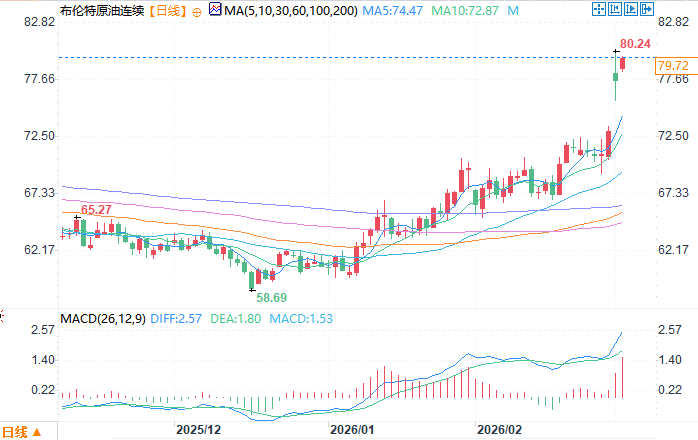
Brent crude oil daily chart source: EasyForex
At 13:19 Beijing time on March 3, Brent crude oil futures were trading at $79.69 per barrel.
Detailed account of the attack
The Strait of Hormuz, a narrow waterway connecting the Persian Gulf and the Arabian Sea, is a crucial passage for global oil and liquefied natural gas transportation, and its strategic importance is self-evident. On March 1st, a dual-purpose oil and gas carrier named "Skylight" became one of the targets of an attack. This 7,600-ton vessel was located north of the Omani port of Hasab, near the narrowest point of the strait, where the channel is only 3 kilometers wide, making it an easy bottleneck for an attack.
Reports indicate that three civilian vessels were attacked in the region that day, while U.S. Central Command announced it had struck a nearby Iranian naval frigate. These incidents, intertwined in a chaotic situation, underscore the intensity of the conflict and its potential disruption to civilian shipping.
Strait shipping disruptions and insurance dilemmas
Following the outbreak of the conflict, shipping activity in the strait quickly came to a standstill. According to an analysis of data from the MarineTraffic website, at least 150 vessels, including numerous oil and gas tankers, have anchored nearby awaiting further instructions.
This large-scale ship docking indicates that the shipping industry is facing unprecedented pressure. While reports contradict each other regarding whether Iran has officially announced the closure of the strait, a de facto barrier to passage has already been created. Experts point out that the strait remains technically open; however, high insurance costs have become a major obstacle preventing ships from risking crossing.
Amena Bakr, Head of Middle East and OPEC+ Research at Kpler Trade Intelligence, emphasized at a webinar that international oil companies are advising against using the strait precisely because insurance costs have soared to unaffordable levels. She further explained that genuine panic will only spread rapidly once headlines emerge about "strait closures and oil supply disruptions." Currently, this extreme scenario has not yet occurred, but shipping disruptions have already had a substantial impact on global supply chains.
Oil price fluctuations and expert predictions
The global benchmark Brent crude oil price surged by as much as 10% on March 1, reflecting the market's sensitive reaction to supply disruptions. Many analysts believe that oil prices will rise further if the conflict continues.
In an interview, Ajay Parmar, Director of Energy and Refining at ICIS, predicted that oil prices could approach $100 per barrel, or even break through that level in the event of a prolonged disruption to the Strait of Hormuz.
In contrast, Bakr took a more cautious stance, comparing the current conflict to the brief 12-day standoff in June 2025. In that incident, oil prices briefly touched $80 before quickly falling back, largely due to prior warnings from all sides; the conflict seemed more like a carefully orchestrated "performance." This current conflict, however, lacks warning and appears more chaotic and dangerous. Speaking in Dubai, Bakr noted the shock of Iran's "unprecedented" attack and predicted that oil prices would stabilize in the $85-$90 range. Such price increases would not only exacerbate global inflationary pressures but could also trigger political instability in various countries.
Multiple impacts of geopolitical conflict
The conflict in Iran is driving up oil prices on several levels. First, despite severe sanctions, Iran continues to export large quantities of crude oil to Asian countries through various channels. If the war drags on, these supply disruptions will force major Asian powers to turn to other sources, thereby boosting global demand.
Secondly, reports indicate that a possible Iranian drone or missile attack has led to the suspension of production at some Iraqi oil fields for security reasons, further compressing regional oil output.
Furthermore, a complete closure of the Strait of Hormuz would severely disrupt exports from Kuwait and other Persian Gulf countries. While pipelines in the Saudi Arabian desert offer alternative routes, their limited capacity cannot fully compensate for the shortfall. These factors intertwine to form a complex network of geopolitical risks that threaten global energy stability.
Strategic Responses of OPEC+ and Russia
Against this backdrop, OPEC+ plays a crucial role. The organization has stated it will closely monitor market conditions and emphasized the necessity of a cautious approach. While their statement did not directly mention the Iranian conflict, a separate statement from the Russian Foreign Ministry warned that disruptions to shipping through the Strait of Hormuz could lead to significant imbalances in the global oil and gas market. This imbalance may not be entirely negative for Russia. For a long time, depressed global oil prices, coupled with sanctions such as the G7 price cap, have caused a sharp decline in Russia's crude oil export revenue. According to a February report from the Energy and Clean Air Research Center, its revenue fell by 18% year-on-year. As a major buyer of Russian oil, if major Asian countries increase their orders to Russia due to reduced Iranian supplies, it will bring unexpected benefits to Russia, thereby alleviating its economic pressure to some extent.
Brent crude oil daily chart source: EasyForex
At 13:19 Beijing time on March 3, Brent crude oil futures were trading at $79.69 per barrel.
- Risk Warning and Disclaimer
- The market involves risk, and trading may not be suitable for all investors. This article is for reference only and does not constitute personal investment advice, nor does it take into account certain users’ specific investment objectives, financial situation, or other needs. Any investment decisions made based on this information are at your own risk.