Gold Trading Alert: The Middle East conflict is escalating! Gold prices plummeted by 4.4%, but is it the most ruthless "easy win king" of 2026?
2026-03-04 07:29:10
In early March 2026, global financial markets were plunged into turmoil. The conflict with Iran entered its fourth day, with the US-Israeli coalition launching a fierce attack on targets within Iran. The Iranian Revolutionary Guard retaliated, closing the Strait of Hormuz and instantly disrupting one-fifth of the world's oil transportation lifeline. Oil prices surged 5% to 8% in a single day, with Brent crude briefly reaching $85, and European natural gas wholesale prices soaring by over 40%. This energy supply shock quickly transmitted to global inflation expectations, forcing the Federal Reserve to postpone its interest rate cuts. US Treasury yields rose for the second consecutive trading day, and the US dollar index rebounded strongly above 99. In this extreme environment, spot gold plunged as much as 6% on Tuesday (March 3rd), ultimately closing down 4.4% at approximately $5088 per ounce, marking its worst single-day performance since January 30th. US gold futures settled down 3.5% at $5123.70. What market logic does this "abnormal" plunge in gold reflect? How will it unfold in the future?

The conflict escalated far faster than expected. Israeli and US air forces launched successive bombing raids on Iranian nuclear facilities and military targets, resulting in the death of Iran's Supreme Leader Ayatollah Khamenei. Explosions continued in Tehran, Beirut, and other cities, and Israeli forces destroyed approximately 60 Hezbollah targets in southern Lebanon. The Iranian Revolutionary Guard subsequently closed the Strait of Hormuz, warning international shipping of missile and drone risks. More than ten oil tankers have been attacked, shipping war risk insurance premiums have skyrocketed, and some of Qatar's liquefied natural gas facilities have suspended production. The global energy supply chain has been disrupted, with the average retail gasoline price in the US rising to $3.11 per gallon, and European households and industries facing a new round of energy bill pressures.
Against this backdrop, a clear "liquidity chase" phenomenon emerged in the market. Investors rushed to seek refuge in cash and dollar assets, causing the dollar to strengthen significantly as another safe-haven currency. This led to a sharp increase in the cost of purchasing dollar-denominated gold for non-dollar holders. Simultaneously, the yield on the 10-year US Treasury note rose to 4.056%, and the two-year yield hit a recent high, with the flattening yield curve reflecting increased uncertainty about the economic outlook. These factors combined to suppress the short-term attractiveness of gold, resulting in a sell-off. Silver plummeted by over 8%, platinum plunged by nearly 10%, and palladium fell by nearly 7%, demonstrating that precious metals with stronger industrial attributes were more severely affected by the sell-off in risk assets.
Soaring energy prices have reignited the specter of inflation. The market had initially expected the Federal Reserve to cut interest rates mid-year to support the economy, but now the CME FedWatch tool shows the probability of a 25 basis point rate cut in June has fallen to around 39%, narrowing the expected total rate cuts for the year from 59 basis points to 46 basis points. Several Fed officials have publicly stated that the impact of the Iran war on inflation and growth is still difficult to assess, but the resilience of the energy shock has begun to emerge. Officials from the New York and Minneapolis Feds have both emphasized increased uncertainty and a more ambiguous monetary policy outlook.
Higher inflation expectations are theoretically beneficial to gold, as gold, as a non-interest-bearing asset, can provide protection when purchasing power depreciates. However, in this round of market activity, rising inflation has first reinforced expectations of "higher and longer" interest rates, pushing up Treasury yields and the US dollar index, which in the short term has become the biggest source of pressure on gold. The market is experiencing a phase of "inflation first, then safe haven": inflationary panic triggered by the energy crisis has temporarily overshadowed geopolitical safe-haven demand.
Despite short-term pressure, many strategists believe that the current pullback in gold prices is likely just a temporary correction. Bob Haberkorn, senior strategist at RJO Futures, points out that safe-haven flows driven by geopolitical risks will eventually return, supporting higher gold prices. The risk of a prolonged conflict in Iran, continued uncertainty regarding Middle Eastern energy supplies, persistent global central bank demand for gold, and the potential trend towards de-dollarization all provide structural support for gold.
Historically, Middle East crises have often initially triggered liquidity panics, followed by sustained gold buying. Since 2026, gold has risen by over 70%, breaking through the $5,000 mark and reaching a historical high of over $5,600 in January. Following this correction, if there are no signs of a swift resolution to the conflict, oil prices remain high, inflationary pressures persist, and the Federal Reserve is forced to postpone or even shift to a neutral-to-tight policy, gold is likely to resume its upward trend and may even challenge higher levels. Some institutions have already set their year-end 2026 price targets at over $6,000.
The current gold market exhibits a typical pattern of "short-term panic, medium-term opportunity." For long-term investors, this pullback presents a good opportunity to buy on dips. Geopolitical uncertainty remains a key theme in 2026, and coupled with continued global central bank gold purchases and a potential shift towards monetary easing, gold's safe-haven and inflation-hedging properties remain irreplaceable. Short-term traders should be wary of further increases in the US dollar and Treasury yields, but if there are any signs of easing tensions in the Middle East or an unexpected recovery in energy supply, gold could experience a rapid V-shaped rebound.
The flames of war continue, and oil prices, inflation, and the dollar are all weighing on the market, yet gold has never been absent from a true crisis. The gold story of 2026 may have only just begun its most thrilling chapter. On Wednesday (March 4th) in early Asian trading, spot gold traded in a narrow range, currently hovering around the $5120 level. Today, the market will continue to focus on the latest developments in the Middle East, the progress of navigation in the Strait of Hormuz, and the latest statements from central bank officials in Europe and the US regarding the energy impact. At 20:30 Beijing time, the US will release its February ADP employment data and ISM services PMI, followed by the February ISM non-manufacturing index at 22:00. These are key windows for observing the resilience of the US economy and inflationary pressures. Investors need to pay close attention to breaking geopolitical news, as volatility may continue to increase.
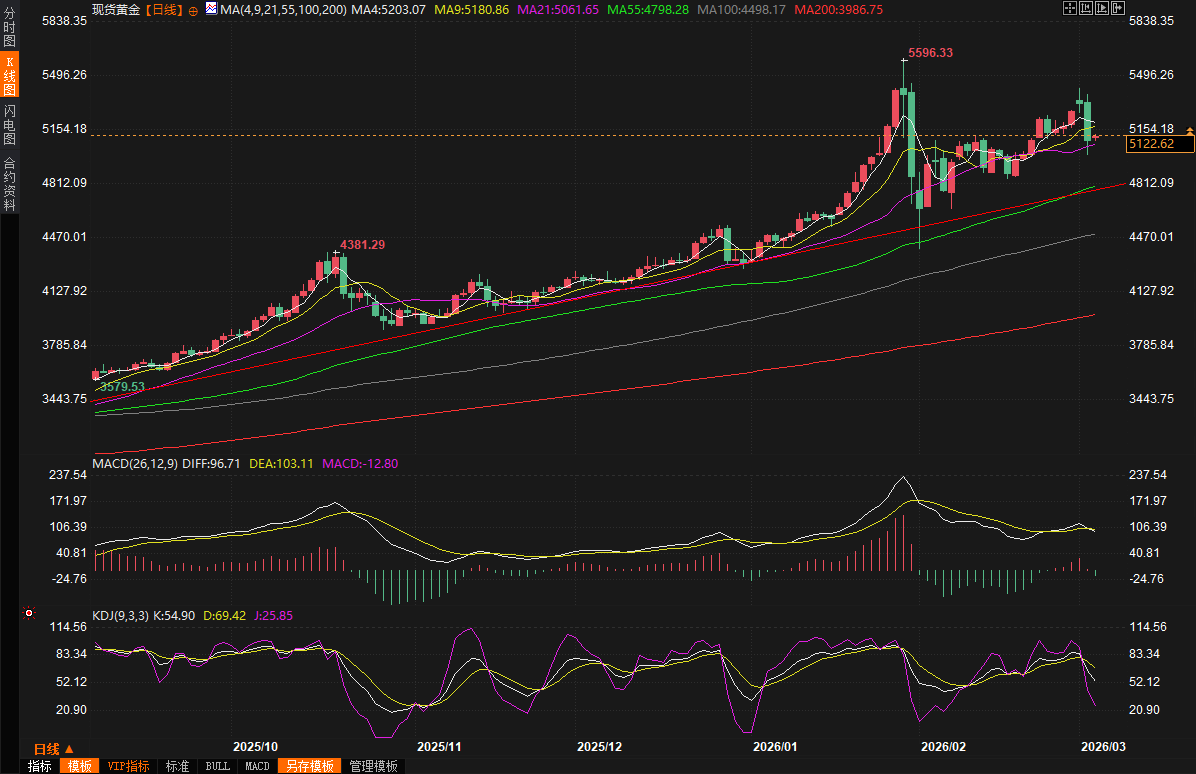
(Spot gold daily chart, source: FX678)
At 07:27 Beijing time, spot gold was trading at $5124.03 per ounce.
Geopolitical tensions trigger energy crisis, short-term liquidity panic squeezes gold.
The conflict escalated far faster than expected. Israeli and US air forces launched successive bombing raids on Iranian nuclear facilities and military targets, resulting in the death of Iran's Supreme Leader Ayatollah Khamenei. Explosions continued in Tehran, Beirut, and other cities, and Israeli forces destroyed approximately 60 Hezbollah targets in southern Lebanon. The Iranian Revolutionary Guard subsequently closed the Strait of Hormuz, warning international shipping of missile and drone risks. More than ten oil tankers have been attacked, shipping war risk insurance premiums have skyrocketed, and some of Qatar's liquefied natural gas facilities have suspended production. The global energy supply chain has been disrupted, with the average retail gasoline price in the US rising to $3.11 per gallon, and European households and industries facing a new round of energy bill pressures.
Against this backdrop, a clear "liquidity chase" phenomenon emerged in the market. Investors rushed to seek refuge in cash and dollar assets, causing the dollar to strengthen significantly as another safe-haven currency. This led to a sharp increase in the cost of purchasing dollar-denominated gold for non-dollar holders. Simultaneously, the yield on the 10-year US Treasury note rose to 4.056%, and the two-year yield hit a recent high, with the flattening yield curve reflecting increased uncertainty about the economic outlook. These factors combined to suppress the short-term attractiveness of gold, resulting in a sell-off. Silver plummeted by over 8%, platinum plunged by nearly 10%, and palladium fell by nearly 7%, demonstrating that precious metals with stronger industrial attributes were more severely affected by the sell-off in risk assets.
Inflation expectations have reignited, significantly reducing the Federal Reserve's room for interest rate cuts.
Soaring energy prices have reignited the specter of inflation. The market had initially expected the Federal Reserve to cut interest rates mid-year to support the economy, but now the CME FedWatch tool shows the probability of a 25 basis point rate cut in June has fallen to around 39%, narrowing the expected total rate cuts for the year from 59 basis points to 46 basis points. Several Fed officials have publicly stated that the impact of the Iran war on inflation and growth is still difficult to assess, but the resilience of the energy shock has begun to emerge. Officials from the New York and Minneapolis Feds have both emphasized increased uncertainty and a more ambiguous monetary policy outlook.
Higher inflation expectations are theoretically beneficial to gold, as gold, as a non-interest-bearing asset, can provide protection when purchasing power depreciates. However, in this round of market activity, rising inflation has first reinforced expectations of "higher and longer" interest rates, pushing up Treasury yields and the US dollar index, which in the short term has become the biggest source of pressure on gold. The market is experiencing a phase of "inflation first, then safe haven": inflationary panic triggered by the energy crisis has temporarily overshadowed geopolitical safe-haven demand.
Gold's safe-haven appeal remains unchanged; a medium-term rebound is poised to begin.
Despite short-term pressure, many strategists believe that the current pullback in gold prices is likely just a temporary correction. Bob Haberkorn, senior strategist at RJO Futures, points out that safe-haven flows driven by geopolitical risks will eventually return, supporting higher gold prices. The risk of a prolonged conflict in Iran, continued uncertainty regarding Middle Eastern energy supplies, persistent global central bank demand for gold, and the potential trend towards de-dollarization all provide structural support for gold.
Historically, Middle East crises have often initially triggered liquidity panics, followed by sustained gold buying. Since 2026, gold has risen by over 70%, breaking through the $5,000 mark and reaching a historical high of over $5,600 in January. Following this correction, if there are no signs of a swift resolution to the conflict, oil prices remain high, inflationary pressures persist, and the Federal Reserve is forced to postpone or even shift to a neutral-to-tight policy, gold is likely to resume its upward trend and may even challenge higher levels. Some institutions have already set their year-end 2026 price targets at over $6,000.
How should investors respond to the current turmoil?
The current gold market exhibits a typical pattern of "short-term panic, medium-term opportunity." For long-term investors, this pullback presents a good opportunity to buy on dips. Geopolitical uncertainty remains a key theme in 2026, and coupled with continued global central bank gold purchases and a potential shift towards monetary easing, gold's safe-haven and inflation-hedging properties remain irreplaceable. Short-term traders should be wary of further increases in the US dollar and Treasury yields, but if there are any signs of easing tensions in the Middle East or an unexpected recovery in energy supply, gold could experience a rapid V-shaped rebound.
The flames of war continue, and oil prices, inflation, and the dollar are all weighing on the market, yet gold has never been absent from a true crisis. The gold story of 2026 may have only just begun its most thrilling chapter. On Wednesday (March 4th) in early Asian trading, spot gold traded in a narrow range, currently hovering around the $5120 level. Today, the market will continue to focus on the latest developments in the Middle East, the progress of navigation in the Strait of Hormuz, and the latest statements from central bank officials in Europe and the US regarding the energy impact. At 20:30 Beijing time, the US will release its February ADP employment data and ISM services PMI, followed by the February ISM non-manufacturing index at 22:00. These are key windows for observing the resilience of the US economy and inflationary pressures. Investors need to pay close attention to breaking geopolitical news, as volatility may continue to increase.
(Spot gold daily chart, source: FX678)
At 07:27 Beijing time, spot gold was trading at $5124.03 per ounce.
- Risk Warning and Disclaimer
- The market involves risk, and trading may not be suitable for all investors. This article is for reference only and does not constitute personal investment advice, nor does it take into account certain users’ specific investment objectives, financial situation, or other needs. Any investment decisions made based on this information are at your own risk.