With war clouds looming between the US and Iran, New Zealand has unexpectedly become a "winner"?
2026-03-05 20:43:53
New Zealand Finance Minister Willis's statement clearly indicates that this geopolitical turmoil presents New Zealand with a test of both imported cost shocks and export benefits, and has become a core external variable dominating the medium-term trend of the New Zealand dollar.

Willis clearly pointed out that the duration and scope of the Middle East conflict, as well as whether oil prices will surge, are key factors in assessing the economic impact.
If oil prices fluctuate only moderately with market sentiment, the New Zealand economy can gradually absorb the impact. However, if shipping in the Strait of Hormuz is disrupted and oil prices spiral out of control, imported inflation will quickly spread to the transportation, agriculture, and infrastructure sectors, directly putting pressure on the purchasing power of the New Zealand dollar and its exchange rate performance.
Fortunately, New Zealand's fiscal resilience exceeded expectations: as of the end of January, the operating deficit excluding ACC was NZ$6 billion, NZ$1.9 billion less than expected.
The core royal family's net debt was NZ$184.3 billion, NZ$1.1 billion lower than expected. This sound fiscal position provided ample buffer against the impact of high oil prices and also provided underlying support for the New Zealand dollar exchange rate.
As a typical commodity currency, the New Zealand dollar exhibits a clear duality in geopolitical conflicts.
In the short term, risk aversion will drive global capital back to the US dollar, making the New Zealand dollar vulnerable to weakening. The local currency costs of imported fuel and consumer goods will rise simultaneously, creating a double pressure of "rising oil prices + currency depreciation".
From a medium- to long-term perspective, New Zealand's core export structure consists of dairy products, meat, and timber. Conflicts have driven up global commodity prices, and exports are priced and settled in US dollars.
Even if the New Zealand dollar depreciates in stages, the scale of export earnings is still expected to expand, creating a compensatory effect at the exchange rate level and limiting the potential for a deeper decline in the New Zealand dollar.
Willis stated that the May fiscal budget, finalized in April, will formally incorporate the Middle East situation into its assessment framework.
If the conflict continues to escalate, the government will need to reserve more funds to cope with the inflation and cost of living crisis, and its fiscal stance will become more prudent. Even though current fiscal data is better than expected, the authorities remain cautious and are not in a hurry to draw optimistic conclusions. This defensive policy approach will be an important constraint on the New Zealand dollar's volatility.
Unlike the Eurozone, which is mired in energy shortages and under pressure on the production side, New Zealand has unique resilience due to its position as a "global supplier of essential goods".
The Eurozone is facing a hard shock from the paralysis of energy supply, while New Zealand is only facing upward cost pressures. However, its agricultural and livestock products are in high demand globally, and this rigid demand supports the export fundamentals, which also makes the New Zealand dollar relatively resilient among G10 currencies.
Overall, as long as the Middle East conflict does not escalate to the extreme scenario of disrupting core global shipping, New Zealand is expected to achieve a dynamic economic balance amid global volatility, thanks to its better-than-expected fiscal buffers, its essential export structure, and the benefits of commodity premiums.
More importantly, New Zealand has long had a natural resilience logic based on low foreign exchange hedging.
As a typical agricultural and livestock commodity currency, the New Zealand dollar is highly correlated with the prices of essential products such as dairy products and meat, and has a natural buffer against exchange rate fluctuations.
Given that domestic assets are mainly domestically needed assets with no exchange rate risk, and overseas investment exposure is relatively small, and long-term foreign exchange hedging costs will significantly erode returns, institutions generally choose low-hedging operations.
Amidst the dramatic currency market fluctuations triggered by geopolitical conflicts, this well-established model has further stabilized the domestic financial environment, becoming a unique defensive advantage for New Zealand in the face of the looming US-Iran conflict.
For the New Zealand dollar exchange rate, it weakens in the short term due to risk aversion and oil price fluctuations, while in the medium term it is priced by fiscal resilience and export dividends, showing an overall trend of initial decline followed by stabilization and relative resilience.
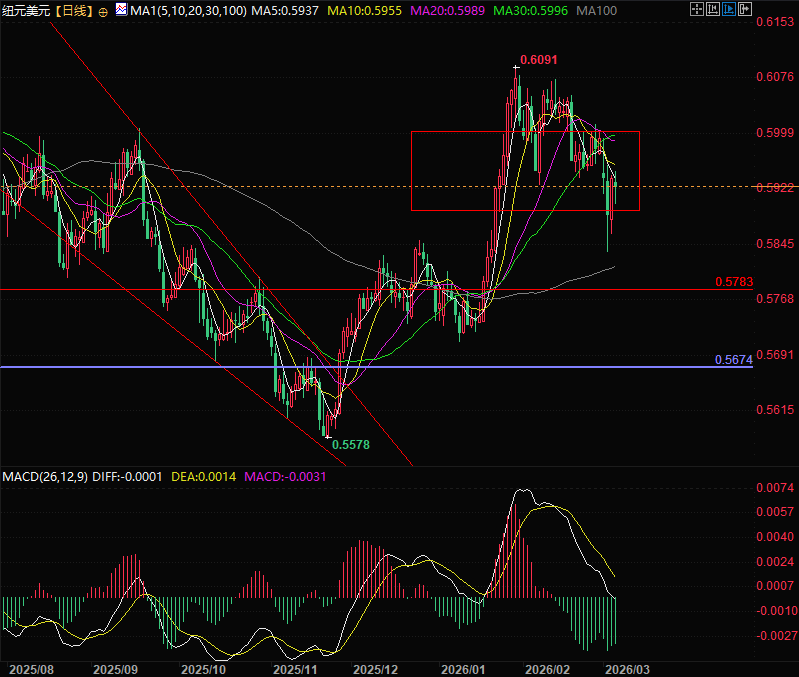
(NZD/USD daily chart, source: FX678)
At 20:42 Beijing time, the New Zealand dollar was trading at 0.5923/24 against the US dollar.
Key pricing factors: The scale of the conflict and oil prices will determine the short-term pressure on the New Zealand dollar.
Willis clearly pointed out that the duration and scope of the Middle East conflict, as well as whether oil prices will surge, are key factors in assessing the economic impact.
If oil prices fluctuate only moderately with market sentiment, the New Zealand economy can gradually absorb the impact. However, if shipping in the Strait of Hormuz is disrupted and oil prices spiral out of control, imported inflation will quickly spread to the transportation, agriculture, and infrastructure sectors, directly putting pressure on the purchasing power of the New Zealand dollar and its exchange rate performance.
Fortunately, New Zealand's fiscal resilience exceeded expectations: as of the end of January, the operating deficit excluding ACC was NZ$6 billion, NZ$1.9 billion less than expected.
The core royal family's net debt was NZ$184.3 billion, NZ$1.1 billion lower than expected. This sound fiscal position provided ample buffer against the impact of high oil prices and also provided underlying support for the New Zealand dollar exchange rate.
The New Zealand dollar's dual nature as a commodity currency: short-term pressure, medium-term benefits.
As a typical commodity currency, the New Zealand dollar exhibits a clear duality in geopolitical conflicts.
In the short term, risk aversion will drive global capital back to the US dollar, making the New Zealand dollar vulnerable to weakening. The local currency costs of imported fuel and consumer goods will rise simultaneously, creating a double pressure of "rising oil prices + currency depreciation".
From a medium- to long-term perspective, New Zealand's core export structure consists of dairy products, meat, and timber. Conflicts have driven up global commodity prices, and exports are priced and settled in US dollars.
Even if the New Zealand dollar depreciates in stages, the scale of export earnings is still expected to expand, creating a compensatory effect at the exchange rate level and limiting the potential for a deeper decline in the New Zealand dollar.
May Budget: Geopolitical Risks Included in Framework, Cautious Stance Guides Exchange Rate Expectations
Willis stated that the May fiscal budget, finalized in April, will formally incorporate the Middle East situation into its assessment framework.
If the conflict continues to escalate, the government will need to reserve more funds to cope with the inflation and cost of living crisis, and its fiscal stance will become more prudent. Even though current fiscal data is better than expected, the authorities remain cautious and are not in a hurry to draw optimistic conclusions. This defensive policy approach will be an important constraint on the New Zealand dollar's volatility.
Structural resilience: New Zealand's differentiation from the Eurozone is beneficial to the relative performance of the New Zealand dollar.
Unlike the Eurozone, which is mired in energy shortages and under pressure on the production side, New Zealand has unique resilience due to its position as a "global supplier of essential goods".
The Eurozone is facing a hard shock from the paralysis of energy supply, while New Zealand is only facing upward cost pressures. However, its agricultural and livestock products are in high demand globally, and this rigid demand supports the export fundamentals, which also makes the New Zealand dollar relatively resilient among G10 currencies.
Summarize:
Overall, as long as the Middle East conflict does not escalate to the extreme scenario of disrupting core global shipping, New Zealand is expected to achieve a dynamic economic balance amid global volatility, thanks to its better-than-expected fiscal buffers, its essential export structure, and the benefits of commodity premiums.
More importantly, New Zealand has long had a natural resilience logic based on low foreign exchange hedging.
As a typical agricultural and livestock commodity currency, the New Zealand dollar is highly correlated with the prices of essential products such as dairy products and meat, and has a natural buffer against exchange rate fluctuations.
Given that domestic assets are mainly domestically needed assets with no exchange rate risk, and overseas investment exposure is relatively small, and long-term foreign exchange hedging costs will significantly erode returns, institutions generally choose low-hedging operations.
Amidst the dramatic currency market fluctuations triggered by geopolitical conflicts, this well-established model has further stabilized the domestic financial environment, becoming a unique defensive advantage for New Zealand in the face of the looming US-Iran conflict.
For the New Zealand dollar exchange rate, it weakens in the short term due to risk aversion and oil price fluctuations, while in the medium term it is priced by fiscal resilience and export dividends, showing an overall trend of initial decline followed by stabilization and relative resilience.
(NZD/USD daily chart, source: FX678)
At 20:42 Beijing time, the New Zealand dollar was trading at 0.5923/24 against the US dollar.
- Risk Warning and Disclaimer
- The market involves risk, and trading may not be suitable for all investors. This article is for reference only and does not constitute personal investment advice, nor does it take into account certain users’ specific investment objectives, financial situation, or other needs. Any investment decisions made based on this information are at your own risk.