Economists issue a strong warning: Don't mistake short-term trading for long-term investment; gold prices could reach $8,000 within five years.
2026-03-06 11:04:54
Amid heightened global economic and geopolitical uncertainty, the gold market continues to maintain support above $5,000 per ounce, but it is struggling to attract sustained bullish momentum, especially as the US dollar absorbs some safe-haven inflows. However, a prominent economist cautions investors against confusing short-term trading momentum with long-term investment strategies.
This perspective not only reveals the complexity of current market dynamics but also provides profound insights into the future trajectory of precious metals. By analyzing liquidity shifts, the impact of geopolitical conflicts, and macroeconomic pressures, we can see that although gold is under short-term pressure, its long-term bull market foundation remains solid, especially with significant price potential supported by structural demand.
The gold market is currently facing a dual test of support and pressure. Although prices are holding above $5,000 per ounce, it is difficult to generate sustainable upward momentum, mainly because the US dollar is attracting safe-haven inflows.
Thorsten Polleit, Professor Emeritus of Economics at the University of Bayreuth and publisher of BOOM & BUST REPORT, said the dollar and U.S. Treasuries are benefiting from broader liquidity trading as investors seek to protect themselves amid economic and geopolitical uncertainty. He further explained that the joint U.S.-Israeli military action against Iran has put enormous pressure on the global economy, which he expects will force central banks, led by the Federal Reserve, to curb risk in order to support the economy. Polleit noted that investors are fairly confident that central banks will open the floodgates to bail out troubled banks, hedge funds, or other entities that could threaten the financial system.
During periods of market stress, investors tend to shift towards the most liquid assets, which further exacerbates the short-term predicament of gold.
Pollett points out that in such situations, investors tend to flock to the most liquid assets, which currently favors the dollar over precious metals. This shift in liquidity could temporarily suppress gold and silver prices, even as underlying economic risks increase. He adds that in crisis situations, people might even temporarily forgo gold and silver in favor of holding cash.
However, Paulette emphasized that this liquidity dynamic should not be mistaken for a weakening long-term demand for precious metals. He pointed out that structural investment demand for gold and silver continues to accumulate as investors seek protection against rising government debt and persistent inflation risks. Paulette stated that structural demand for gold and silver has now materialized.
Despite a short-term liquidity preference for cash, the broader macroeconomic environment provides strong support for precious metals. Pollett further added that while investors may temporarily favor cash during periods of uncertainty, the broader macroeconomic environment continues to support precious metals. He stated that rising government debt, geopolitical conflicts, and ongoing central bank monetary intervention will continue to erode the purchasing power of fiat currencies. Pollett pointed out that this is an inflationary regime. With increasing government debt, rising energy prices, and escalating geopolitical conflicts, the purchasing power of all fiat currencies faces pressure.
He also warned that central banks have limited room to significantly raise interest rates due to the massive debt burdens faced by governments and businesses. Higher interest rates would quickly destabilize the financial system, forcing policymakers to return to monetary stimulus. Paulette stated that the economy is highly indebted. If interest rates rise sharply, the central bank will intervene to support the bond market.
Despite these structural pressures, the long-term outlook for precious metals remains optimistic. Paulette believes that even with periods of price volatility, the long-term bull market for precious metals remains intact. He states that gold and silver appear to have undergone a fundamental revaluation in recent years as investors have become increasingly aware of the risks embedded in the global financial system. Paulette adds that gold and silver have entered uncharted territory. However, this does not mean they are in a bubble, but rather that they have been revalued relative to other asset classes.
Looking ahead, he expects precious metals to continue rising as governments rely on deficit spending and monetary expansion to cope with economic shocks. Pollett stated that he wouldn't be surprised if gold trades around $8,000 per ounce over the next five years, as that would simply reflect the risks accumulating in the global economy.
Despite his bullish outlook, Pollett cautioned investors to approach precious metals with a long-term perspective, rather than attempting to trade short-term fluctuations. He stated that if you already hold gold, continue to hold it. Furthermore, if you are considering buying gold or silver, these levels are still viable entry points, provided you have an investment horizon of at least two to three years.
In conclusion, while the gold market may struggle to sustain its upward momentum in the short term due to liquidity shifts and safe-haven inflows of the US dollar, Torsten Polette's analysis clearly reveals its long-term potential. Driven by multiple factors including geopolitical conflicts, inflationary pressures, and debt burdens, structural demand for precious metals will continue to push prices higher. Investors should abandon short-term trading strategies and adopt a long-term holding approach to capitalize on gold's potential for significant gains. This insight is not only applicable to market volatility in the context of the current Iranian conflict but also provides valuable guidance for navigating global economic uncertainties.
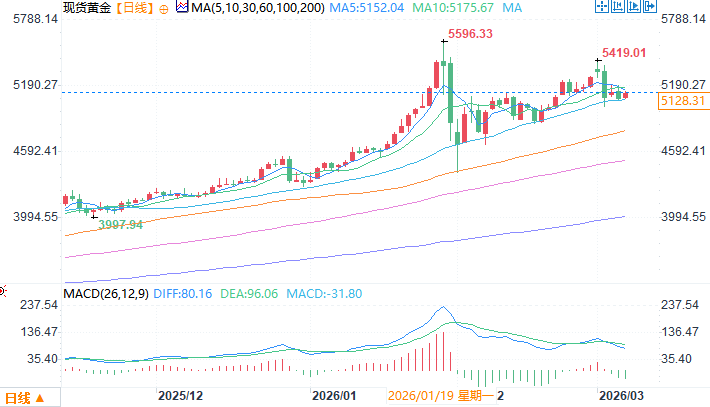
Spot gold daily chart source: EasyForex
At 11:03 AM Beijing time on March 6, spot gold was trading at $5130.31 per ounce.
This perspective not only reveals the complexity of current market dynamics but also provides profound insights into the future trajectory of precious metals. By analyzing liquidity shifts, the impact of geopolitical conflicts, and macroeconomic pressures, we can see that although gold is under short-term pressure, its long-term bull market foundation remains solid, especially with significant price potential supported by structural demand.
Gold prices are supported but lack momentum, highlighting the safe-haven appeal of the US dollar.
The gold market is currently facing a dual test of support and pressure. Although prices are holding above $5,000 per ounce, it is difficult to generate sustainable upward momentum, mainly because the US dollar is attracting safe-haven inflows.
Thorsten Polleit, Professor Emeritus of Economics at the University of Bayreuth and publisher of BOOM & BUST REPORT, said the dollar and U.S. Treasuries are benefiting from broader liquidity trading as investors seek to protect themselves amid economic and geopolitical uncertainty. He further explained that the joint U.S.-Israeli military action against Iran has put enormous pressure on the global economy, which he expects will force central banks, led by the Federal Reserve, to curb risk in order to support the economy. Polleit noted that investors are fairly confident that central banks will open the floodgates to bail out troubled banks, hedge funds, or other entities that could threaten the financial system.
During the crisis, liquidity shifted to cash, putting short-term downward pressure on precious metal prices.
During periods of market stress, investors tend to shift towards the most liquid assets, which further exacerbates the short-term predicament of gold.
Pollett points out that in such situations, investors tend to flock to the most liquid assets, which currently favors the dollar over precious metals. This shift in liquidity could temporarily suppress gold and silver prices, even as underlying economic risks increase. He adds that in crisis situations, people might even temporarily forgo gold and silver in favor of holding cash.
However, Paulette emphasized that this liquidity dynamic should not be mistaken for a weakening long-term demand for precious metals. He pointed out that structural investment demand for gold and silver continues to accumulate as investors seek protection against rising government debt and persistent inflation risks. Paulette stated that structural demand for gold and silver has now materialized.
The macroeconomic environment provides a solid foundation for a long-term bull market in precious metals.
Despite a short-term liquidity preference for cash, the broader macroeconomic environment provides strong support for precious metals. Pollett further added that while investors may temporarily favor cash during periods of uncertainty, the broader macroeconomic environment continues to support precious metals. He stated that rising government debt, geopolitical conflicts, and ongoing central bank monetary intervention will continue to erode the purchasing power of fiat currencies. Pollett pointed out that this is an inflationary regime. With increasing government debt, rising energy prices, and escalating geopolitical conflicts, the purchasing power of all fiat currencies faces pressure.
He also warned that central banks have limited room to significantly raise interest rates due to the massive debt burdens faced by governments and businesses. Higher interest rates would quickly destabilize the financial system, forcing policymakers to return to monetary stimulus. Paulette stated that the economy is highly indebted. If interest rates rise sharply, the central bank will intervene to support the bond market.
Gold is revaluing and entering uncharted territory; $8,000 is expected within the next five years.
Despite these structural pressures, the long-term outlook for precious metals remains optimistic. Paulette believes that even with periods of price volatility, the long-term bull market for precious metals remains intact. He states that gold and silver appear to have undergone a fundamental revaluation in recent years as investors have become increasingly aware of the risks embedded in the global financial system. Paulette adds that gold and silver have entered uncharted territory. However, this does not mean they are in a bubble, but rather that they have been revalued relative to other asset classes.
Looking ahead, he expects precious metals to continue rising as governments rely on deficit spending and monetary expansion to cope with economic shocks. Pollett stated that he wouldn't be surprised if gold trades around $8,000 per ounce over the next five years, as that would simply reflect the risks accumulating in the global economy.
Despite his bullish outlook, Pollett cautioned investors to approach precious metals with a long-term perspective, rather than attempting to trade short-term fluctuations. He stated that if you already hold gold, continue to hold it. Furthermore, if you are considering buying gold or silver, these levels are still viable entry points, provided you have an investment horizon of at least two to three years.
In conclusion, while the gold market may struggle to sustain its upward momentum in the short term due to liquidity shifts and safe-haven inflows of the US dollar, Torsten Polette's analysis clearly reveals its long-term potential. Driven by multiple factors including geopolitical conflicts, inflationary pressures, and debt burdens, structural demand for precious metals will continue to push prices higher. Investors should abandon short-term trading strategies and adopt a long-term holding approach to capitalize on gold's potential for significant gains. This insight is not only applicable to market volatility in the context of the current Iranian conflict but also provides valuable guidance for navigating global economic uncertainties.
Spot gold daily chart source: EasyForex
At 11:03 AM Beijing time on March 6, spot gold was trading at $5130.31 per ounce.
- Risk Warning and Disclaimer
- The market involves risk, and trading may not be suitable for all investors. This article is for reference only and does not constitute personal investment advice, nor does it take into account certain users’ specific investment objectives, financial situation, or other needs. Any investment decisions made based on this information are at your own risk.