The container shipping index fell for the second consecutive day, while international oil prices declined in tandem; caution is advised regarding the risk of high volatility.
2026-03-06 13:17:31
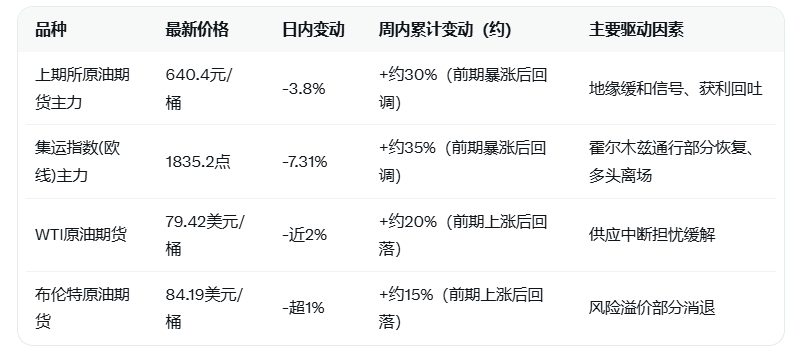
According to the APP, the Shanghai Futures Exchange's main crude oil futures contract continued its downward trend on Thursday (March 6), closing down 3.8% at 640.4 yuan/barrel; the container shipping index (European route) main contract fell even more, closing down 7.31% at 1835.2 points.
This marks the second consecutive day of decline for both commodities, a stark contrast to the previous surge triggered by the escalating conflict in the Middle East. International oil prices also weakened, with WTI crude futures falling nearly 2% to $79.42 per barrel and Brent crude futures dropping over 1% to $84.19 per barrel. The oil and gas and shipping sectors also saw a collective pullback.

The pullback primarily stemmed from a market reassessment of the Middle East situation. Recent escalation of the US-Iran conflict strongly anticipated disruptions to shipping through the Strait of Hormuz, driving a surge in crude oil and shipping futures. However, the latest news indicates that Iran has stated it has not completely closed the Strait of Hormuz, with some oil tankers resuming passage. Saudi Arabia and other oil-producing countries are accelerating their export via the Red Sea, temporarily easing the risk of global energy supply disruptions. This easing signal triggered profit-taking by long positions, coupled with previous excessive gains (crude oil futures rose by over 37% this week at one point, and container shipping routes to Europe rose by over 40%), leading to a rapid outflow of funds and a sharp drop in prices.
Analysts point out that this round of market activity is driven more by geopolitical sentiment than by a substantial improvement in fundamentals, and there has been no sustained shortage in spot freight rates or crude oil supply. Zhong Sheng Futures' latest view emphasizes that "the situation in the Middle East remains unclear, and the risk of increased volatility in crude oil prices remains. For container shipping indices (European routes), bullish sentiment has faded, and caution is advised regarding volatility risks; close attention should be paid to the subsequent evolution of the geopolitical situation."
Huatai Securities analysts point out that the escalation in the Middle East has temporarily boosted global shipping prices, but the medium- to long-term trend depends on the duration of the disruption. If the conflict reaches a stalemate, freight rates will gradually return to their off-season fundamentals (March and April are traditionally the off-season for European routes, and spot freight rates have not yet increased significantly). To clearly compare recent key price changes,
The following table summarizes the latest performance of major varieties:
From a technical perspective, crude oil futures are experiencing sharp fluctuations in the 620-700 yuan/barrel range in the short term. After a pullback, support is expected around 620 yuan, while resistance lies in the 680-700 yuan resistance zone. The container shipping index (European route) has fallen rapidly from its high, with short-term support near the 1750-1800 point range. If geopolitical risks escalate again, a rebound may resume. Overall, high volatility has become the norm, and exchanges have continuously adjusted margin requirements and price limits, reminding investors to control their positions. From a broader perspective, although short-term supply concerns have eased, the uncertainty surrounding the duration of the Middle East conflict remains. If retaliatory actions escalate or the Strait of Hormuz remains blocked for an extended period, oil prices and freight rates may reignite upward momentum; conversely, the global oversupply (OPEC+ production increases expected, high inventories) will suppress the rebound potential. Investors should be wary of extreme volatility triggered by sudden news and avoid emotional buying and selling.
Editor's Summary : Signals of short-term easing in geopolitical tensions have driven a shift in market sentiment, with profit-taking in crude oil and container shipping futures exacerbating the pullback. The decline in international oil prices reflects a partial reduction in risk premiums, but uncertainties in the Middle East remain, and volatility risks persist. Close monitoring of the Strait of Hormuz and global supply and demand changes is necessary.
Frequently Asked Questions
Question 1: Why did the Shanghai Futures Exchange crude oil futures and container shipping index (European line) fall for the second consecutive day?
The main reason for the decline was the easing of geopolitical tensions in the Middle East. Iran stated that it had not completely closed the Strait of Hormuz, allowing some oil tankers to resume passage. Saudi Arabia and other countries diverted their exports via the Red Sea, reducing expectations of supply disruptions. After a previous surge (crude oil up over 37% and shipping over 40% this week), profit-taking by long positions triggered a sharp drop, and sentiment shifted from panic to rationality.
Question 2: What impact will the decline in international oil prices have on domestic futures markets?
WTI crude oil fell nearly 2% to $79.42 per barrel, and Brent crude fell more than 1% to $84.19 per barrel, directly weakening the cost support for domestic crude oil futures and transmitting to the chemical and shipping chains. As a freight rate index, the European shipping route is highly sensitive to oil prices and geopolitical transportation risks; the decline amplifies the off-season characteristics of the spot market and cooling sentiment.
Question 3: How does the current situation in the Strait of Hormuz affect the market?
The escalation of the conflict previously brought shipping across the strait to a near standstill, driving up oil and freight rates. However, the latest reports indicate that traffic has partially resumed, easing the global energy crisis in the short term and causing market risk premiums to recede rapidly. If Iranian retaliation escalates or the strait remains blocked for an extended period, oil prices may return to an upward trend; the current probability of a "stalemate" is increasing, which is bearish for short-term bullish sentiment.
Question 4: What warnings do institutions have regarding the risk of market volatility in the future?
Zhong Sheng Futures believes bullish sentiment is waning and warns of increased volatility; Huatai Securities points out that the duration of the disturbances needs to be observed in the medium to long term; if it turns into a stalemate, freight rates will return to fundamentals. Multiple institutions emphasize that geopolitical uncertainty is the dominant factor, and high volatility is becoming the norm, suggesting controlling positions, reducing holdings on rallies, and avoiding chasing highs and selling lows.
Question 5: How should investors currently respond to opportunities in crude oil and shipping futures?
Short-term outlook is for a volatile pullback; watch the 620-680 yuan (crude oil) and 1750-1900 points (shipping) ranges. Upward rebounds depend on renewed geopolitical risks; diversified portfolios and close attention to news developments are recommended. In the long term, global oversupply will suppress gains, making event-driven rather than trend-following positions more suitable, with risk management as a priority.
This marks the second consecutive day of decline for both commodities, a stark contrast to the previous surge triggered by the escalating conflict in the Middle East. International oil prices also weakened, with WTI crude futures falling nearly 2% to $79.42 per barrel and Brent crude futures dropping over 1% to $84.19 per barrel. The oil and gas and shipping sectors also saw a collective pullback.
The pullback primarily stemmed from a market reassessment of the Middle East situation. Recent escalation of the US-Iran conflict strongly anticipated disruptions to shipping through the Strait of Hormuz, driving a surge in crude oil and shipping futures. However, the latest news indicates that Iran has stated it has not completely closed the Strait of Hormuz, with some oil tankers resuming passage. Saudi Arabia and other oil-producing countries are accelerating their export via the Red Sea, temporarily easing the risk of global energy supply disruptions. This easing signal triggered profit-taking by long positions, coupled with previous excessive gains (crude oil futures rose by over 37% this week at one point, and container shipping routes to Europe rose by over 40%), leading to a rapid outflow of funds and a sharp drop in prices.
Analysts point out that this round of market activity is driven more by geopolitical sentiment than by a substantial improvement in fundamentals, and there has been no sustained shortage in spot freight rates or crude oil supply. Zhong Sheng Futures' latest view emphasizes that "the situation in the Middle East remains unclear, and the risk of increased volatility in crude oil prices remains. For container shipping indices (European routes), bullish sentiment has faded, and caution is advised regarding volatility risks; close attention should be paid to the subsequent evolution of the geopolitical situation."
Huatai Securities analysts point out that the escalation in the Middle East has temporarily boosted global shipping prices, but the medium- to long-term trend depends on the duration of the disruption. If the conflict reaches a stalemate, freight rates will gradually return to their off-season fundamentals (March and April are traditionally the off-season for European routes, and spot freight rates have not yet increased significantly). To clearly compare recent key price changes,
The following table summarizes the latest performance of major varieties:
From a technical perspective, crude oil futures are experiencing sharp fluctuations in the 620-700 yuan/barrel range in the short term. After a pullback, support is expected around 620 yuan, while resistance lies in the 680-700 yuan resistance zone. The container shipping index (European route) has fallen rapidly from its high, with short-term support near the 1750-1800 point range. If geopolitical risks escalate again, a rebound may resume. Overall, high volatility has become the norm, and exchanges have continuously adjusted margin requirements and price limits, reminding investors to control their positions. From a broader perspective, although short-term supply concerns have eased, the uncertainty surrounding the duration of the Middle East conflict remains. If retaliatory actions escalate or the Strait of Hormuz remains blocked for an extended period, oil prices and freight rates may reignite upward momentum; conversely, the global oversupply (OPEC+ production increases expected, high inventories) will suppress the rebound potential. Investors should be wary of extreme volatility triggered by sudden news and avoid emotional buying and selling.
Editor's Summary : Signals of short-term easing in geopolitical tensions have driven a shift in market sentiment, with profit-taking in crude oil and container shipping futures exacerbating the pullback. The decline in international oil prices reflects a partial reduction in risk premiums, but uncertainties in the Middle East remain, and volatility risks persist. Close monitoring of the Strait of Hormuz and global supply and demand changes is necessary.
Frequently Asked Questions
Question 1: Why did the Shanghai Futures Exchange crude oil futures and container shipping index (European line) fall for the second consecutive day?
The main reason for the decline was the easing of geopolitical tensions in the Middle East. Iran stated that it had not completely closed the Strait of Hormuz, allowing some oil tankers to resume passage. Saudi Arabia and other countries diverted their exports via the Red Sea, reducing expectations of supply disruptions. After a previous surge (crude oil up over 37% and shipping over 40% this week), profit-taking by long positions triggered a sharp drop, and sentiment shifted from panic to rationality.
Question 2: What impact will the decline in international oil prices have on domestic futures markets?
WTI crude oil fell nearly 2% to $79.42 per barrel, and Brent crude fell more than 1% to $84.19 per barrel, directly weakening the cost support for domestic crude oil futures and transmitting to the chemical and shipping chains. As a freight rate index, the European shipping route is highly sensitive to oil prices and geopolitical transportation risks; the decline amplifies the off-season characteristics of the spot market and cooling sentiment.
Question 3: How does the current situation in the Strait of Hormuz affect the market?
The escalation of the conflict previously brought shipping across the strait to a near standstill, driving up oil and freight rates. However, the latest reports indicate that traffic has partially resumed, easing the global energy crisis in the short term and causing market risk premiums to recede rapidly. If Iranian retaliation escalates or the strait remains blocked for an extended period, oil prices may return to an upward trend; the current probability of a "stalemate" is increasing, which is bearish for short-term bullish sentiment.
Question 4: What warnings do institutions have regarding the risk of market volatility in the future?
Zhong Sheng Futures believes bullish sentiment is waning and warns of increased volatility; Huatai Securities points out that the duration of the disturbances needs to be observed in the medium to long term; if it turns into a stalemate, freight rates will return to fundamentals. Multiple institutions emphasize that geopolitical uncertainty is the dominant factor, and high volatility is becoming the norm, suggesting controlling positions, reducing holdings on rallies, and avoiding chasing highs and selling lows.
Question 5: How should investors currently respond to opportunities in crude oil and shipping futures?
Short-term outlook is for a volatile pullback; watch the 620-680 yuan (crude oil) and 1750-1900 points (shipping) ranges. Upward rebounds depend on renewed geopolitical risks; diversified portfolios and close attention to news developments are recommended. In the long term, global oversupply will suppress gains, making event-driven rather than trend-following positions more suitable, with risk management as a priority.
- Risk Warning and Disclaimer
- The market involves risk, and trading may not be suitable for all investors. This article is for reference only and does not constitute personal investment advice, nor does it take into account certain users’ specific investment objectives, financial situation, or other needs. Any investment decisions made based on this information are at your own risk.