US February Non-Farm Payrolls Preview: Job growth expectations plummet to 50,000, unemployment rate remains stable at 4.3%, be wary of significant dollar volatility.
2026-03-06 13:52:01
According to APP, the U.S. Bureau of Labor Statistics (BLS) will release the February non-farm payrolls report on Friday (March 6th) at 21:30 Beijing time. This is one of the most closely watched economic data points in the market, and it will directly determine the direction of the Federal Reserve's policy in March. The latest institutional consensus indicates that the number of new non-farm jobs in February is expected to be around 50,000, a significant slowdown from the 130,000 added in January. This expectation is mainly due to seasonal factors, strikes (the Kaiser Permanente union strike affected approximately 31,000 jobs in the healthcare sector), and a moderate recovery in overall hiring demand. The unemployment rate is expected to remain unchanged at 4.3%, with average hourly earnings increasing by 0.3% month-over-month and the year-over-year growth rate remaining stable at 3.7%.

The ADP Private Sector Employment Report , a key leading indicator, was released on March 4th, showing an increase of 63,000 jobs in February, better than the market expectation of 50,000 and the largest increase since July last year, mainly driven by the construction, education, and healthcare sectors. This figure represents a significant improvement from the heavily revised 11,000 in January, indicating that while the labor market has not yet returned to the strong momentum expected in 2025, it has escaped its near-stagnation.
However, the correlation between ADP and official non-farm payrolls has historically been unstable, and the market still primarily relies on BLS data. While the latest forecasts from various institutions show little disagreement, they are generally cautious. Bank of America predicts only 35,000 unemployment due to strike factors; Citigroup expects 55,000, with the unemployment rate potentially rebounding slightly to 4.4%; Credit Agricole is the most optimistic, predicting 70,000. Goldman Sachs, while not providing precise figures, emphasizes that the resilience of employment will support a soft landing for the economy. The Chicago Fed's real-time model shows the February unemployment rate at approximately 4.27%, with the hiring rate rising slightly to 45.42%. Overall, current job growth is close to the "natural level" (approximately 50,000 per month) needed to maintain a stable unemployment rate, and no longer poses inflationary pressure.
To clearly compare key indicators, the following table summarizes January's actual figures, February's expected figures, and institutional forecasts:
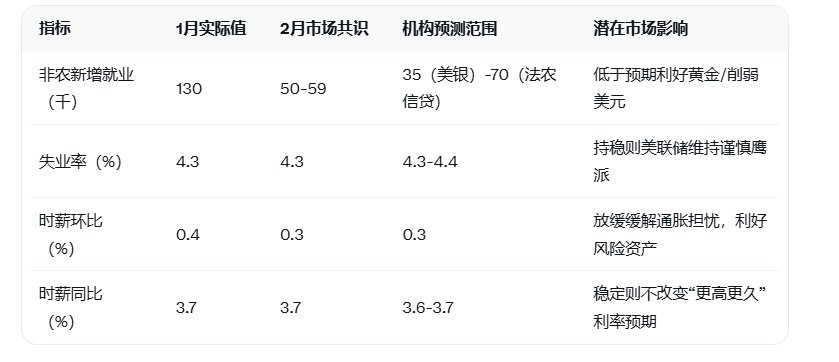
From a technical and macroeconomic perspective, February's data will test the narrative of labor market resilience. Following the Middle East conflict which pushed up oil prices, inflation expectations have rebounded somewhat. If non-farm payrolls are weaker than expected (<50,000), it will reignite bets on a Fed rate cut in March-June, putting pressure on the dollar index and potentially leading to a rebound in gold (XAU/USD). Conversely, better-than-expected data will reinforce the view that there is no immediate need for rate cuts, supporting the dollar and pressuring precious metals. Investors should also pay attention to the impact of benchmark revisions (2025 data may be revised downwards) and changes in participation rates.
Editor's Summary
February's non-farm payrolls are expected to slow significantly to around 50,000, while the ADP preliminary data, though showing signs of improvement, exhibits clear structural divergence. Stable unemployment and wages will likely maintain the Federal Reserve's cautious stance, and the data results could become a watershed moment for the short-term movements of the dollar and gold. Geopolitical and inflationary variables will continue to dominate volatility.
Frequently Asked Questions
Question 1: What is the consensus on the increase in non-farm payrolls in February?
Market consensus is around 50,000-59,000, far below the actual 130,000 in January. The ADP private sector figure has already reported +63,000, better than expected, but factors such as strikes may drag down official data. Weaker-than-expected figures will be beneficial to expectations of interest rate cuts.
Question 2: What are the projected unemployment rate and hourly wages?
The unemployment rate remained stable at 4.3%, while hourly wages rose 0.3% month-over-month and 3.7% year-over-year. This level maintains labor market stability without exacerbating inflation concerns, making it the "Goldilocks" scenario most desired by the Federal Reserve.
Question 3: What is the reference significance of ADP data for the official non-farm payrolls?
The ADP report for February, showing an increase of 63,000 jobs, indicates a hiring recovery, but its historical relevance is limited and should only be used as a leading indicator. The January ADP report was significantly revised downwards, and the market still primarily relies on the BLS report.
Question 4: What impact does the data have on the Federal Reserve's policy?
If the data is weaker than expected, the probability of a rate cut in March increases, and a weaker dollar would be beneficial for gold; if it exceeds expectations, it would reinforce the "higher and longer" interest rates, supporting the dollar and suppressing non-US assets. The market has already priced in 1-2 rate cuts this year.
Question 5: How should investors respond to this non-farm payrolls report?
Short-term focus on the 50,000 level: lower-than-expected levels are bullish for gold, higher-than-expected levels warrant reducing long positions in the US dollar. Long-term outlook, considering geopolitical risks and inflation data, suggests controlling position size and setting stop-loss orders to avoid significant volatility before and after data releases.
The ADP Private Sector Employment Report , a key leading indicator, was released on March 4th, showing an increase of 63,000 jobs in February, better than the market expectation of 50,000 and the largest increase since July last year, mainly driven by the construction, education, and healthcare sectors. This figure represents a significant improvement from the heavily revised 11,000 in January, indicating that while the labor market has not yet returned to the strong momentum expected in 2025, it has escaped its near-stagnation.
However, the correlation between ADP and official non-farm payrolls has historically been unstable, and the market still primarily relies on BLS data. While the latest forecasts from various institutions show little disagreement, they are generally cautious. Bank of America predicts only 35,000 unemployment due to strike factors; Citigroup expects 55,000, with the unemployment rate potentially rebounding slightly to 4.4%; Credit Agricole is the most optimistic, predicting 70,000. Goldman Sachs, while not providing precise figures, emphasizes that the resilience of employment will support a soft landing for the economy. The Chicago Fed's real-time model shows the February unemployment rate at approximately 4.27%, with the hiring rate rising slightly to 45.42%. Overall, current job growth is close to the "natural level" (approximately 50,000 per month) needed to maintain a stable unemployment rate, and no longer poses inflationary pressure.
To clearly compare key indicators, the following table summarizes January's actual figures, February's expected figures, and institutional forecasts:
From a technical and macroeconomic perspective, February's data will test the narrative of labor market resilience. Following the Middle East conflict which pushed up oil prices, inflation expectations have rebounded somewhat. If non-farm payrolls are weaker than expected (<50,000), it will reignite bets on a Fed rate cut in March-June, putting pressure on the dollar index and potentially leading to a rebound in gold (XAU/USD). Conversely, better-than-expected data will reinforce the view that there is no immediate need for rate cuts, supporting the dollar and pressuring precious metals. Investors should also pay attention to the impact of benchmark revisions (2025 data may be revised downwards) and changes in participation rates.
Editor's Summary
February's non-farm payrolls are expected to slow significantly to around 50,000, while the ADP preliminary data, though showing signs of improvement, exhibits clear structural divergence. Stable unemployment and wages will likely maintain the Federal Reserve's cautious stance, and the data results could become a watershed moment for the short-term movements of the dollar and gold. Geopolitical and inflationary variables will continue to dominate volatility.
Frequently Asked Questions
Question 1: What is the consensus on the increase in non-farm payrolls in February?
Market consensus is around 50,000-59,000, far below the actual 130,000 in January. The ADP private sector figure has already reported +63,000, better than expected, but factors such as strikes may drag down official data. Weaker-than-expected figures will be beneficial to expectations of interest rate cuts.
Question 2: What are the projected unemployment rate and hourly wages?
The unemployment rate remained stable at 4.3%, while hourly wages rose 0.3% month-over-month and 3.7% year-over-year. This level maintains labor market stability without exacerbating inflation concerns, making it the "Goldilocks" scenario most desired by the Federal Reserve.
Question 3: What is the reference significance of ADP data for the official non-farm payrolls?
The ADP report for February, showing an increase of 63,000 jobs, indicates a hiring recovery, but its historical relevance is limited and should only be used as a leading indicator. The January ADP report was significantly revised downwards, and the market still primarily relies on the BLS report.
Question 4: What impact does the data have on the Federal Reserve's policy?
If the data is weaker than expected, the probability of a rate cut in March increases, and a weaker dollar would be beneficial for gold; if it exceeds expectations, it would reinforce the "higher and longer" interest rates, supporting the dollar and suppressing non-US assets. The market has already priced in 1-2 rate cuts this year.
Question 5: How should investors respond to this non-farm payrolls report?
Short-term focus on the 50,000 level: lower-than-expected levels are bullish for gold, higher-than-expected levels warrant reducing long positions in the US dollar. Long-term outlook, considering geopolitical risks and inflation data, suggests controlling position size and setting stop-loss orders to avoid significant volatility before and after data releases.
- Risk Warning and Disclaimer
- The market involves risk, and trading may not be suitable for all investors. This article is for reference only and does not constitute personal investment advice, nor does it take into account certain users’ specific investment objectives, financial situation, or other needs. Any investment decisions made based on this information are at your own risk.