Is gold experiencing a "safe-haven failure"? Middle East conflict pushes up oil prices, ironically becoming a drag on gold prices.
2026-03-06 14:22:55
On Friday (March 6), spot gold rebounded from the previous trading day's lows during the Asian and European sessions, currently trading around $5,120 per ounce, with a daily gain of approximately 0.8%. The precious metals market saw a general corrective rebound, primarily driven by safe-haven demand. However, gold prices were under pressure this week due to escalating conflicts in the Middle East pushing up oil prices and triggering inflation concerns, and are poised to record their first weekly decline after five consecutive weeks of gains.
Gold prices have fallen more than 3% so far this week, primarily pressured by a strong dollar and market repricing of the Federal Reserve's monetary policy path. Traders are closely watching the upcoming US February non-farm payroll data to determine whether the Fed will further tighten policy due to persistent inflation.
Escalating geopolitical risks in the Middle East should have strengthened gold's safe-haven appeal, but rising inflation expectations driven by high oil prices have instead weakened the prospect of a Federal Reserve rate cut, becoming a major drag on gold prices. Brent crude oil surged this week, rising nearly 20%, as concerns about global energy supply intensified and the market worried that renewed inflation would force the Federal Reserve to maintain high interest rates or even consider raising them.
This "double whammy" of safe-haven demand and inflation is putting short-term pressure on gold. While geopolitical conflicts are generally beneficial to gold prices, when conflicts drive up energy costs and affect growth expectations, gold's safe-haven premium may be offset by inflation and rising real interest rates.
During Friday's Asian and European sessions, the US dollar index fluctuated narrowly around 99.05, remaining at a relatively high level. Overall, the US dollar index continued its strength this week, directly suppressing dollar-denominated gold.
Several Federal Reserve officials have recently adopted hawkish stances, suggesting that further interest rate hikes are possible if inflation continues to rise above the 2% target. Fed Chairman Powell previously emphasized "data dependence," and rising energy prices triggered by the Middle East conflict are providing new arguments for the hawks.
A stronger dollar makes gold more expensive for investors holding other currencies, suppressing demand. Conversely, if the dollar index falls, gold prices will receive significant support. Currently, market expectations for the number of Federal Reserve rate cuts in 2026 have decreased from 4-5 at the beginning of the year to 2-3, with some even making extreme bets of "rate cuts instead of cuts this year."
The joint US-Israeli strikes against Iran have entered their seventh day. On Thursday, Iran launched missiles and drones at several Gulf states, hitting an oil refinery in Bahrain and causing a fire; Israel continues its airstrikes on Tehran. The US has suspended operations at its embassy in Kuwait. President Trump stated that Iranian officials had attempted to contact him seeking a ceasefire agreement, but he refused, emphasizing that "it's too late now, the United States is doing everything it can to destroy Iran."
Iranian Foreign Minister Abbas Araghchi responded strongly, stating, "Tehran has never sought a ceasefire and has no intention of negotiating." The Iranian Islamic Revolutionary Guard Corps warned of escalating retaliatory strikes in the coming days. The conflict has spilled over to Bahrain, Kuwait, and other countries, and shipping in the Strait of Hormuz continues to be disrupted, fueling panic in global energy markets.
Trump reiterated his "zero tolerance" stance on Iran and announced that a temporary 15% global tariff would be introduced this week, replacing most of the tariffs previously rejected by the Supreme Court. US Treasury Secretary Bessenter stated that the tariff could be reinstated within five months to coincide with a new round of trade investigations.
Traders are also focused on the US February non-farm payrolls report, due at 21:30 on Friday. The market expects approximately 59,000 new jobs added (January's actual figure of 130,000 exceeded expectations); January retail sales are expected to decline by 0.3% month-on-month. Strong employment data may further reinforce hawkish expectations from the Federal Reserve, putting additional pressure on gold prices.
The daily chart shows that gold prices remain within an upward channel, testing short-term resistance at the nine-day exponential moving average (EMA) around $5,135. This moving average is flattening, indicating a slight weakening of short-term momentum, but prices remain above the rising 50-day EMA (4,879.12), and the overall bullish trend remains intact.
The Relative Strength Index (RSI) on the 14th is slightly above the midline, in a neutral to bullish range, and buying pressure remains.
On the upside, if the price breaks through the resistance at $5,135, it could potentially test the upper channel line at $5,480 and further challenge the all-time high of $5,596.33 set on January 29.
On the downside, the first support level is at the lower channel line at $5,080. If this level is breached, the key support level of the 50-day EMA will be exposed.
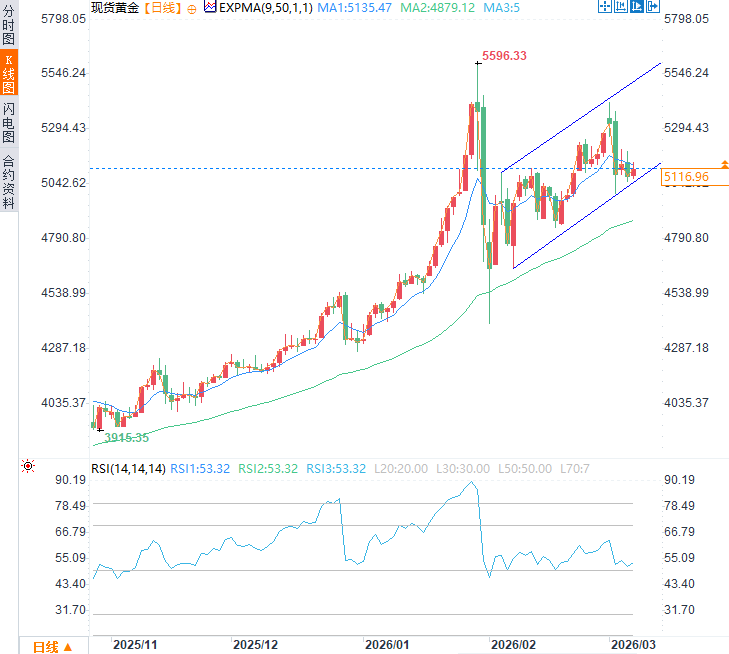
(Spot gold daily chart, source: FX678)
At 14:22 Beijing time, spot gold was trading at $5119.08 per ounce.
Gold prices have fallen more than 3% so far this week, primarily pressured by a strong dollar and market repricing of the Federal Reserve's monetary policy path. Traders are closely watching the upcoming US February non-farm payroll data to determine whether the Fed will further tighten policy due to persistent inflation.
Safe-haven demand supported gold, but this was offset by inflationary pressures from oil prices.
Escalating geopolitical risks in the Middle East should have strengthened gold's safe-haven appeal, but rising inflation expectations driven by high oil prices have instead weakened the prospect of a Federal Reserve rate cut, becoming a major drag on gold prices. Brent crude oil surged this week, rising nearly 20%, as concerns about global energy supply intensified and the market worried that renewed inflation would force the Federal Reserve to maintain high interest rates or even consider raising them.
This "double whammy" of safe-haven demand and inflation is putting short-term pressure on gold. While geopolitical conflicts are generally beneficial to gold prices, when conflicts drive up energy costs and affect growth expectations, gold's safe-haven premium may be offset by inflation and rising real interest rates.
A stronger dollar is putting pressure on gold prices, and the likelihood of a Federal Reserve rate hike is rising again.
During Friday's Asian and European sessions, the US dollar index fluctuated narrowly around 99.05, remaining at a relatively high level. Overall, the US dollar index continued its strength this week, directly suppressing dollar-denominated gold.
Several Federal Reserve officials have recently adopted hawkish stances, suggesting that further interest rate hikes are possible if inflation continues to rise above the 2% target. Fed Chairman Powell previously emphasized "data dependence," and rising energy prices triggered by the Middle East conflict are providing new arguments for the hawks.
A stronger dollar makes gold more expensive for investors holding other currencies, suppressing demand. Conversely, if the dollar index falls, gold prices will receive significant support. Currently, market expectations for the number of Federal Reserve rate cuts in 2026 have decreased from 4-5 at the beginning of the year to 2-3, with some even making extreme bets of "rate cuts instead of cuts this year."
The conflict between the US, Israel, and Iran entered its seventh day, with Iran launching a missile attack on a Bahrain oil refinery.
The joint US-Israeli strikes against Iran have entered their seventh day. On Thursday, Iran launched missiles and drones at several Gulf states, hitting an oil refinery in Bahrain and causing a fire; Israel continues its airstrikes on Tehran. The US has suspended operations at its embassy in Kuwait. President Trump stated that Iranian officials had attempted to contact him seeking a ceasefire agreement, but he refused, emphasizing that "it's too late now, the United States is doing everything it can to destroy Iran."
Iranian Foreign Minister Abbas Araghchi responded strongly, stating, "Tehran has never sought a ceasefire and has no intention of negotiating." The Iranian Islamic Revolutionary Guard Corps warned of escalating retaliatory strikes in the coming days. The conflict has spilled over to Bahrain, Kuwait, and other countries, and shipping in the Strait of Hormuz continues to be disrupted, fueling panic in global energy markets.
Trump says Iran's peace offer rejected, US to impose 15% global tariffs
Trump reiterated his "zero tolerance" stance on Iran and announced that a temporary 15% global tariff would be introduced this week, replacing most of the tariffs previously rejected by the Supreme Court. US Treasury Secretary Bessenter stated that the tariff could be reinstated within five months to coincide with a new round of trade investigations.
Traders are also focused on the US February non-farm payrolls report, due at 21:30 on Friday. The market expects approximately 59,000 new jobs added (January's actual figure of 130,000 exceeded expectations); January retail sales are expected to decline by 0.3% month-on-month. Strong employment data may further reinforce hawkish expectations from the Federal Reserve, putting additional pressure on gold prices.
Gold prices tested resistance at the nine-day moving average, with the upper channel line pointing towards $5480.
The daily chart shows that gold prices remain within an upward channel, testing short-term resistance at the nine-day exponential moving average (EMA) around $5,135. This moving average is flattening, indicating a slight weakening of short-term momentum, but prices remain above the rising 50-day EMA (4,879.12), and the overall bullish trend remains intact.
The Relative Strength Index (RSI) on the 14th is slightly above the midline, in a neutral to bullish range, and buying pressure remains.
On the upside, if the price breaks through the resistance at $5,135, it could potentially test the upper channel line at $5,480 and further challenge the all-time high of $5,596.33 set on January 29.
On the downside, the first support level is at the lower channel line at $5,080. If this level is breached, the key support level of the 50-day EMA will be exposed.
(Spot gold daily chart, source: FX678)
At 14:22 Beijing time, spot gold was trading at $5119.08 per ounce.
- Risk Warning and Disclaimer
- The market involves risk, and trading may not be suitable for all investors. This article is for reference only and does not constitute personal investment advice, nor does it take into account certain users’ specific investment objectives, financial situation, or other needs. Any investment decisions made based on this information are at your own risk.