Can Japan's 254-day oil arsenal save the yen from its downward spiral?
2026-03-06 19:33:15
On Friday, March 6, the US dollar traded around 157.85 against the Japanese yen during the European session, while Brent crude futures prices had risen above $87 per barrel. This market movement is intertwined with the escalating conflict in the Middle East and a 70% drop in shipping traffic through the Strait of Hormuz. Japanese refiners are urging the government to consider releasing national oil reserves to mitigate the risk of physical supply disruptions. While this motion has not been immediately approved, it has already sparked in-depth discussions in the market regarding energy security, the transmission path of the yen's exchange rate, and the global oil market's supply and demand balance.
As a major global oil importer, Japan sources over 90% of its crude oil from the Middle East, almost all of which is transported through the Strait of Hormuz. The strait is currently experiencing operational disruptions, with several shipping companies suspending passage, leading to a significant decrease in feedstock arrivals at Japanese refineries. This physical shortage has transcended simple price fluctuations, accelerating inventory depletion and putting pressure on production adjustments. Japanese Prime Minister Sanae Takaichi recently emphasized in parliament that all necessary measures will be taken to ensure a stable energy supply, highlighting a high level of vigilance regarding the vulnerability of the supply chain. Driven by the conflict, oil prices have risen rapidly, with the increase per barrel exceeding the average level of the past month, further amplifying the negative impact of import costs on the trade balance. As a net importer, high oil prices directly increase production costs for businesses and affect consumer and investment confidence through inflation.
Japan's strategic petroleum reserves total 254 days of consumption, with 146 days in national reserves and over 100 days in private sector stocks. This buffer far exceeds the International Energy Agency's (IEA) minimum requirement of 90 days of net imports, providing substantial room for short-term supply disruptions. The core objective of the proposed release is to ensure energy security, not simply to suppress prices, but the legal boundaries are somewhat ambiguous: unilateral action, while not requiring external permission, may conflict with the IEA's collective coordination practices. Minister of Economy, Trade and Industry Ryomaki Akazawa has clearly stated that there are currently no immediate plans for release, but calls from refiners have brought the issue to the forefront. If implemented, the release would prioritize alleviating the actual shortage at domestic refineries and preventing uncontrolled price transmission.
This structure ensures a multi-layered buffer, allowing for phased release operations, but must strictly adhere to a balance between domestic energy laws and international obligations.
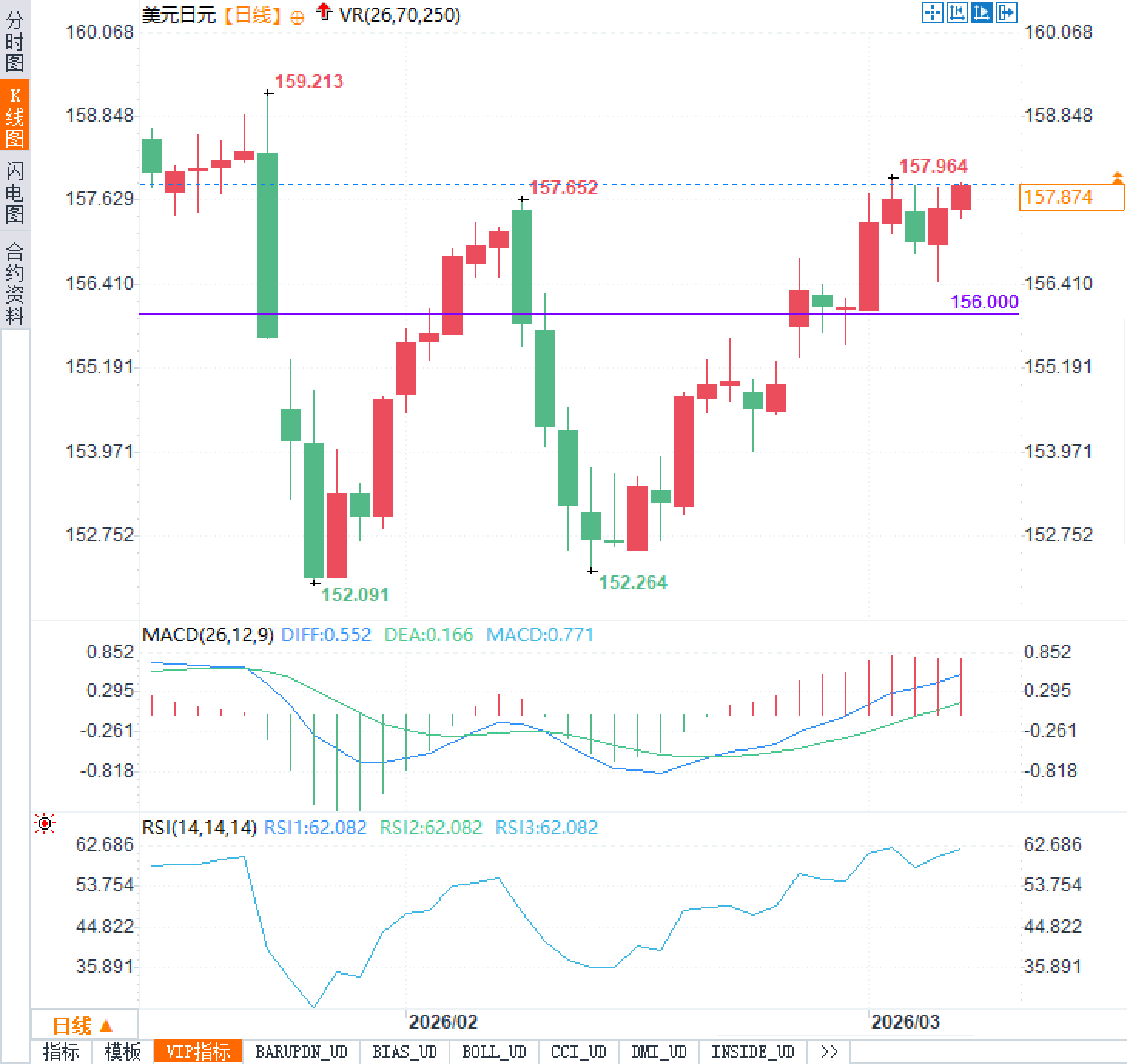
Releasing reserves is expected to increase effective market supply and alleviate the pressure on Japan's import bills. Current oil prices have rebounded significantly from their February lows. If the reserves are released, the supply-demand gap can be adjusted through actual delivery volumes, indirectly stabilizing corporate costs. Bank of Japan Governor Kazuo Ueda recently pointed out that he will closely monitor the impact of the Middle East conflict and rising oil prices on the Japanese economy. Improved trade balance will boost the yen's fundamentals: As a major energy importer, falling oil prices can reduce the current account deficit and enhance the resilience of the exchange rate. The current USD/JPY daily chart shows that the price is under pressure around 158, with a high of 159.213. The RSI (14) is in the 62.08 range, and the MACD indicator is showing a positive alignment, reflecting that the market's pricing of risk events is still dynamically adjusting. However, if the release measures trigger coordination pressure from the International Energy Agency, it may also bring short-term uncertainty and amplify the fluctuation range of the exchange rate.
The International Energy Agency (IEA) urges member countries to prioritize collective action during global crises to avoid unilateral releases that could disrupt market expectations. While Japan possesses independent decision-making space, it must weigh the risks of a "bad situation": premature unilateral action could weaken the effectiveness of multilateral mechanisms and affect the coordination efficiency of future joint interventions. Historical experience shows that coordinated releases are generally more effective at stabilizing price fluctuations, while unilateral actions, although able to quickly address domestic shortages, may provoke skepticism from allies. The Japanese government is currently adopting a cautious approach, retaining the option of releases while emphasizing communication with international partners, aiming to maximize energy security benefits while minimizing geopolitical costs. This strategic maneuvering directly impacts the long-term stability of the yen's exchange rate.
The direct impact of the Middle East conflict on Japan's energy supply chain
As a major global oil importer, Japan sources over 90% of its crude oil from the Middle East, almost all of which is transported through the Strait of Hormuz. The strait is currently experiencing operational disruptions, with several shipping companies suspending passage, leading to a significant decrease in feedstock arrivals at Japanese refineries. This physical shortage has transcended simple price fluctuations, accelerating inventory depletion and putting pressure on production adjustments. Japanese Prime Minister Sanae Takaichi recently emphasized in parliament that all necessary measures will be taken to ensure a stable energy supply, highlighting a high level of vigilance regarding the vulnerability of the supply chain. Driven by the conflict, oil prices have risen rapidly, with the increase per barrel exceeding the average level of the past month, further amplifying the negative impact of import costs on the trade balance. As a net importer, high oil prices directly increase production costs for businesses and affect consumer and investment confidence through inflation.
The size and feasibility of Japan's oil reserve system
Japan's strategic petroleum reserves total 254 days of consumption, with 146 days in national reserves and over 100 days in private sector stocks. This buffer far exceeds the International Energy Agency's (IEA) minimum requirement of 90 days of net imports, providing substantial room for short-term supply disruptions. The core objective of the proposed release is to ensure energy security, not simply to suppress prices, but the legal boundaries are somewhat ambiguous: unilateral action, while not requiring external permission, may conflict with the IEA's collective coordination practices. Minister of Economy, Trade and Industry Ryomaki Akazawa has clearly stated that there are currently no immediate plans for release, but calls from refiners have brought the issue to the forefront. If implemented, the release would prioritize alleviating the actual shortage at domestic refineries and preventing uncontrolled price transmission.
| Reserve Category | Reserve days |
|---|---|
| National Reserves | 146 days |
| Private sector inventory | More than 100 days |
| total | 254 days |
The potential impact of reserve releases on oil price transmission and the USD/JPY exchange rate.
Releasing reserves is expected to increase effective market supply and alleviate the pressure on Japan's import bills. Current oil prices have rebounded significantly from their February lows. If the reserves are released, the supply-demand gap can be adjusted through actual delivery volumes, indirectly stabilizing corporate costs. Bank of Japan Governor Kazuo Ueda recently pointed out that he will closely monitor the impact of the Middle East conflict and rising oil prices on the Japanese economy. Improved trade balance will boost the yen's fundamentals: As a major energy importer, falling oil prices can reduce the current account deficit and enhance the resilience of the exchange rate. The current USD/JPY daily chart shows that the price is under pressure around 158, with a high of 159.213. The RSI (14) is in the 62.08 range, and the MACD indicator is showing a positive alignment, reflecting that the market's pricing of risk events is still dynamically adjusting. However, if the release measures trigger coordination pressure from the International Energy Agency, it may also bring short-term uncertainty and amplify the fluctuation range of the exchange rate.
Policy game under the International Energy Agency coordination mechanism
The International Energy Agency (IEA) urges member countries to prioritize collective action during global crises to avoid unilateral releases that could disrupt market expectations. While Japan possesses independent decision-making space, it must weigh the risks of a "bad situation": premature unilateral action could weaken the effectiveness of multilateral mechanisms and affect the coordination efficiency of future joint interventions. Historical experience shows that coordinated releases are generally more effective at stabilizing price fluctuations, while unilateral actions, although able to quickly address domestic shortages, may provoke skepticism from allies. The Japanese government is currently adopting a cautious approach, retaining the option of releases while emphasizing communication with international partners, aiming to maximize energy security benefits while minimizing geopolitical costs. This strategic maneuvering directly impacts the long-term stability of the yen's exchange rate.
Frequently Asked Questions
Question 1: Why is Japan considering releasing its oil reserves unilaterally, rather than waiting for collective action from the International Energy Agency?
A: Japanese refineries are facing physical shortages, with 254 days of reserves providing a buffer window. However, the obstruction of the Strait of Hormuz has caused delays in deliveries. Acting independently can quickly stabilize domestic supply and avoid the risk of production shutdowns. Although the International Energy Agency favors a collective response, Japanese domestic law allows for independent decision-making, prioritizing national energy security.
Question 2: Can releasing reserves effectively curb the current oil price of $87 per barrel?
A: Releasing the reserves can increase market supply and alleviate panic premiums in the short term, but the effect depends on the scale and duration of the release. Combined with Japan's 146-day national reserves, a moderate release can help smooth the transmission of import costs, but it is unlikely to completely reverse the supply-demand imbalance driven by geopolitical conflicts.
Question 3: What are the medium- to long-term implications of this move for the USD/JPY exchange rate?
A: A decline in oil prices would improve the trade balance and support the yen's fundamentals, but short-term volatility may be amplified by policy uncertainty. The current exchange rate level of 157.85 already reflects risk pricing; if this risk is mitigated, it could reduce the pressure of high oil prices on the yen's depreciation.
- Risk Warning and Disclaimer
- The market involves risk, and trading may not be suitable for all investors. This article is for reference only and does not constitute personal investment advice, nor does it take into account certain users’ specific investment objectives, financial situation, or other needs. Any investment decisions made based on this information are at your own risk.