Gold and crude oil show rare divergence; when will the king of safe havens return?
2026-03-06 20:27:05
A comparison reveals that the impact of this conflict on oil prices is strikingly similar to that of the Russia-Ukraine conflict in March 2022. Both instances saw escalating tensions, with oil prices rising while gold prices remained stagnant. Why is this?
Meanwhile, Iran has recently become a hot topic, with geopolitics overshadowing data and central banks. But does this mean that central banks have become less important recently?
Gold failed to rise in tandem with the escalating geopolitical conflict between the US and Iran. The core logic behind this was not simply profit-taking, but rather a replication of the underlying transmission chain seen during the 2022 Russia-Ukraine conflict: soaring oil prices pushed up supply-side inflation expectations, which in turn forced market benchmark interest rates to rise, ultimately suppressing the safe-haven premium of gold, a non-interest-bearing asset.
In March 2022, the United States began its interest rate hike cycle (raising the rate from 0.25% to 0.5%), coupled with oil prices breaking through $100 per barrel. The yield on the 10-year US Treasury bond soared from 2.2% to 3.5%, and gold subsequently fell from $2,000 per ounce to $1,700 per ounce, confirming the decisive impact of "inflation-interest rate" on gold.
The current oil price surge triggered by the US-Iran conflict is working through the same transmission path, and the support for gold from geopolitical risk aversion cannot offset the negative impact of rising interest rates.
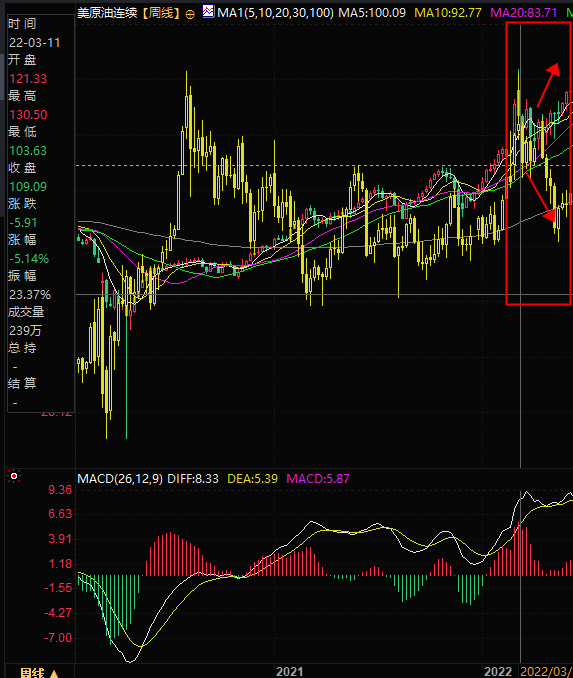
(Crude oil and gold weekly chart)
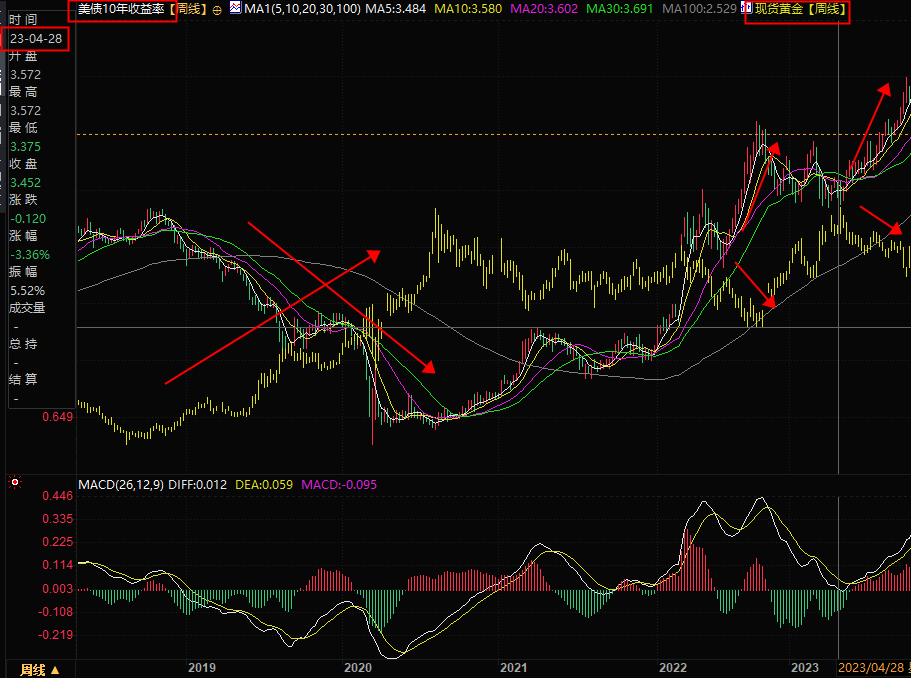
(US 10-year Treasury yield overlaid with weekly gold chart)
The impact of the US-Iran conflict on the crude oil market has become fully apparent, with rigid supply shortages becoming the core engine of rising oil prices.
The risk of supply disruptions has increased: Qatar’s core LNG production facility, Ras Lafan, has been shut down after being attacked by Iranian drones. Qatar and the UAE together account for one-fifth of the world’s LNG supply, and the recovery period will take “weeks to months”.
Qatari Energy Minister Saad al-Kabi warned that if the conflict escalates, Gulf energy-producing countries may collectively invoke force majeure clauses to suspend energy supplies, and in extreme cases, oil prices could soar to $150 per barrel.
Shipping and facility risks: Disruptions to shipping through the Strait of Hormuz have affected approximately one-fifth of global seaborne oil shipments. Coupled with repeated Iranian attacks on energy facilities in the Gulf region, which forced several refineries to shut down, this has further tightened the global supply of refined petroleum products.
Inflation expectation transmission: Concerns about supply-side inflation triggered by rising oil prices have intensified rapidly, and traders have significantly lowered their expectations for dovish policies from major central banks around the world, further compressing the room for monetary policy easing.
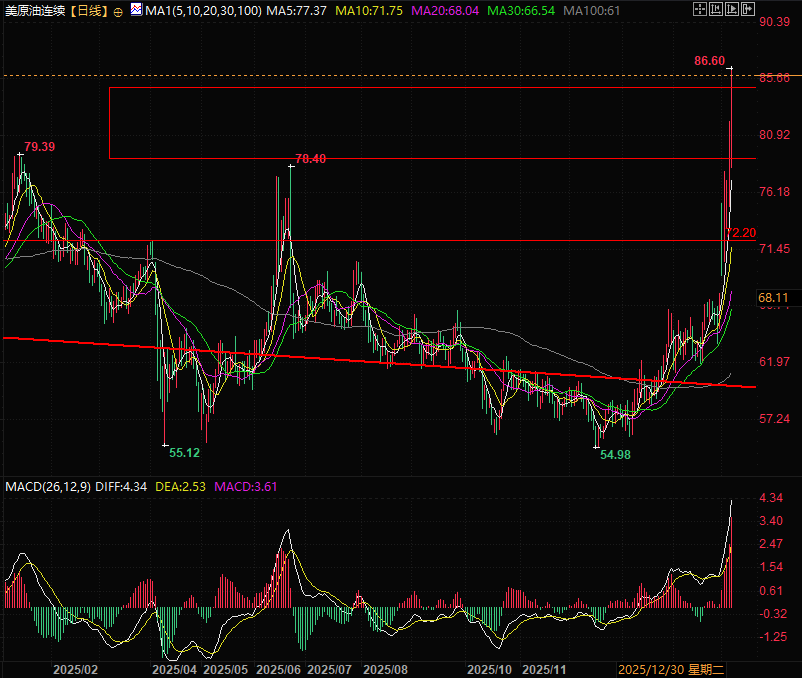
(US crude oil daily chart)
Despite the ongoing escalation of the US-Iran conflict into its seventh day, gold has failed to see a significant rise, remaining caught in a tug-of-war between limited safe-haven support and dominant interest rate pressures.
The core constraint on interest rate expectations is inflationary expectations driven by rising oil prices, which directly limits the Federal Reserve's room for interest rate cuts. Data from the interest rate futures market shows that the probability of a 25 basis point rate cut in March has fallen from 42% before the non-farm payroll data release to 28%, and the probability of a cumulative 50 basis point rate cut in June has dropped from 78% to 61%.
The Federal Reserve is currently maintaining the federal funds rate in the range of 3.50%-3.75%, and officials have repeatedly signaled a hawkish stance, stating that "if inflation continues to exceed the 2% target, a rate hike cannot be ruled out," further reinforcing expectations of rising interest rates and increasing the cost of holding gold.
The inverse trend between gold and crude oil is essentially a result of the "interest rate pricing logic" suppressing the "geopolitical safe-haven logic." Central bank policies have never been marginalized by geopolitical conflicts; on the contrary, they have become a key variable driving asset price movements.
Commonalities between 2022 and the present: Both conflicts led to a surge in oil prices, but gold did not rise in tandem. The core reason is that the inflationary expectations triggered by rising oil prices forced central banks to maintain hawkish monetary policies.
In 2022, the Federal Reserve began a rate hike cycle. Currently, the Fed is pausing rate cuts and retaining the option to raise rates. Both of these actions reduce the attractiveness of gold by pushing up market benchmark interest rates. As a non-interest-bearing asset, the opportunity cost of gold increases significantly during a rising interest rate cycle.
The key role of central bank policy: Although recent geopolitical issues related to Iran have become a hot topic in the market, central bank policy remains the core pricing variable.
Federal Reserve Chairman Jerome Powell made it clear that inflation remains high and the Fed has not yet decided on the timing or pace of further easing. Policy easing may only occur if tariff inflation peaks and then declines.
The IMF predicts that the US inflation rate will not fall back to the 2% target until early 2027, meaning that the central bank's hawkish stance may continue, and the downward pressure on gold will persist for a long time.
The combined impact of data and policy: Non-farm payroll data is expected to show that the US will add 59,000 jobs in February, with the unemployment rate remaining at 4.3%. If the labor market ultimately shows a pattern of "weak growth + stable unemployment", it will further strengthen the expectation that the Federal Reserve will "pause interest rate cuts".
Furthermore, the US's implementation of a temporary 15% global tariff this week may further push up inflation through trade channels, indirectly increasing pressure on gold.
Gold failed to rise significantly despite the escalating US-Iran conflict. The core reason was not profit-taking, but rather the dominant role played by the closed loop of transmission: "rising oil prices → rising inflation → rising interest rates." This logic is highly consistent with that of the Russia-Ukraine conflict in 2022.
Geopolitics can only provide safe-haven support for gold, but it cannot offset the negative impact of rising interest rates. Central bank policies remain the core pricing variable and have not been overshadowed by geopolitical conflicts.
Looking ahead, gold will remain caught in a battle between "safe-haven support" and "interest rate suppression": if rising oil prices drive inflation higher than expected and the Fed's hawkish stance strengthens, gold may test support again. If the conflict eases or inflation data falls short of expectations and interest rate cut expectations rise, gold will gain upward momentum.
For traders, it is necessary to focus on the US CPI data on March 12, speeches by Federal Reserve officials, and developments in the Middle East conflict. In a volatile market, it is important to grasp the marginal changes in interest rate expectations and geopolitical risks, avoid the misconception of "geopolitical risk aversion dominating", and adhere to the core trading logic of "inflation-interest rate".
From a technical perspective, spot gold has recently failed to close above the key price level of 5123, and has been trading below the 5-day moving average for three consecutive days, indicating a weakening trend. In the future, gold may only regain its status as the king of safe-haven assets if the rise in oil prices weakens and the war continues to spread.
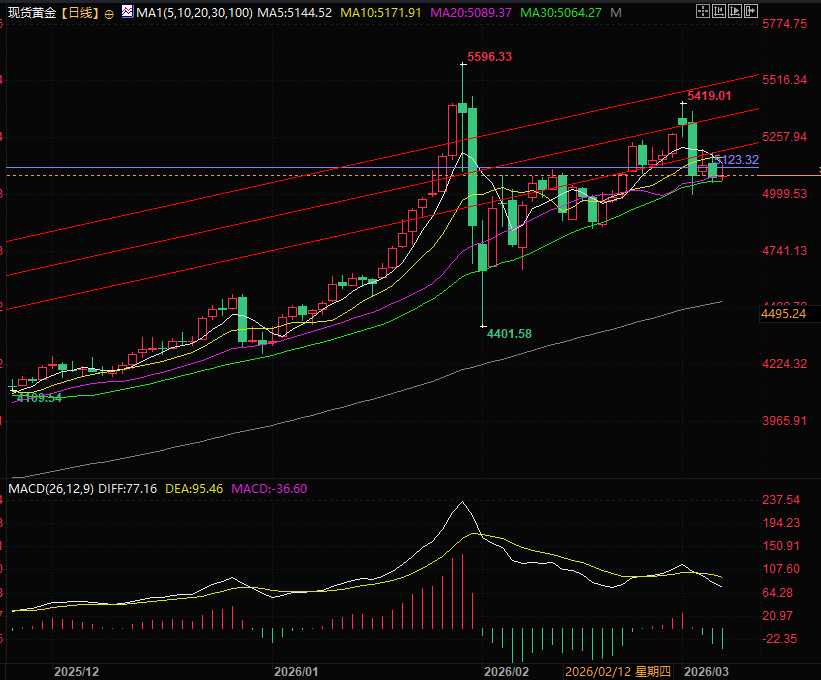
(Spot gold daily chart, source: FX678)
At 20:18 Beijing time, spot gold was trading at $5,090 per ounce, and US crude oil futures were trading at $85.69 per barrel.
Meanwhile, Iran has recently become a hot topic, with geopolitics overshadowing data and central banks. But does this mean that central banks have become less important recently?
Historically, gold prices have been significantly suppressed when oil prices are high.
Gold failed to rise in tandem with the escalating geopolitical conflict between the US and Iran. The core logic behind this was not simply profit-taking, but rather a replication of the underlying transmission chain seen during the 2022 Russia-Ukraine conflict: soaring oil prices pushed up supply-side inflation expectations, which in turn forced market benchmark interest rates to rise, ultimately suppressing the safe-haven premium of gold, a non-interest-bearing asset.
In March 2022, the United States began its interest rate hike cycle (raising the rate from 0.25% to 0.5%), coupled with oil prices breaking through $100 per barrel. The yield on the 10-year US Treasury bond soared from 2.2% to 3.5%, and gold subsequently fell from $2,000 per ounce to $1,700 per ounce, confirming the decisive impact of "inflation-interest rate" on gold.
The current oil price surge triggered by the US-Iran conflict is working through the same transmission path, and the support for gold from geopolitical risk aversion cannot offset the negative impact of rising interest rates.
(Crude oil and gold weekly chart)
(US 10-year Treasury yield overlaid with weekly gold chart)
Crude oil: Geopolitical conflicts drive supply shortages, oil prices begin a strong upward trend
The impact of the US-Iran conflict on the crude oil market has become fully apparent, with rigid supply shortages becoming the core engine of rising oil prices.
The risk of supply disruptions has increased: Qatar’s core LNG production facility, Ras Lafan, has been shut down after being attacked by Iranian drones. Qatar and the UAE together account for one-fifth of the world’s LNG supply, and the recovery period will take “weeks to months”.
Qatari Energy Minister Saad al-Kabi warned that if the conflict escalates, Gulf energy-producing countries may collectively invoke force majeure clauses to suspend energy supplies, and in extreme cases, oil prices could soar to $150 per barrel.
Shipping and facility risks: Disruptions to shipping through the Strait of Hormuz have affected approximately one-fifth of global seaborne oil shipments. Coupled with repeated Iranian attacks on energy facilities in the Gulf region, which forced several refineries to shut down, this has further tightened the global supply of refined petroleum products.
Inflation expectation transmission: Concerns about supply-side inflation triggered by rising oil prices have intensified rapidly, and traders have significantly lowered their expectations for dovish policies from major central banks around the world, further compressing the room for monetary policy easing.
(US crude oil daily chart)
Gold: A tug-of-war between safe-haven support and interest rate suppression continues, with the range-bound pattern persisting.
Despite the ongoing escalation of the US-Iran conflict into its seventh day, gold has failed to see a significant rise, remaining caught in a tug-of-war between limited safe-haven support and dominant interest rate pressures.
The core constraint on interest rate expectations is inflationary expectations driven by rising oil prices, which directly limits the Federal Reserve's room for interest rate cuts. Data from the interest rate futures market shows that the probability of a 25 basis point rate cut in March has fallen from 42% before the non-farm payroll data release to 28%, and the probability of a cumulative 50 basis point rate cut in June has dropped from 78% to 61%.
The Federal Reserve is currently maintaining the federal funds rate in the range of 3.50%-3.75%, and officials have repeatedly signaled a hawkish stance, stating that "if inflation continues to exceed the 2% target, a rate hike cannot be ruled out," further reinforcing expectations of rising interest rates and increasing the cost of holding gold.
The essence of the opposite trend: interest rate logic transcends geopolitics, and central bank policy remains the core.
The inverse trend between gold and crude oil is essentially a result of the "interest rate pricing logic" suppressing the "geopolitical safe-haven logic." Central bank policies have never been marginalized by geopolitical conflicts; on the contrary, they have become a key variable driving asset price movements.
Commonalities between 2022 and the present: Both conflicts led to a surge in oil prices, but gold did not rise in tandem. The core reason is that the inflationary expectations triggered by rising oil prices forced central banks to maintain hawkish monetary policies.
In 2022, the Federal Reserve began a rate hike cycle. Currently, the Fed is pausing rate cuts and retaining the option to raise rates. Both of these actions reduce the attractiveness of gold by pushing up market benchmark interest rates. As a non-interest-bearing asset, the opportunity cost of gold increases significantly during a rising interest rate cycle.
The key role of central bank policy: Although recent geopolitical issues related to Iran have become a hot topic in the market, central bank policy remains the core pricing variable.
Federal Reserve Chairman Jerome Powell made it clear that inflation remains high and the Fed has not yet decided on the timing or pace of further easing. Policy easing may only occur if tariff inflation peaks and then declines.
The IMF predicts that the US inflation rate will not fall back to the 2% target until early 2027, meaning that the central bank's hawkish stance may continue, and the downward pressure on gold will persist for a long time.
The combined impact of data and policy: Non-farm payroll data is expected to show that the US will add 59,000 jobs in February, with the unemployment rate remaining at 4.3%. If the labor market ultimately shows a pattern of "weak growth + stable unemployment", it will further strengthen the expectation that the Federal Reserve will "pause interest rate cuts".
Furthermore, the US's implementation of a temporary 15% global tariff this week may further push up inflation through trade channels, indirectly increasing pressure on gold.
Summary: The underlying logic behind gold's stagnation and future prospects
Gold failed to rise significantly despite the escalating US-Iran conflict. The core reason was not profit-taking, but rather the dominant role played by the closed loop of transmission: "rising oil prices → rising inflation → rising interest rates." This logic is highly consistent with that of the Russia-Ukraine conflict in 2022.
Geopolitics can only provide safe-haven support for gold, but it cannot offset the negative impact of rising interest rates. Central bank policies remain the core pricing variable and have not been overshadowed by geopolitical conflicts.
Looking ahead, gold will remain caught in a battle between "safe-haven support" and "interest rate suppression": if rising oil prices drive inflation higher than expected and the Fed's hawkish stance strengthens, gold may test support again. If the conflict eases or inflation data falls short of expectations and interest rate cut expectations rise, gold will gain upward momentum.
For traders, it is necessary to focus on the US CPI data on March 12, speeches by Federal Reserve officials, and developments in the Middle East conflict. In a volatile market, it is important to grasp the marginal changes in interest rate expectations and geopolitical risks, avoid the misconception of "geopolitical risk aversion dominating", and adhere to the core trading logic of "inflation-interest rate".
From a technical perspective, spot gold has recently failed to close above the key price level of 5123, and has been trading below the 5-day moving average for three consecutive days, indicating a weakening trend. In the future, gold may only regain its status as the king of safe-haven assets if the rise in oil prices weakens and the war continues to spread.
(Spot gold daily chart, source: FX678)
At 20:18 Beijing time, spot gold was trading at $5,090 per ounce, and US crude oil futures were trading at $85.69 per barrel.
- Risk Warning and Disclaimer
- The market involves risk, and trading may not be suitable for all investors. This article is for reference only and does not constitute personal investment advice, nor does it take into account certain users’ specific investment objectives, financial situation, or other needs. Any investment decisions made based on this information are at your own risk.