Renewed inflation concerns sent gold prices down to $5,065 as the market focuses on this week's US CPI data.
2026-03-09 09:54:06
International gold prices retreated during Monday's Asian trading session. Spot gold (XAU/USD) fell to around $5065, mainly due to a stronger dollar and rising inflation concerns. The rapid rise in oil prices has fueled market worries that energy costs will push up inflation again, thus reducing market expectations for interest rate cuts.
For gold, changes in interest rate expectations are often a significant factor influencing its price. Since gold itself does not generate interest income, its attractiveness typically decreases in an environment of persistently high interest rates. Soaring oil prices have reinforced inflation expectations; the recent sharp rise in the oil market has become one of the important factors suppressing gold prices.

International oil prices surged due to escalating tensions in the Middle East, raising concerns that rising energy costs will further fuel global inflation. Increased energy prices often have a ripple effect across multiple sectors, including rising transportation costs, increased manufacturing costs, and higher consumer prices . These factors may force central banks to maintain higher interest rates for an extended period, thus putting short-term pressure on gold.
The market widely expects the Federal Reserve to maintain interest rates at its March 17-18 policy meeting, with most economists anticipating that the Fed will not begin its next round of rate cuts until mid-2026. This expectation of prolonged high interest rates is putting downward pressure on gold prices in the short term.
Federal Reserve officials downplayed the potential impact of oil price shocks on rising oil prices, adopting a relatively cautious stance. Fed Governor Waller stated that he believes the recent rise in oil prices is more of a "short-term event" and may not necessarily require a monetary policy response.
"The rise in oil prices is more of a one-off shock, but uncertainty remains if the conflict continues and pushes oil prices even higher." This statement implies that the Federal Reserve is still observing whether rising energy prices will continue to affect overall inflation.
While a stronger dollar put pressure on gold, the latest US employment data provided some support for gold prices. The latest US non-farm payroll report showed that non-farm payrolls decreased by 92,000 in February . The unemployment rate rose to 4.4% from 4.3%. This cooling job market may weaken the dollar, thus providing some support for dollar-denominated gold prices.
This week's market focus : The most anticipated economic data this week will be the US Consumer Price Index (CPI) report. The market will be closely watching the upcoming US CPI data. If the inflation data is higher than expected, the market may further postpone expectations of interest rate cuts, thus putting pressure on gold. Conversely, if inflation shows a significant decline, it could boost gold demand again.
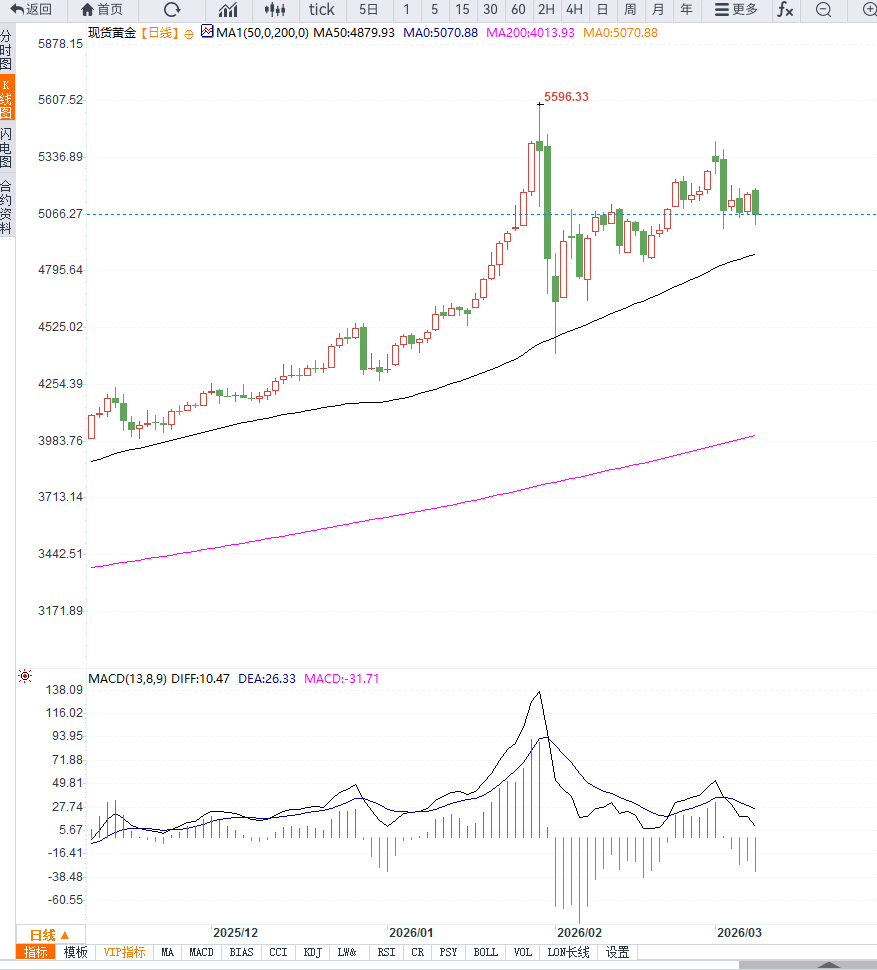
From a technical perspective, gold prices have shown signs of consolidation after recent gains. The daily chart shows that gold prices previously tested historical highs but have experienced a short-term technical pullback. Key technical levels: First support: $5000, Second support: $4950. Resistance: $5100, Strong resistance: $5200.
The 4-hour chart shows that short-term momentum has weakened, and the RSI indicator has fallen back from the overbought zone, suggesting that the market may be entering a period of consolidation. If gold prices can hold the $5,000 level, the medium-term upward trend is likely to continue.
Editor's Summary:
The gold market is currently in a phase of intertwined factors. On the one hand, escalating tensions in the Middle East and global risk aversion continue to provide safe-haven demand for gold; on the other hand, inflation concerns triggered by rising oil prices may force the Federal Reserve to maintain high interest rates for a longer period, thus putting downward pressure on gold. In the short term, US CPI data and developments in the Middle East will be key variables determining the next move in gold prices. In a highly volatile environment, the gold market is likely to continue its oscillating pattern.
For gold, changes in interest rate expectations are often a significant factor influencing its price. Since gold itself does not generate interest income, its attractiveness typically decreases in an environment of persistently high interest rates. Soaring oil prices have reinforced inflation expectations; the recent sharp rise in the oil market has become one of the important factors suppressing gold prices.
International oil prices surged due to escalating tensions in the Middle East, raising concerns that rising energy costs will further fuel global inflation. Increased energy prices often have a ripple effect across multiple sectors, including rising transportation costs, increased manufacturing costs, and higher consumer prices . These factors may force central banks to maintain higher interest rates for an extended period, thus putting short-term pressure on gold.
The market widely expects the Federal Reserve to maintain interest rates at its March 17-18 policy meeting, with most economists anticipating that the Fed will not begin its next round of rate cuts until mid-2026. This expectation of prolonged high interest rates is putting downward pressure on gold prices in the short term.
Federal Reserve officials downplayed the potential impact of oil price shocks on rising oil prices, adopting a relatively cautious stance. Fed Governor Waller stated that he believes the recent rise in oil prices is more of a "short-term event" and may not necessarily require a monetary policy response.
"The rise in oil prices is more of a one-off shock, but uncertainty remains if the conflict continues and pushes oil prices even higher." This statement implies that the Federal Reserve is still observing whether rising energy prices will continue to affect overall inflation.
While a stronger dollar put pressure on gold, the latest US employment data provided some support for gold prices. The latest US non-farm payroll report showed that non-farm payrolls decreased by 92,000 in February . The unemployment rate rose to 4.4% from 4.3%. This cooling job market may weaken the dollar, thus providing some support for dollar-denominated gold prices.
This week's market focus : The most anticipated economic data this week will be the US Consumer Price Index (CPI) report. The market will be closely watching the upcoming US CPI data. If the inflation data is higher than expected, the market may further postpone expectations of interest rate cuts, thus putting pressure on gold. Conversely, if inflation shows a significant decline, it could boost gold demand again.
From a technical perspective, gold prices have shown signs of consolidation after recent gains. The daily chart shows that gold prices previously tested historical highs but have experienced a short-term technical pullback. Key technical levels: First support: $5000, Second support: $4950. Resistance: $5100, Strong resistance: $5200.
The 4-hour chart shows that short-term momentum has weakened, and the RSI indicator has fallen back from the overbought zone, suggesting that the market may be entering a period of consolidation. If gold prices can hold the $5,000 level, the medium-term upward trend is likely to continue.
Editor's Summary:
The gold market is currently in a phase of intertwined factors. On the one hand, escalating tensions in the Middle East and global risk aversion continue to provide safe-haven demand for gold; on the other hand, inflation concerns triggered by rising oil prices may force the Federal Reserve to maintain high interest rates for a longer period, thus putting downward pressure on gold. In the short term, US CPI data and developments in the Middle East will be key variables determining the next move in gold prices. In a highly volatile environment, the gold market is likely to continue its oscillating pattern.
- Risk Warning and Disclaimer
- The market involves risk, and trading may not be suitable for all investors. This article is for reference only and does not constitute personal investment advice, nor does it take into account certain users’ specific investment objectives, financial situation, or other needs. Any investment decisions made based on this information are at your own risk.