The Euro's Dilemma Amid Middle East Conflicts: Why Interest Rate Hikes Fail to Reverse the Decline
2026-03-09 19:15:20
On Monday (March 9), the foreign exchange market experienced significant volatility again during the European trading session amid escalating tensions in the Middle East. What initially seemed like a regional conflict far removed from Europe is gradually becoming a crucial external variable influencing the euro's trajectory. As tensions between the United States, Israel, and Iran continue to escalate, Europe has become an "unexpected victim" of this geopolitical shock, putting significant pressure on the euro against the US dollar.
The market had previously believed that the European Central Bank (ECB) might keep interest rates unchanged this year, but with rising energy prices and potential inflation risks, investors have begun to reassess the path of monetary policy. Currently, market expectations for two ECB rate hikes this year have clearly intensified, with some institutions even predicting that the deposit rate could rise from the current 2% to 2.25%, and potentially even reach 2.5% if inflationary pressures further increase. However, despite the strengthened expectations of rate hikes, this change has failed to provide significant support for the euro. The logic of the foreign exchange market is being dominated by geopolitical risks, with traditional interest rate carry trades temporarily taking a backseat.
In stark contrast to the euro, the US dollar has performed strongly. The dollar index surged this week, reaching its highest level in nearly a year. As uncertainty surrounding the Middle East conflict increases, global capital is turning back to dollar assets for safe-haven protection. Changes in Iran's domestic political situation have further exacerbated market anxiety, with investors fearing potential spillover effects from the regional conflict, leading to continued inflows into traditional safe-haven assets such as the dollar and US Treasury bonds.
The rapid rise in energy prices is also reshaping the global economic landscape. Historical experience shows that soaring oil prices often impact economic growth. The 1973 oil crisis, the energy shock of the early 1980s, the 1990 Gulf War, and the lead-up to the 2008 financial crisis all showed a clear correlation between soaring oil prices and the US economic recession. Currently, the market is similarly concerned that if oil prices continue to break through the $100 per barrel mark, the global economic recovery will be significantly hampered.
However, unlike in previous periods, the United States is now a net energy exporter, which significantly reduces its economic sensitivity to rising oil prices. In contrast, Europe and Asia remain highly dependent on energy imports, making them more directly affected by rising oil and natural gas prices. This structural difference makes global capital more likely to flow into the US market during geopolitical shocks.
Meanwhile, while the US economy has shown some signs of cooling, its overall resilience remains. Affected by the White House's tariff and anti-immigration policies, the US labor market is gradually cooling. Latest data shows that non-farm payrolls in the US decreased by 92,000 in February, and the unemployment rate rose to 4.4%. These figures indicate that the momentum of US economic growth is slowing, but supported by its energy advantages and attractive capital markets, the US economy is still significantly less affected by energy shocks than Europe.
This divergence is driving a global reallocation of funds. As the impact of rising oil prices gradually becomes apparent, the previously prevalent "sell-off of US assets" trade is beginning to reverse. US stocks have seen a more limited decline compared to other major markets, while the US dollar continues to strengthen. Market positioning data shows that speculative funds have reduced their net short positions in the US dollar by about two-thirds in the past few days, indicating a rapid shift in market sentiment.
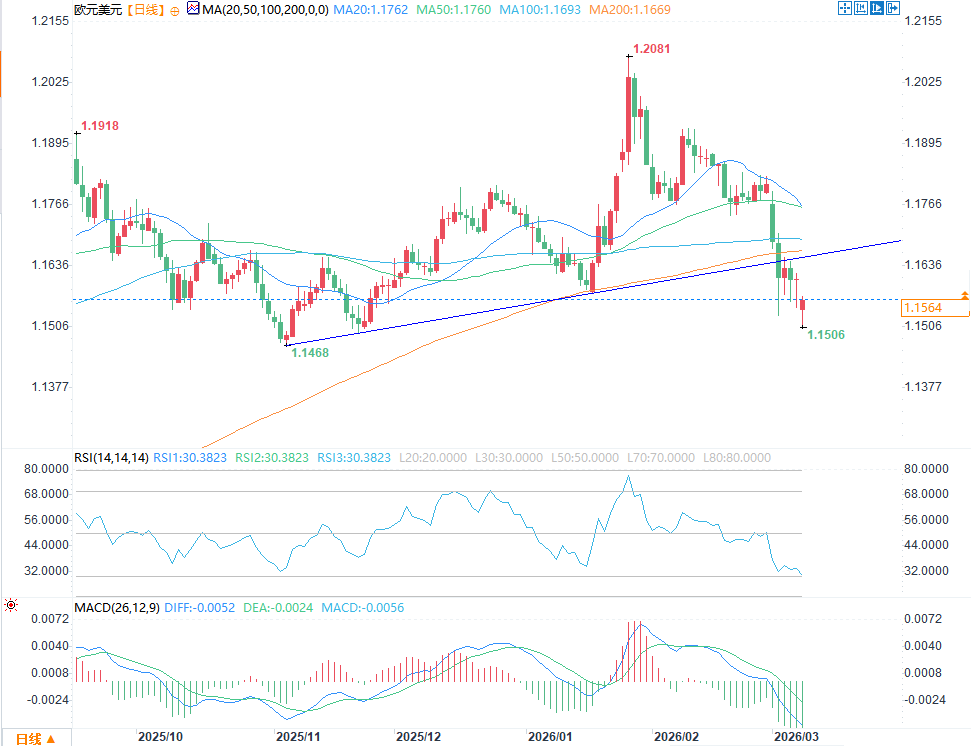
(EUR/USD daily chart source: FX678)
In this environment, even if the European Central Bank adopts a more hawkish policy stance, it will be difficult to reverse the euro's weakness. Geopolitical risks often suppress the influence of monetary policy. When investors are more focused on escalating conflicts, energy supply disruptions, and global financial stability, the impact of interest rate changes on exchange rates is significantly weakened.
More importantly, Europe's structural vulnerabilities in the energy sector remain unresolved. Europe is one of the world's major net energy importers, with a significant portion of its energy supply dependent on the Middle East. If regional conflicts escalate and disrupt oil or gas transport, the European economy will face even more severe shocks. Current European energy inventories are already significantly low, meaning any new supply disruptions could quickly drive up energy prices and drag down economic growth.
Against this backdrop, the euro is gradually becoming one of the most geopolitically sensitive currency pairs in the foreign exchange market. As tensions between the US, Israel, and Iran continue to escalate, energy prices, capital flows, and safe-haven demand will continue to dominate market trends. In the short term, as long as uncertainty in the Middle East remains high, even with support from the European Central Bank's policy expectations, the euro will struggle to escape the dual pressures of a strong dollar and energy shocks.
The market had previously believed that the European Central Bank (ECB) might keep interest rates unchanged this year, but with rising energy prices and potential inflation risks, investors have begun to reassess the path of monetary policy. Currently, market expectations for two ECB rate hikes this year have clearly intensified, with some institutions even predicting that the deposit rate could rise from the current 2% to 2.25%, and potentially even reach 2.5% if inflationary pressures further increase. However, despite the strengthened expectations of rate hikes, this change has failed to provide significant support for the euro. The logic of the foreign exchange market is being dominated by geopolitical risks, with traditional interest rate carry trades temporarily taking a backseat.
In stark contrast to the euro, the US dollar has performed strongly. The dollar index surged this week, reaching its highest level in nearly a year. As uncertainty surrounding the Middle East conflict increases, global capital is turning back to dollar assets for safe-haven protection. Changes in Iran's domestic political situation have further exacerbated market anxiety, with investors fearing potential spillover effects from the regional conflict, leading to continued inflows into traditional safe-haven assets such as the dollar and US Treasury bonds.
The rapid rise in energy prices is also reshaping the global economic landscape. Historical experience shows that soaring oil prices often impact economic growth. The 1973 oil crisis, the energy shock of the early 1980s, the 1990 Gulf War, and the lead-up to the 2008 financial crisis all showed a clear correlation between soaring oil prices and the US economic recession. Currently, the market is similarly concerned that if oil prices continue to break through the $100 per barrel mark, the global economic recovery will be significantly hampered.
However, unlike in previous periods, the United States is now a net energy exporter, which significantly reduces its economic sensitivity to rising oil prices. In contrast, Europe and Asia remain highly dependent on energy imports, making them more directly affected by rising oil and natural gas prices. This structural difference makes global capital more likely to flow into the US market during geopolitical shocks.
Meanwhile, while the US economy has shown some signs of cooling, its overall resilience remains. Affected by the White House's tariff and anti-immigration policies, the US labor market is gradually cooling. Latest data shows that non-farm payrolls in the US decreased by 92,000 in February, and the unemployment rate rose to 4.4%. These figures indicate that the momentum of US economic growth is slowing, but supported by its energy advantages and attractive capital markets, the US economy is still significantly less affected by energy shocks than Europe.
This divergence is driving a global reallocation of funds. As the impact of rising oil prices gradually becomes apparent, the previously prevalent "sell-off of US assets" trade is beginning to reverse. US stocks have seen a more limited decline compared to other major markets, while the US dollar continues to strengthen. Market positioning data shows that speculative funds have reduced their net short positions in the US dollar by about two-thirds in the past few days, indicating a rapid shift in market sentiment.
(EUR/USD daily chart source: FX678)
In this environment, even if the European Central Bank adopts a more hawkish policy stance, it will be difficult to reverse the euro's weakness. Geopolitical risks often suppress the influence of monetary policy. When investors are more focused on escalating conflicts, energy supply disruptions, and global financial stability, the impact of interest rate changes on exchange rates is significantly weakened.
More importantly, Europe's structural vulnerabilities in the energy sector remain unresolved. Europe is one of the world's major net energy importers, with a significant portion of its energy supply dependent on the Middle East. If regional conflicts escalate and disrupt oil or gas transport, the European economy will face even more severe shocks. Current European energy inventories are already significantly low, meaning any new supply disruptions could quickly drive up energy prices and drag down economic growth.
Against this backdrop, the euro is gradually becoming one of the most geopolitically sensitive currency pairs in the foreign exchange market. As tensions between the US, Israel, and Iran continue to escalate, energy prices, capital flows, and safe-haven demand will continue to dominate market trends. In the short term, as long as uncertainty in the Middle East remains high, even with support from the European Central Bank's policy expectations, the euro will struggle to escape the dual pressures of a strong dollar and energy shocks.
- Risk Warning and Disclaimer
- The market involves risk, and trading may not be suitable for all investors. This article is for reference only and does not constitute personal investment advice, nor does it take into account certain users’ specific investment objectives, financial situation, or other needs. Any investment decisions made based on this information are at your own risk.