As panic subsided and the dollar weakened, gold returned to its place in interest rate pricing.
2026-03-10 10:04:14
According to APP, XAU/USD gold prices saw modest gains in early Asian trading on Tuesday, hovering around $5140. Despite some recent profit-taking pressure, persistent geopolitical risks in the Middle East are providing key support for this traditional safe-haven asset. US President Trump's latest clear signal that the war with Iran "will be over soon" comes as the Middle East conflict enters its 11th day. However, the Strait of Hormuz remains effectively closed, leading major oil-producing countries in the Persian Gulf, including Saudi Arabia, to significantly reduce production.
The uncertainty and concerns about the prolonged conflict continue to drive demand for gold as a safe haven in the short term, with investors increasing their holdings to hedge against supply chain disruptions and energy price volatility. Meanwhile, the Middle East conflict further fuels concerns about accelerating inflation in the United States, directly increasing the likelihood that the Federal Reserve will maintain higher interest rates for an extended period. High borrowing costs typically have a significant negative impact on the price of gold, which does not generate returns, as the opportunity cost of holding gold increases accordingly.
The Federal Reserve is expected to keep interest rates unchanged at its policy meeting on March 17-18, and multiple economists unanimously predict that the next rate-cutting cycle will not begin until June or July 2026 at the earliest. This means that the US dollar will remain strong in the coming months, thus limiting the upside potential for gold. Traders are currently paying close attention to the US February Consumer Price Index ( CPI ) inflation data to be released later on Wednesday.
According to market consensus, the CPI is expected to rise 2.4% year-on-year, and the core CPI is expected to rise 2.5% month-on-month. If the actual data exceeds expectations and shows that inflationary pressures are overheated, it will further strengthen dollar buying and put downward pressure on the prices of commodities such as gold, which are denominated in dollars. Conversely, if the inflation data is moderate, it may ease expectations of Fed tightening and provide additional upward momentum for gold.
From a deep supply and demand perspective, the closure of the Strait of Hormuz not only directly pushed up global oil prices but also amplified the risk of imported inflation in the US through cost transmission. This, in the short term, has become a hidden support for gold. Although the Fed's high-interest-rate policy constitutes a "ceiling," geopolitical premiums currently dominate, and market risk appetite is recovering slowly. While Trump's optimistic statements have alleviated some panic, there is still no clear timetable for the actual resumption of navigation in the Strait. Oil-producing countries have already reduced production by millions of barrels per day, and global energy security concerns remain. Investors should be wary: if CPI data exceeds expectations, the US dollar index may quickly break through recent highs, causing gold to fall back below $5,000; conversely, escalating geopolitical tensions could push gold prices back above $5,200.
The table below compares recent key macroeconomic data expectations with their potential impact on gold prices, helping to intuitively understand market dynamics:
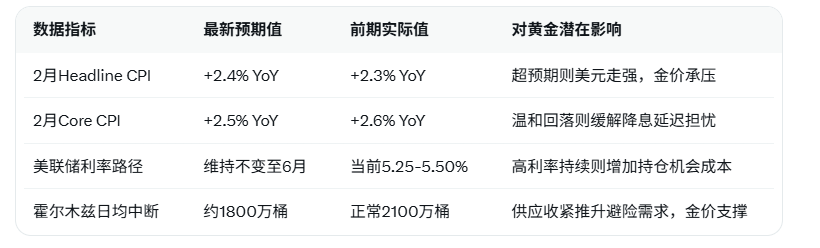
Based on comprehensive analysis, the current gold market is in a state of hedging between the dual forces of geopolitical risk aversion and monetary policy. In the short term, there is strong support around $5,140, but in the medium to long term, we still need to wait for a shift signal from the Federal Reserve and a substantial easing of the situation in the Middle East.
Editor's Summary: The current movement of gold (XAU/USD) reflects the dynamic balance between geopolitical risk premium and the Fed's high interest rate expectations. While the Strait of Hormuz disruption and Trump's statements provide a short-term buffer, the upcoming CPI data will be a key turning point. Investors should pay attention to inflation and conflict developments to adjust their positions.
Frequently Asked Questions
Question 1: Why did gold prices manage to rise moderately even in a high-interest-rate environment?
Answer: Although the Federal Reserve's maintenance of high interest rates increases the opportunity cost of holding gold, the geopolitical conflicts in the Middle East, especially the supply disruption risk caused by the closure of the Strait of Hormuz, significantly enhance gold's safe-haven appeal. While Trump's statement that the "war with Iran will end soon" alleviated some panic, the failure to immediately restore navigation through the Strait led to production cuts by oil-producing countries. Oil price fluctuations then translated into inflation expectations, resulting in a continued inflow of safe-haven funds into gold in the short term, offsetting some of the interest rate pressure.
Question 2: What specific impact will Trump's latest remarks have on the gold market?
Answer: Trump's clear signal that "the war with Iran will end soon" directly reduced market concerns about a prolonged conflict, thus suppressing gold's gains to some extent. However, the actual closure of the Strait of Hormuz remains unchanged, and production cuts by Saudi Arabia and other countries are a reality, meaning investors still view gold as a hedging tool. Therefore, while the remarks created short-term downward pressure, they failed to reverse overall safe-haven demand, and gold found support around $5140.
Question 3: How will the closure of the Strait of Hormuz affect gold prices?
Answer: The strait transports approximately 18 million barrels of crude oil daily, accounting for one-fifth of global crude oil production. Its closure has strained the global energy supply chain, and rising oil prices have further fueled US inflation expectations. Demand for gold as an inflation hedge has increased, and even with the Federal Reserve delaying interest rate cuts, its safe-haven status has been strengthened, providing short-term support for gold prices to remain high.
Question 4: What is the key significance of the upcoming February CPI data for gold price movements?
Answer: The market expects the headline CPI to be 2.4% year-on-year and the core CPI to be 2.5%. If the data exceeds expectations, it will strengthen the US dollar and put downward pressure on gold; if it is lower than expected, it will alleviate concerns about high interest rates and benefit gold prices. As a leading indicator for the Fed's decision-making, the CPI result will directly determine the market's repricing of the timing of interest rate cuts after the March meeting, thus affecting the medium-term direction of gold.
Question 5: How should investors view the medium- to long-term prospects of gold?
Answer: Gold finds strong support around $5140 in the short term, with geopolitical risks remaining the primary driver. However, if the Federal Reserve maintains high interest rates as expected until June-July, and the conflict with Iran eases rapidly, gold will face downward pressure. It is recommended to pay close attention to actual CPI data and the latest developments in the Taiwan Strait, employing a range-trading strategy, strictly controlling position size, adding to positions appropriately when geopolitical tensions escalate, and reducing positions to lock in profits when inflation data is moderate. Overall, gold still possesses defensive characteristics, but caution is advised against the dual pressures of a weakening dollar and high interest rates.
The uncertainty and concerns about the prolonged conflict continue to drive demand for gold as a safe haven in the short term, with investors increasing their holdings to hedge against supply chain disruptions and energy price volatility. Meanwhile, the Middle East conflict further fuels concerns about accelerating inflation in the United States, directly increasing the likelihood that the Federal Reserve will maintain higher interest rates for an extended period. High borrowing costs typically have a significant negative impact on the price of gold, which does not generate returns, as the opportunity cost of holding gold increases accordingly.
The Federal Reserve is expected to keep interest rates unchanged at its policy meeting on March 17-18, and multiple economists unanimously predict that the next rate-cutting cycle will not begin until June or July 2026 at the earliest. This means that the US dollar will remain strong in the coming months, thus limiting the upside potential for gold. Traders are currently paying close attention to the US February Consumer Price Index ( CPI ) inflation data to be released later on Wednesday.
According to market consensus, the CPI is expected to rise 2.4% year-on-year, and the core CPI is expected to rise 2.5% month-on-month. If the actual data exceeds expectations and shows that inflationary pressures are overheated, it will further strengthen dollar buying and put downward pressure on the prices of commodities such as gold, which are denominated in dollars. Conversely, if the inflation data is moderate, it may ease expectations of Fed tightening and provide additional upward momentum for gold.
From a deep supply and demand perspective, the closure of the Strait of Hormuz not only directly pushed up global oil prices but also amplified the risk of imported inflation in the US through cost transmission. This, in the short term, has become a hidden support for gold. Although the Fed's high-interest-rate policy constitutes a "ceiling," geopolitical premiums currently dominate, and market risk appetite is recovering slowly. While Trump's optimistic statements have alleviated some panic, there is still no clear timetable for the actual resumption of navigation in the Strait. Oil-producing countries have already reduced production by millions of barrels per day, and global energy security concerns remain. Investors should be wary: if CPI data exceeds expectations, the US dollar index may quickly break through recent highs, causing gold to fall back below $5,000; conversely, escalating geopolitical tensions could push gold prices back above $5,200.
The table below compares recent key macroeconomic data expectations with their potential impact on gold prices, helping to intuitively understand market dynamics:
Based on comprehensive analysis, the current gold market is in a state of hedging between the dual forces of geopolitical risk aversion and monetary policy. In the short term, there is strong support around $5,140, but in the medium to long term, we still need to wait for a shift signal from the Federal Reserve and a substantial easing of the situation in the Middle East.
Editor's Summary: The current movement of gold (XAU/USD) reflects the dynamic balance between geopolitical risk premium and the Fed's high interest rate expectations. While the Strait of Hormuz disruption and Trump's statements provide a short-term buffer, the upcoming CPI data will be a key turning point. Investors should pay attention to inflation and conflict developments to adjust their positions.
Frequently Asked Questions
Question 1: Why did gold prices manage to rise moderately even in a high-interest-rate environment?
Answer: Although the Federal Reserve's maintenance of high interest rates increases the opportunity cost of holding gold, the geopolitical conflicts in the Middle East, especially the supply disruption risk caused by the closure of the Strait of Hormuz, significantly enhance gold's safe-haven appeal. While Trump's statement that the "war with Iran will end soon" alleviated some panic, the failure to immediately restore navigation through the Strait led to production cuts by oil-producing countries. Oil price fluctuations then translated into inflation expectations, resulting in a continued inflow of safe-haven funds into gold in the short term, offsetting some of the interest rate pressure.
Question 2: What specific impact will Trump's latest remarks have on the gold market?
Answer: Trump's clear signal that "the war with Iran will end soon" directly reduced market concerns about a prolonged conflict, thus suppressing gold's gains to some extent. However, the actual closure of the Strait of Hormuz remains unchanged, and production cuts by Saudi Arabia and other countries are a reality, meaning investors still view gold as a hedging tool. Therefore, while the remarks created short-term downward pressure, they failed to reverse overall safe-haven demand, and gold found support around $5140.
Question 3: How will the closure of the Strait of Hormuz affect gold prices?
Answer: The strait transports approximately 18 million barrels of crude oil daily, accounting for one-fifth of global crude oil production. Its closure has strained the global energy supply chain, and rising oil prices have further fueled US inflation expectations. Demand for gold as an inflation hedge has increased, and even with the Federal Reserve delaying interest rate cuts, its safe-haven status has been strengthened, providing short-term support for gold prices to remain high.
Question 4: What is the key significance of the upcoming February CPI data for gold price movements?
Answer: The market expects the headline CPI to be 2.4% year-on-year and the core CPI to be 2.5%. If the data exceeds expectations, it will strengthen the US dollar and put downward pressure on gold; if it is lower than expected, it will alleviate concerns about high interest rates and benefit gold prices. As a leading indicator for the Fed's decision-making, the CPI result will directly determine the market's repricing of the timing of interest rate cuts after the March meeting, thus affecting the medium-term direction of gold.
Question 5: How should investors view the medium- to long-term prospects of gold?
Answer: Gold finds strong support around $5140 in the short term, with geopolitical risks remaining the primary driver. However, if the Federal Reserve maintains high interest rates as expected until June-July, and the conflict with Iran eases rapidly, gold will face downward pressure. It is recommended to pay close attention to actual CPI data and the latest developments in the Taiwan Strait, employing a range-trading strategy, strictly controlling position size, adding to positions appropriately when geopolitical tensions escalate, and reducing positions to lock in profits when inflation data is moderate. Overall, gold still possesses defensive characteristics, but caution is advised against the dual pressures of a weakening dollar and high interest rates.
- Risk Warning and Disclaimer
- The market involves risk, and trading may not be suitable for all investors. This article is for reference only and does not constitute personal investment advice, nor does it take into account certain users’ specific investment objectives, financial situation, or other needs. Any investment decisions made based on this information are at your own risk.