With panic subsiding, the Hang Seng Index may present a buying opportunity.
2026-03-10 11:16:22
According to an APP report, Liu Gang , Managing Director and Chief Overseas and Hong Kong Stock Strategist at CICC , pointed out that in the short term, Hang Seng Tech 's price-to-earnings ratio has reached one standard deviation below the mean, while the RSI indicator suggests it may be oversold, making it somewhat attractive. For some investors, the current valuation and market sentiment of Hang Seng Tech offer an opportunity for gradual, dollar-cost averaging. Liu Gang 's assessment is consistent with his recent emphasis at an internal strategy meeting that "a window for valuation repair in the Hong Kong stock technology sector has appeared."
The latest market data (as of March 10, 2026) shows that the Hang Seng Tech Index closed at 4941.73 points, having rebounded to around 4982.87 points during the session, recovering from the low of 4760 on March 9. However, the 14-day RSI indicator is around 55, having gradually recovered from the previous oversold range to the neutral-to-buy range, confirming that Liu Gang 's judgment still has reference value.
Historical data shows that the long-term average price-to-earnings ratio (P/E ratio) of the Hang Seng TECH Index is around 20-22 times. Currently, the weighted P/E ratio (using the iShares Hang Seng TECH ETF as a proxy) has fallen to around 17.96 times, indeed falling within one standard deviation below the average, significantly enhancing its valuation attractiveness. This level often corresponds to the starting point of historical rebounds, coupled with oversold technical signals, providing a window for investors with a higher risk appetite to gradually build positions at lower levels.
Looking ahead, Liu Gang believes that the opportunity for Hong Kong stocks to outperform other markets again stems from three core conditions: first, rising expectations of further easing by the Federal Reserve ; second, the return of Hong Kong stocks' unique structural characteristics to market focus; and third, the influx of southbound capital. If the Federal Reserve's interest rate cuts are implemented sooner or more aggressively, it will significantly reduce the discount rate of global risk assets, benefiting highly valued technology stocks. If Hong Kong's internet, consumer electronics, and new energy vehicle sectors regain favor with investors, sector rotation will accelerate the index's recovery. The net inflow of southbound capital is also a key point to observe; historical data shows that when southbound capital net purchases exceed HK$10 billion per day, the Hang Seng Tech Index's average weekly gain can reach over 3%. The table below compares the current market conditions and potential impact of these three outperforming opportunities to help investors quantify opportunity windows:
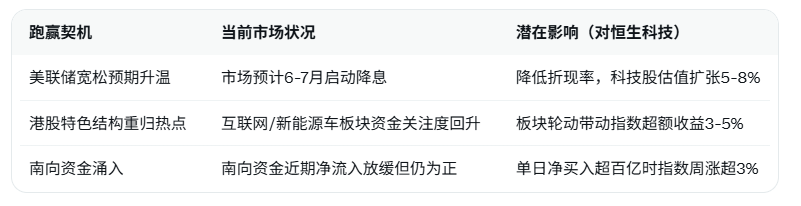
From an in-depth analysis, the current valuation of Hang Seng Tech is at a relatively low level compared to the past three years. Combined with the oversold RSI , the probability of a short-term rebound is high. However, it is necessary to be wary of the Federal Reserve's actual policy path falling short of expectations or geopolitical disturbances causing a decline in risk appetite. Attention should also be paid to the monthly Federal Reserve meeting minutes and southbound capital flow data as a basis for dynamic adjustments. Overall, this combination of valuation and technical signals provides a high safety margin for medium- to long-term investment in Hong Kong technology stocks.
Editor's Summary: Liu Gang's analysis from CICC highlights the dual appeal of Hang Seng Tech's current valuation and technical aspects. The three outperformance conditions are clear and traceable. Hong Kong stock investors can take advantage of the recovery by using left-side fixed-amount investment, but they still need to continuously monitor the Fed's policies and capital flows to cope with potential volatility.
Frequently Asked Questions
Question 1: What does it mean that Hang Seng Technology's price-to-earnings ratio is less than one standard deviation below the mean?
Answer: A price-to-earnings ratio (P/E ratio) below one standard deviation from its historical average indicates that the current valuation has entered a significantly undervalued range. According to the latest data, the weighted P/E ratio of the Hang Seng TECH Index is approximately 17.96, about one standard deviation lower than the long-term average of 20-22. Historically, this level has often corresponded to the starting point of a rebound, meaning the market has already priced in significant pessimistic expectations. If a catalyst emerges in the future, there is substantial room for valuation repair, providing a safety margin for left-side entry.
Question 2: What is the operational significance for investors when the RSI indicator is at an oversold level?
Answer: An RSI below 30 is generally considered oversold, suggesting excessive short-term selling pressure and an increased probability of a technical rebound. Liu Gang points out that the index has already reached this area, and although the latest 14-day RSI of around 55 has recovered to neutral, it is still in a low-level recovery phase. Investors can use this signal to gradually increase their investment, avoiding a large one-time investment, and wait for the index to stabilize above 4900 points before adding more shares to reduce short-term volatility risk.
Question 3: How did the rising expectations of Fed easing drive Hong Kong stocks to outperform?
Answer: If the Federal Reserve cuts interest rates earlier or more aggressively, it will lower global funding costs, with the high-beta Hang Seng Tech Index benefiting the most. Historical data shows that within three months of the start of a Fed rate-cutting cycle, the Hang Seng Tech Index has seen an average increase of over 15%. Liu Gang emphasized that this is one of the core catalysts for Hong Kong stocks outperforming global markets, and investors should closely monitor the Fed's March meeting minutes and dot plot changes.
Question 4: What specific impact does the influx of southbound capital have on the Hang Seng Tech Index?
Answer: Southbound capital tends to flow into high-quality Hong Kong technology stocks. Historical data shows that when net purchases exceed HK$10 billion in a single day, the Hang Seng Tech Index can rise by more than 3% weekly. Liu Gang believes this is a key driver for the return of Hong Kong stocks' unique structural strength to market focus, and suggests that investors pay attention to daily real-time southbound capital data as an important reference indicator for judging the strength of short-term liquidity.
Question 5: Is it suitable to make a left-side fixed investment in Hang Seng Technology at this time?
Answer: Liu Gang clearly stated that valuations and sentiment have provided an opportunity window, especially for long-term investors. Considering the latest index level of 4941.73 points and the RSI recovery signal, a phased investment strategy is recommended. At the same time, caution is advised regarding potential outflows of southbound funds due to weaker-than-expected Fed policies; overall portfolio allocation should be kept below 30% to balance risk and return.
The latest market data (as of March 10, 2026) shows that the Hang Seng Tech Index closed at 4941.73 points, having rebounded to around 4982.87 points during the session, recovering from the low of 4760 on March 9. However, the 14-day RSI indicator is around 55, having gradually recovered from the previous oversold range to the neutral-to-buy range, confirming that Liu Gang 's judgment still has reference value.
Historical data shows that the long-term average price-to-earnings ratio (P/E ratio) of the Hang Seng TECH Index is around 20-22 times. Currently, the weighted P/E ratio (using the iShares Hang Seng TECH ETF as a proxy) has fallen to around 17.96 times, indeed falling within one standard deviation below the average, significantly enhancing its valuation attractiveness. This level often corresponds to the starting point of historical rebounds, coupled with oversold technical signals, providing a window for investors with a higher risk appetite to gradually build positions at lower levels.
Looking ahead, Liu Gang believes that the opportunity for Hong Kong stocks to outperform other markets again stems from three core conditions: first, rising expectations of further easing by the Federal Reserve ; second, the return of Hong Kong stocks' unique structural characteristics to market focus; and third, the influx of southbound capital. If the Federal Reserve's interest rate cuts are implemented sooner or more aggressively, it will significantly reduce the discount rate of global risk assets, benefiting highly valued technology stocks. If Hong Kong's internet, consumer electronics, and new energy vehicle sectors regain favor with investors, sector rotation will accelerate the index's recovery. The net inflow of southbound capital is also a key point to observe; historical data shows that when southbound capital net purchases exceed HK$10 billion per day, the Hang Seng Tech Index's average weekly gain can reach over 3%. The table below compares the current market conditions and potential impact of these three outperforming opportunities to help investors quantify opportunity windows:
From an in-depth analysis, the current valuation of Hang Seng Tech is at a relatively low level compared to the past three years. Combined with the oversold RSI , the probability of a short-term rebound is high. However, it is necessary to be wary of the Federal Reserve's actual policy path falling short of expectations or geopolitical disturbances causing a decline in risk appetite. Attention should also be paid to the monthly Federal Reserve meeting minutes and southbound capital flow data as a basis for dynamic adjustments. Overall, this combination of valuation and technical signals provides a high safety margin for medium- to long-term investment in Hong Kong technology stocks.
Editor's Summary: Liu Gang's analysis from CICC highlights the dual appeal of Hang Seng Tech's current valuation and technical aspects. The three outperformance conditions are clear and traceable. Hong Kong stock investors can take advantage of the recovery by using left-side fixed-amount investment, but they still need to continuously monitor the Fed's policies and capital flows to cope with potential volatility.
Frequently Asked Questions
Question 1: What does it mean that Hang Seng Technology's price-to-earnings ratio is less than one standard deviation below the mean?
Answer: A price-to-earnings ratio (P/E ratio) below one standard deviation from its historical average indicates that the current valuation has entered a significantly undervalued range. According to the latest data, the weighted P/E ratio of the Hang Seng TECH Index is approximately 17.96, about one standard deviation lower than the long-term average of 20-22. Historically, this level has often corresponded to the starting point of a rebound, meaning the market has already priced in significant pessimistic expectations. If a catalyst emerges in the future, there is substantial room for valuation repair, providing a safety margin for left-side entry.
Question 2: What is the operational significance for investors when the RSI indicator is at an oversold level?
Answer: An RSI below 30 is generally considered oversold, suggesting excessive short-term selling pressure and an increased probability of a technical rebound. Liu Gang points out that the index has already reached this area, and although the latest 14-day RSI of around 55 has recovered to neutral, it is still in a low-level recovery phase. Investors can use this signal to gradually increase their investment, avoiding a large one-time investment, and wait for the index to stabilize above 4900 points before adding more shares to reduce short-term volatility risk.
Question 3: How did the rising expectations of Fed easing drive Hong Kong stocks to outperform?
Answer: If the Federal Reserve cuts interest rates earlier or more aggressively, it will lower global funding costs, with the high-beta Hang Seng Tech Index benefiting the most. Historical data shows that within three months of the start of a Fed rate-cutting cycle, the Hang Seng Tech Index has seen an average increase of over 15%. Liu Gang emphasized that this is one of the core catalysts for Hong Kong stocks outperforming global markets, and investors should closely monitor the Fed's March meeting minutes and dot plot changes.
Question 4: What specific impact does the influx of southbound capital have on the Hang Seng Tech Index?
Answer: Southbound capital tends to flow into high-quality Hong Kong technology stocks. Historical data shows that when net purchases exceed HK$10 billion in a single day, the Hang Seng Tech Index can rise by more than 3% weekly. Liu Gang believes this is a key driver for the return of Hong Kong stocks' unique structural strength to market focus, and suggests that investors pay attention to daily real-time southbound capital data as an important reference indicator for judging the strength of short-term liquidity.
Question 5: Is it suitable to make a left-side fixed investment in Hang Seng Technology at this time?
Answer: Liu Gang clearly stated that valuations and sentiment have provided an opportunity window, especially for long-term investors. Considering the latest index level of 4941.73 points and the RSI recovery signal, a phased investment strategy is recommended. At the same time, caution is advised regarding potential outflows of southbound funds due to weaker-than-expected Fed policies; overall portfolio allocation should be kept below 30% to balance risk and return.
- Risk Warning and Disclaimer
- The market involves risk, and trading may not be suitable for all investors. This article is for reference only and does not constitute personal investment advice, nor does it take into account certain users’ specific investment objectives, financial situation, or other needs. Any investment decisions made based on this information are at your own risk.