The Hang Seng Tech Index has rebounded sharply; is a left-side opportunity emerging?
2026-03-10 13:52:09
According to the APP, the Hong Kong stock market has rebounded significantly after recent volatility, with the Hang Seng Tech Index rising by 2% in the afternoon, and the Hang Seng Index currently up 1.79%. This trend reflects a rapid recovery in market sentiment, with the technology sector leading the gains, and strong support provided by a large inflow of southbound funds.
This rebound was primarily driven by a confluence of positive factors. Firstly, the marginal easing of geopolitical risks was the most direct trigger. Trump's recent statement that "the war with Iran will soon be over" quickly alleviated market concerns about an escalation of the Middle East conflict, leading to a more than 10% drop in international oil prices from their highs, and a simultaneous recovery in global risk appetite. Asian-Pacific stock markets rebounded collectively, with Hong Kong stocks, as a high-beta offshore market, showing increased resilience. While energy-related sectors recovered, growth-oriented technology assets led the rebound.
Secondly, record-breaking southbound capital inflows provide core support for the market. Latest data shows that southbound capital saw a net inflow of approximately HK$37.2 billion in a single day, breaking the previous record for single-day net inflows (the previous record was HK$35.876 billion in August 2025). The cumulative net inflow this year has exceeded HK$180 billion, with funds primarily flowing into Hang Seng Technology heavyweights such as Tencent Holdings, Xiaomi Group, and SMIC, as well as related ETFs. Even with previous periods of net outflows, the "buy on dips" attitude remained steadfast, with low valuations and policy expectations attracting mainland funds to invest against the trend.
Third, the valuation repair logic and the amplified elasticity of the sector provide intrinsic momentum. The Hang Seng Tech Index has significantly corrected from its previous high, and its current PE-TTM is around 20, which is in the lower percentile of the past five years (around 13-20%), making it highly cost-effective. Compared to the Hang Seng Index, the tech sector has experienced a larger decline in the previous period, and once sentiment shifts, the rebound slope will be higher. Among the constituent stocks, core assets in fields such as AI applications, internet platforms, and semiconductors have performed outstandingly, with companies like Bilibili, JD Health, and Lenovo Group showing the largest gains. The following table compares key indicators of this rebound with similar historical phases (based on reasonable inferences from the latest market data):
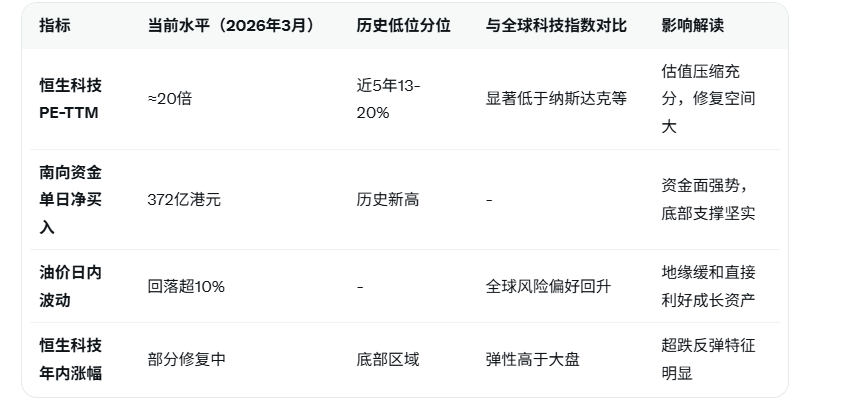
In the short term, the market's recovery momentum may continue, but volatility will increase. While the geopolitical situation has improved marginally, uncertainty remains, and oil prices, inflation, and the Fed's policy path could cause disturbances. Hong Kong stocks are sensitive to foreign investment and are prone to short-term rallies followed by consolidation. Southbound funds may have taken profits after today's buying spree, but the overall "low-level allocation" logic remains unchanged, and continued inflows into technology ETFs will provide bottom support.
A more optimistic medium-term perspective suggests that undervalued core technology assets are poised for a double boost in both valuation and earnings. Major Asian economies continue to emphasize high-quality development, technological self-reliance, and expanding domestic demand, with clear support for cutting-edge fields such as AI, quantum computing, and robotics. Coupled with a favorable earnings window, the Hang Seng Tech sector has ample momentum for recovery. Key areas to watch include the pace of AI big data model implementation, progress in semiconductor domestic production, and the recovery in consumer data.
Risk Warning: An unexpected escalation of geopolitical conflicts could lead to another surge in oil prices and a tightening of global liquidity. Uncertainties surrounding the Federal Reserve's policy path could result in a stronger dollar and a decline in risk appetite, leading to a phase of capital outflows. Overall, the outlook is positive, but short-term volatility should be accepted. The current position is more suitable for left-side positioning in leading technology stocks rather than chasing high prices.
Editor's Summary: The recent rebound in Hong Kong stocks highlights the combined effect of improved liquidity and market sentiment. Record inflows of southbound capital, coupled with easing geopolitical risks, validated the undervaluation advantage of Hang Seng Tech. In the medium to long term, supported by policy dividends and industry trends, the technology sector offers significant investment value; however, caution is advised regarding potential short-term adjustments due to external uncertainties.
Frequently Asked Questions
Q: What was the main trigger for this rebound in Hong Kong stocks?
A: The most direct trigger was the easing of geopolitical risks. Trump recently stated that "the war with Iran will soon be over," alleviating market panic about an escalation of the Middle East conflict. International oil prices fell by more than 10% from their highs, global risk appetite recovered, and Hong Kong stocks, as a highly sensitive market, were the first to rebound.
Q: What specific impact will the record-breaking southbound capital inflows have on Hang Seng Technology?
A: Southbound capital saw a record-breaking net inflow of HK$37.2 billion in a single day, bringing the year-to-date total to over HK$180 billion. The funds primarily flowed into heavyweight stocks such as Tencent, Xiaomi, and SMIC, as well as technology ETFs. This strengthens the bottom support level and drives the Hang Seng Tech index to recover rapidly from its undervalued position. Historically, similar large-scale inflows have often been accompanied by a period of rebound.
Q: What is the current valuation level of the Hang Seng Tech Index, and why is it considered to be cost-effective?
A: The PE-TTM ratio is approximately 20, placing it in the 13-20% historical low percentile over the past five years, significantly lower than major global technology indices. Given the significant previous correction (over 26%) and policy support for AI and semiconductor sectors, there is substantial room for valuation recovery, offering a high potential return.
Q: In what ways will the market experience increased short-term volatility in the future?
A: Geopolitical uncertainties persist, potentially causing fluctuations in oil prices and inflation; southbound capital inflows may be followed by profit-taking; if the Fed's actions fall short of expectations, a decline in risk appetite could trigger a phase of foreign capital outflows. Volatility is amplified, but the "buying on dips" logic supports a bottom.
Q: How should investors allocate their investments in Hang Seng Technology-related assets?
A: The current position is suitable for left-side positioning in core leading stocks, rather than chasing high prices. Risk can be diversified through technology ETFs, with attention focused on AI implementation, semiconductor trends, and consumer data as dynamic signals. Overall position control is advised, accepting short-term fluctuations to capture medium-term recovery opportunities.
This rebound was primarily driven by a confluence of positive factors. Firstly, the marginal easing of geopolitical risks was the most direct trigger. Trump's recent statement that "the war with Iran will soon be over" quickly alleviated market concerns about an escalation of the Middle East conflict, leading to a more than 10% drop in international oil prices from their highs, and a simultaneous recovery in global risk appetite. Asian-Pacific stock markets rebounded collectively, with Hong Kong stocks, as a high-beta offshore market, showing increased resilience. While energy-related sectors recovered, growth-oriented technology assets led the rebound.
Secondly, record-breaking southbound capital inflows provide core support for the market. Latest data shows that southbound capital saw a net inflow of approximately HK$37.2 billion in a single day, breaking the previous record for single-day net inflows (the previous record was HK$35.876 billion in August 2025). The cumulative net inflow this year has exceeded HK$180 billion, with funds primarily flowing into Hang Seng Technology heavyweights such as Tencent Holdings, Xiaomi Group, and SMIC, as well as related ETFs. Even with previous periods of net outflows, the "buy on dips" attitude remained steadfast, with low valuations and policy expectations attracting mainland funds to invest against the trend.
Third, the valuation repair logic and the amplified elasticity of the sector provide intrinsic momentum. The Hang Seng Tech Index has significantly corrected from its previous high, and its current PE-TTM is around 20, which is in the lower percentile of the past five years (around 13-20%), making it highly cost-effective. Compared to the Hang Seng Index, the tech sector has experienced a larger decline in the previous period, and once sentiment shifts, the rebound slope will be higher. Among the constituent stocks, core assets in fields such as AI applications, internet platforms, and semiconductors have performed outstandingly, with companies like Bilibili, JD Health, and Lenovo Group showing the largest gains. The following table compares key indicators of this rebound with similar historical phases (based on reasonable inferences from the latest market data):
In the short term, the market's recovery momentum may continue, but volatility will increase. While the geopolitical situation has improved marginally, uncertainty remains, and oil prices, inflation, and the Fed's policy path could cause disturbances. Hong Kong stocks are sensitive to foreign investment and are prone to short-term rallies followed by consolidation. Southbound funds may have taken profits after today's buying spree, but the overall "low-level allocation" logic remains unchanged, and continued inflows into technology ETFs will provide bottom support.
A more optimistic medium-term perspective suggests that undervalued core technology assets are poised for a double boost in both valuation and earnings. Major Asian economies continue to emphasize high-quality development, technological self-reliance, and expanding domestic demand, with clear support for cutting-edge fields such as AI, quantum computing, and robotics. Coupled with a favorable earnings window, the Hang Seng Tech sector has ample momentum for recovery. Key areas to watch include the pace of AI big data model implementation, progress in semiconductor domestic production, and the recovery in consumer data.
Risk Warning: An unexpected escalation of geopolitical conflicts could lead to another surge in oil prices and a tightening of global liquidity. Uncertainties surrounding the Federal Reserve's policy path could result in a stronger dollar and a decline in risk appetite, leading to a phase of capital outflows. Overall, the outlook is positive, but short-term volatility should be accepted. The current position is more suitable for left-side positioning in leading technology stocks rather than chasing high prices.
Editor's Summary: The recent rebound in Hong Kong stocks highlights the combined effect of improved liquidity and market sentiment. Record inflows of southbound capital, coupled with easing geopolitical risks, validated the undervaluation advantage of Hang Seng Tech. In the medium to long term, supported by policy dividends and industry trends, the technology sector offers significant investment value; however, caution is advised regarding potential short-term adjustments due to external uncertainties.
Frequently Asked Questions
Q: What was the main trigger for this rebound in Hong Kong stocks?
A: The most direct trigger was the easing of geopolitical risks. Trump recently stated that "the war with Iran will soon be over," alleviating market panic about an escalation of the Middle East conflict. International oil prices fell by more than 10% from their highs, global risk appetite recovered, and Hong Kong stocks, as a highly sensitive market, were the first to rebound.
Q: What specific impact will the record-breaking southbound capital inflows have on Hang Seng Technology?
A: Southbound capital saw a record-breaking net inflow of HK$37.2 billion in a single day, bringing the year-to-date total to over HK$180 billion. The funds primarily flowed into heavyweight stocks such as Tencent, Xiaomi, and SMIC, as well as technology ETFs. This strengthens the bottom support level and drives the Hang Seng Tech index to recover rapidly from its undervalued position. Historically, similar large-scale inflows have often been accompanied by a period of rebound.
Q: What is the current valuation level of the Hang Seng Tech Index, and why is it considered to be cost-effective?
A: The PE-TTM ratio is approximately 20, placing it in the 13-20% historical low percentile over the past five years, significantly lower than major global technology indices. Given the significant previous correction (over 26%) and policy support for AI and semiconductor sectors, there is substantial room for valuation recovery, offering a high potential return.
Q: In what ways will the market experience increased short-term volatility in the future?
A: Geopolitical uncertainties persist, potentially causing fluctuations in oil prices and inflation; southbound capital inflows may be followed by profit-taking; if the Fed's actions fall short of expectations, a decline in risk appetite could trigger a phase of foreign capital outflows. Volatility is amplified, but the "buying on dips" logic supports a bottom.
Q: How should investors allocate their investments in Hang Seng Technology-related assets?
A: The current position is suitable for left-side positioning in core leading stocks, rather than chasing high prices. Risk can be diversified through technology ETFs, with attention focused on AI implementation, semiconductor trends, and consumer data as dynamic signals. Overall position control is advised, accepting short-term fluctuations to capture medium-term recovery opportunities.
- Risk Warning and Disclaimer
- The market involves risk, and trading may not be suitable for all investors. This article is for reference only and does not constitute personal investment advice, nor does it take into account certain users’ specific investment objectives, financial situation, or other needs. Any investment decisions made based on this information are at your own risk.