European natural gas futures plunge 13%! Easing geopolitical risks coupled with high inventory levels exert downward pressure.
2026-03-10 15:15:42
According to APP reports, European natural gas futures prices have fallen sharply, with the latest trading data showing that the most active contract fell by as much as 13% intraday, hitting a significant recent low. This sharp fluctuation reflects the market's rapid repricing of the supply and demand dynamics, further easing concerns about the European energy crisis.
The recent plunge in European natural gas futures prices was primarily driven by a confluence of positive factors:
1. Geopolitical risks have significantly eased (the most direct catalyst )
With the situation in the Middle East improving marginally and Trump recently reiterating that "the war against Iran will end soon," market fears of potential supply disruptions have subsided significantly. International oil prices have fallen by more than 10% from their highs, dragging down global energy prices in tandem. European natural gas, as a highly sensitive commodity, has shown the greatest resilience, quickly releasing the previous geopolitical premium.
2. High Inventory Levels + Weakening Heating Demand Expectations <br />Currently, European natural gas inventories are at historically high levels for this time of year (the EU average fill rate has exceeded 80% , with some countries approaching 90% ), far exceeding the average level for the same period over the past decade. Since March, temperatures have risen significantly, and heating demand in the Northern Hemisphere is nearing its end, drastically reducing short-term consumption pressure. Coupled with continued strong LNG imports (with numerous shipments arriving from the US, Qatar, and other locations), the oversupply situation in both the spot and futures markets has intensified.
3. Increased Share of Renewable Energy Generation + Weak Industrial Demand <br />Recently, wind and solar power output in Europe has exceeded seasonal averages, partially substituting demand for natural gas power generation. Meanwhile, the Eurozone manufacturing PMI remains weak, and industrial gas demand is recovering slowly, further weakening the rigid consumption support for natural gas.
4. Accelerated Short Covering Following Technical Oversold Conditions <br />After geopolitical tensions pushed prices up in the early stages, the market accumulated a large number of long positions. The realization of positive news triggered concentrated profit-taking and short covering, amplifying the decline due to technical selling pressure and creating a short-term "waterfall-like" correction.
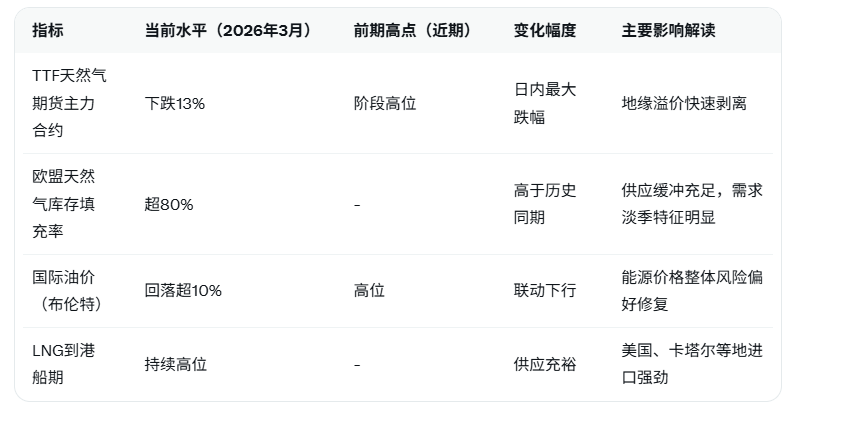
The following table compares recent changes in key indicators for European natural gas futures (TTF benchmark) (based on reasonable inferences from the latest market data):
In the short term, European natural gas futures prices may still have room to fall further, but the 13% single-day drop has already released a large amount of panic, and signs of overselling are obvious. Unless there are new geopolitical supply disruptions, prices are likely to fluctuate and consolidate at current low levels. The dual pressure of high inventory levels and the off-season demand will continue until the end of spring. The medium-term outlook leans towards a slightly weaker, volatile market, but downside potential is relatively limited. Europe is accelerating its energy transition, with LNG infrastructure continuing to expand. In the long term, reliance on Russian pipeline gas will decrease significantly, and improved supply security will suppress upward price elasticity. Key areas to watch : ① Inventory peak and destocking pace in April-May; ② Industrial recovery and electricity demand recovery in the second half of the year; ③ Global LNG new capacity commissioning progress (multiple projects in the US, Qatar, etc., are entering the commissioning window).
Risk Warnings: 1. Sudden and recurring geopolitical events could reignite supply concerns and cause a rapid price rebound. 2. Extreme weather events could prematurely end spring or trigger unusual cold waves, stimulating heating demand beyond expectations. 3. A significant recovery in European industrial activity could lead to a more pronounced than seasonal increase in natural gas consumption demand.
Editor's Summary:
European natural gas futures plunged 13% intraday, driven primarily by easing geopolitical risks in the Middle East, high inventory levels, the off-season for heating demand, and the substitution effect of renewable energy. The previously accumulated geopolitical premium has been rapidly dissipated, suggesting a high probability of short-term price weakness and consolidation. In the medium to long term, the accelerated diversification and transformation of European energy supply will continue to suppress the upside potential of natural gas prices, and investors should be wary of sudden fluctuations caused by unforeseen weather and geopolitical events.
Frequently Asked Questions
1. Question: What was the main trigger for the 13% plunge in European natural gas futures?
A: The most direct catalyst was the significant easing of geopolitical risks. Trump's statement that "the war with Iran will end soon" quickly dispelled extreme market concerns about supply disruptions in the Middle East, causing international oil prices to fall by more than 10% from their highs, leading to a coordinated decline in global energy prices. European natural gas, being the most geopolitically sensitive commodity, saw its pent-up premium released all at once, resulting in a sharp single-day adjustment.
2. Question: Why are high levels of natural gas inventories in Europe exerting such strong downward pressure on prices?
A: Currently, the EU's natural gas storage capacity is over 80% , with some countries approaching 90% , far exceeding the average level for the same period over the past decade. This means that even without additional replenishment before summer, existing inventory can adequately cover summer air conditioning demand and autumn restocking needs. Given this supply-demand imbalance, the futures market has already priced in the risk of excess supply during the off-season, naturally putting significant downward pressure on prices.
3. Question: How does the increase in the proportion of renewable energy generation affect natural gas prices?
A: Recent wind and solar power output in Europe has exceeded seasonal averages, significantly replacing demand for natural gas power generation (natural gas is commonly used for peak shaving and baseload supplementation). With the marginal cost of renewable energy in the electricity market approaching zero, priority dispatch has led to a decrease in the utilization rate of natural gas generating units, weakening rigid consumer demand and further exacerbating expectations of a loose supply and demand situation.
4. Question: Is there still room for European natural gas futures prices to fall further in the short term?
A: There is still some possibility of further bottoming out in the short term, but the 13% single-day drop has already released a large amount of panic, and the technical oversold condition is obvious. Unless there are new geopolitical supply disruptions or extreme weather events, prices will likely consolidate near current lows. The market will focus on whether April-May inventories reach historical peaks and whether the destocking pace is faster than expected.
5. Question: How do investors currently view the allocation opportunities in European natural gas-related assets?
A: In the short term, it is recommended to remain on the sidelines or take a small position to speculate on a rebound, paying attention to signs of stabilization at lower levels after technical oversold conditions. A cautious approach is advised in the medium to long term, as accelerated energy transition in Europe, diversification of LNG supply, and structural oversupply will continue to suppress the upward movement of natural gas prices. Aggressive investors may wait for extreme lows (such as a break below key support levels) to gradually build positions in related ETFs or futures, but must strictly set stop-loss orders, control position size, and prioritize mitigating the impact of unforeseen geopolitical and weather risks.
The recent plunge in European natural gas futures prices was primarily driven by a confluence of positive factors:
1. Geopolitical risks have significantly eased (the most direct catalyst )
With the situation in the Middle East improving marginally and Trump recently reiterating that "the war against Iran will end soon," market fears of potential supply disruptions have subsided significantly. International oil prices have fallen by more than 10% from their highs, dragging down global energy prices in tandem. European natural gas, as a highly sensitive commodity, has shown the greatest resilience, quickly releasing the previous geopolitical premium.
2. High Inventory Levels + Weakening Heating Demand Expectations <br />Currently, European natural gas inventories are at historically high levels for this time of year (the EU average fill rate has exceeded 80% , with some countries approaching 90% ), far exceeding the average level for the same period over the past decade. Since March, temperatures have risen significantly, and heating demand in the Northern Hemisphere is nearing its end, drastically reducing short-term consumption pressure. Coupled with continued strong LNG imports (with numerous shipments arriving from the US, Qatar, and other locations), the oversupply situation in both the spot and futures markets has intensified.
3. Increased Share of Renewable Energy Generation + Weak Industrial Demand <br />Recently, wind and solar power output in Europe has exceeded seasonal averages, partially substituting demand for natural gas power generation. Meanwhile, the Eurozone manufacturing PMI remains weak, and industrial gas demand is recovering slowly, further weakening the rigid consumption support for natural gas.
4. Accelerated Short Covering Following Technical Oversold Conditions <br />After geopolitical tensions pushed prices up in the early stages, the market accumulated a large number of long positions. The realization of positive news triggered concentrated profit-taking and short covering, amplifying the decline due to technical selling pressure and creating a short-term "waterfall-like" correction.
The following table compares recent changes in key indicators for European natural gas futures (TTF benchmark) (based on reasonable inferences from the latest market data):
In the short term, European natural gas futures prices may still have room to fall further, but the 13% single-day drop has already released a large amount of panic, and signs of overselling are obvious. Unless there are new geopolitical supply disruptions, prices are likely to fluctuate and consolidate at current low levels. The dual pressure of high inventory levels and the off-season demand will continue until the end of spring. The medium-term outlook leans towards a slightly weaker, volatile market, but downside potential is relatively limited. Europe is accelerating its energy transition, with LNG infrastructure continuing to expand. In the long term, reliance on Russian pipeline gas will decrease significantly, and improved supply security will suppress upward price elasticity. Key areas to watch : ① Inventory peak and destocking pace in April-May; ② Industrial recovery and electricity demand recovery in the second half of the year; ③ Global LNG new capacity commissioning progress (multiple projects in the US, Qatar, etc., are entering the commissioning window).
Risk Warnings: 1. Sudden and recurring geopolitical events could reignite supply concerns and cause a rapid price rebound. 2. Extreme weather events could prematurely end spring or trigger unusual cold waves, stimulating heating demand beyond expectations. 3. A significant recovery in European industrial activity could lead to a more pronounced than seasonal increase in natural gas consumption demand.
Editor's Summary:
European natural gas futures plunged 13% intraday, driven primarily by easing geopolitical risks in the Middle East, high inventory levels, the off-season for heating demand, and the substitution effect of renewable energy. The previously accumulated geopolitical premium has been rapidly dissipated, suggesting a high probability of short-term price weakness and consolidation. In the medium to long term, the accelerated diversification and transformation of European energy supply will continue to suppress the upside potential of natural gas prices, and investors should be wary of sudden fluctuations caused by unforeseen weather and geopolitical events.
Frequently Asked Questions
1. Question: What was the main trigger for the 13% plunge in European natural gas futures?
A: The most direct catalyst was the significant easing of geopolitical risks. Trump's statement that "the war with Iran will end soon" quickly dispelled extreme market concerns about supply disruptions in the Middle East, causing international oil prices to fall by more than 10% from their highs, leading to a coordinated decline in global energy prices. European natural gas, being the most geopolitically sensitive commodity, saw its pent-up premium released all at once, resulting in a sharp single-day adjustment.
2. Question: Why are high levels of natural gas inventories in Europe exerting such strong downward pressure on prices?
A: Currently, the EU's natural gas storage capacity is over 80% , with some countries approaching 90% , far exceeding the average level for the same period over the past decade. This means that even without additional replenishment before summer, existing inventory can adequately cover summer air conditioning demand and autumn restocking needs. Given this supply-demand imbalance, the futures market has already priced in the risk of excess supply during the off-season, naturally putting significant downward pressure on prices.
3. Question: How does the increase in the proportion of renewable energy generation affect natural gas prices?
A: Recent wind and solar power output in Europe has exceeded seasonal averages, significantly replacing demand for natural gas power generation (natural gas is commonly used for peak shaving and baseload supplementation). With the marginal cost of renewable energy in the electricity market approaching zero, priority dispatch has led to a decrease in the utilization rate of natural gas generating units, weakening rigid consumer demand and further exacerbating expectations of a loose supply and demand situation.
4. Question: Is there still room for European natural gas futures prices to fall further in the short term?
A: There is still some possibility of further bottoming out in the short term, but the 13% single-day drop has already released a large amount of panic, and the technical oversold condition is obvious. Unless there are new geopolitical supply disruptions or extreme weather events, prices will likely consolidate near current lows. The market will focus on whether April-May inventories reach historical peaks and whether the destocking pace is faster than expected.
5. Question: How do investors currently view the allocation opportunities in European natural gas-related assets?
A: In the short term, it is recommended to remain on the sidelines or take a small position to speculate on a rebound, paying attention to signs of stabilization at lower levels after technical oversold conditions. A cautious approach is advised in the medium to long term, as accelerated energy transition in Europe, diversification of LNG supply, and structural oversupply will continue to suppress the upward movement of natural gas prices. Aggressive investors may wait for extreme lows (such as a break below key support levels) to gradually build positions in related ETFs or futures, but must strictly set stop-loss orders, control position size, and prioritize mitigating the impact of unforeseen geopolitical and weather risks.
- Risk Warning and Disclaimer
- The market involves risk, and trading may not be suitable for all investors. This article is for reference only and does not constitute personal investment advice, nor does it take into account certain users’ specific investment objectives, financial situation, or other needs. Any investment decisions made based on this information are at your own risk.