Internal strife at the Federal Reserve! Hawks and doves clash fiercely, dashing hopes for a June rate cut?
2026-03-11 10:11:39
Federal Reserve officials are facing a tough test as this week’s inflation data release comes amid growing internal disagreements over the biggest risks to the U.S. economy.
The divergence between hawks and doves within the Federal Reserve has intensified, making this week's inflation data crucial. Geopolitical conflicts have pushed up oil prices, reigniting inflation concerns, but the February CPI is unlikely to have fully reflected the energy shock. The market has shifted towards hawkish pricing, and investors need to prepare for a prolonged pause in rate cuts.
The divergence between hawks and doves over the future path of monetary policy will directly determine the trend of interest rates throughout the year, how to deal with the energy shock caused by high oil prices, and whether investors should prepare for a "long-term pause in rate cuts" rather than a "rapid shift to easing."
Doves believe that a weakening labor market and fading price pressures from tariffs provide room for further interest rate cuts; hawks, on the other hand, emphasize the stubbornness of inflation and the excessive risk of short-term easing.
The market has clearly shifted to hawkish pricing, with futures indicating a 99.4% probability that interest rates will remain unchanged at next week's meeting, and the probability of keeping rates steady in June has surged from 24.8% a month ago to 57.3%.
The joint US-Israeli strikes against Iran disrupted the Strait of Hormuz, causing oil prices to reach around $119 per barrel earlier this week. The surge in energy costs directly pushed up inflation expectations. Gasoline, jet fuel, and transportation costs rose rapidly, raising market concerns that the energy shock would be fully transmitted to core CPI.
Economist Joe Brusuelas points out that the February inflation data, due to be released later on Wednesday, will hardly reflect the latest oil price shock. The real impact will be seen in the March CPI, to be released in April, when energy-related items such as gasoline and airfares will significantly boost headline inflation.
Inflation expectations are rising rapidly: the 1-year inflation swap rate has climbed, while the 2-year rate has risen by about 0.25 percentage points, as investors believe that inflation is likely to stabilize around 3% rather than quickly return to the 2% target.
Doves (including some board members and potential external successor Kevin Walsh) believe that: February's non-farm payrolls plummeted by 92,000 (affected by temporary factors such as weather and strikes), the unemployment rate rose to 4.4%, and the labor market weakened significantly; Trump's tariff plan is progressing slower than expected, and price pressures may subside; AI-driven productivity growth will curb inflation and create room for interest rate cuts.
Warsh publicly advocated for "rapid interest rate cuts," arguing that current policies are still too tight. However, the impact of oil price shocks and persistent inflation have suppressed dovish voices in the short term.
Hawks (currently in the majority) emphasize that inflation has progressed unevenly over the past five years, with housing costs continuing to anchor to high levels of core inflation; geopolitical conflicts have pushed up energy prices, raising inflation risks again; and the weakness in the labor market may be exaggerated by temporary factors, with the strong January data also being distorted.
Hawks believe that premature easing before inflation clearly returns to the 2% target will undermine the hard-won gains in combating inflation. The market has already priced in the hawkish stance, with the probability of no change in June and July rising to 57.3% and 41.4%, respectively.
According to the CME FedWatch tool, there is a 99.4% probability that interest rates will remain unchanged at next week's meeting; the probability of keeping rates unchanged in June has surged from 24.8% a month ago to 57.3%; and the probability of keeping rates unchanged in July has risen from 15.3% to 41.4%.
The market has significantly repriced the "higher and longer" path, with investors expecting the Federal Reserve to remain patient and wait for inflation data and geopolitical risks to become clearer.
This week's two major inflation data releases will be key watershed moments: the February CPI will be released later on Wednesday, and the January PCE (the Fed's preferred indicator) will be released on Friday.
Economists expect the data to show a slight cooling in inflation, but it will still be well above the 2% target. The energy shock has not yet been fully reflected, and the March CPI in April will more clearly show the impact of oil prices. If the data is more stubborn than expected, the hawkish stance will be further solidified, and expectations for interest rate cuts will continue to be postponed.
Driven by a combination of hawkish sentiment, renewed inflation risks, and market repricing, the US dollar is likely to maintain a volatile but slightly bullish trend in the near future. On Wednesday (March 11) during the Asian session, the US dollar index fluctuated narrowly around 98.85.
The sustainability of its strength will depend on whether subsequent inflation data can continue to validate the hawkish concerns. A sudden easing of geopolitical tensions is the biggest potential variable that could disrupt this trend.
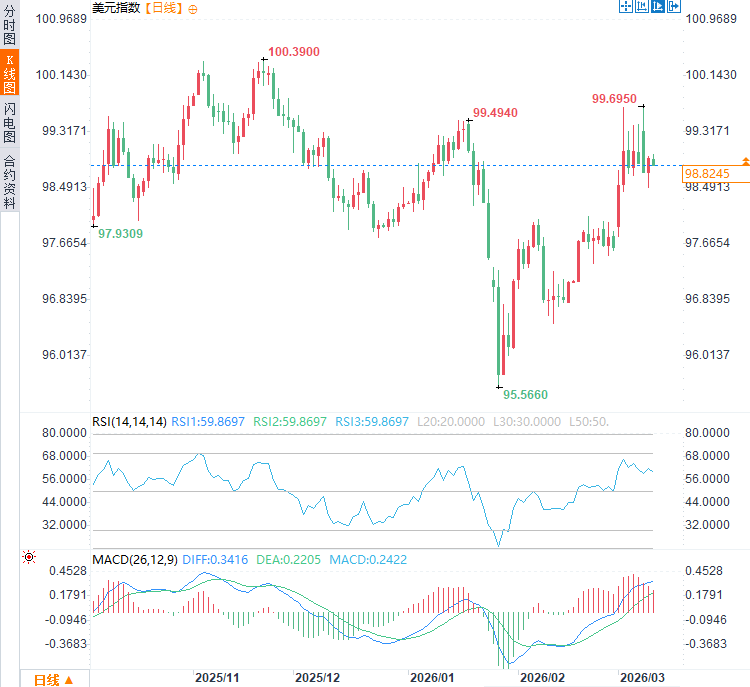
(US Dollar Index Daily Chart, Source: FX678)
Brent Schutte, chief investment officer at Northwestern Mutual, said: "The U.S. economy and markets are in a delicate balance, with the Federal Reserve walking a tightrope between weak labor and stubborn inflation."
RSM chief economist Joe Brusuelas warned that the oil price shock will push up inflation in April, and the Federal Reserve may be forced to maintain high interest rates for longer.
Investors should currently prepare for: a "long-term pause" rather than rapid interest rate cuts; persistently high real interest rates suppressing stock market valuations; inflation hedging demand supporting gold and commodities; and increased short-term volatility in energy and supply chain-related sectors.
Worst-case scenario: Oil prices return to triple digits and inflation rises above 3%, forcing the Federal Reserve to discuss restarting interest rate hikes, plunging the US economy into stagflation, and causing a double whammy for both the stock and bond markets.
At 10:10 Beijing time, the US dollar index is currently at 98.84.
The divergence between hawks and doves within the Federal Reserve has intensified, making this week's inflation data crucial. Geopolitical conflicts have pushed up oil prices, reigniting inflation concerns, but the February CPI is unlikely to have fully reflected the energy shock. The market has shifted towards hawkish pricing, and investors need to prepare for a prolonged pause in rate cuts.
The divergence between hawks and doves at the Federal Reserve is widening; this week's inflation data will be a key watershed.
The divergence between hawks and doves over the future path of monetary policy will directly determine the trend of interest rates throughout the year, how to deal with the energy shock caused by high oil prices, and whether investors should prepare for a "long-term pause in rate cuts" rather than a "rapid shift to easing."
Doves believe that a weakening labor market and fading price pressures from tariffs provide room for further interest rate cuts; hawks, on the other hand, emphasize the stubbornness of inflation and the excessive risk of short-term easing.
The market has clearly shifted to hawkish pricing, with futures indicating a 99.4% probability that interest rates will remain unchanged at next week's meeting, and the probability of keeping rates steady in June has surged from 24.8% a month ago to 57.3%.
Oil prices fluctuate at high levels, reigniting inflation risks.
The joint US-Israeli strikes against Iran disrupted the Strait of Hormuz, causing oil prices to reach around $119 per barrel earlier this week. The surge in energy costs directly pushed up inflation expectations. Gasoline, jet fuel, and transportation costs rose rapidly, raising market concerns that the energy shock would be fully transmitted to core CPI.
Economist Joe Brusuelas points out that the February inflation data, due to be released later on Wednesday, will hardly reflect the latest oil price shock. The real impact will be seen in the March CPI, to be released in April, when energy-related items such as gasoline and airfares will significantly boost headline inflation.
Inflation expectations are rising rapidly: the 1-year inflation swap rate has climbed, while the 2-year rate has risen by about 0.25 percentage points, as investors believe that inflation is likely to stabilize around 3% rather than quickly return to the 2% target.
Dovish: Weak labor market and easing tariff pressures warrant continued interest rate cuts.
Doves (including some board members and potential external successor Kevin Walsh) believe that: February's non-farm payrolls plummeted by 92,000 (affected by temporary factors such as weather and strikes), the unemployment rate rose to 4.4%, and the labor market weakened significantly; Trump's tariff plan is progressing slower than expected, and price pressures may subside; AI-driven productivity growth will curb inflation and create room for interest rate cuts.
Warsh publicly advocated for "rapid interest rate cuts," arguing that current policies are still too tight. However, the impact of oil price shocks and persistent inflation have suppressed dovish voices in the short term.
Hawks prevail: Inflation remains stubborn, short-term easing is not advisable.
Hawks (currently in the majority) emphasize that inflation has progressed unevenly over the past five years, with housing costs continuing to anchor to high levels of core inflation; geopolitical conflicts have pushed up energy prices, raising inflation risks again; and the weakness in the labor market may be exaggerated by temporary factors, with the strong January data also being distorted.
Hawks believe that premature easing before inflation clearly returns to the 2% target will undermine the hard-won gains in combating inflation. The market has already priced in the hawkish stance, with the probability of no change in June and July rising to 57.3% and 41.4%, respectively.
The futures market has undergone a significant correction, increasing the probability of no change in interest rates in June.
According to the CME FedWatch tool, there is a 99.4% probability that interest rates will remain unchanged at next week's meeting; the probability of keeping rates unchanged in June has surged from 24.8% a month ago to 57.3%; and the probability of keeping rates unchanged in July has risen from 15.3% to 41.4%.
The market has significantly repriced the "higher and longer" path, with investors expecting the Federal Reserve to remain patient and wait for inflation data and geopolitical risks to become clearer.
February's CPI and PCE will determine the direction of market expectations.
This week's two major inflation data releases will be key watershed moments: the February CPI will be released later on Wednesday, and the January PCE (the Fed's preferred indicator) will be released on Friday.
Economists expect the data to show a slight cooling in inflation, but it will still be well above the 2% target. The energy shock has not yet been fully reflected, and the March CPI in April will more clearly show the impact of oil prices. If the data is more stubborn than expected, the hawkish stance will be further solidified, and expectations for interest rate cuts will continue to be postponed.
Analysis of the impact of the US dollar
Driven by a combination of hawkish sentiment, renewed inflation risks, and market repricing, the US dollar is likely to maintain a volatile but slightly bullish trend in the near future. On Wednesday (March 11) during the Asian session, the US dollar index fluctuated narrowly around 98.85.
The sustainability of its strength will depend on whether subsequent inflation data can continue to validate the hawkish concerns. A sudden easing of geopolitical tensions is the biggest potential variable that could disrupt this trend.
(US Dollar Index Daily Chart, Source: FX678)
Investors need to be prepared for a long-term pause, rather than a rapid rate cut.
Brent Schutte, chief investment officer at Northwestern Mutual, said: "The U.S. economy and markets are in a delicate balance, with the Federal Reserve walking a tightrope between weak labor and stubborn inflation."
RSM chief economist Joe Brusuelas warned that the oil price shock will push up inflation in April, and the Federal Reserve may be forced to maintain high interest rates for longer.
Investors should currently prepare for: a "long-term pause" rather than rapid interest rate cuts; persistently high real interest rates suppressing stock market valuations; inflation hedging demand supporting gold and commodities; and increased short-term volatility in energy and supply chain-related sectors.
Worst-case scenario: Oil prices return to triple digits and inflation rises above 3%, forcing the Federal Reserve to discuss restarting interest rate hikes, plunging the US economy into stagflation, and causing a double whammy for both the stock and bond markets.
At 10:10 Beijing time, the US dollar index is currently at 98.84.
- Risk Warning and Disclaimer
- The market involves risk, and trading may not be suitable for all investors. This article is for reference only and does not constitute personal investment advice, nor does it take into account certain users’ specific investment objectives, financial situation, or other needs. Any investment decisions made based on this information are at your own risk.