Is a major intervention in the yen imminent? What will the fall in CPI and the disillusionment with interest rate hikes bring?
2026-03-11 17:55:48
On Wednesday, March 11, the USD/JPY exchange rate traded above 158 during the European session. As geopolitical tensions in the Middle East escalated, news that US intelligence indicated Iran might deploy mines in the Strait of Hormuz shattered market expectations for a quick resolution to the conflict, leading to a rapid return of dollar buying. On the fundamental front, US President Trump's earlier comments in an interview suggesting the war might end soon briefly triggered traders to unwind some of their hawkish interest rate expectations, causing the dollar to weaken across the board, further pressured by improved risk appetite; however, the dollar's rebound was established after the conflict outlook reversed.
The US Consumer Price Index (CPI) report will be released tonight. While the market's focus is on geopolitical risks, stronger-than-expected data could amplify inflation concerns, especially given the potential for rising oil prices, which would exacerbate future price pressures. In Japan, Prime Minister Sanae Takaichi's opposition, coupled with weak latest inflation data, has led to a continued postponement of expectations for a Bank of Japan interest rate hike. The Nikkei index is experiencing increased volatility due to risk aversion, and overall, there is a lack of momentum to support a stronger yen.
Uncertainty surrounding the Middle East conflict has become the core catalyst for the current USD/JPY exchange rate movement. Trump's statements initially repriced the Fed's rate-cutting path, easing hawkish bets and putting downward pressure on the dollar index. However, after US intelligence detected potential Iranian mine-laying activities along key shipping lanes, expectations of a quick reconciliation vanished. While risk aversion didn't fully erupt, it was enough to stimulate a return of dollar buying. Traders should note that this geopolitical driver differs from regular economic data; its sustainability depends on the evolution of the conflict: if tensions persist, the dollar's appeal as a safe-haven asset will remain; conversely, if signs of easing emerge, the dollar may face renewed profit-taking pressure. The upcoming US Consumer Price Index (CPI) data may have a less significant impact in this context, as investors have shifted their focus to the long-term oil price transmission effect. Even if the report is dovish, the market tends to view it as a lagging indicator; however, a strong core reading could reinforce the Fed's narrative of maintaining high interest rates, further solidifying the dollar's interest rate advantage against the yen.
Japan's consumer price index (CPI) fell to 1.5% year-on-year in January, a significant drop from the previous month's 2.1%, and fell below the Bank of Japan's (BOJ) 2% target range for the first time. This directly undermined market confidence in further tightening by the central bank. Core inflation also weakened to 2.0%, while the core-core index, excluding food and energy, was 2.6%, indicating an overall easing of price pressures. Prime Minister Sanae Takaichi recently expressed reservations about aggressive interest rate hikes during a meeting with BOJ Governor Kazuo Ueda, emphasizing the need to balance economic growth stability. This stance, combined with the weak data, makes it difficult for the BOJ to normalize its policy in the short term. Recent fluctuations in the Nikkei index due to Middle East risk aversion have further dampened corporate investment and consumption expectations, prolonging the period of economic pressure. This inflationary setback is not an isolated event, but rather the result of tax cuts and falling food prices. It will prolong the low-interest-rate environment and widen the policy divergence with major economies such as the United States.
The above comparison clearly shows that the interest rate differential between Japan and the US remains high, and the decline in Japanese inflation has directly amplified this gap, becoming an important fundamental support for the upward movement of USD/JPY.
The Bank of Japan's policy rate is currently maintained at 0.75%, while the Federal Reserve's interest rate range is significantly higher, and the interest rate differential structure continues to favor dollar assets. The former chief economist of the Bank of Japan recently pointed out that due to market volatility caused by the Middle East conflict, the central bank is likely to postpone the next rate hike to June or July, rather than the previously expected April. This statement contrasts with market pricing: although some traders still expect about two rate hikes this year, the latest polls show that the consensus has shifted to only one adjustment to 1% by the end of June, and optimism has clearly cooled. Prime Minister Sanae Takaichi's opposing stance further reinforces this cautious tone, and coupled with weak inflation data, the uncertainty of the rate hike path will continue to suppress the yen exchange rate. Traders need to be wary of the risk of pricing decoupling: if the actual pace of rate hikes is slower than expected, the cost advantage of arbitrage trading will be prolonged, and USD/JPY is likely to form a one-sided upward momentum; conversely, while a sudden hawkish signal may trigger a short-term pullback, the overall trend will still be dominated by the interest rate differential.
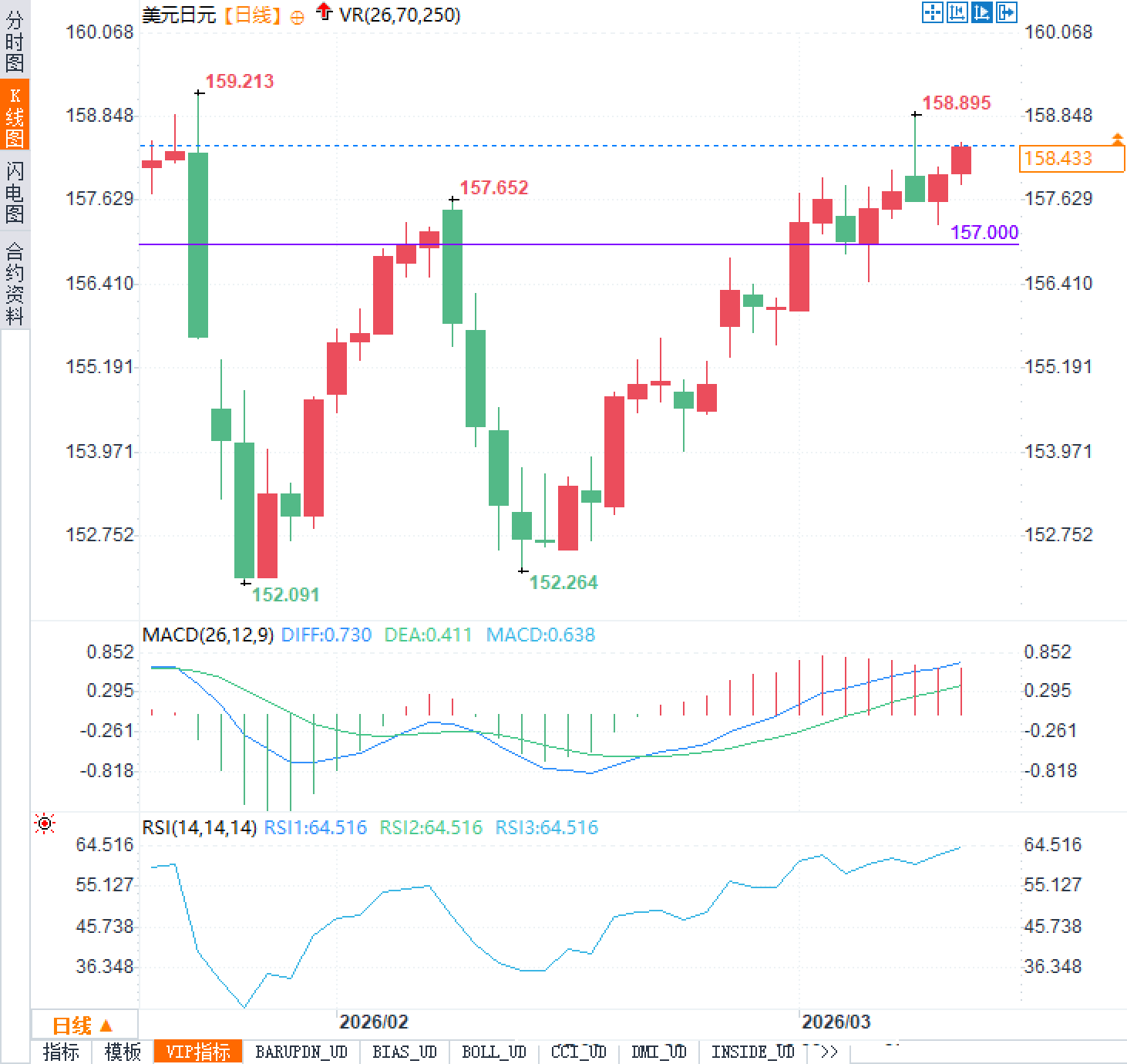
The USD/JPY exchange rate is currently trading around 158.5. The technical chart shows bullish momentum building, with short-term moving averages sloping upwards. A decisive break above 159 would put it directly in front of a historically sensitive intervention zone, with the market widely focused on potential intervention signals from the Japanese Ministry of Finance. Past interventions have primarily focused on periods of rapid currency depreciation, aiming to stabilize export costs and financial market expectations. In the current environment, geopolitical factors amplify the probability of a breakout: if tensions in the Middle East continue, dollar buying could accelerate the rise in the exchange rate to the psychological level of 160. Traders should pay attention to increased trading volume and changes in volatility indicators, as these signals often indicate an approaching intervention threshold. Although the Bank of Japan and the Ministry of Finance maintain close communication, weak data and policy divergence will limit the yen's upside potential, and the risk of a technical breakout warrants close monitoring.
The US Consumer Price Index (CPI) report will be released tonight. While the market's focus is on geopolitical risks, stronger-than-expected data could amplify inflation concerns, especially given the potential for rising oil prices, which would exacerbate future price pressures. In Japan, Prime Minister Sanae Takaichi's opposition, coupled with weak latest inflation data, has led to a continued postponement of expectations for a Bank of Japan interest rate hike. The Nikkei index is experiencing increased volatility due to risk aversion, and overall, there is a lack of momentum to support a stronger yen.
Geopolitical risks drive short-term resilience of the US dollar.
Uncertainty surrounding the Middle East conflict has become the core catalyst for the current USD/JPY exchange rate movement. Trump's statements initially repriced the Fed's rate-cutting path, easing hawkish bets and putting downward pressure on the dollar index. However, after US intelligence detected potential Iranian mine-laying activities along key shipping lanes, expectations of a quick reconciliation vanished. While risk aversion didn't fully erupt, it was enough to stimulate a return of dollar buying. Traders should note that this geopolitical driver differs from regular economic data; its sustainability depends on the evolution of the conflict: if tensions persist, the dollar's appeal as a safe-haven asset will remain; conversely, if signs of easing emerge, the dollar may face renewed profit-taking pressure. The upcoming US Consumer Price Index (CPI) data may have a less significant impact in this context, as investors have shifted their focus to the long-term oil price transmission effect. Even if the report is dovish, the market tends to view it as a lagging indicator; however, a strong core reading could reinforce the Fed's narrative of maintaining high interest rates, further solidifying the dollar's interest rate advantage against the yen.
Japan's declining inflation exacerbates policy dilemmas.
Japan's consumer price index (CPI) fell to 1.5% year-on-year in January, a significant drop from the previous month's 2.1%, and fell below the Bank of Japan's (BOJ) 2% target range for the first time. This directly undermined market confidence in further tightening by the central bank. Core inflation also weakened to 2.0%, while the core-core index, excluding food and energy, was 2.6%, indicating an overall easing of price pressures. Prime Minister Sanae Takaichi recently expressed reservations about aggressive interest rate hikes during a meeting with BOJ Governor Kazuo Ueda, emphasizing the need to balance economic growth stability. This stance, combined with the weak data, makes it difficult for the BOJ to normalize its policy in the short term. Recent fluctuations in the Nikkei index due to Middle East risk aversion have further dampened corporate investment and consumption expectations, prolonging the period of economic pressure. This inflationary setback is not an isolated event, but rather the result of tax cuts and falling food prices. It will prolong the low-interest-rate environment and widen the policy divergence with major economies such as the United States.
| index | Japan's January data | US January data |
|---|---|---|
| CPI year-on-year growth | 1.5% | 2.4% |
| Core CPI year-on-year growth | 2.0% | 2.5% |
| Policy interest rate level | 0.75% | 3.5%-3.75% |
Interest rate divergence and market pricing adjustments
The Bank of Japan's policy rate is currently maintained at 0.75%, while the Federal Reserve's interest rate range is significantly higher, and the interest rate differential structure continues to favor dollar assets. The former chief economist of the Bank of Japan recently pointed out that due to market volatility caused by the Middle East conflict, the central bank is likely to postpone the next rate hike to June or July, rather than the previously expected April. This statement contrasts with market pricing: although some traders still expect about two rate hikes this year, the latest polls show that the consensus has shifted to only one adjustment to 1% by the end of June, and optimism has clearly cooled. Prime Minister Sanae Takaichi's opposing stance further reinforces this cautious tone, and coupled with weak inflation data, the uncertainty of the rate hike path will continue to suppress the yen exchange rate. Traders need to be wary of the risk of pricing decoupling: if the actual pace of rate hikes is slower than expected, the cost advantage of arbitrage trading will be prolonged, and USD/JPY is likely to form a one-sided upward momentum; conversely, while a sudden hawkish signal may trigger a short-term pullback, the overall trend will still be dominated by the interest rate differential.
Technical Breakthrough and Intervention Risk Considerations
The USD/JPY exchange rate is currently trading around 158.5. The technical chart shows bullish momentum building, with short-term moving averages sloping upwards. A decisive break above 159 would put it directly in front of a historically sensitive intervention zone, with the market widely focused on potential intervention signals from the Japanese Ministry of Finance. Past interventions have primarily focused on periods of rapid currency depreciation, aiming to stabilize export costs and financial market expectations. In the current environment, geopolitical factors amplify the probability of a breakout: if tensions in the Middle East continue, dollar buying could accelerate the rise in the exchange rate to the psychological level of 160. Traders should pay attention to increased trading volume and changes in volatility indicators, as these signals often indicate an approaching intervention threshold. Although the Bank of Japan and the Ministry of Finance maintain close communication, weak data and policy divergence will limit the yen's upside potential, and the risk of a technical breakout warrants close monitoring.
Frequently Asked Questions
Question 1: Why is the USD/JPY pair consistently approaching intervention levels amid geopolitical conflicts?
A: The fluctuating conflict outlook directly drove a return of dollar buying: Trump's statements briefly pressured the dollar, but intelligence regarding the Strait of Hormuz in Iran reversed expectations, and the dollar regained support after risk aversion subsided. Meanwhile, declining Japanese inflation and a shift in interest rate hike expectations combined to widen the interest rate differential, further pushing the exchange rate up to around 158.5. This trend is not solely driven by the economic cycle, but rather a result of the combined effects of geopolitical and policy factors. In the short term, if the conflict does not ease, the exchange rate is likely to maintain upward pressure.
Question 2: What profound impact will the drop in Japan's January CPI to 1.5% have on the yen's exchange rate?
A: The figure falling below the 2% target, coupled with Prime Minister Sanae Takashi's opposition and fluctuations in the Nikkei index, directly weakened the Bank of Japan's tightening momentum. The market's initial pricing in two rate hikes this year was already optimistic, and the former chief economist's statement that rate hikes might be delayed until June or July further widened the Japan-US interest rate differential. The yen therefore lacks upward momentum, and its weakness will continue. Export companies will benefit in the short term but face long-term concerns about imported inflation.
Question 3: What potential impact will today's US Consumer Price Index report have on USD/JPY?
A: With the war at the center, the market may downplay mild data, viewing it as a lagging indicator; however, if the readings are overbought, it will reinforce concerns about inflation driven by oil prices, pushing the dollar further higher. Although the Fed's policy path is relatively clear, geopolitics remains the dominant variable. Overall, the report is unlikely to change the upward trend of USD/JPY, unless there are significant signs of easing tensions; otherwise, the risk of a breakout in the exchange rate remains.
- Risk Warning and Disclaimer
- The market involves risk, and trading may not be suitable for all investors. This article is for reference only and does not constitute personal investment advice, nor does it take into account certain users’ specific investment objectives, financial situation, or other needs. Any investment decisions made based on this information are at your own risk.