Is the Middle East conflict entering a "garbage time"? With extreme market conditions cooling down, oil prices may enter a period of high-level fluctuation.
2026-03-12 19:00:22
As of March 12, 2026, international oil prices have rebounded after a period of sharp fluctuations. Brent crude futures briefly touched around $99, while WTI crude remained stable above $90. Compared to the pre-conflict level of approximately $73, oil prices have still risen by about 30% overall.
However, unlike the panic buying in the market at the beginning of the conflict, current trading sentiment is clearly more restrained. As news of the war continues to emerge and the veracity of information becomes increasingly difficult to discern, the market is gradually entering a state of "aesthetic fatigue"—the conflict continues, but it is no longer likely to trigger the same emotional surge as at the beginning.
Against this backdrop, the crude oil market seems to be entering a typical "garbage time": there is a lot of news and even more noise, but fewer and fewer new variables that can truly change price trends.
Trump's "de-escalation narrative" suppresses extreme market conditions.
Since the outbreak of the conflict, US President Trump has repeatedly stated publicly that the war is "going well" and "will be over soon." Such statements almost always occurred during periods of rapid oil price increases and were quickly disseminated to the market through interviews, press conferences, or social media.
For example, on March 9, when Brent crude oil prices approached $120, Trump reiterated that the war was "far ahead of schedule." The market quickly adjusted its expectations. On March 11, oil prices fell by nearly 12% in a single day, marking one of the largest drops in recent times.
As similar statements continue to emerge, the market has gradually developed a kind of "conditioned reflex": whenever the White House signals that the conflict may end quickly, the geopolitical risk premium rapidly declines. As a result, although oil prices remain highly volatile throughout the day, the upward momentum tends to falter whenever prices approach the panic zone.
This "anticipation cooling mechanism" has significantly suppressed the sustainability of extreme price increases in the short term.
Releasing strategic reserves cannot resolve the core contradictions.
To ease tensions in the energy market, the International Energy Agency (IEA) announced that its 32 member countries would jointly release approximately 400 million barrels of strategic petroleum reserves. The United States subsequently authorized the release of an additional 172 million barrels of crude oil reserves, marking a new high in recent years.
However, the market did not react strongly to this move. Oil prices briefly fell after the announcement, but quickly rebounded.
The reason is not complicated: the release of strategic reserves is more of a short-term liquidity tool than a structural solution. What truly determines the risk premium for oil prices remains the security of energy transportation in the Middle East.
The Strait of Hormuz handles about one-fifth of the world's oil shipments; any disruption to shipping would quickly strain the global supply chain. The current conflict has significantly increased shipping risks in the region, with several shipping companies already adjusting routes or raising insurance rates. As long as this risk is not substantially mitigated, market concerns about supply disruptions will be difficult to dispel.
Some institutions have also stated that simply releasing reserves is not enough to suppress rising oil prices. If the conflict lasts longer than expected, the buffering effect of releasing reserves will weaken rapidly.
The narrative of "$200 oil price" is losing its impact.
Iran has recently issued multiple warnings that a deteriorating regional security situation could push oil prices up to $200 per barrel. While such statements initially triggered significant market volatility in the early stages of the conflict, their marginal impact has noticeably diminished as similar pronouncements have been repeated.
Investors are gradually realizing that such statements are more of a psychological tactic or a political signal than a price path that can be realized in the short term. Therefore, the stimulating effect of such statements on the market has significantly diminished.
Of course, if the conflict escalates to the point of damaging major energy infrastructure, oil prices could still experience another sharp rise. However, at this stage, the market is already pricing in these extreme scenarios with significantly greater caution.
Fundamental Game: Supply Shocks and Demand Pressures Coexist
From a fundamental perspective, the crude oil market is currently experiencing a typical "supply shock" phase.
Increased shipping risks in the Hormuz region and damage to some refining facilities have temporarily rendered approximately 1.9 million barrels per day of refining capacity in the Middle East idle. Meanwhile, OPEC+ has not yet signaled a significant increase in production, and non-OPEC oil-producing countries such as Russia are unlikely to rapidly expand supply in the short term.
However, demand factors are also beginning to emerge. High oil prices have gradually been transmitted to the end market, with gasoline prices in Europe and the United States rising significantly, aviation fuel costs continuing to climb, and Asian importing countries facing higher imported inflationary pressures.
If oil prices remain high for too long, the demand-damaging effect may gradually emerge, thus exerting a reverse constraint on prices.
In addition, speculative funds have begun to reduce their risk exposure. Latest data shows that hedge funds' net long positions in crude oil futures have decreased significantly since the end of February, indicating that some funds are locking in profits and reducing geopolitical bets.
Technical Analysis
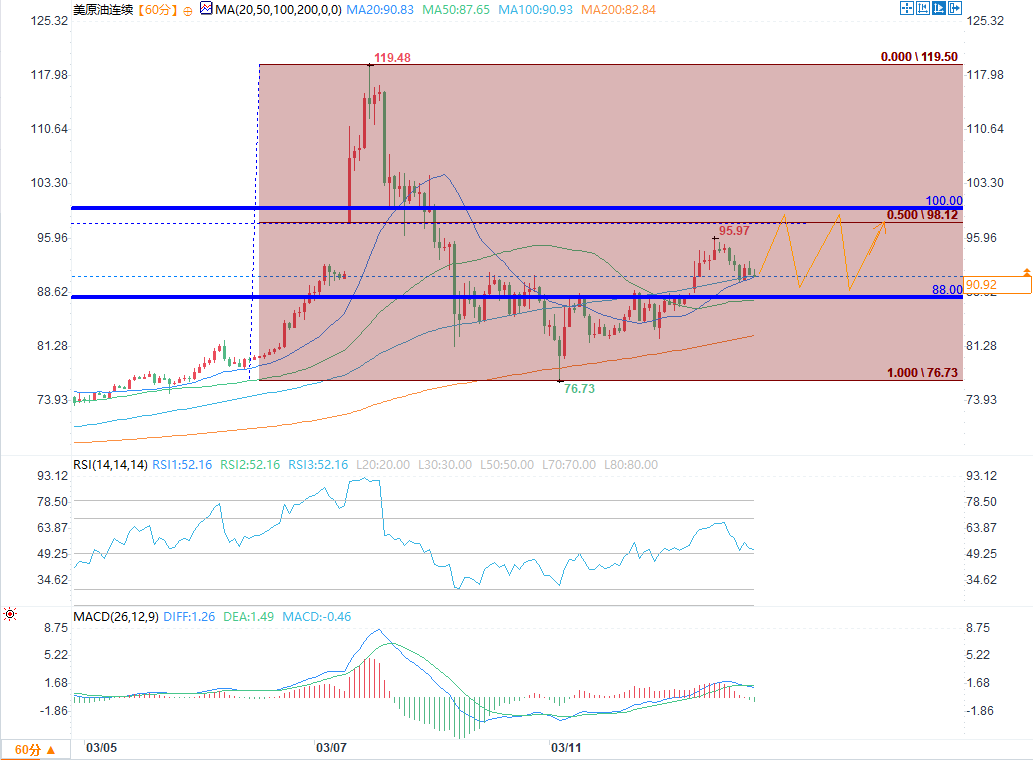
(WTI crude oil 1-hour chart source: EasyForex)
WTI crude oil prices are likely to fluctuate within a wide range of 88.00–100.00 in the future. The 50% retracement level of the decline from the high of 119.48 to the low of 76.73 is approximately 98.12, forming a strong resistance zone above the 100.00 psychological level. The 50-day moving average (MA50) around 88 USD provides strong support at the lower end of this range.
In the short term, both the upper and lower support levels are quite strong, and there are no clear one-sided trend signals yet. An upward breakout would require a significant volume breakout and a firm hold above 95.97 before challenging the 98.12 and 100.00 levels. A downward breakout would require a decisive breach of 88.00 to open up room for a correction towards 82.84 (MA200). The core trading strategy remains focused on buying low and selling high within the range, waiting for a valid breakout before following the trend.
Support and Resistance
Resistance levels: 95.97 (recent high) → 98.12 (50% Fibonacci retracement level) → 100.00 (upper limit of the range + psychological level)
Support levels: 90.93 (MA50) → 88.00 (lower edge of the range + MA50) → 82.84 (MA200 moving average)
in conclusion
Considering current factors, the crude oil market is more likely to enter a period of high-level fluctuation in the short term, rather than continuing to experience one-sided extreme market conditions.
However, unlike the panic buying in the market at the beginning of the conflict, current trading sentiment is clearly more restrained. As news of the war continues to emerge and the veracity of information becomes increasingly difficult to discern, the market is gradually entering a state of "aesthetic fatigue"—the conflict continues, but it is no longer likely to trigger the same emotional surge as at the beginning.
Against this backdrop, the crude oil market seems to be entering a typical "garbage time": there is a lot of news and even more noise, but fewer and fewer new variables that can truly change price trends.
Trump's "de-escalation narrative" suppresses extreme market conditions.
Since the outbreak of the conflict, US President Trump has repeatedly stated publicly that the war is "going well" and "will be over soon." Such statements almost always occurred during periods of rapid oil price increases and were quickly disseminated to the market through interviews, press conferences, or social media.
For example, on March 9, when Brent crude oil prices approached $120, Trump reiterated that the war was "far ahead of schedule." The market quickly adjusted its expectations. On March 11, oil prices fell by nearly 12% in a single day, marking one of the largest drops in recent times.
As similar statements continue to emerge, the market has gradually developed a kind of "conditioned reflex": whenever the White House signals that the conflict may end quickly, the geopolitical risk premium rapidly declines. As a result, although oil prices remain highly volatile throughout the day, the upward momentum tends to falter whenever prices approach the panic zone.
This "anticipation cooling mechanism" has significantly suppressed the sustainability of extreme price increases in the short term.
Releasing strategic reserves cannot resolve the core contradictions.
To ease tensions in the energy market, the International Energy Agency (IEA) announced that its 32 member countries would jointly release approximately 400 million barrels of strategic petroleum reserves. The United States subsequently authorized the release of an additional 172 million barrels of crude oil reserves, marking a new high in recent years.
However, the market did not react strongly to this move. Oil prices briefly fell after the announcement, but quickly rebounded.
The reason is not complicated: the release of strategic reserves is more of a short-term liquidity tool than a structural solution. What truly determines the risk premium for oil prices remains the security of energy transportation in the Middle East.
The Strait of Hormuz handles about one-fifth of the world's oil shipments; any disruption to shipping would quickly strain the global supply chain. The current conflict has significantly increased shipping risks in the region, with several shipping companies already adjusting routes or raising insurance rates. As long as this risk is not substantially mitigated, market concerns about supply disruptions will be difficult to dispel.
Some institutions have also stated that simply releasing reserves is not enough to suppress rising oil prices. If the conflict lasts longer than expected, the buffering effect of releasing reserves will weaken rapidly.
The narrative of "$200 oil price" is losing its impact.
Iran has recently issued multiple warnings that a deteriorating regional security situation could push oil prices up to $200 per barrel. While such statements initially triggered significant market volatility in the early stages of the conflict, their marginal impact has noticeably diminished as similar pronouncements have been repeated.
Investors are gradually realizing that such statements are more of a psychological tactic or a political signal than a price path that can be realized in the short term. Therefore, the stimulating effect of such statements on the market has significantly diminished.
Of course, if the conflict escalates to the point of damaging major energy infrastructure, oil prices could still experience another sharp rise. However, at this stage, the market is already pricing in these extreme scenarios with significantly greater caution.
Fundamental Game: Supply Shocks and Demand Pressures Coexist
From a fundamental perspective, the crude oil market is currently experiencing a typical "supply shock" phase.
Increased shipping risks in the Hormuz region and damage to some refining facilities have temporarily rendered approximately 1.9 million barrels per day of refining capacity in the Middle East idle. Meanwhile, OPEC+ has not yet signaled a significant increase in production, and non-OPEC oil-producing countries such as Russia are unlikely to rapidly expand supply in the short term.
However, demand factors are also beginning to emerge. High oil prices have gradually been transmitted to the end market, with gasoline prices in Europe and the United States rising significantly, aviation fuel costs continuing to climb, and Asian importing countries facing higher imported inflationary pressures.
If oil prices remain high for too long, the demand-damaging effect may gradually emerge, thus exerting a reverse constraint on prices.
In addition, speculative funds have begun to reduce their risk exposure. Latest data shows that hedge funds' net long positions in crude oil futures have decreased significantly since the end of February, indicating that some funds are locking in profits and reducing geopolitical bets.
Technical Analysis
(WTI crude oil 1-hour chart source: EasyForex)
WTI crude oil prices are likely to fluctuate within a wide range of 88.00–100.00 in the future. The 50% retracement level of the decline from the high of 119.48 to the low of 76.73 is approximately 98.12, forming a strong resistance zone above the 100.00 psychological level. The 50-day moving average (MA50) around 88 USD provides strong support at the lower end of this range.
In the short term, both the upper and lower support levels are quite strong, and there are no clear one-sided trend signals yet. An upward breakout would require a significant volume breakout and a firm hold above 95.97 before challenging the 98.12 and 100.00 levels. A downward breakout would require a decisive breach of 88.00 to open up room for a correction towards 82.84 (MA200). The core trading strategy remains focused on buying low and selling high within the range, waiting for a valid breakout before following the trend.
Support and Resistance
Resistance levels: 95.97 (recent high) → 98.12 (50% Fibonacci retracement level) → 100.00 (upper limit of the range + psychological level)
Support levels: 90.93 (MA50) → 88.00 (lower edge of the range + MA50) → 82.84 (MA200 moving average)
in conclusion
Considering current factors, the crude oil market is more likely to enter a period of high-level fluctuation in the short term, rather than continuing to experience one-sided extreme market conditions.
- Risk Warning and Disclaimer
- The market involves risk, and trading may not be suitable for all investors. This article is for reference only and does not constitute personal investment advice, nor does it take into account certain users’ specific investment objectives, financial situation, or other needs. Any investment decisions made based on this information are at your own risk.