Gold Trading Alert: Middle East War Blocks "World Oil Valve"! Gold Prices Plunge Nearly 2%, Is the $5000 Level About to Collapse? Pay Attention to the US PCE
2026-03-13 07:47:43
Global financial markets are experiencing unprecedented turmoil, and gold, as the traditional king of safe havens, has seen a rollercoaster ride amid this geopolitical storm. On Thursday (March 12), spot gold prices fell sharply by 1.88%, closing near $5079.25 per ounce, with futures prices also declining, indicating intense competition among multiple forces in the short term. However, looking at a longer timeframe, gold has surged from its lows at the beginning of the year to record highs, a remarkable increase. This seemingly contradictory performance precisely reflects the extremely complex macroeconomic and geopolitical environment. On Friday (March 13) in early Asian trading, spot gold traded in a narrow range, currently hovering around $5096 per ounce.
Thursday's sharp drop in gold prices was mainly due to the direct impact of the US dollar index strengthening for the third consecutive trading day. As one of the world's main safe-haven currencies, the appreciation of the US dollar directly increased the cost of purchasing gold denominated in US dollars for holders of other currencies, leading to a weakening of the buying willingness of non-US dollar investors.
Meanwhile, U.S. Treasury yields rose significantly, with the two-year yield hitting a multi-month high, reflecting a re-anchoring of market expectations for inflation. Expectations for a Fed rate-cutting path have shifted considerably later, with traders now anticipating only about 19 basis points of cuts by the end of the year, far below the previous optimistic assumption of 50 basis points. This high-interest-rate environment naturally puts downward pressure on gold, a non-interest-bearing asset, as funds tend to flow to higher-yielding bonds or cash-like products.
Nevertheless, some institutional strategists point out that while the negative impact of a stronger dollar and rising yields has dominated short-term market movements, it has not completely erased the structural support for gold. Safe-haven demand stemming from escalating Middle East conflicts continues to flow in, albeit temporarily overshadowed by the stronger dollar factor.
The most crucial driver of current gold price volatility is undoubtedly the rapidly escalating conflict in the Middle East. Iran's new Supreme Leader, Mojtaba Khamenei, publicly vowed to close the Strait of Hormuz and launched multiple strikes against US military targets in the Middle East, including missile and drone attacks on the US Fifth Fleet base in Bahrain, and claims to have destroyed 70% of US military bases and command centers in the region. These actions directly led to a series of incidents, including two oil tankers catching fire in Iraqi waters and a US refueling plane crashing, causing oil prices to surge by nearly 10% in a single day, approaching the $100 per barrel mark.
The Strait of Hormuz is a vital waterway for approximately 20% of the world's oil and a significant amount of natural gas transportation. A prolonged disruption would trigger the largest energy supply crisis in history. The International Energy Agency's emergency release of 400 million barrels of strategic reserves can only temporarily cover the shortfall for about 20 days, and the release process will take weeks to months. Soaring energy prices will quickly translate into global production and transportation costs, pushing up inflation expectations. Gold, as a classic inflation hedge, should have received strong support under such stagflation concerns. Ironically, however, the combination of high inflation and high interest rates has significantly increased the opportunity cost of holding gold, weakening its appeal in the short term. This is the fundamental logic behind the dramatic fluctuations in gold prices under the dual pressure of safe-haven demand and real interest rates.
Beyond short-term fluctuations, gold's long-term fundamentals remain solid. The Central Bank of Chile announced its first large-scale gold purchase since at least 2000, with its gold reserves surging from $42 million to $1.108 billion in February, representing 2.2% of its total reserves. This move is not an isolated case; in recent years, many central banks have continuously increased their gold holdings to hedge against the risks of dollar hegemony and geopolitical uncertainties. Central bank demand provides strong support for gold prices, making a systemic collapse unlikely even in the event of a short-term pullback.
Compared to gold, silver has performed even better. Although it fell 2% on Thursday, its 2025 growth rate has already exceeded 146%, and BMI predicts that the average price of silver will reach $93 per ounce in 2026. Silver possesses both precious metal and industrial attributes, and driven by both new energy and investment demand, its elasticity far surpasses that of gold. It may become another important target for capital outflow in the future.
In the short term, next week's Federal Reserve meeting will be a key juncture. The market is closely watching whether the Fed will remove the "dovish bias" from its policy statement and adjust its expectation for rate cuts this year from one to zero. If the Fed adopts a more hawkish stance due to the energy shock, gold prices may further test support below the $5,000 level. However, as long as the Middle East conflict does not show substantial easing, oil prices remain high, and inflation expectations continue to rise, safe-haven buying of gold will not truly subside.
From a medium- to long-term perspective, the gold market in 2026 is destined to be anything but calm. Frequent geopolitical black swan events, continued central bank gold purchases, and concerns about the credibility of the US dollar—these structural factors collectively form the foundation for a super bull market in gold. The current pullback is more like a respite in a storm than a trend reversal. For investors, this may be a strategic window to buy at higher levels or add to positions on dips—after all, in this era of uncertainty, gold has never been a tool for quick profits, but rather the last line of defense for wealth.
The US January PCE data will be released today, which is one of the key inflation indicators that the Federal Reserve focuses on, and investors need to pay close attention.
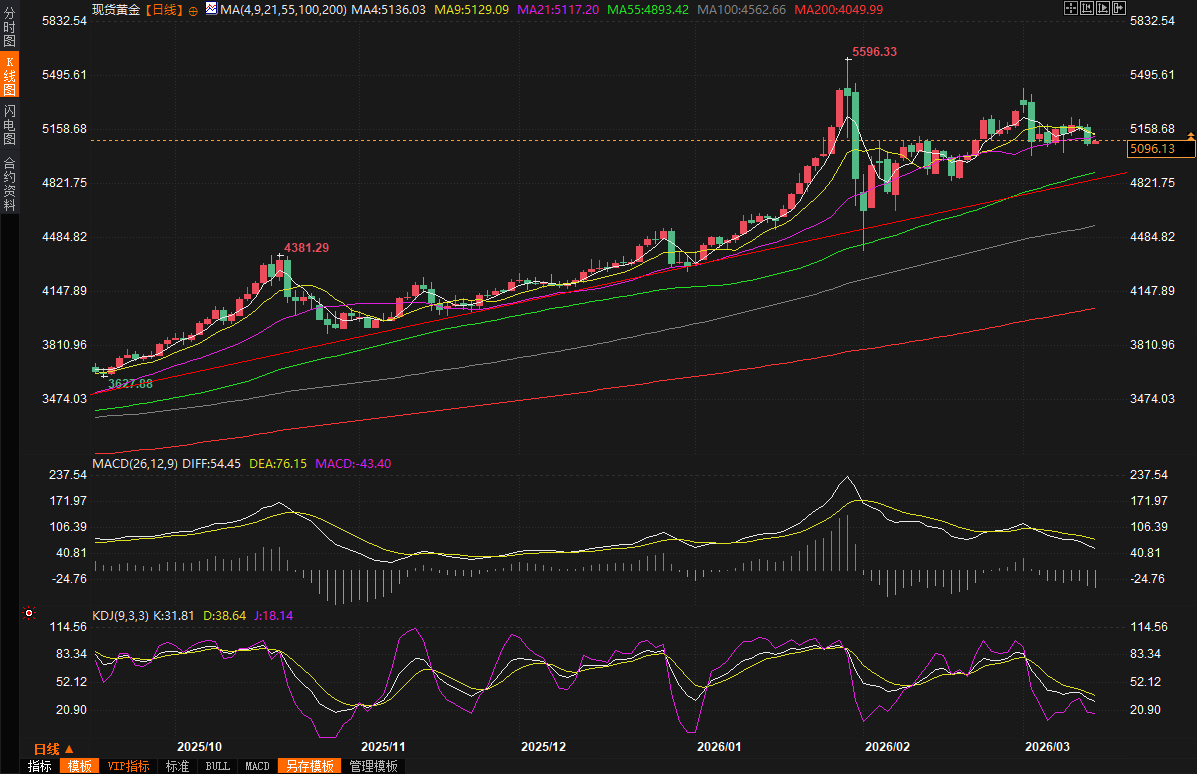
(Spot gold daily chart, source: FX678)
At 07:45 Beijing time, spot gold is currently trading at $5095.35 per ounce.
A strong US dollar and expectations of interest rate cuts are both putting downward pressure on gold prices in the short term.
Thursday's sharp drop in gold prices was mainly due to the direct impact of the US dollar index strengthening for the third consecutive trading day. As one of the world's main safe-haven currencies, the appreciation of the US dollar directly increased the cost of purchasing gold denominated in US dollars for holders of other currencies, leading to a weakening of the buying willingness of non-US dollar investors.
Meanwhile, U.S. Treasury yields rose significantly, with the two-year yield hitting a multi-month high, reflecting a re-anchoring of market expectations for inflation. Expectations for a Fed rate-cutting path have shifted considerably later, with traders now anticipating only about 19 basis points of cuts by the end of the year, far below the previous optimistic assumption of 50 basis points. This high-interest-rate environment naturally puts downward pressure on gold, a non-interest-bearing asset, as funds tend to flow to higher-yielding bonds or cash-like products.
Nevertheless, some institutional strategists point out that while the negative impact of a stronger dollar and rising yields has dominated short-term market movements, it has not completely erased the structural support for gold. Safe-haven demand stemming from escalating Middle East conflicts continues to flow in, albeit temporarily overshadowed by the stronger dollar factor.
The Strait of Hormuz "chokehold" crisis: How soaring oil prices indirectly reshape the gold narrative
The most crucial driver of current gold price volatility is undoubtedly the rapidly escalating conflict in the Middle East. Iran's new Supreme Leader, Mojtaba Khamenei, publicly vowed to close the Strait of Hormuz and launched multiple strikes against US military targets in the Middle East, including missile and drone attacks on the US Fifth Fleet base in Bahrain, and claims to have destroyed 70% of US military bases and command centers in the region. These actions directly led to a series of incidents, including two oil tankers catching fire in Iraqi waters and a US refueling plane crashing, causing oil prices to surge by nearly 10% in a single day, approaching the $100 per barrel mark.
The Strait of Hormuz is a vital waterway for approximately 20% of the world's oil and a significant amount of natural gas transportation. A prolonged disruption would trigger the largest energy supply crisis in history. The International Energy Agency's emergency release of 400 million barrels of strategic reserves can only temporarily cover the shortfall for about 20 days, and the release process will take weeks to months. Soaring energy prices will quickly translate into global production and transportation costs, pushing up inflation expectations. Gold, as a classic inflation hedge, should have received strong support under such stagflation concerns. Ironically, however, the combination of high inflation and high interest rates has significantly increased the opportunity cost of holding gold, weakening its appeal in the short term. This is the fundamental logic behind the dramatic fluctuations in gold prices under the dual pressure of safe-haven demand and real interest rates.
The central bank gold rush continues, with Chile's first major entry sending a long-term signal.
Beyond short-term fluctuations, gold's long-term fundamentals remain solid. The Central Bank of Chile announced its first large-scale gold purchase since at least 2000, with its gold reserves surging from $42 million to $1.108 billion in February, representing 2.2% of its total reserves. This move is not an isolated case; in recent years, many central banks have continuously increased their gold holdings to hedge against the risks of dollar hegemony and geopolitical uncertainties. Central bank demand provides strong support for gold prices, making a systemic collapse unlikely even in the event of a short-term pullback.
Compared to gold, silver has performed even better. Although it fell 2% on Thursday, its 2025 growth rate has already exceeded 146%, and BMI predicts that the average price of silver will reach $93 per ounce in 2026. Silver possesses both precious metal and industrial attributes, and driven by both new energy and investment demand, its elasticity far surpasses that of gold. It may become another important target for capital outflow in the future.
Market Outlook: The Tripartite Game Between the War, Inflation, and the Federal Reserve Will Determine the Direction
In the short term, next week's Federal Reserve meeting will be a key juncture. The market is closely watching whether the Fed will remove the "dovish bias" from its policy statement and adjust its expectation for rate cuts this year from one to zero. If the Fed adopts a more hawkish stance due to the energy shock, gold prices may further test support below the $5,000 level. However, as long as the Middle East conflict does not show substantial easing, oil prices remain high, and inflation expectations continue to rise, safe-haven buying of gold will not truly subside.
From a medium- to long-term perspective, the gold market in 2026 is destined to be anything but calm. Frequent geopolitical black swan events, continued central bank gold purchases, and concerns about the credibility of the US dollar—these structural factors collectively form the foundation for a super bull market in gold. The current pullback is more like a respite in a storm than a trend reversal. For investors, this may be a strategic window to buy at higher levels or add to positions on dips—after all, in this era of uncertainty, gold has never been a tool for quick profits, but rather the last line of defense for wealth.
The US January PCE data will be released today, which is one of the key inflation indicators that the Federal Reserve focuses on, and investors need to pay close attention.
(Spot gold daily chart, source: FX678)
At 07:45 Beijing time, spot gold is currently trading at $5095.35 per ounce.
- Risk Warning and Disclaimer
- The market involves risk, and trading may not be suitable for all investors. This article is for reference only and does not constitute personal investment advice, nor does it take into account certain users’ specific investment objectives, financial situation, or other needs. Any investment decisions made based on this information are at your own risk.