Oil prices surge as the dollar approaches 160 against the yen, further stalling the Bank of Japan's interest rate hike plans.
2026-03-16 15:13:37
Against the backdrop of escalating conflicts between the US and Israel in the Middle East and Iran, and the disruption of shipping in the Strait of Hormuz leading to sharp fluctuations in global energy prices, Japan's economy and monetary policy are facing an unprecedented dilemma.
The Bank of Japan was originally committed to achieving its 2% stable inflation target through wage growth and domestic demand, but imported inflationary pressures from soaring oil prices are seriously disrupting this path.
While the Bank of Japan's policymakers still favor continuing to raise interest rates, geopolitical uncertainties, financial market volatility, and the government's priority on economic growth make it highly unlikely that action will be taken at this week's policy meeting. The market is betting on a rate hike in April with a 60% probability, but even if a rate hike occurs then, the pace of tightening may be slower than the economic fundamentals require.

The conflict in Iran has pushed Brent crude oil prices to around $100 a barrel, a shock that has dealt a double blow to Japan's heavily import-dependent economy. On the one hand, soaring energy prices have directly boosted overall inflation, seemingly providing a veneer justification for interest rate hikes; on the other hand, high import costs are hurting consumer spending and placing a heavy burden on businesses, especially small and medium-sized enterprises already struggling with rising raw material prices.
"If oil prices remain high or continue to rise, there is a risk of a vicious cycle where a worsening trade deficit leads to a weaker yen, which in turn pushes up import prices," said Kenji Yamamoto, an economist at Daiwa Securities. He added, "Imported inflation caused by a weak yen can accumulate upside risks over time. In the medium to long term, this increases the likelihood that policy responses will lag behind the situation, effectively allowing inflationary 'magma' to build up beneath the surface."
Bank of Japan Governor Kazuo Ueda has acknowledged that exchange rate fluctuations are now more easily transmitted to domestic prices than in the past, as businesses are more comfortable passing on increased costs to consumers.
Sources within the decision-making body revealed that despite geopolitical turmoil, Bank of Japan officials remain committed to pursuing interest rate hikes, but given the instability in financial markets and the high degree of uncertainty in the Middle East, it is highly unlikely that any action will be taken at this week's meeting.
Kenji Yamamoto predicts that the Bank of Japan will wait until April to raise its policy rate. He stated, "Whether the Bank of Japan can raise interest rates in April will likely be a turning point in determining market confidence in the Bank of Japan's continued tightening strategy."
He added that Prime Minister Sanae Kaohsiung prefers a looser monetary environment to support economic growth, which could slow the pace of tightening compared to what economic fundamentals require.
Japanese stocks continued to be pressured by the dual impact of the potential protracted Iranian crisis, rising energy prices, and a weakening yen. On Monday, the Nikkei 225 index fell as much as 1.3% to 53,113.95 points, while the broader Topix index fell as much as 0.7% to 3,602.71 points. Since the US and Israel began airstrikes against Iran more than two weeks ago, the Nikkei index has fallen by nearly 9%.
"The market seems increasingly worried about stagflation, where economies are simultaneously plagued by rising inflation and slowing growth," said Maki Sawada, an equity strategist at Nomura Securities. She added, "Concerns about rising oil prices leading to an economic slowdown are being priced in. What we're seeing is that these domestic demand sectors are performing strongly, supporting the Japanese stock market, rather than today's widespread decline."
Japanese Prime Minister Sanae Takaichi stated that Japan currently has no plans to send naval vessels to escort ships in the Middle East.
Finance Minister Satsuki Katayama stated that the government is prepared to take decisive measures in the financial markets as the yen has fallen to near the psychological threshold of 160 against the dollar.
The Japanese government is trying to cushion the impact on the real economy by providing gasoline subsidies and releasing oil reserves, but it still faces a more systemic challenge: the continued weakness of the yen and the accumulated risk of imported inflation.
Overall , the energy price shock and stagflation concerns triggered by the Iranian crisis are pushing the Bank of Japan to a policy crossroads. Raising interest rates could curb imported inflation and yen depreciation, but could stifle the fragile recovery; remaining on hold could exacerbate runaway inflation expectations and further currency weakness. Market expectations for a rate hike this week are almost zero, with a 60% chance of a hike in April, but even if action is taken then, the pace of tightening is likely to be slow.
There is a clear tension between the Sanae Takaichi government's priority on economic growth and the Bank of Japan's goal of pursuing price stability.
In the coming months, the direction of Japan's economic and monetary policies will depend heavily on the development of the situation in the Middle East, the actual trend of oil prices, and the stability of the yen exchange rate.
Investors should closely monitor the Bank of Japan's April meeting and its latest economic and price forecasts to assess the true strength and pace of the policy shift. In the short term, the Nikkei index and the yen may continue to be under pressure, with stagflation risk becoming a new core variable in Asian financial markets.
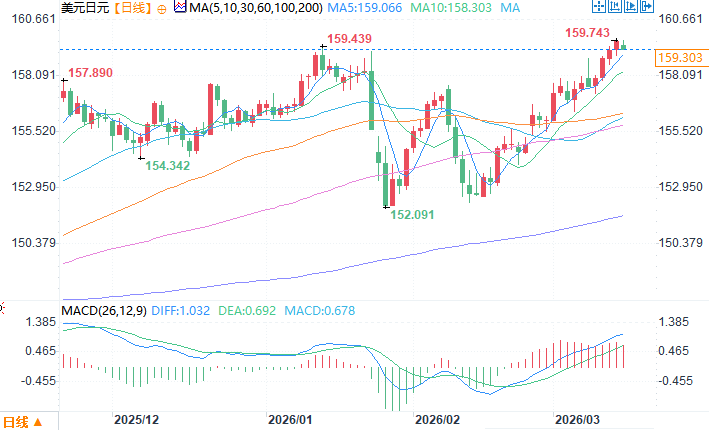
USD/JPY Daily Chart Source: EasyForex
At 15:12 Beijing time on March 16, the USD/JPY exchange rate was 159.20/21.
The Bank of Japan was originally committed to achieving its 2% stable inflation target through wage growth and domestic demand, but imported inflationary pressures from soaring oil prices are seriously disrupting this path.
While the Bank of Japan's policymakers still favor continuing to raise interest rates, geopolitical uncertainties, financial market volatility, and the government's priority on economic growth make it highly unlikely that action will be taken at this week's policy meeting. The market is betting on a rate hike in April with a 60% probability, but even if a rate hike occurs then, the pace of tightening may be slower than the economic fundamentals require.
Rising oil prices are a double-edged sword: rising inflation hurts growth.
The conflict in Iran has pushed Brent crude oil prices to around $100 a barrel, a shock that has dealt a double blow to Japan's heavily import-dependent economy. On the one hand, soaring energy prices have directly boosted overall inflation, seemingly providing a veneer justification for interest rate hikes; on the other hand, high import costs are hurting consumer spending and placing a heavy burden on businesses, especially small and medium-sized enterprises already struggling with rising raw material prices.
"If oil prices remain high or continue to rise, there is a risk of a vicious cycle where a worsening trade deficit leads to a weaker yen, which in turn pushes up import prices," said Kenji Yamamoto, an economist at Daiwa Securities. He added, "Imported inflation caused by a weak yen can accumulate upside risks over time. In the medium to long term, this increases the likelihood that policy responses will lag behind the situation, effectively allowing inflationary 'magma' to build up beneath the surface."
The Bank of Japan faces another dilemma: raise interest rates or remain on hold?
Bank of Japan Governor Kazuo Ueda has acknowledged that exchange rate fluctuations are now more easily transmitted to domestic prices than in the past, as businesses are more comfortable passing on increased costs to consumers.
Sources within the decision-making body revealed that despite geopolitical turmoil, Bank of Japan officials remain committed to pursuing interest rate hikes, but given the instability in financial markets and the high degree of uncertainty in the Middle East, it is highly unlikely that any action will be taken at this week's meeting.
Kenji Yamamoto predicts that the Bank of Japan will wait until April to raise its policy rate. He stated, "Whether the Bank of Japan can raise interest rates in April will likely be a turning point in determining market confidence in the Bank of Japan's continued tightening strategy."
He added that Prime Minister Sanae Kaohsiung prefers a looser monetary environment to support economic growth, which could slow the pace of tightening compared to what economic fundamentals require.
The Nikkei index fell for the third consecutive day as the market digested concerns about stagflation.
Japanese stocks continued to be pressured by the dual impact of the potential protracted Iranian crisis, rising energy prices, and a weakening yen. On Monday, the Nikkei 225 index fell as much as 1.3% to 53,113.95 points, while the broader Topix index fell as much as 0.7% to 3,602.71 points. Since the US and Israel began airstrikes against Iran more than two weeks ago, the Nikkei index has fallen by nearly 9%.
"The market seems increasingly worried about stagflation, where economies are simultaneously plagued by rising inflation and slowing growth," said Maki Sawada, an equity strategist at Nomura Securities. She added, "Concerns about rising oil prices leading to an economic slowdown are being priced in. What we're seeing is that these domestic demand sectors are performing strongly, supporting the Japanese stock market, rather than today's widespread decline."
The government's reluctance to send warships to escort ships has pushed the yen close to the psychological threshold of 160.
Japanese Prime Minister Sanae Takaichi stated that Japan currently has no plans to send naval vessels to escort ships in the Middle East.
Finance Minister Satsuki Katayama stated that the government is prepared to take decisive measures in the financial markets as the yen has fallen to near the psychological threshold of 160 against the dollar.
The Japanese government is trying to cushion the impact on the real economy by providing gasoline subsidies and releasing oil reserves, but it still faces a more systemic challenge: the continued weakness of the yen and the accumulated risk of imported inflation.
Overall , the energy price shock and stagflation concerns triggered by the Iranian crisis are pushing the Bank of Japan to a policy crossroads. Raising interest rates could curb imported inflation and yen depreciation, but could stifle the fragile recovery; remaining on hold could exacerbate runaway inflation expectations and further currency weakness. Market expectations for a rate hike this week are almost zero, with a 60% chance of a hike in April, but even if action is taken then, the pace of tightening is likely to be slow.
There is a clear tension between the Sanae Takaichi government's priority on economic growth and the Bank of Japan's goal of pursuing price stability.
In the coming months, the direction of Japan's economic and monetary policies will depend heavily on the development of the situation in the Middle East, the actual trend of oil prices, and the stability of the yen exchange rate.
Investors should closely monitor the Bank of Japan's April meeting and its latest economic and price forecasts to assess the true strength and pace of the policy shift. In the short term, the Nikkei index and the yen may continue to be under pressure, with stagflation risk becoming a new core variable in Asian financial markets.
USD/JPY Daily Chart Source: EasyForex
At 15:12 Beijing time on March 16, the USD/JPY exchange rate was 159.20/21.
- Risk Warning and Disclaimer
- The market involves risk, and trading may not be suitable for all investors. This article is for reference only and does not constitute personal investment advice, nor does it take into account certain users’ specific investment objectives, financial situation, or other needs. Any investment decisions made based on this information are at your own risk.