Gold Trading Alert: The Middle East conflict continues; the ultimate tug-of-war between inflation and safe-haven demand rages on; bulls and bears battle at the $5000 mark; focus on the Fed's decision.
2026-03-17 06:58:27
In March 2026, the Middle East geopolitical conflict entered its third week, with the US-Israeli coalition's military operations against Iran escalating, effectively severing the Strait of Hormuz, a vital global energy route. The disruption of approximately 20% of global oil and liquefied natural gas transport routes directly ignited a firestorm in energy prices and plunged the gold market into an unprecedented dilemma.
On Monday (March 16), spot gold briefly fell below the psychological barrier of $5,000, hitting a low of $4,967.44 per ounce before closing down slightly by 0.3% at $5,006.19. US gold futures plunged even more sharply, falling 1.2% to $5,002.20. On the surface, this appears to be a flash crash in gold prices, but behind it lies a classic game where inflation concerns completely overshadow traditional safe-haven demand. While the US dollar retreated from its 10-month high, the AI sector in the stock market rebounded, and oil prices experienced a brief correction, these factors cannot obscure a core reality: the "specter of stagflation" triggered by high oil prices is drastically narrowing the Federal Reserve's path to interest rate cuts, significantly increasing the opportunity cost of gold as a non-interest-bearing asset.
On Tuesday (March 17) in early Asian trading, spot gold fluctuated narrowly and is currently hovering around the $5,000 mark.

Since the conflict erupted at the end of February, Brent crude and U.S. crude oil prices have surged by more than 40%-60%, even reaching their highest levels since 2022 this month. The global energy supply chain was instantly strained after Iran effectively blocked the Strait of Hormuz using drones and mines.
Iran's retaliatory drone strikes against US military bases in the UAE and Bahrain led to the temporary closure of Dubai Airport and the suspension of oil loading at the port of Fujairah. US gasoline retail prices surged nearly 25% in two weeks, reaching a new high since October 2023.
This energy shock directly translates into inflation expectations: although the US one-year inflation swap rate has slightly fallen to 2.9%, it is still far higher than the February CPI of 2.4%, and the market implies an average CPI of about 3% for the next 12 months.
Bob Haberkorn, senior strategist at RJO Futures, succinctly stated: "Rising oil prices will push up inflation. If inflation rises, central banks will be far less inclined to cut interest rates than they were six months ago, which is clearly bearish for gold prices."
Meanwhile, the high-interest-rate environment has become gold's biggest enemy. The Federal Reserve is almost 100% likely to keep interest rates unchanged at this week's policy meeting, and the transition period for new Chairman Warsh has made Powell's final statements more cautious.
According to the CME FedWatch tool, expectations for rate cuts in 2026 have shrunk from two to just one, with the probability of a third rate cut falling to 50%. The US Treasury yield curve is showing a "bullish flattening" trend, with two-year and ten-year yields falling but remaining high, reflecting that the market has already priced in the fact that the Fed will not significantly ease monetary policy.
Under the dual pressure of high inflation and high interest rates, the opportunity cost of holding gold has risen sharply, and short-term funds are more inclined to flow to the US dollar and US Treasury bonds rather than interest-free precious metals. This explains why, despite the escalation of the conflict, gold prices did not continue to surge but instead experienced a correction.
President Trump has repeatedly called for a multinational coalition to safeguard the Strait of Hormuz, but this has been explicitly rejected by traditional allies such as Germany, Spain, and Italy, citing a lack of UN or NATO authorization. Trump publicly accused his Western partners of "ingratitude," while the Israeli military announced it had developed detailed operational plans for at least another three weeks, targeting Iranian ballistic missiles, nuclear facilities, security agencies, and even "thousands" of targets. The Iranian Revolutionary Guard retaliated fiercely, launching missile attacks on Israeli territory, threatening US industrial facilities in the Middle East, and urging residents to evacuate areas near US-owned factories.
This expectation of a protracted conflict has subtly shifted market risk appetite: while oil prices retreated on Monday (Brent crude fell 2.8% to $100.88, and U.S. crude fell 5.28% to $93.50), analysts generally believe this is a temporary respite rather than a turning point. U.S. officials optimistically predict an end within weeks, while Iran insists it is "stable and strong." Ali Hassan of Thornburg Investment Management warned, "There is no reason for the market to be so optimistic about an easy de-escalation of the conflict." If the Strait of Hormuz remains closed for an extended period or energy infrastructure suffers permanent damage, oil prices could return to higher levels, further amplifying inflationary pressures and severely compressing the Federal Reserve's policy space.
Wall Street unexpectedly rallied on Monday, with the S&P 500 rising 1.01% and the Nasdaq gaining 1.22%, primarily driven by the AI sector: Meta rose 2.3% due to plans to lay off 20% of its workforce to optimize AI investments, Nvidia gained 1.6%, and Tesla climbed 1.1%. As a net oil exporter, the US benefited from rising energy prices, with US stocks outperforming other global markets. This briefly eased risk aversion and caused some funds to flow out of gold.
But Edward Jones economist James McCann cautioned, "Any movement in oil prices could quickly change the Fed's thinking."
The VIX fear index has fallen back to 23.7, but geopolitical uncertainty still looms large. If conflict breaks out again, safe-haven funds are likely to return to gold.
Despite short-term pressure, many experts remain optimistic about gold in the medium to long term. Haberkorn emphasized, "Given the global situation, there is still a large amount of off-exchange capital on the sidelines, and I expect the price of gold to reach $6,000."
Analysts point out that gold's fundamental nature as an inflation hedge and a safe-haven asset for uncertainty has never changed; it has only been temporarily suppressed by high interest rates. Gold will see a strong rebound once any of the following turning points occur: 1) A clear easing of tensions, a decline in oil prices, and a cooling of inflation expectations; 2) The Federal Reserve is forced to restart interest rate cuts due to an economic slowdown; 3) The dollar cycle peaks, and global central bank demand for gold continues to increase.
Several investment banks, such as JPMorgan Chase, have raised their year-end 2026 targets to $6,300, while Goldman Sachs sees them in the $5,400-$6,000 range.
Gold prices are currently consolidating around the $5,000 mark, forming a potential double bottom or W-shaped pattern on the technical charts, with strong support in the $4,900-$4,950 range. Holding this level would significantly strengthen the rebound momentum; a break below it could lead to further testing of the $4,700-$4,800 range.
However, from a medium- to long-term perspective, the structural bull market for gold is far from over, given the combination of geopolitical risks, a potential turning point in the US dollar, central bank gold purchases, and rising global uncertainty. Investors need to be highly vigilant about this week's Federal Reserve decision, Powell's speech, PPI data, and geopolitical developments, as these will be key variables determining the short-term direction of gold prices.
This battle between the "inflation bomb" and the "safe-haven powder keg" has only just begun. Short-term fluctuations and dips are possible, but for patient and forward-thinking investors, every pullback around $5,000 could be an excellent opportunity to position themselves towards $6,000 or even higher targets.
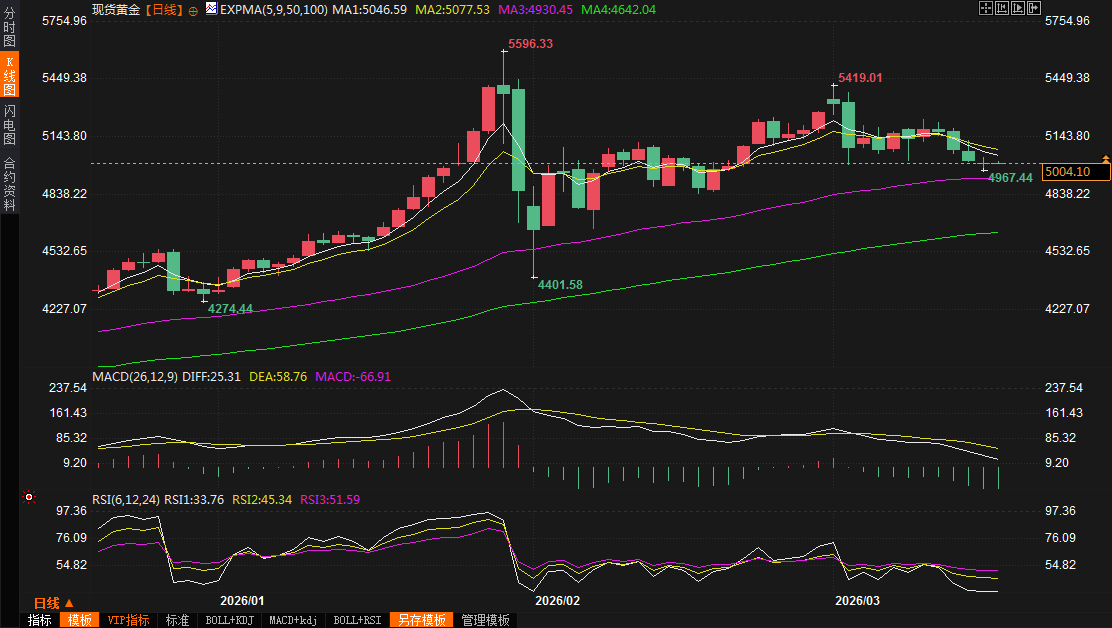
(Spot gold daily chart, source: FX678)
At 06:55 Beijing time, spot gold was trading at $5004.63 per ounce.
On Monday (March 16), spot gold briefly fell below the psychological barrier of $5,000, hitting a low of $4,967.44 per ounce before closing down slightly by 0.3% at $5,006.19. US gold futures plunged even more sharply, falling 1.2% to $5,002.20. On the surface, this appears to be a flash crash in gold prices, but behind it lies a classic game where inflation concerns completely overshadow traditional safe-haven demand. While the US dollar retreated from its 10-month high, the AI sector in the stock market rebounded, and oil prices experienced a brief correction, these factors cannot obscure a core reality: the "specter of stagflation" triggered by high oil prices is drastically narrowing the Federal Reserve's path to interest rate cuts, significantly increasing the opportunity cost of gold as a non-interest-bearing asset.
On Tuesday (March 17) in early Asian trading, spot gold fluctuated narrowly and is currently hovering around the $5,000 mark.
Short-term pressure stems from: the oil price inflation bomb versus the double squeeze of high interest rates.
Since the conflict erupted at the end of February, Brent crude and U.S. crude oil prices have surged by more than 40%-60%, even reaching their highest levels since 2022 this month. The global energy supply chain was instantly strained after Iran effectively blocked the Strait of Hormuz using drones and mines.
Iran's retaliatory drone strikes against US military bases in the UAE and Bahrain led to the temporary closure of Dubai Airport and the suspension of oil loading at the port of Fujairah. US gasoline retail prices surged nearly 25% in two weeks, reaching a new high since October 2023.
This energy shock directly translates into inflation expectations: although the US one-year inflation swap rate has slightly fallen to 2.9%, it is still far higher than the February CPI of 2.4%, and the market implies an average CPI of about 3% for the next 12 months.
Bob Haberkorn, senior strategist at RJO Futures, succinctly stated: "Rising oil prices will push up inflation. If inflation rises, central banks will be far less inclined to cut interest rates than they were six months ago, which is clearly bearish for gold prices."
Meanwhile, the high-interest-rate environment has become gold's biggest enemy. The Federal Reserve is almost 100% likely to keep interest rates unchanged at this week's policy meeting, and the transition period for new Chairman Warsh has made Powell's final statements more cautious.
According to the CME FedWatch tool, expectations for rate cuts in 2026 have shrunk from two to just one, with the probability of a third rate cut falling to 50%. The US Treasury yield curve is showing a "bullish flattening" trend, with two-year and ten-year yields falling but remaining high, reflecting that the market has already priced in the fact that the Fed will not significantly ease monetary policy.
Under the dual pressure of high inflation and high interest rates, the opportunity cost of holding gold has risen sharply, and short-term funds are more inclined to flow to the US dollar and US Treasury bonds rather than interest-free precious metals. This explains why, despite the escalation of the conflict, gold prices did not continue to surge but instead experienced a correction.
Escalating geopolitical uncertainty: Allies splitting, the shadow of protracted war looms over the market.
President Trump has repeatedly called for a multinational coalition to safeguard the Strait of Hormuz, but this has been explicitly rejected by traditional allies such as Germany, Spain, and Italy, citing a lack of UN or NATO authorization. Trump publicly accused his Western partners of "ingratitude," while the Israeli military announced it had developed detailed operational plans for at least another three weeks, targeting Iranian ballistic missiles, nuclear facilities, security agencies, and even "thousands" of targets. The Iranian Revolutionary Guard retaliated fiercely, launching missile attacks on Israeli territory, threatening US industrial facilities in the Middle East, and urging residents to evacuate areas near US-owned factories.
This expectation of a protracted conflict has subtly shifted market risk appetite: while oil prices retreated on Monday (Brent crude fell 2.8% to $100.88, and U.S. crude fell 5.28% to $93.50), analysts generally believe this is a temporary respite rather than a turning point. U.S. officials optimistically predict an end within weeks, while Iran insists it is "stable and strong." Ali Hassan of Thornburg Investment Management warned, "There is no reason for the market to be so optimistic about an easy de-escalation of the conflict." If the Strait of Hormuz remains closed for an extended period or energy infrastructure suffers permanent damage, oil prices could return to higher levels, further amplifying inflationary pressures and severely compressing the Federal Reserve's policy space.
The stock market and the AI boom provided a buffer, but the safe-haven logic for gold remains intact.
Wall Street unexpectedly rallied on Monday, with the S&P 500 rising 1.01% and the Nasdaq gaining 1.22%, primarily driven by the AI sector: Meta rose 2.3% due to plans to lay off 20% of its workforce to optimize AI investments, Nvidia gained 1.6%, and Tesla climbed 1.1%. As a net oil exporter, the US benefited from rising energy prices, with US stocks outperforming other global markets. This briefly eased risk aversion and caused some funds to flow out of gold.
But Edward Jones economist James McCann cautioned, "Any movement in oil prices could quickly change the Fed's thinking."
The VIX fear index has fallen back to 23.7, but geopolitical uncertainty still looms large. If conflict breaks out again, safe-haven funds are likely to return to gold.
The long-term bull market logic remains solid: the $6,000 target is poised to be reached.
Despite short-term pressure, many experts remain optimistic about gold in the medium to long term. Haberkorn emphasized, "Given the global situation, there is still a large amount of off-exchange capital on the sidelines, and I expect the price of gold to reach $6,000."
Analysts point out that gold's fundamental nature as an inflation hedge and a safe-haven asset for uncertainty has never changed; it has only been temporarily suppressed by high interest rates. Gold will see a strong rebound once any of the following turning points occur: 1) A clear easing of tensions, a decline in oil prices, and a cooling of inflation expectations; 2) The Federal Reserve is forced to restart interest rate cuts due to an economic slowdown; 3) The dollar cycle peaks, and global central bank demand for gold continues to increase.
Several investment banks, such as JPMorgan Chase, have raised their year-end 2026 targets to $6,300, while Goldman Sachs sees them in the $5,400-$6,000 range.
Gold prices are currently consolidating around the $5,000 mark, forming a potential double bottom or W-shaped pattern on the technical charts, with strong support in the $4,900-$4,950 range. Holding this level would significantly strengthen the rebound momentum; a break below it could lead to further testing of the $4,700-$4,800 range.
However, from a medium- to long-term perspective, the structural bull market for gold is far from over, given the combination of geopolitical risks, a potential turning point in the US dollar, central bank gold purchases, and rising global uncertainty. Investors need to be highly vigilant about this week's Federal Reserve decision, Powell's speech, PPI data, and geopolitical developments, as these will be key variables determining the short-term direction of gold prices.
This battle between the "inflation bomb" and the "safe-haven powder keg" has only just begun. Short-term fluctuations and dips are possible, but for patient and forward-thinking investors, every pullback around $5,000 could be an excellent opportunity to position themselves towards $6,000 or even higher targets.
(Spot gold daily chart, source: FX678)
At 06:55 Beijing time, spot gold was trading at $5004.63 per ounce.
- Risk Warning and Disclaimer
- The market involves risk, and trading may not be suitable for all investors. This article is for reference only and does not constitute personal investment advice, nor does it take into account certain users’ specific investment objectives, financial situation, or other needs. Any investment decisions made based on this information are at your own risk.