Gold Trading Alert: Iranian Conflict Ignites Oil Price Inflation Storm! Gold Prices Plunge Around $5,000, Fed Decision Looms!
2026-03-18 07:05:56
Spot gold was largely unchanged on Tuesday (March 17) around $5,005.45 per ounce, while April U.S. gold futures rose slightly by 0.1% to $5,008.20. The market is in a delicate balance: on one hand, there is safe-haven demand driven by the escalating conflict in the Middle East; on the other hand, there are bearish forces exerted by the high-interest-rate environment and inflationary pressures. Just as the Federal Reserve is about to announce its interest rate decision, global investors are holding their breath—Iran's continued attacks on the UAE, the near-closure of the Strait of Hormuz due to the energy crisis, and the decline in the dollar index and a slight drop in U.S. Treasury yields are all contributing to the key variables in gold's short-term price movement. On Wednesday (March 18) in early Asian trading, spot gold traded in a narrow range, currently at $5,000.72 per ounce.
The joint US-Israel military operation against Iran has entered its third week, and the situation is far from calm. Iran launched another attack on the UAE port of Fujairah on Tuesday, the third in four days, causing partial disruption to the key oil export hub and setting fires at the export terminals. The Strait of Hormuz has been effectively closed, disrupting approximately one-fifth of the world's oil and liquefied natural gas trade routes. The UAE, OPEC's third-largest oil producer, has already cut production by more than half. Brent crude futures surged 3.2% to settle at $103.42 a barrel, a new high since 2022, while US crude also held above $96.
These energy supply disruptions have directly fueled global inflation expectations. Jim Wyckoff, senior analyst at Kitco Metals, points out that the gold market currently reflects "a state of equilibrium": rising geopolitical uncertainty is driving safe-haven buying, but inflationary pressures are simultaneously creating bearish pressure. He believes gold prices still have the potential to reach new record highs, but "the bulls are already somewhat exhausted," and a rapid breakthrough in the short term is unlikely. A report from Commerzbank also emphasizes that the uncertainty surrounding the duration of the war and disruptions to oil supplies will keep the Federal Reserve cautious, thus limiting the upside potential for gold prices. In a high-interest-rate environment, gold's appeal as a non-interest-bearing asset has already diminished, but concerns about "stagflation" stemming from the turmoil in the Middle East are becoming the core logic supporting gold prices.
Despite the ongoing Russia-Ukraine conflict posing a long-term geopolitical risk, market attention is currently almost entirely focused on the Middle East. The paralysis of shipping in the Strait of Hormuz and Iran's repeated attacks on the UAE have a far more direct impact on global energy pricing and inflation than the sporadic developments in Eastern Europe. Investors generally believe that while the Russia-Ukraine situation still provides some safe-haven support, its marginal impact on oil and gold prices has significantly weakened. In contrast, if the Middle East conflict cannot be resolved in the short term, it will continue to push up energy costs, thereby strengthening gold's role as an inflation hedge.
The Federal Reserve will announce its policy decision on Wednesday, with the market consensus expecting the benchmark interest rate to remain unchanged at 3.50%-3.75%. The key lies in the subsequent "dot plot" and Powell's remarks. Before the outbreak of the Iran conflict, the market had priced in approximately 55 basis points of rate cuts by 2026; this has now plummeted to about 26 basis points, reflecting the latest pricing in the OIS market. Analysts expect Fed officials to adopt a more hawkish stance—perhaps shifting the policy inclination to "neutral," leaving room for considering both rate hikes and cuts in the coming months to avoid accusations of misleading the market amid high oil prices and rising inflation.
As a net exporter of crude oil, the United States has actually benefited from rising energy prices: improved terms of trade and potential boost to real GDP growth further reduce the pressure on the Federal Reserve to ease monetary policy quickly. Matthew Ryan, head of market strategy at Ebury, bluntly stated that the Fed is "not under any pressure to make a quick decision." Commerzbank also pointed out that this meeting is unlikely to provide a direct boost to gold prices. Investors are most concerned about how the Fed will assess the impact of the Iranian conflict on inflation and the economic outlook—if the dot plot only points to a 25-basis-point rate cut in 2026, the bearish pressure on gold prices will further increase.
The dollar index fell 0.24% on Tuesday, marking its second consecutive day of decline, closing at 99.56, a significant pullback from the 10-month high of 100.54 reached last Friday. Marc Chandler, chief strategist at Bannockburn Global Forex, observed a subtle shift in sentiment, with the dollar being bought on dips since the outbreak of the war, but now being sold on rallies. The euro rose against the dollar, and the Australian dollar also gained on the back of the Reserve Bank of Australia's interest rate hike, improving the overall performance of risk currencies.
The US Treasury market rose slightly in tandem, with yields across all maturities declining. The 10-year Treasury yield fell 2 basis points to 4.20%, the 30-year yield fell 1 basis point to 4.849%, and the 2-year yield fell 1.4 basis points to 3.669%, a cumulative decline of 9 basis points over the past three trading days, the largest three-day drop since November last year. The yield curve flattened, with the spread between the 2-year and 10-year yields narrowing to 52.7 basis points, exhibiting a "bull market flattening" characteristic—long-term interest rates have fallen more than short-term rates, reflecting the market's perception that there is limited room for aggressive easing.
These trends indirectly benefit gold: a weaker dollar reduces holding costs, and lower yields reduce opportunity costs. Evercore ISI strategist Stan Shipley emphasizes that the market's core focus will be on "how neutral" the Fed will be. If the statement is cautious, gold prices may rebound; conversely, if Powell emphasizes inflation risks, the dollar and yields may rise again, suppressing gold.
Oil prices have rebounded above $100, exacerbating inflation concerns and bringing the risk of stagflation to the forefront. Naomi Fink, chief global strategist at Amova Asset Management, points out that the energy shock is causing central banks to shift from a "slower growth, therefore looser policy" model to a focus on the stagflation dilemma. A recent Wall Street fund manager survey shows investor sentiment has fallen to a six-month low, with increased cash hoarding, downward revisions to economic growth expectations, and geopolitics seen as the biggest risk.
However, the US economy has shown some resilience: as a net exporter of crude oil, high oil prices may actually boost terms of trade and GDP. Stocks rose slightly on Tuesday, with the S&P 500 up 0.2%, led by the energy sector; airlines rebounded as travel demand was not significantly impacted. These factors combined mean that while gold bulls face pressure from high interest rates, the support from geopolitical risks and inflation expectations cannot be ignored.
Gold prices are currently at a critical juncture, caught in a tug-of-war between bulls and bears. Geopolitical uncertainty and oil price inflation expectations provide natural support for gold, while the Federal Reserve's cautious interest rate path and the high-interest-rate environment pose significant resistance. Wyckoff's assessment is perhaps the most apt: "Gold prices may still reach new record highs, but probably not soon." If Wednesday's Fed dot plot shows a further downward revision of interest rate cut expectations, or if there are signs of easing tensions in the Iranian conflict, gold prices may face downward pressure; conversely, if the conflict continues to escalate and oil prices remain high, gold's safe-haven appeal will be highlighted again, and the $5,000 mark could become a new starting point.
The best strategy for investors right now is to maintain flexible positions and closely monitor the wording of the Federal Reserve statement, the recovery of shipping in the Strait of Hormuz, and oil price movements. In this complex environment of intertwined geopolitical risks and monetary policy, gold will remain an indispensable "ballast" in global asset allocation. Today's Federal Reserve decision will reveal whether the gold bull market can be reignited.
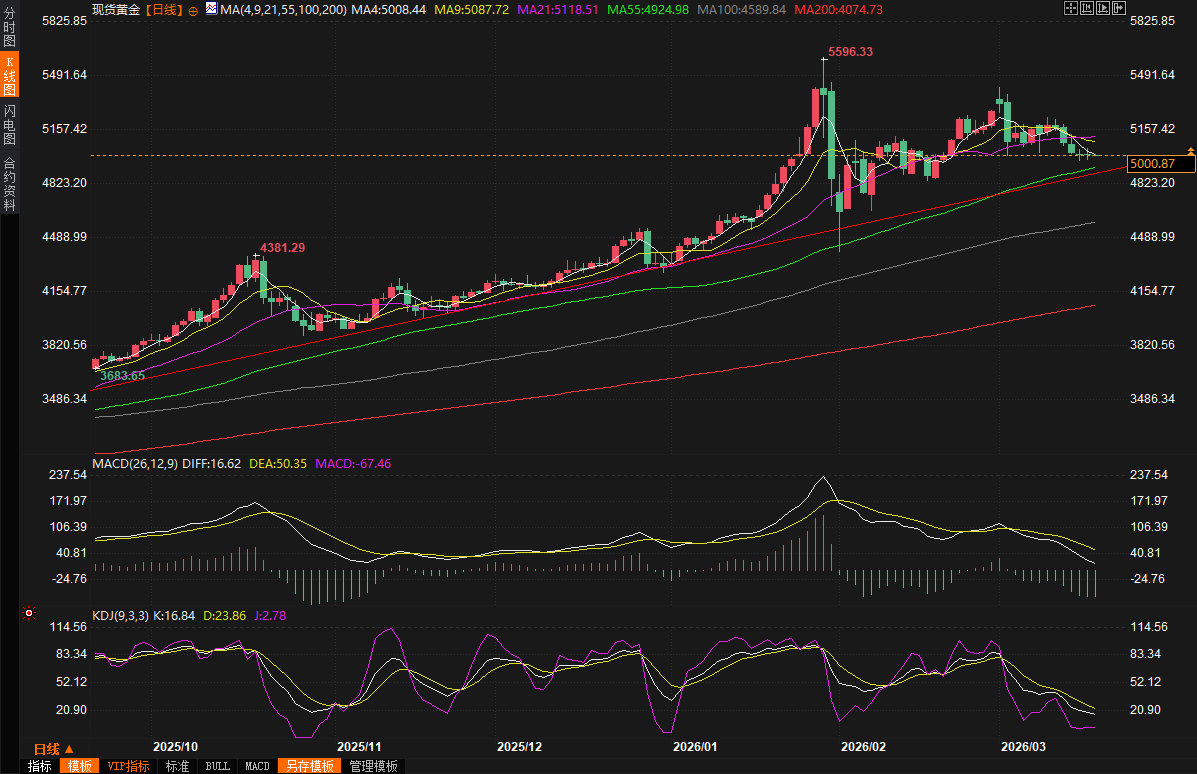
(Spot gold daily chart, source: FX678)
At 07:04 Beijing time, spot gold is currently trading at $5000.36 per ounce.
Escalating conflict in the Middle East: a dual impetus from safe-haven demand and inflation.
The joint US-Israel military operation against Iran has entered its third week, and the situation is far from calm. Iran launched another attack on the UAE port of Fujairah on Tuesday, the third in four days, causing partial disruption to the key oil export hub and setting fires at the export terminals. The Strait of Hormuz has been effectively closed, disrupting approximately one-fifth of the world's oil and liquefied natural gas trade routes. The UAE, OPEC's third-largest oil producer, has already cut production by more than half. Brent crude futures surged 3.2% to settle at $103.42 a barrel, a new high since 2022, while US crude also held above $96.
These energy supply disruptions have directly fueled global inflation expectations. Jim Wyckoff, senior analyst at Kitco Metals, points out that the gold market currently reflects "a state of equilibrium": rising geopolitical uncertainty is driving safe-haven buying, but inflationary pressures are simultaneously creating bearish pressure. He believes gold prices still have the potential to reach new record highs, but "the bulls are already somewhat exhausted," and a rapid breakthrough in the short term is unlikely. A report from Commerzbank also emphasizes that the uncertainty surrounding the duration of the war and disruptions to oil supplies will keep the Federal Reserve cautious, thus limiting the upside potential for gold prices. In a high-interest-rate environment, gold's appeal as a non-interest-bearing asset has already diminished, but concerns about "stagflation" stemming from the turmoil in the Middle East are becoming the core logic supporting gold prices.
The Russia-Ukraine situation takes a backseat: Market focus shifts entirely to the Middle East energy crisis.
Despite the ongoing Russia-Ukraine conflict posing a long-term geopolitical risk, market attention is currently almost entirely focused on the Middle East. The paralysis of shipping in the Strait of Hormuz and Iran's repeated attacks on the UAE have a far more direct impact on global energy pricing and inflation than the sporadic developments in Eastern Europe. Investors generally believe that while the Russia-Ukraine situation still provides some safe-haven support, its marginal impact on oil and gold prices has significantly weakened. In contrast, if the Middle East conflict cannot be resolved in the short term, it will continue to push up energy costs, thereby strengthening gold's role as an inflation hedge.
The Fed decision is imminent: interest rate path tightens, expectations for rate cuts cool significantly.
The Federal Reserve will announce its policy decision on Wednesday, with the market consensus expecting the benchmark interest rate to remain unchanged at 3.50%-3.75%. The key lies in the subsequent "dot plot" and Powell's remarks. Before the outbreak of the Iran conflict, the market had priced in approximately 55 basis points of rate cuts by 2026; this has now plummeted to about 26 basis points, reflecting the latest pricing in the OIS market. Analysts expect Fed officials to adopt a more hawkish stance—perhaps shifting the policy inclination to "neutral," leaving room for considering both rate hikes and cuts in the coming months to avoid accusations of misleading the market amid high oil prices and rising inflation.
As a net exporter of crude oil, the United States has actually benefited from rising energy prices: improved terms of trade and potential boost to real GDP growth further reduce the pressure on the Federal Reserve to ease monetary policy quickly. Matthew Ryan, head of market strategy at Ebury, bluntly stated that the Fed is "not under any pressure to make a quick decision." Commerzbank also pointed out that this meeting is unlikely to provide a direct boost to gold prices. Investors are most concerned about how the Fed will assess the impact of the Iranian conflict on inflation and the economic outlook—if the dot plot only points to a 25-basis-point rate cut in 2026, the bearish pressure on gold prices will further increase.
A decline in the US dollar index and a drop in US Treasury yields provide some breathing room for gold.
The dollar index fell 0.24% on Tuesday, marking its second consecutive day of decline, closing at 99.56, a significant pullback from the 10-month high of 100.54 reached last Friday. Marc Chandler, chief strategist at Bannockburn Global Forex, observed a subtle shift in sentiment, with the dollar being bought on dips since the outbreak of the war, but now being sold on rallies. The euro rose against the dollar, and the Australian dollar also gained on the back of the Reserve Bank of Australia's interest rate hike, improving the overall performance of risk currencies.
The US Treasury market rose slightly in tandem, with yields across all maturities declining. The 10-year Treasury yield fell 2 basis points to 4.20%, the 30-year yield fell 1 basis point to 4.849%, and the 2-year yield fell 1.4 basis points to 3.669%, a cumulative decline of 9 basis points over the past three trading days, the largest three-day drop since November last year. The yield curve flattened, with the spread between the 2-year and 10-year yields narrowing to 52.7 basis points, exhibiting a "bull market flattening" characteristic—long-term interest rates have fallen more than short-term rates, reflecting the market's perception that there is limited room for aggressive easing.
These trends indirectly benefit gold: a weaker dollar reduces holding costs, and lower yields reduce opportunity costs. Evercore ISI strategist Stan Shipley emphasizes that the market's core focus will be on "how neutral" the Fed will be. If the statement is cautious, gold prices may rebound; conversely, if Powell emphasizes inflation risks, the dollar and yields may rise again, suppressing gold.
Oil Price Repercussions and the Resilience of the US Economy: Gold Faces a Double-Edged Sword Test
Oil prices have rebounded above $100, exacerbating inflation concerns and bringing the risk of stagflation to the forefront. Naomi Fink, chief global strategist at Amova Asset Management, points out that the energy shock is causing central banks to shift from a "slower growth, therefore looser policy" model to a focus on the stagflation dilemma. A recent Wall Street fund manager survey shows investor sentiment has fallen to a six-month low, with increased cash hoarding, downward revisions to economic growth expectations, and geopolitics seen as the biggest risk.
However, the US economy has shown some resilience: as a net exporter of crude oil, high oil prices may actually boost terms of trade and GDP. Stocks rose slightly on Tuesday, with the S&P 500 up 0.2%, led by the energy sector; airlines rebounded as travel demand was not significantly impacted. These factors combined mean that while gold bulls face pressure from high interest rates, the support from geopolitical risks and inflation expectations cannot be ignored.
Market Outlook: Gold prices are expected to fluctuate in the short term, but still have upward potential in the medium to long term.
Gold prices are currently at a critical juncture, caught in a tug-of-war between bulls and bears. Geopolitical uncertainty and oil price inflation expectations provide natural support for gold, while the Federal Reserve's cautious interest rate path and the high-interest-rate environment pose significant resistance. Wyckoff's assessment is perhaps the most apt: "Gold prices may still reach new record highs, but probably not soon." If Wednesday's Fed dot plot shows a further downward revision of interest rate cut expectations, or if there are signs of easing tensions in the Iranian conflict, gold prices may face downward pressure; conversely, if the conflict continues to escalate and oil prices remain high, gold's safe-haven appeal will be highlighted again, and the $5,000 mark could become a new starting point.
The best strategy for investors right now is to maintain flexible positions and closely monitor the wording of the Federal Reserve statement, the recovery of shipping in the Strait of Hormuz, and oil price movements. In this complex environment of intertwined geopolitical risks and monetary policy, gold will remain an indispensable "ballast" in global asset allocation. Today's Federal Reserve decision will reveal whether the gold bull market can be reignited.
(Spot gold daily chart, source: FX678)
At 07:04 Beijing time, spot gold is currently trading at $5000.36 per ounce.
- Risk Warning and Disclaimer
- The market involves risk, and trading may not be suitable for all investors. This article is for reference only and does not constitute personal investment advice, nor does it take into account certain users’ specific investment objectives, financial situation, or other needs. Any investment decisions made based on this information are at your own risk.