Crude Oil Trading Alert: With the marginal impact of geopolitical conflicts waning and a surprise surge in US inventories, the risk of a short-term peak for WTI crude oil prices has increased as they approach $95.
2026-03-18 09:20:47
On Wednesday during Asian trading hours, WTI crude oil prices fluctuated around $94. Despite the escalating situation in the Middle East, the price increase slowed significantly, indicating a shift in market reaction to geopolitical conflicts. This shift from "high sensitivity" to "marginal desensitization" is one of the most crucial changes in the current crude oil market.

Market research indicates that Iran's recent strikes on oil production facilities in the UAE and Iraq represent the first direct attack on upstream production since the conflict began. This event has briefly heightened market concerns about supply disruptions. However, in terms of price performance, oil prices have not experienced a sustained one-sided rise; instead, they have fluctuated repeatedly at high levels, suggesting that the geopolitical risk premium has already been significantly priced in during the previous price increases .
Meanwhile, Israel announced the death of a key Iranian security official in an airstrike, further fueling market expectations of an escalation of the conflict. However, fund flows indicate that the market is shifting from a "buy-the-rally" mentality to "profit-taking." In other words, the positive impact of the geopolitical conflict is gradually being digested by the market, and may even be triggering some long positions to take profits.
From a supply and demand perspective, US inventory data exerted significant downward pressure on oil prices. According to data released by the American Petroleum Institute, US crude oil inventories increased by approximately 6.6 million barrels in the week ending March 13, far exceeding market expectations of a decrease of about 600,000 barrels. This data significantly weakened the narrative of tight supply, suggesting that there may not be a substantial shortage in the market in the short term.
An unexpected increase in inventories suggests two possibilities: either demand is weaker than expected, or supply is recovering temporarily. Either way, it will constrain oil price increases. Given that prices are already high, this "contrarian fundamental signal" is particularly crucial.
From a global market perspective, rising oil prices have begun to push up inflation expectations again, but may also dampen demand growth. This is particularly true for major importing regions such as Asian countries, where rising energy costs could exacerbate economic pressures, thus negatively impacting crude oil demand in the medium term.
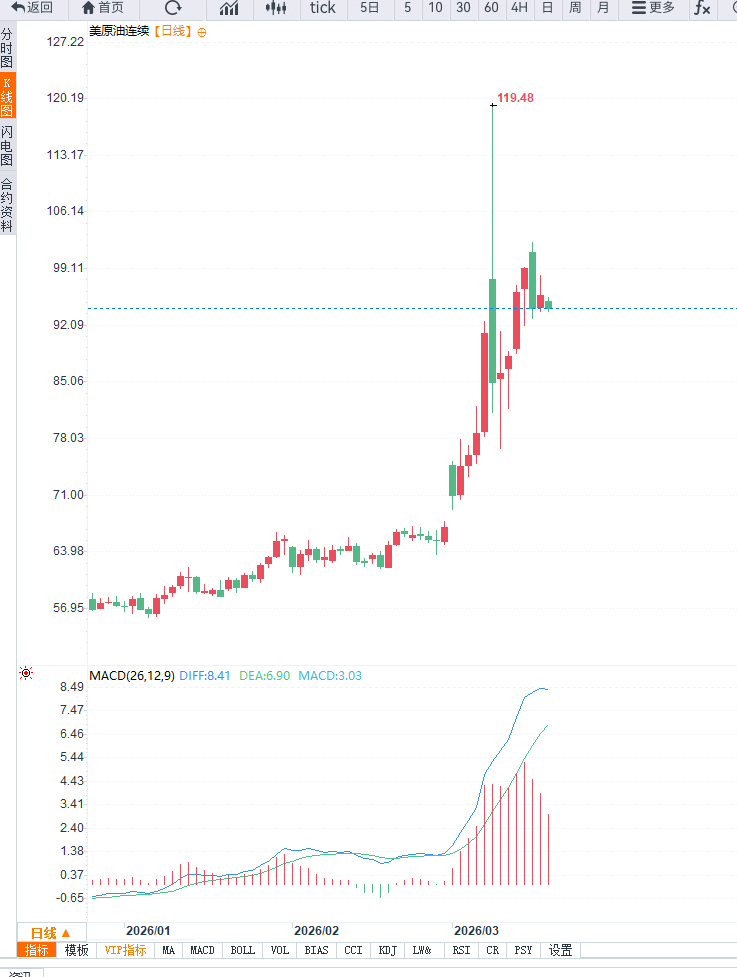
From a technical perspective, WTI crude oil maintains an upward trend on the daily chart, but the rate of increase has slowed significantly, and prices are fluctuating repeatedly in the high-level area, indicating increasing divergence between bulls and bears. Currently, the $90 level forms a key support, while the $97-$100 range is a significant resistance area. From a momentum perspective, although the trend has not completely weakened, it has shown signs of high-level consolidation, a typical characteristic of the end of an uptrend.
In the 4-hour timeframe, price action exhibits a "rising oscillation" structure with diminishing momentum. The upward movement of highs is decreasing, and the price has repeatedly encountered resistance near $95, indicating increasing selling pressure. A break below the short-term support level of $92 could trigger a technical pullback, further confirming the formation of a temporary top.
Overall, the market is gradually transitioning from being "geopolitically driven" to being "driven by a combination of fundamentals and macroeconomic factors." With risk premiums declining marginally, it is significantly more difficult for oil prices to continue their unilateral upward trend.
Editor's Summary:
The crude oil market is entering a critical turning point. While the situation in the Middle East remains uncertain, the market has gradually digested most of the geopolitical risks, and oil prices are significantly less sensitive to unexpected events. At the same time, a sharp increase in US inventories signals a weakening of the supply-demand balance, which, combined with high prices, increases the probability of a short-term peak. Future oil price movements will depend more on whether actual supply is disrupted and whether demand continues to weaken. In the absence of new and stronger stimuli, WTI is more likely to enter a period of high-level fluctuations or even a phase of correction. Investors should be wary of the risks associated with increased volatility at high levels.
Market research indicates that Iran's recent strikes on oil production facilities in the UAE and Iraq represent the first direct attack on upstream production since the conflict began. This event has briefly heightened market concerns about supply disruptions. However, in terms of price performance, oil prices have not experienced a sustained one-sided rise; instead, they have fluctuated repeatedly at high levels, suggesting that the geopolitical risk premium has already been significantly priced in during the previous price increases .
Meanwhile, Israel announced the death of a key Iranian security official in an airstrike, further fueling market expectations of an escalation of the conflict. However, fund flows indicate that the market is shifting from a "buy-the-rally" mentality to "profit-taking." In other words, the positive impact of the geopolitical conflict is gradually being digested by the market, and may even be triggering some long positions to take profits.
From a supply and demand perspective, US inventory data exerted significant downward pressure on oil prices. According to data released by the American Petroleum Institute, US crude oil inventories increased by approximately 6.6 million barrels in the week ending March 13, far exceeding market expectations of a decrease of about 600,000 barrels. This data significantly weakened the narrative of tight supply, suggesting that there may not be a substantial shortage in the market in the short term.
An unexpected increase in inventories suggests two possibilities: either demand is weaker than expected, or supply is recovering temporarily. Either way, it will constrain oil price increases. Given that prices are already high, this "contrarian fundamental signal" is particularly crucial.
From a global market perspective, rising oil prices have begun to push up inflation expectations again, but may also dampen demand growth. This is particularly true for major importing regions such as Asian countries, where rising energy costs could exacerbate economic pressures, thus negatively impacting crude oil demand in the medium term.
From a technical perspective, WTI crude oil maintains an upward trend on the daily chart, but the rate of increase has slowed significantly, and prices are fluctuating repeatedly in the high-level area, indicating increasing divergence between bulls and bears. Currently, the $90 level forms a key support, while the $97-$100 range is a significant resistance area. From a momentum perspective, although the trend has not completely weakened, it has shown signs of high-level consolidation, a typical characteristic of the end of an uptrend.
In the 4-hour timeframe, price action exhibits a "rising oscillation" structure with diminishing momentum. The upward movement of highs is decreasing, and the price has repeatedly encountered resistance near $95, indicating increasing selling pressure. A break below the short-term support level of $92 could trigger a technical pullback, further confirming the formation of a temporary top.
Overall, the market is gradually transitioning from being "geopolitically driven" to being "driven by a combination of fundamentals and macroeconomic factors." With risk premiums declining marginally, it is significantly more difficult for oil prices to continue their unilateral upward trend.
Editor's Summary:
The crude oil market is entering a critical turning point. While the situation in the Middle East remains uncertain, the market has gradually digested most of the geopolitical risks, and oil prices are significantly less sensitive to unexpected events. At the same time, a sharp increase in US inventories signals a weakening of the supply-demand balance, which, combined with high prices, increases the probability of a short-term peak. Future oil price movements will depend more on whether actual supply is disrupted and whether demand continues to weaken. In the absence of new and stronger stimuli, WTI is more likely to enter a period of high-level fluctuations or even a phase of correction. Investors should be wary of the risks associated with increased volatility at high levels.
- Risk Warning and Disclaimer
- The market involves risk, and trading may not be suitable for all investors. This article is for reference only and does not constitute personal investment advice, nor does it take into account certain users’ specific investment objectives, financial situation, or other needs. Any investment decisions made based on this information are at your own risk.