Escalating conflicts in the Middle East are driving up safe-haven demand, while the Federal Reserve maintains its interest rate expectations, leaving gold prices hovering around the $5,000 mark and facing a directional choice.
2026-03-18 09:34:38
Gold prices remained range-bound around the $5,000 mark in early Asian trading on Wednesday. Market sentiment is clearly cautious, with investors opting for a wait-and-see approach amid continued tensions in the Middle East and the upcoming Federal Reserve interest rate decision.

Geopolitically, the conflict shows no signs of easing. Market research indicates that Israel has confirmed the strike on senior Iranian security official Ali Larijani, while Iran previously ignited a large gas field in the UAE, further escalating regional tensions. Meanwhile, US President Trump stated he would not rule out expanding strikes against key Iranian export hubs. This series of events continues to fuel market risk aversion, supporting gold as a traditional safe-haven asset.
However, unlike before, the upward momentum of gold has not significantly strengthened. Instead, it has shown signs of consolidation at high levels, indicating that while the safe-haven premium exists, it has not continued to amplify . This aligns with the current market's assessment that geopolitical risks are gradually "marginally diminishing," meaning that while conflicts continue, there has been no unexpected escalation, making it difficult to drive a one-sided rise in gold prices.
Meanwhile, the rapid rise in energy prices is having another impact on gold. The recent sustained high levels of WTI crude oil prices have strengthened market expectations of rising inflation. Rising inflation expectations directly influence the path of monetary policy, causing the market to repric the timing of the Federal Reserve's interest rate cuts.
Institutional opinions indicate that expectations for interest rate cuts have shifted significantly later. Some institutions predict that the Federal Reserve may not begin cutting rates until September or December , whereas previously it was expected to begin in the middle of the year. This change in expectations means that interest rates will remain high for a longer period, thus putting downward pressure on gold, as gold itself does not generate interest income and its attractiveness decreases in a high-interest-rate environment.
"As oil prices rise, inflation will follow. If inflation remains high, central banks will not be as aggressive in cutting interest rates as before, which is detrimental to gold." — Bob Habercohn, Senior Market Strategist at RJO Futures
From a policy perspective, the market widely expects the Federal Reserve to maintain interest rates unchanged at this meeting, with the current target range expected to remain at 3.50%-3.75% . What will truly influence market direction will be Chairman Jerome Powell's remarks at the post-meeting press conference.
If Powell releases hawkish signals, such as emphasizing inflation risks or delaying expectations of interest rate cuts, the dollar may strengthen, thus putting downward pressure on dollar-denominated gold; conversely, if his rhetoric is dovish, it may reignite the upward momentum of gold.
From a global market perspective, gold is currently in a phase of intertwined factors: on the one hand, there is safe-haven demand driven by geopolitical conflicts, and on the other hand, there is rising opportunity costs due to high interest rates. These two factors are offsetting each other, causing gold prices to fluctuate in the short term.
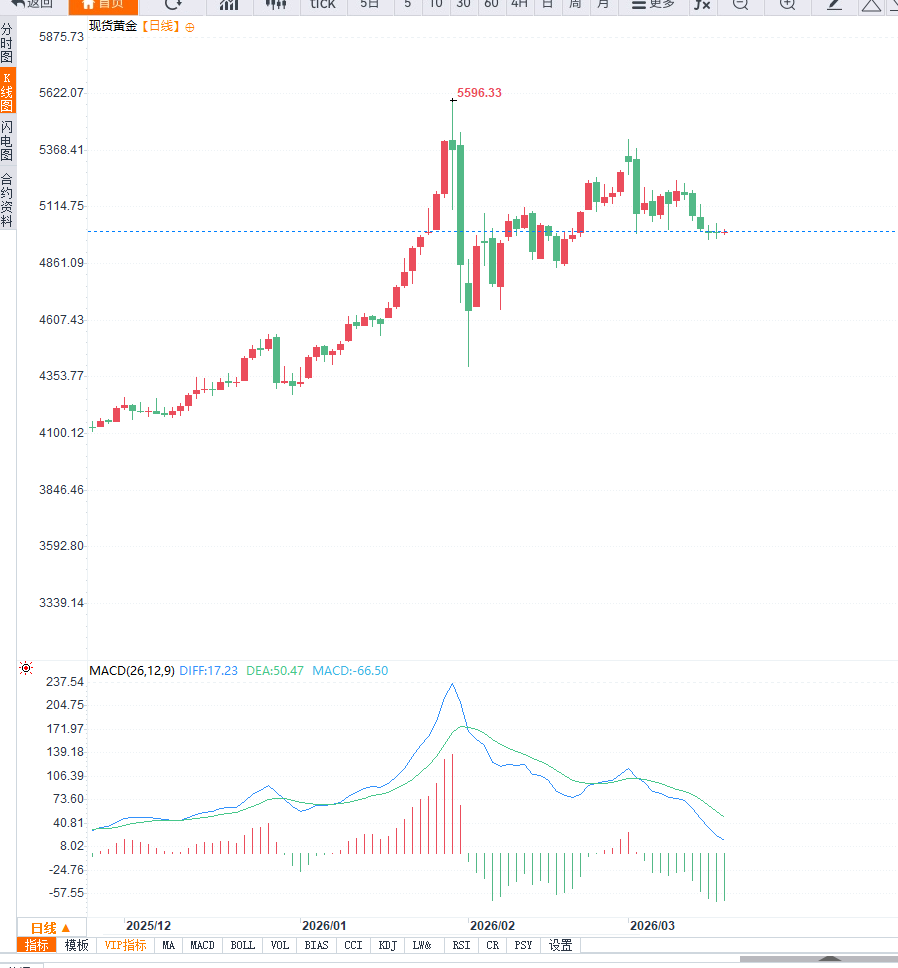
From a technical perspective, gold is maintaining a high-level consolidation structure on the daily chart. The overall trend remains bullish, but the upward momentum has clearly weakened. The price has repeatedly tested the $5,000 level without a decisive breakthrough, indicating increasing selling pressure above. Currently, the $4,900 area forms a key support level, while the $5,050-$5,100 range is a significant short-term resistance zone. Momentum indicators show signs of high-level consolidation and even potential bearish divergence, suggesting that the upward trend may be entering its later stages.
In the 4-hour timeframe, prices are exhibiting a range-bound movement, with highs failing to rise consistently and lows gradually moving upwards but with limited strength, indicating that the market is in a phase of directional decision-making. A break below $4950 could trigger a short-term pullback; conversely, a decisive break above $5050 could open up further upside potential.
Overall, gold is currently in a tug-of-war between "safe-haven support" and "interest rate suppression," and its short-term trend depends on changes in policy signals and market expectations.
Editor's Summary:
The core contradiction in the current gold market lies in the interplay between safe-haven demand and the interest rate environment. While the Middle East conflict continues to support gold prices, its marginal impact is weakening; meanwhile, rising oil prices are pushing up inflation expectations, delaying the pace of interest rate cuts, and exerting substantial downward pressure on gold. Against this backdrop, gold is more likely to maintain a high-level consolidation pattern in the short term. The key to future price movements lies in whether the Federal Reserve's policy path changes. If interest rates remain high for longer than expected, gold prices may face the risk of a phase of correction.
Geopolitically, the conflict shows no signs of easing. Market research indicates that Israel has confirmed the strike on senior Iranian security official Ali Larijani, while Iran previously ignited a large gas field in the UAE, further escalating regional tensions. Meanwhile, US President Trump stated he would not rule out expanding strikes against key Iranian export hubs. This series of events continues to fuel market risk aversion, supporting gold as a traditional safe-haven asset.
However, unlike before, the upward momentum of gold has not significantly strengthened. Instead, it has shown signs of consolidation at high levels, indicating that while the safe-haven premium exists, it has not continued to amplify . This aligns with the current market's assessment that geopolitical risks are gradually "marginally diminishing," meaning that while conflicts continue, there has been no unexpected escalation, making it difficult to drive a one-sided rise in gold prices.
Meanwhile, the rapid rise in energy prices is having another impact on gold. The recent sustained high levels of WTI crude oil prices have strengthened market expectations of rising inflation. Rising inflation expectations directly influence the path of monetary policy, causing the market to repric the timing of the Federal Reserve's interest rate cuts.
Institutional opinions indicate that expectations for interest rate cuts have shifted significantly later. Some institutions predict that the Federal Reserve may not begin cutting rates until September or December , whereas previously it was expected to begin in the middle of the year. This change in expectations means that interest rates will remain high for a longer period, thus putting downward pressure on gold, as gold itself does not generate interest income and its attractiveness decreases in a high-interest-rate environment.
"As oil prices rise, inflation will follow. If inflation remains high, central banks will not be as aggressive in cutting interest rates as before, which is detrimental to gold." — Bob Habercohn, Senior Market Strategist at RJO Futures
From a policy perspective, the market widely expects the Federal Reserve to maintain interest rates unchanged at this meeting, with the current target range expected to remain at 3.50%-3.75% . What will truly influence market direction will be Chairman Jerome Powell's remarks at the post-meeting press conference.
If Powell releases hawkish signals, such as emphasizing inflation risks or delaying expectations of interest rate cuts, the dollar may strengthen, thus putting downward pressure on dollar-denominated gold; conversely, if his rhetoric is dovish, it may reignite the upward momentum of gold.
From a global market perspective, gold is currently in a phase of intertwined factors: on the one hand, there is safe-haven demand driven by geopolitical conflicts, and on the other hand, there is rising opportunity costs due to high interest rates. These two factors are offsetting each other, causing gold prices to fluctuate in the short term.
From a technical perspective, gold is maintaining a high-level consolidation structure on the daily chart. The overall trend remains bullish, but the upward momentum has clearly weakened. The price has repeatedly tested the $5,000 level without a decisive breakthrough, indicating increasing selling pressure above. Currently, the $4,900 area forms a key support level, while the $5,050-$5,100 range is a significant short-term resistance zone. Momentum indicators show signs of high-level consolidation and even potential bearish divergence, suggesting that the upward trend may be entering its later stages.
In the 4-hour timeframe, prices are exhibiting a range-bound movement, with highs failing to rise consistently and lows gradually moving upwards but with limited strength, indicating that the market is in a phase of directional decision-making. A break below $4950 could trigger a short-term pullback; conversely, a decisive break above $5050 could open up further upside potential.
Overall, gold is currently in a tug-of-war between "safe-haven support" and "interest rate suppression," and its short-term trend depends on changes in policy signals and market expectations.
Editor's Summary:
The core contradiction in the current gold market lies in the interplay between safe-haven demand and the interest rate environment. While the Middle East conflict continues to support gold prices, its marginal impact is weakening; meanwhile, rising oil prices are pushing up inflation expectations, delaying the pace of interest rate cuts, and exerting substantial downward pressure on gold. Against this backdrop, gold is more likely to maintain a high-level consolidation pattern in the short term. The key to future price movements lies in whether the Federal Reserve's policy path changes. If interest rates remain high for longer than expected, gold prices may face the risk of a phase of correction.
- Risk Warning and Disclaimer
- The market involves risk, and trading may not be suitable for all investors. This article is for reference only and does not constitute personal investment advice, nor does it take into account certain users’ specific investment objectives, financial situation, or other needs. Any investment decisions made based on this information are at your own risk.