Geopolitical conflicts offset a strong dollar, gold trades in a narrow range; will the correction continue or will the bulls return?
2026-03-18 16:54:59
According to APP, ING commodity strategists Warren Patterson and Ewa Manthey noted that gold is currently trading in a narrow range as the conflict between the US, Israel, and Iran has continued to prolong. A stronger dollar and rising real yields are offsetting safe-haven demand stemming from Middle East tensions. They maintain a constructive view on gold in the medium term but warn that a prolonged conflict and higher, longer-lasting interest rates pose downside risks. Latest market data shows that as of March 18, 2026, spot gold prices hovered around $5,000 per ounce, with an intraday range of approximately $4,980-$5,020 per ounce, up about 16% from the beginning of the year. Geopolitical risk premiums are already partially reflected in the quotes, but macroeconomic headwinds are limiting further breakthroughs.

Strategists further analyzed: "While high energy prices and ongoing Middle East tensions continue to support safe-haven demand, concerns that inflationary pressures may delay Fed rate cuts have capped upside potential." In the near term, gold remains caught between geopolitical risks and macroeconomic headwinds from high interest rates. The medium-term outlook remains bullish due to diversified demand, central bank gold purchases, and stagflation risks. However, downside risks remain if the conflict prolongs and reinforces the outlook for higher and longer interest rates. Despite a year-to-date gain of approximately 16%, the current pullback is relatively mild, and a deeper correction could attract buying interest.
To clearly compare the relationship between Federal Reserve policy and geopolitical risk transmission, the following table presents key indicators (including price levels, risk drivers, policy hedging effects, inflation transmission paths, and medium-term scenario assumptions):
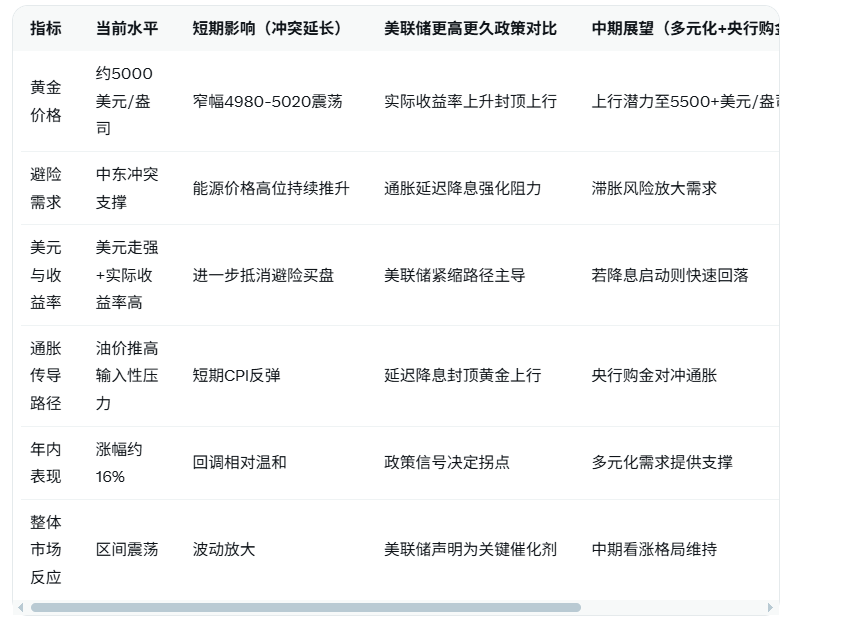
From an in-depth analysis perspective, the US-Israel-Iran conflict directly amplifies global inflation uncertainty through oil prices. Warren Patterson and Ewa Manthey clearly contrast the Fed's strategy: the current higher and longer-lasting interest rate framework is strengthened by the energy shock, and rising real yields and a stronger dollar form a double hedge, directly suppressing the safe-haven premium of gold. It is reasonable to speculate that if the conflict continues into mid-to-late April, daily safe-haven buying, while continuing, will struggle to break through the $5000-$5100 range; conversely, if the Fed releases any dovish signals in its dot plot or the conflict eases, gold will quickly break free from macroeconomic resistance and test its medium-term upward target. Coupled with central bank gold purchases and diversified investor demand, this comparison highlights that gold pricing is in a dynamic balance between "geopolitical support vs. Fed tightening." While short-term volatility is high, the downside is limited, and deeper corrections may present buying opportunities.
On the other hand, US economic data and the resilience of the labor market have raised the threshold for the Federal Reserve to cut interest rates. Strategists warn that a prolonged conflict would further solidify the "higher and longer" path, but gold's medium-term appeal as a hedge against stagflation has not diminished. Traders generally believe that the communication at this Fed meeting will be a turning point for gold pricing: hawkish statements will exacerbate downward pressure, while dovish hints will open an upward window.
Editor's Summary : While the US-Israel-Iran conflict continues to inject a safe-haven premium into gold, the macroeconomic hedging effect created by the Federal Reserve's higher and longer-term interest rate strategy has dominated short-term pricing. Medium-term diversification and central bank gold purchases continue to support a bullish outlook. Future price movements will depend on the pace of the conflict's evolution and the confirmation of policy signals from the Federal Reserve. Investors need to closely monitor geopolitical developments and interest rate paths.
Frequently Asked Questions
Q1: Why did the conflict between the US, Israel, and Iran increase demand for gold as a safe haven but fail to break through the narrow trading range?
A: The prolonged conflict directly stimulated energy prices and inflation concerns, supporting traditional safe-haven buying. However, a stronger dollar and rising real yields provided a strong offset, with ING strategists noting that this balance kept gold oscillating between $4980 and $5020 per ounce. In the short term, macroeconomic resistance dominates, and while safe-haven demand is strong, it is unlikely to drive a unilateral breakout.
Q2: How does the Fed's strategy of higher and longer interest rates contrast with gold pricing?
A: The Federal Reserve delayed interest rate cuts due to inflationary pressures caused by oil prices, and rising real yields directly suppressed the attractiveness of gold. Warren Patterson and Ewa Manthey emphasized that this tightening path contrasts sharply with geopolitical safe-haven demand: the former caps the upside, while the latter provides support. If the Fed's dot plot remains hawkish, the downside risk for gold will increase; conversely, it will unlock upside potential.
Q3: What is the specific path of the impact of prolonged conflict on the downside risk of gold?
A: Prolonged conflict reinforces high oil prices, pushes up inflation expectations, and solidifies the Federal Reserve's framework for higher and longer interest rates. This, coupled with further strengthening of real yields and the dollar, directly suppresses gold. ING strategists warn that this scenario will amplify downward pressure, but the risk of stagflation in the medium term still provides natural support for gold.
Strategists further analyzed: "While high energy prices and ongoing Middle East tensions continue to support safe-haven demand, concerns that inflationary pressures may delay Fed rate cuts have capped upside potential." In the near term, gold remains caught between geopolitical risks and macroeconomic headwinds from high interest rates. The medium-term outlook remains bullish due to diversified demand, central bank gold purchases, and stagflation risks. However, downside risks remain if the conflict prolongs and reinforces the outlook for higher and longer interest rates. Despite a year-to-date gain of approximately 16%, the current pullback is relatively mild, and a deeper correction could attract buying interest.
To clearly compare the relationship between Federal Reserve policy and geopolitical risk transmission, the following table presents key indicators (including price levels, risk drivers, policy hedging effects, inflation transmission paths, and medium-term scenario assumptions):
From an in-depth analysis perspective, the US-Israel-Iran conflict directly amplifies global inflation uncertainty through oil prices. Warren Patterson and Ewa Manthey clearly contrast the Fed's strategy: the current higher and longer-lasting interest rate framework is strengthened by the energy shock, and rising real yields and a stronger dollar form a double hedge, directly suppressing the safe-haven premium of gold. It is reasonable to speculate that if the conflict continues into mid-to-late April, daily safe-haven buying, while continuing, will struggle to break through the $5000-$5100 range; conversely, if the Fed releases any dovish signals in its dot plot or the conflict eases, gold will quickly break free from macroeconomic resistance and test its medium-term upward target. Coupled with central bank gold purchases and diversified investor demand, this comparison highlights that gold pricing is in a dynamic balance between "geopolitical support vs. Fed tightening." While short-term volatility is high, the downside is limited, and deeper corrections may present buying opportunities.
On the other hand, US economic data and the resilience of the labor market have raised the threshold for the Federal Reserve to cut interest rates. Strategists warn that a prolonged conflict would further solidify the "higher and longer" path, but gold's medium-term appeal as a hedge against stagflation has not diminished. Traders generally believe that the communication at this Fed meeting will be a turning point for gold pricing: hawkish statements will exacerbate downward pressure, while dovish hints will open an upward window.
Editor's Summary : While the US-Israel-Iran conflict continues to inject a safe-haven premium into gold, the macroeconomic hedging effect created by the Federal Reserve's higher and longer-term interest rate strategy has dominated short-term pricing. Medium-term diversification and central bank gold purchases continue to support a bullish outlook. Future price movements will depend on the pace of the conflict's evolution and the confirmation of policy signals from the Federal Reserve. Investors need to closely monitor geopolitical developments and interest rate paths.
Frequently Asked Questions
Q1: Why did the conflict between the US, Israel, and Iran increase demand for gold as a safe haven but fail to break through the narrow trading range?
A: The prolonged conflict directly stimulated energy prices and inflation concerns, supporting traditional safe-haven buying. However, a stronger dollar and rising real yields provided a strong offset, with ING strategists noting that this balance kept gold oscillating between $4980 and $5020 per ounce. In the short term, macroeconomic resistance dominates, and while safe-haven demand is strong, it is unlikely to drive a unilateral breakout.
Q2: How does the Fed's strategy of higher and longer interest rates contrast with gold pricing?
A: The Federal Reserve delayed interest rate cuts due to inflationary pressures caused by oil prices, and rising real yields directly suppressed the attractiveness of gold. Warren Patterson and Ewa Manthey emphasized that this tightening path contrasts sharply with geopolitical safe-haven demand: the former caps the upside, while the latter provides support. If the Fed's dot plot remains hawkish, the downside risk for gold will increase; conversely, it will unlock upside potential.
Q3: What is the specific path of the impact of prolonged conflict on the downside risk of gold?
A: Prolonged conflict reinforces high oil prices, pushes up inflation expectations, and solidifies the Federal Reserve's framework for higher and longer interest rates. This, coupled with further strengthening of real yields and the dollar, directly suppresses gold. ING strategists warn that this scenario will amplify downward pressure, but the risk of stagflation in the medium term still provides natural support for gold.
- Risk Warning and Disclaimer
- The market involves risk, and trading may not be suitable for all investors. This article is for reference only and does not constitute personal investment advice, nor does it take into account certain users’ specific investment objectives, financial situation, or other needs. Any investment decisions made based on this information are at your own risk.