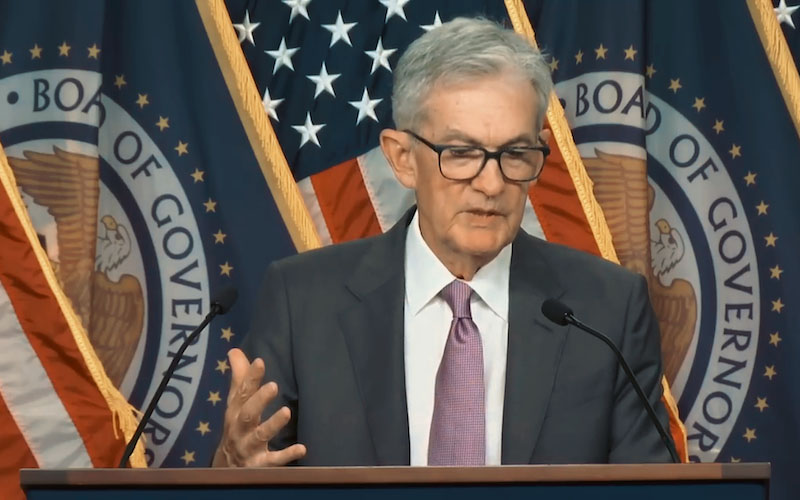
The Federal Reserve kept interest rates unchanged: the dot plot raised inflation and long-term interest rate expectations, and for the first time explicitly mentioned the Middle East conflict.
2026-03-19 02:41:07
On Wednesday (March 19, 2026), the Federal Open Market Committee (FOMC) held rates steady as expected, maintaining the target range for the federal funds rate at 3.50%-3.75%. This marks the second consecutive meeting where rates have remained unchanged. The FOMC passed a resolution by a vote of 11 to 1, with Governor Stephen Milan casting the sole dissenting vote, advocating for an immediate 25 basis point rate cut. The policy statement added a section on the situation in the Middle East, acknowledging that "the impact of developments in the Middle East on the U.S. economy remains unclear," and emphasizing that the Committee is "closely monitoring" the risks to its dual mandate of price stability and full employment.

Economic forecasts have been revised upwards across the board, and inflationary pressures have intensified significantly.
The Federal Reserve's latest State of the Economy (SEP) and dot plot, released simultaneously, show that policymakers are more optimistic about the economic outlook for 2026 than in December of last year, but the inflation path has deteriorated significantly: the median federal funds rate at the end of 2026 remains unchanged at 3.4%, and is projected to be 3.1% at the end of both 2027 and 2028, with the long-term equilibrium rate raised to 3.1% (previously 3.0%). The median GDP growth rate for 2026 has been revised upward from 2.3% to 2.4%, and the long-term growth rate has been revised upward from 1.8% to 2.0%. The median unemployment rate at the end of 2026 remains unchanged at 4.4%. The median core PCE inflation has been significantly revised upward to 2.7% (previously 2.5%), and overall PCE inflation has also been revised upward to 2.7% (previously 2.4%).
The dot plot shows that 7 of the 19 officials still expect no rate cuts throughout 2026, another 7 support a cumulative rate cut of 25 basis points, and a few officials expect rate cuts of 50-100 basis points. The Federal Reserve maintains its median path of "25 basis point rate cuts in 2026 and another 25 basis point rate cuts in 2027," but 7 policymakers expect no rate cuts in 2026, and one official even believes that interest rates need to be raised in 2027.
The market reacted mildly immediately, with risk assets experiencing slight pressure.
Following the interest rate decision, market volatility was limited: US stocks narrowed their losses, with the S&P 500 down about 0.6% and the Nasdaq down 0.5%. Spot gold was little changed, ultimately falling 2.2% to $4,896.94 per ounce. US Treasury yields pared earlier gains: the 10-year Treasury yield rose 1.2 basis points to 4.214%, and the two-year yield rose 2.4 basis points to 3.695%; the 2-year/10-year yield curve steepened slightly, with the spread widening from 50.8 basis points to 51.3 basis points. The US dollar index briefly pared its gains, trading at 99.76, up 0.21%; the dollar was at 159.31 against the yen (+0.2%), and the euro was at 1.152425 against the dollar (-0.16%).
US interest rate futures pricing indicates that the cumulative rate cut expectation for 2026 remains at 21 basis points, unchanged from before the decision; the timing of the first rate cut is still anchored in December 2026 or January 2027.
mainstream view
Nick Timiraos, the “New Fed Watcher,” commented: The Fed kept interest rates unchanged. There was one dissenting vote at the meeting. The median forecast in the dot plot remained unchanged, and the ratio of officials supporting a rate cut to those opposing it remained 12:7. The median core PCE inflation forecast was revised upward from 2.5% to 2.7%. The median long-term interest rate in the dot plot was revised upward to 3.1%.
Market observers believe that the current conflict between the US and Israel in Iraq, which has driven up international oil prices and exacerbated inflation concerns, is forcing the Federal Reserve to maintain a cautious approach to future monetary policy. Furthermore, recent data shows conflicting signals in the US labor market, while the economic fundamentals remain robust, raising the bar for further interest rate cuts. Several international financial institutions have adjusted their forecasts, postponing the Fed's first rate cut this year from June to September or October, and predicting only one rate cut this year.
The minor adjustments to the statement highlight two key concerns.
Compared to the January statement, this statement made only two key adjustments: the phrase "the labor market has shown some signs of stabilization" was changed to "the unemployment rate has not changed much in recent months," acknowledging that job growth has been "persistently sluggish"; and the Middle East conflict was mentioned for the first time, with cautious wording but sending a clear signal—geopolitical risks have become an important variable in the Fed's assessment framework.
In conclusion, a cautious wait-and-see approach remains the main theme.
The core message conveyed by the Federal Reserve's meeting was "data dependence + risk balance": despite signs of weakness in the labor market and a slight upward revision of GDP expectations, persistent inflation and the supply shock from the Middle East conflict are forcing policymakers to remain highly cautious. The dot plot shows that the path of one rate cut this year remains unchanged, but the timing of the first rate cut is still far off, and seven officials have clearly stated a "zero rate cut" stance. Investors need to closely monitor the next non-farm payroll report, PCE data, and developments in the Middle East—any continued surge in energy prices could further postpone the rate cut timetable. In the current environment, the Fed is striving to find a balance between "avoiding a rebound in inflation" and "supporting economic growth," and the Middle East conflict has quietly become the most important external variable affecting this balance.
Economic forecasts have been revised upwards across the board, and inflationary pressures have intensified significantly.
The Federal Reserve's latest State of the Economy (SEP) and dot plot, released simultaneously, show that policymakers are more optimistic about the economic outlook for 2026 than in December of last year, but the inflation path has deteriorated significantly: the median federal funds rate at the end of 2026 remains unchanged at 3.4%, and is projected to be 3.1% at the end of both 2027 and 2028, with the long-term equilibrium rate raised to 3.1% (previously 3.0%). The median GDP growth rate for 2026 has been revised upward from 2.3% to 2.4%, and the long-term growth rate has been revised upward from 1.8% to 2.0%. The median unemployment rate at the end of 2026 remains unchanged at 4.4%. The median core PCE inflation has been significantly revised upward to 2.7% (previously 2.5%), and overall PCE inflation has also been revised upward to 2.7% (previously 2.4%).
The dot plot shows that 7 of the 19 officials still expect no rate cuts throughout 2026, another 7 support a cumulative rate cut of 25 basis points, and a few officials expect rate cuts of 50-100 basis points. The Federal Reserve maintains its median path of "25 basis point rate cuts in 2026 and another 25 basis point rate cuts in 2027," but 7 policymakers expect no rate cuts in 2026, and one official even believes that interest rates need to be raised in 2027.
The market reacted mildly immediately, with risk assets experiencing slight pressure.
Following the interest rate decision, market volatility was limited: US stocks narrowed their losses, with the S&P 500 down about 0.6% and the Nasdaq down 0.5%. Spot gold was little changed, ultimately falling 2.2% to $4,896.94 per ounce. US Treasury yields pared earlier gains: the 10-year Treasury yield rose 1.2 basis points to 4.214%, and the two-year yield rose 2.4 basis points to 3.695%; the 2-year/10-year yield curve steepened slightly, with the spread widening from 50.8 basis points to 51.3 basis points. The US dollar index briefly pared its gains, trading at 99.76, up 0.21%; the dollar was at 159.31 against the yen (+0.2%), and the euro was at 1.152425 against the dollar (-0.16%).
US interest rate futures pricing indicates that the cumulative rate cut expectation for 2026 remains at 21 basis points, unchanged from before the decision; the timing of the first rate cut is still anchored in December 2026 or January 2027.
mainstream view
Nick Timiraos, the “New Fed Watcher,” commented: The Fed kept interest rates unchanged. There was one dissenting vote at the meeting. The median forecast in the dot plot remained unchanged, and the ratio of officials supporting a rate cut to those opposing it remained 12:7. The median core PCE inflation forecast was revised upward from 2.5% to 2.7%. The median long-term interest rate in the dot plot was revised upward to 3.1%.
Market observers believe that the current conflict between the US and Israel in Iraq, which has driven up international oil prices and exacerbated inflation concerns, is forcing the Federal Reserve to maintain a cautious approach to future monetary policy. Furthermore, recent data shows conflicting signals in the US labor market, while the economic fundamentals remain robust, raising the bar for further interest rate cuts. Several international financial institutions have adjusted their forecasts, postponing the Fed's first rate cut this year from June to September or October, and predicting only one rate cut this year.
The minor adjustments to the statement highlight two key concerns.
Compared to the January statement, this statement made only two key adjustments: the phrase "the labor market has shown some signs of stabilization" was changed to "the unemployment rate has not changed much in recent months," acknowledging that job growth has been "persistently sluggish"; and the Middle East conflict was mentioned for the first time, with cautious wording but sending a clear signal—geopolitical risks have become an important variable in the Fed's assessment framework.
In conclusion, a cautious wait-and-see approach remains the main theme.
The core message conveyed by the Federal Reserve's meeting was "data dependence + risk balance": despite signs of weakness in the labor market and a slight upward revision of GDP expectations, persistent inflation and the supply shock from the Middle East conflict are forcing policymakers to remain highly cautious. The dot plot shows that the path of one rate cut this year remains unchanged, but the timing of the first rate cut is still far off, and seven officials have clearly stated a "zero rate cut" stance. Investors need to closely monitor the next non-farm payroll report, PCE data, and developments in the Middle East—any continued surge in energy prices could further postpone the rate cut timetable. In the current environment, the Fed is striving to find a balance between "avoiding a rebound in inflation" and "supporting economic growth," and the Middle East conflict has quietly become the most important external variable affecting this balance.
- Risk Warning and Disclaimer
- The market involves risk, and trading may not be suitable for all investors. This article is for reference only and does not constitute personal investment advice, nor does it take into account certain users’ specific investment objectives, financial situation, or other needs. Any investment decisions made based on this information are at your own risk.