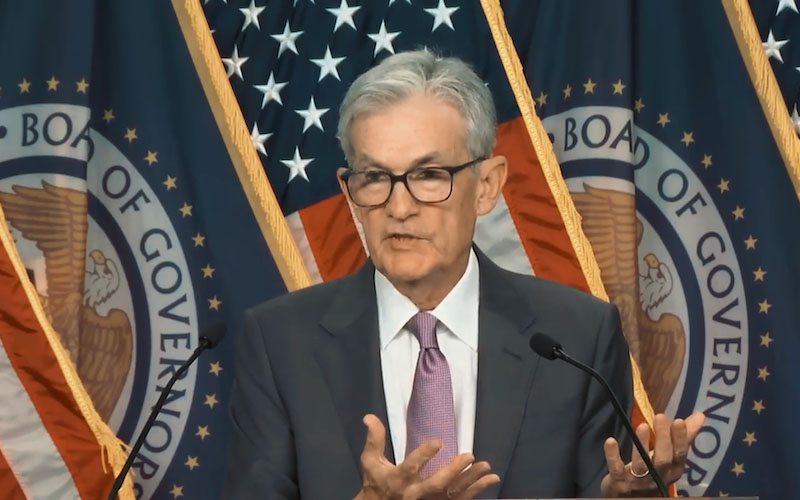
The Federal Reserve keeps interest rates unchanged! The Iran war has sparked uncertainty, with Powell stating bluntly: "Nobody knows whether the economy will collapse or remain stable; we can only wait and see!"
2026-03-19 06:56:33
The Federal Reserve made a crucial decision at its March 2026 policy meeting, maintaining the target range for the federal funds rate at 3.50%-3.75%. This decision was expected by the market, but the sharp escalation of geopolitical conflicts in the Middle East added layers of complexity. In the post-meeting press conference, Fed Chairman Jerome Powell frankly acknowledged that the current policy outlook faces extremely high uncertainty, primarily due to the impact of the US and Israeli military action against Iran. This has led to a sharp rise in global oil prices and energy costs, directly pushing up inflationary pressures and placing the Fed in a dilemma while fulfilling its dual mandate of controlling price stability and promoting full employment.
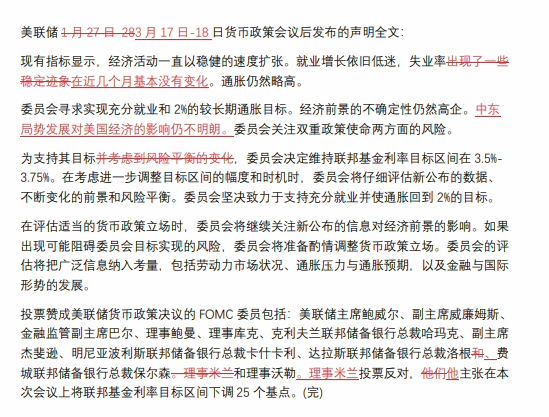
The Federal Open Market Committee (FOMC) passed a resolution to keep interest rates unchanged by a vote of 11 to 1. The only official to vote against was Federal Reserve Governor Mirren, who has consistently advocated for a more aggressive easing policy and favors an immediate rate cut to support economic growth.
While the overall policymaking body leans towards a wait-and-see approach, this divergence reflects subtle differences in internal assessments of current economic risks. The Federal Reserve believes that rising energy prices will significantly boost overall inflation in the short term, but it is too early to judge the full scope, depth, and duration of its impact on the economy. Powell emphasized that policymakers must remain highly cautious and avoid hasty action.
The military conflict between the US and Israel over Iran has become one of the biggest external variables affecting the global economy. Following the outbreak of the conflict, international oil prices surged from below $80 per barrel to over $108, leading to a sharp rise in gasoline prices in the US. This energy shock not only directly pushed up core inflation but may also gradually permeate into the core inflation domain through intermediate inputs such as diesel and jet fuel.
The Federal Reserve's latest economic projections show that the preferred inflation gauge (core PCE) is expected to reach 2.7% by the end of 2026, significantly higher than the 2.4% projected in December last year. This upward revision is mainly attributed to soaring oil prices and more sticky price pressures from tariff policies.
Nevertheless, policymakers still view the oil shock as a temporary factor, expecting inflation to fall back to around 2.2% by the end of 2027, and maintain their baseline expectation of only one interest rate cut this year (25 basis points).
Apart from mentioning the war, the Fed’s latest statement was virtually unchanged from the statement released at the end of its January 27-28 meeting .
Powell repeatedly used phrases like "we don't know" and "it could be bigger, it could be smaller" during the press conference, highlighting the uncertainty surrounding the duration and intensity of the war. He noted that the Fed is closely monitoring how energy prices affect core inflation while also assessing potential downside risks to the labor market. The current policy stance is considered "well-positioned" and will be adjusted flexibly based on the latest data, the balance of risks, and changes in the outlook. Notably, while the possibility of an interest rate hike was mentioned in this meeting, the vast majority of officials did not use it as a baseline scenario.
Besides geopolitical conflicts, the ongoing tariff policy is also a significant reason why the Federal Reserve's inflation path is unlikely to return to the 2% target quickly. Powell explicitly stated that the one-off price jump caused by tariffs has accounted for a considerable proportion (half to three-quarters) of core inflation, and the time it will take for its effects to subside is difficult to predict precisely.
Although the U.S. Supreme Court previously lifted some of the broad global tariffs imposed during the Trump era based on emergency laws, the government plans to replace them with other forms, such as tariffs targeting unfair trade practices by 16 major trading partners, making tariff-driven inflation more persistent.
The Federal Reserve is focused this year on making overall progress by reducing commodity inflation, but Powell acknowledged that it is difficult to “see through” the temporary nature of rising energy prices until core inflation stubbornly declines.
Following the Federal Reserve's decision, financial markets reacted strongly immediately. The S&P 500 fell about 1.4%, hitting a near four-month low; the dollar index rose 0.7%; and the yield on the 10-year U.S. Treasury note rose to 4.26%.
Interest rate futures indicate that traders have significantly postponed their expectations for rate cuts, now betting on the next cut not occurring until April 2027 at the earliest, with the probability of a rate cut this year significantly reduced. This shift reflects a strengthening market consensus that the Federal Reserve will maintain a cautious stance for a longer period.
Analysts are divided: some believe the Fed is more concerned about the potential economic slowdown caused by the oil shock and therefore leans towards future easing; others warn that uncertainty will make it difficult for the Fed to be a significant catalyst for risk assets this year.
Overall, this Federal Reserve meeting highlighted the policy dilemma under multiple external shocks. The war with Iran has not only disrupted global energy supply chains but has also intertwined with tariffs, sticky inflation, and labor market signals, creating a highly complex risk landscape. The Fed's decision to hold rates steady aims to accumulate more data for informed decision-making, while Powell's statements before the end of his term in May have added an additional layer of uncertainty to this transition period.
In the coming months, geopolitical developments, inflation data, and the performance of the job market will collectively determine whether the Federal Reserve continues its wait-and-see approach, unexpectedly shifts to easing, or is forced to adjust its path under extreme circumstances. Investors and the global economy need to be highly vigilant about the potential ripple effects of this period of uncertainty.
Background and voting results of the decision to maintain interest rates
The Federal Open Market Committee (FOMC) passed a resolution to keep interest rates unchanged by a vote of 11 to 1. The only official to vote against was Federal Reserve Governor Mirren, who has consistently advocated for a more aggressive easing policy and favors an immediate rate cut to support economic growth.
While the overall policymaking body leans towards a wait-and-see approach, this divergence reflects subtle differences in internal assessments of current economic risks. The Federal Reserve believes that rising energy prices will significantly boost overall inflation in the short term, but it is too early to judge the full scope, depth, and duration of its impact on the economy. Powell emphasized that policymakers must remain highly cautious and avoid hasty action.
How the Iran war is reshaping inflation and the economic outlook
The military conflict between the US and Israel over Iran has become one of the biggest external variables affecting the global economy. Following the outbreak of the conflict, international oil prices surged from below $80 per barrel to over $108, leading to a sharp rise in gasoline prices in the US. This energy shock not only directly pushed up core inflation but may also gradually permeate into the core inflation domain through intermediate inputs such as diesel and jet fuel.
The Federal Reserve's latest economic projections show that the preferred inflation gauge (core PCE) is expected to reach 2.7% by the end of 2026, significantly higher than the 2.4% projected in December last year. This upward revision is mainly attributed to soaring oil prices and more sticky price pressures from tariff policies.
Nevertheless, policymakers still view the oil shock as a temporary factor, expecting inflation to fall back to around 2.2% by the end of 2027, and maintain their baseline expectation of only one interest rate cut this year (25 basis points).
Apart from mentioning the war, the Fed’s latest statement was virtually unchanged from the statement released at the end of its January 27-28 meeting .
Powell repeatedly used phrases like "we don't know" and "it could be bigger, it could be smaller" during the press conference, highlighting the uncertainty surrounding the duration and intensity of the war. He noted that the Fed is closely monitoring how energy prices affect core inflation while also assessing potential downside risks to the labor market. The current policy stance is considered "well-positioned" and will be adjusted flexibly based on the latest data, the balance of risks, and changes in the outlook. Notably, while the possibility of an interest rate hike was mentioned in this meeting, the vast majority of officials did not use it as a baseline scenario.
The dual challenges of tariffs and inflation stickiness
Besides geopolitical conflicts, the ongoing tariff policy is also a significant reason why the Federal Reserve's inflation path is unlikely to return to the 2% target quickly. Powell explicitly stated that the one-off price jump caused by tariffs has accounted for a considerable proportion (half to three-quarters) of core inflation, and the time it will take for its effects to subside is difficult to predict precisely.
Although the U.S. Supreme Court previously lifted some of the broad global tariffs imposed during the Trump era based on emergency laws, the government plans to replace them with other forms, such as tariffs targeting unfair trade practices by 16 major trading partners, making tariff-driven inflation more persistent.
The Federal Reserve is focused this year on making overall progress by reducing commodity inflation, but Powell acknowledged that it is difficult to “see through” the temporary nature of rising energy prices until core inflation stubbornly declines.
The market's sharp reaction and the postponement of expectations for future interest rate cuts
Following the Federal Reserve's decision, financial markets reacted strongly immediately. The S&P 500 fell about 1.4%, hitting a near four-month low; the dollar index rose 0.7%; and the yield on the 10-year U.S. Treasury note rose to 4.26%.
Interest rate futures indicate that traders have significantly postponed their expectations for rate cuts, now betting on the next cut not occurring until April 2027 at the earliest, with the probability of a rate cut this year significantly reduced. This shift reflects a strengthening market consensus that the Federal Reserve will maintain a cautious stance for a longer period.
Analysts are divided: some believe the Fed is more concerned about the potential economic slowdown caused by the oil shock and therefore leans towards future easing; others warn that uncertainty will make it difficult for the Fed to be a significant catalyst for risk assets this year.
Overall, this Federal Reserve meeting highlighted the policy dilemma under multiple external shocks. The war with Iran has not only disrupted global energy supply chains but has also intertwined with tariffs, sticky inflation, and labor market signals, creating a highly complex risk landscape. The Fed's decision to hold rates steady aims to accumulate more data for informed decision-making, while Powell's statements before the end of his term in May have added an additional layer of uncertainty to this transition period.
In the coming months, geopolitical developments, inflation data, and the performance of the job market will collectively determine whether the Federal Reserve continues its wait-and-see approach, unexpectedly shifts to easing, or is forced to adjust its path under extreme circumstances. Investors and the global economy need to be highly vigilant about the potential ripple effects of this period of uncertainty.
- Risk Warning and Disclaimer
- The market involves risk, and trading may not be suitable for all investors. This article is for reference only and does not constitute personal investment advice, nor does it take into account certain users’ specific investment objectives, financial situation, or other needs. Any investment decisions made based on this information are at your own risk.