Crude oil trading alert: Geopolitical tensions are driving further increases in oil price volatility; after a shift in the central range, the market awaits a directional move.
2026-03-19 09:27:05
The situation in the Middle East has entered a critical phase, with the escalating conflict having a substantial impact on the global energy market. Following the attack on a key gas field, Iran stated it would retaliate against related energy facilities and listed energy facilities in several Gulf oil-producing countries as potential targets. This statement quickly triggered high levels of market concern regarding energy supply security, prompting energy infrastructure in the region to enter emergency response mode, and significantly increasing risks in the global energy market.

From the supply side, the impact of the conflict on global oil flows has already begun to emerge. Market surveys show that by mid-March, oil exports from the eight major Gulf oil-producing countries had fallen to an average of approximately 9.71 million barrels per day, a drop of about 61% compared to 25.13 million barrels per day in February. It is worth noting that before the conflict, the region accounted for approximately 36% of global seaborne oil exports. The disruption of this key supply region has rapidly put the global energy market under strain.
At the same time, regional energy supply chains have also been directly impacted. The disruption of Iranian natural gas supplies to Iraq, resulting in a daily shortage of approximately 19 million cubic meters, has led to a loss of over 3.1 GW of generating capacity in Iraq's power system, further exacerbating regional energy tensions. This disruption of transnational energy dependence has reinforced market awareness of the fragility of supply chains.
In terms of shipping, the Strait of Hormuz's transport capacity is severely limited; this strait handles approximately 20% of global seaborne crude oil transport (shown in bold). Faced with this disruption, Saudi Arabia quickly adjusted its export routes, transporting crude oil to the Red Sea port of Yanbu via a 1200-kilometer-long east-west pipeline, while simultaneously assembling a large number of tankers for transshipment. Data shows that Yanbu port's recent crude oil shipments have risen to approximately 4.19 million barrels per day, significantly higher than the previous level of approximately 1.4 million barrels, but this is still insufficient to fully compensate for the shortfall caused by the strait's obstruction.
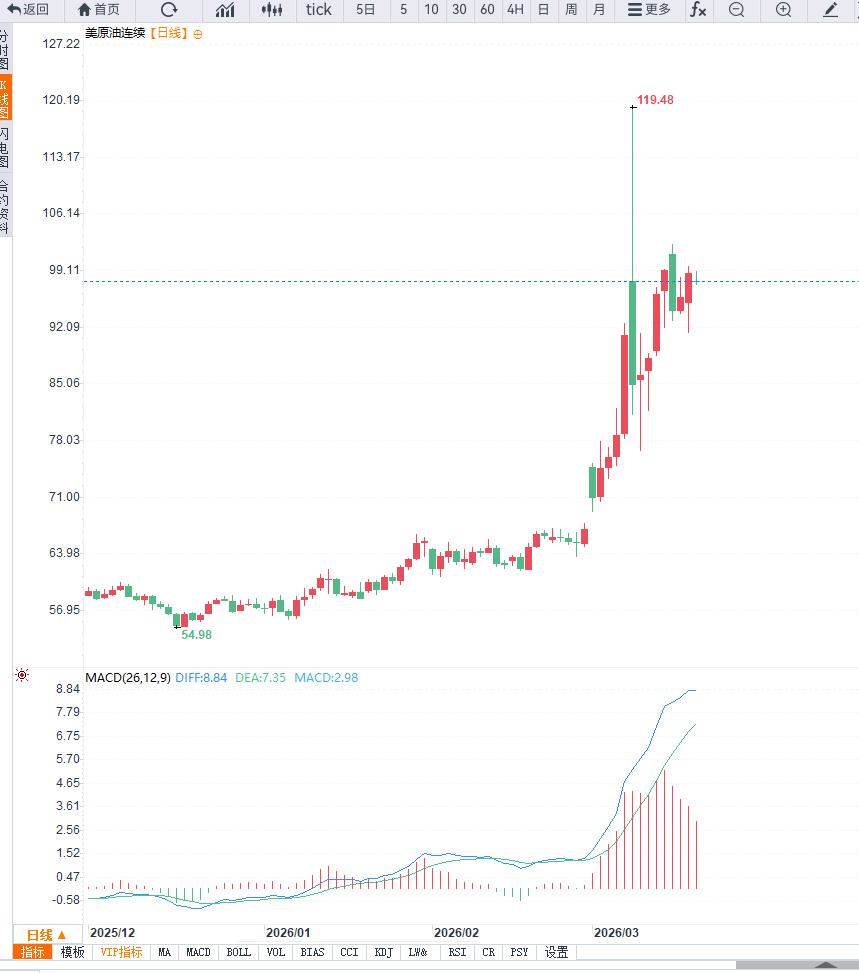
International oil prices surged, approaching the $100 mark, driven by expectations of supply contraction, but failed to break through effectively, with the short-term price level shifting further upward. The market generally believes that oil prices have formed a new trading range of $90 to $100, with further upward risk. In an extreme scenario, if transportation disruptions last for 2 to 4 weeks, the market estimates that oil prices could potentially hit the $150 to $200 range.
Meanwhile, inflationary pressures at the macro level are rising. The latest PPI data was significantly higher than expected, and coupled with rising energy prices, this has further increased inflation expectations. Against this backdrop, the Federal Reserve has signaled a more cautious policy stance, and market expectations for interest rate cuts this year have cooled considerably. Major central banks around the world have also expressed similar concerns, believing that rising energy prices could prolong the period in which inflation remains above target levels.
From a technical perspective, the daily chart for crude oil has broken through the upper edge of the previous consolidation range, showing a clear continuation of the upward trend. The key support level has moved up to around $90, while resistance levels are at $100 and $110. Momentum indicators suggest that bulls are in control. Looking at the 4-hour chart, oil prices have formed a stepped upward structure, rebounding quickly after multiple pullbacks. The short-term moving average system is in a bullish alignment. A break above the $100 level could open up further upside potential; however, if repeated tests of $100 fail, the possibility of further short-term corrections cannot be ruled out.
Overall, the Middle East conflict has evolved from a geopolitical event into a key variable affecting global energy supply. Coupled with expectations of tightening macroeconomic policies, financial markets are entering a period of high volatility.
Editor's Summary : The core contradiction in the current market has shifted to the combined effect of the "energy shock" and "inflationary pressures." The situation in the Middle East has led to a contraction in supply, providing strong support for oil prices, while rising inflation limits the scope for monetary policy easing. Against this backdrop, the global market faces the dual pressures of tightening liquidity and rising costs. In the short term, oil prices still face upside risks, while risk assets may continue to be under pressure. In the medium to long term, the recovery of shipping routes will be a key variable determining the trend of the energy market.
From the supply side, the impact of the conflict on global oil flows has already begun to emerge. Market surveys show that by mid-March, oil exports from the eight major Gulf oil-producing countries had fallen to an average of approximately 9.71 million barrels per day, a drop of about 61% compared to 25.13 million barrels per day in February. It is worth noting that before the conflict, the region accounted for approximately 36% of global seaborne oil exports. The disruption of this key supply region has rapidly put the global energy market under strain.
At the same time, regional energy supply chains have also been directly impacted. The disruption of Iranian natural gas supplies to Iraq, resulting in a daily shortage of approximately 19 million cubic meters, has led to a loss of over 3.1 GW of generating capacity in Iraq's power system, further exacerbating regional energy tensions. This disruption of transnational energy dependence has reinforced market awareness of the fragility of supply chains.
In terms of shipping, the Strait of Hormuz's transport capacity is severely limited; this strait handles approximately 20% of global seaborne crude oil transport (shown in bold). Faced with this disruption, Saudi Arabia quickly adjusted its export routes, transporting crude oil to the Red Sea port of Yanbu via a 1200-kilometer-long east-west pipeline, while simultaneously assembling a large number of tankers for transshipment. Data shows that Yanbu port's recent crude oil shipments have risen to approximately 4.19 million barrels per day, significantly higher than the previous level of approximately 1.4 million barrels, but this is still insufficient to fully compensate for the shortfall caused by the strait's obstruction.
International oil prices surged, approaching the $100 mark, driven by expectations of supply contraction, but failed to break through effectively, with the short-term price level shifting further upward. The market generally believes that oil prices have formed a new trading range of $90 to $100, with further upward risk. In an extreme scenario, if transportation disruptions last for 2 to 4 weeks, the market estimates that oil prices could potentially hit the $150 to $200 range.
Meanwhile, inflationary pressures at the macro level are rising. The latest PPI data was significantly higher than expected, and coupled with rising energy prices, this has further increased inflation expectations. Against this backdrop, the Federal Reserve has signaled a more cautious policy stance, and market expectations for interest rate cuts this year have cooled considerably. Major central banks around the world have also expressed similar concerns, believing that rising energy prices could prolong the period in which inflation remains above target levels.
From a technical perspective, the daily chart for crude oil has broken through the upper edge of the previous consolidation range, showing a clear continuation of the upward trend. The key support level has moved up to around $90, while resistance levels are at $100 and $110. Momentum indicators suggest that bulls are in control. Looking at the 4-hour chart, oil prices have formed a stepped upward structure, rebounding quickly after multiple pullbacks. The short-term moving average system is in a bullish alignment. A break above the $100 level could open up further upside potential; however, if repeated tests of $100 fail, the possibility of further short-term corrections cannot be ruled out.
Overall, the Middle East conflict has evolved from a geopolitical event into a key variable affecting global energy supply. Coupled with expectations of tightening macroeconomic policies, financial markets are entering a period of high volatility.
Editor's Summary : The core contradiction in the current market has shifted to the combined effect of the "energy shock" and "inflationary pressures." The situation in the Middle East has led to a contraction in supply, providing strong support for oil prices, while rising inflation limits the scope for monetary policy easing. Against this backdrop, the global market faces the dual pressures of tightening liquidity and rising costs. In the short term, oil prices still face upside risks, while risk assets may continue to be under pressure. In the medium to long term, the recovery of shipping routes will be a key variable determining the trend of the energy market.
- Risk Warning and Disclaimer
- The market involves risk, and trading may not be suitable for all investors. This article is for reference only and does not constitute personal investment advice, nor does it take into account certain users’ specific investment objectives, financial situation, or other needs. Any investment decisions made based on this information are at your own risk.