Gold plunges 6%! Why? Safe-haven logic suffers a double blow.
2026-03-19 19:58:14
On Thursday, March 19th, spot gold prices continued to decline, hitting a recent low. Geopolitical conflicts leading to inflation, coupled with hawkish signals from the Federal Reserve, have jointly suppressed gold's safe-haven appeal. Currently, spot gold is trading in the $4680-$4700/ounce range, a significant drop from the previous high of $5016/ounce, and is approaching a low of $4666.
Israel's strike on Iran's South Pars gas field triggered a chain reaction in energy infrastructure, prompting retaliatory measures from Iran and causing a rapid rise in oil prices. Simultaneously, stronger-than-expected US producer price index data further strengthened market expectations for a tightening of monetary policy by the Federal Reserve. While the Fed kept interest rates unchanged, Chairman Powell emphasized the potential inflation-boosting effect of the oil price shock at the press conference, mentioned the two-way risks to the interest rate path, and even discussed the possibility of a rate hike as the next move. These factors combined to drive a stronger dollar and tighter financial conditions, preventing gold from benefiting from safe-haven demand as traditionally expected; instead, it experienced accelerated selling pressure.
The latest developments in US-Iran tensions have extended from the military sphere to the energy sector. Israel's strike on Iran's South Pars gas field directly impacted the core of global natural gas supply, and Iran's subsequent response to energy facilities in the Gulf region further amplified uncertainty. As a result, crude oil prices rebounded sharply, with Brent crude breaking through the $110/barrel mark, a daily increase of over 3%. Historically, similar geopolitical conflicts typically boost safe-haven buying of gold, driving prices upward. However, this time the situation is markedly different: gold not only failed to follow oil prices upward but actually fell in tandem. This is mainly due to changes in inflation expectations triggered by the conflict—the surge in energy prices directly impacts overall price levels, and the market is beginning to worry that the Federal Reserve will extend the high-interest-rate cycle, thus weakening gold's appeal as a non-interest-bearing asset. Traders should note that this unusual correlation between rising oil prices and falling gold prices reflects a shift in the current macroeconomic environment compared to previous periods dominated by purely safe-haven logic; a simultaneous strengthening of the US dollar index has become the dominant factor.
The Federal Reserve's latest decision maintained the target range for the federal funds rate at 3.50%-3.75%, in line with market expectations. However, the subsequent summary of economic projections and Chairman Powell's remarks released a distinctly hawkish signal. Powell explicitly stated that the oil price shock could lead to higher-than-expected short-term inflation, and emphasized that "the pace of inflation decline is not as fast as previously hoped." He also acknowledged that the committee had discussed the two-way risks to interest rates, and even mentioned that the next adjustment might be an option for raising interest rates. Coupled with better-than-expected US producer price index data—up 0.7% month-on-month (expected 0.3%) and core producer price index up 0.5% month-on-month (expected 0.3%)—the market's pricing of the number of rate cuts in 2026 plummeted from about 55 basis points to around 26 basis points. This policy shift directly tightens financial conditions, pushing up US Treasury yields and the dollar exchange rate, putting double pressure on gold. As an asset highly sensitive to interest rates, the cost of holding gold increases significantly in a higher-interest-rate environment, leading to a continuous reduction in long positions.
The following is a comparison of key data:
This data combination not only confirms the immediate transmission of energy prices to inflation, but also reinforces the necessity for the Federal Reserve to maintain a tight stance.
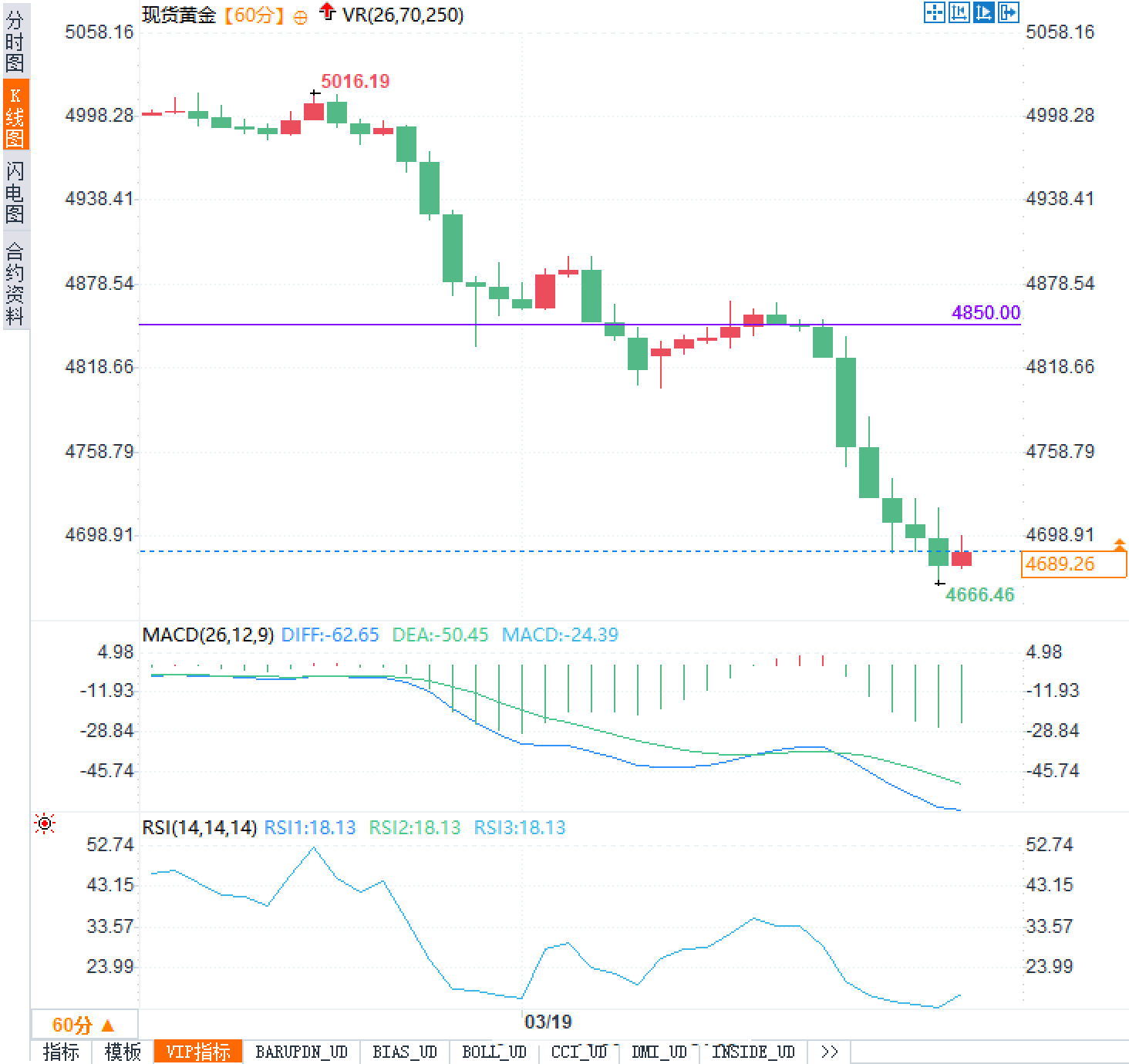
Observing the 60-minute chart, spot gold has broken below the key support level of $4,850 and is now testing the $4,660 level. The MACD indicator shows a DIFF value of -62.65, a DEA value of -50.45, and a MACD histogram of -24.39, showing a clear bearish pattern, and the death cross continues; the RSI (14) indicator reading is only 18.13, which is in an extremely oversold area, but no effective divergence signal has appeared, indicating that the trend momentum is still bearish. The price has fallen by more than 6% from the high of $5,016.19, and the trading volume has increased along with the decline, showing a bearish dominance. Pay attention to the effectiveness of the $4,660 support. If it holds, a technical rebound may occur, but the resistance at $4,850 above still constitutes strong pressure. Unless there is a significant easing in the fundamentals, the technicals will continue to confirm the macro pressure.
Israel's strike on Iran's South Pars gas field triggered a chain reaction in energy infrastructure, prompting retaliatory measures from Iran and causing a rapid rise in oil prices. Simultaneously, stronger-than-expected US producer price index data further strengthened market expectations for a tightening of monetary policy by the Federal Reserve. While the Fed kept interest rates unchanged, Chairman Powell emphasized the potential inflation-boosting effect of the oil price shock at the press conference, mentioned the two-way risks to the interest rate path, and even discussed the possibility of a rate hike as the next move. These factors combined to drive a stronger dollar and tighter financial conditions, preventing gold from benefiting from safe-haven demand as traditionally expected; instead, it experienced accelerated selling pressure.
Abnormal market reactions to escalating geopolitical conflicts
The latest developments in US-Iran tensions have extended from the military sphere to the energy sector. Israel's strike on Iran's South Pars gas field directly impacted the core of global natural gas supply, and Iran's subsequent response to energy facilities in the Gulf region further amplified uncertainty. As a result, crude oil prices rebounded sharply, with Brent crude breaking through the $110/barrel mark, a daily increase of over 3%. Historically, similar geopolitical conflicts typically boost safe-haven buying of gold, driving prices upward. However, this time the situation is markedly different: gold not only failed to follow oil prices upward but actually fell in tandem. This is mainly due to changes in inflation expectations triggered by the conflict—the surge in energy prices directly impacts overall price levels, and the market is beginning to worry that the Federal Reserve will extend the high-interest-rate cycle, thus weakening gold's appeal as a non-interest-bearing asset. Traders should note that this unusual correlation between rising oil prices and falling gold prices reflects a shift in the current macroeconomic environment compared to previous periods dominated by purely safe-haven logic; a simultaneous strengthening of the US dollar index has become the dominant factor.
The Fed's shift in policy signals has put downward pressure on gold.
The Federal Reserve's latest decision maintained the target range for the federal funds rate at 3.50%-3.75%, in line with market expectations. However, the subsequent summary of economic projections and Chairman Powell's remarks released a distinctly hawkish signal. Powell explicitly stated that the oil price shock could lead to higher-than-expected short-term inflation, and emphasized that "the pace of inflation decline is not as fast as previously hoped." He also acknowledged that the committee had discussed the two-way risks to interest rates, and even mentioned that the next adjustment might be an option for raising interest rates. Coupled with better-than-expected US producer price index data—up 0.7% month-on-month (expected 0.3%) and core producer price index up 0.5% month-on-month (expected 0.3%)—the market's pricing of the number of rate cuts in 2026 plummeted from about 55 basis points to around 26 basis points. This policy shift directly tightens financial conditions, pushing up US Treasury yields and the dollar exchange rate, putting double pressure on gold. As an asset highly sensitive to interest rates, the cost of holding gold increases significantly in a higher-interest-rate environment, leading to a continuous reduction in long positions.
The following is a comparison of key data:
| index | actual value | Market expectations | Previous value |
|---|---|---|---|
| US PPI month-on-month | 0.7% | 0.3% | 0.3% |
| Core PPI month-on-month | 0.5% | 0.3% | 0.3% |
| Pricing of interest rate cuts in 2026 (in basis points) | Approximately 26 | Previously 55 | — |
Technical indicators are signaling a continued downward trend.
Observing the 60-minute chart, spot gold has broken below the key support level of $4,850 and is now testing the $4,660 level. The MACD indicator shows a DIFF value of -62.65, a DEA value of -50.45, and a MACD histogram of -24.39, showing a clear bearish pattern, and the death cross continues; the RSI (14) indicator reading is only 18.13, which is in an extremely oversold area, but no effective divergence signal has appeared, indicating that the trend momentum is still bearish. The price has fallen by more than 6% from the high of $5,016.19, and the trading volume has increased along with the decline, showing a bearish dominance. Pay attention to the effectiveness of the $4,660 support. If it holds, a technical rebound may occur, but the resistance at $4,850 above still constitutes strong pressure. Unless there is a significant easing in the fundamentals, the technicals will continue to confirm the macro pressure.
Frequently Asked Questions
Question 1: Why did the escalation of geopolitical conflicts fail to effectively boost demand for gold as a safe haven?
A: While the conflict has driven up oil prices and inflation expectations, it has also simultaneously strengthened the US dollar and US Treasury yields. As a non-interest-bearing asset, gold's opportunity cost increases with rising interest rate expectations, leading to traditional safe-haven buying being drawn to dollar assets. Powell's emphasis on the inflation-boosting effect of oil prices further weakened market willingness to allocate to gold, creating a short-term phenomenon of "safe-haven failure."
Question 2: How will the Fed's hawkish stance change the medium-term pricing logic of gold?
A: The shift in policy signals from easing to caution has significantly reduced expectations for interest rate cuts in 2026. A higher interest rate path lengthens the cost of holding gold, while upside risks to inflation limit the downside potential for real interest rates. Traders need to pay attention to the Federal Reserve's assessment of the energy shock; if oil prices remain high, the upside for gold prices will be limited, while a correction may occur if prices fall.
Question 3: Does the current oversold condition indicated by technical indicators suggest an imminent rebound?
A: Although the RSI reading is extremely oversold, the MACD bearish alignment and continued price breakdowns indicate that downward momentum has not yet subsided. Historical data shows that similar extreme oversold conditions require fundamental improvements to effectively reverse. If geopolitical tensions ease or the Federal Reserve releases dovish signals, a technical rebound may occur; otherwise, the downtrend may continue to lower support levels.
- Risk Warning and Disclaimer
- The market involves risk, and trading may not be suitable for all investors. This article is for reference only and does not constitute personal investment advice, nor does it take into account certain users’ specific investment objectives, financial situation, or other needs. Any investment decisions made based on this information are at your own risk.