The mutual bombing between Iran and Israel ignited an "energy war," leading to a global asset sell-off, with an even bigger storm yet to come.
2026-03-20 09:36:26
The situation in Iran has escalated dramatically. The US-Israel war against Iran has been ongoing for weeks, with the latest developments including a large-scale Iranian retaliatory strike against multiple energy facilities in the Middle East following Israel's airstrike on the South Pars gas field. This is the largest attack on energy infrastructure in the conflict to date, directly increasing concerns about global energy supply disruptions.
Brent crude oil prices surged to $119.11 per barrel on Thursday (March 19) before falling back due to conciliatory remarks from Israeli Prime Minister Netanyahu and the easing of some restrictions on Russian oil sales by the United States. The price spread between WTI and Brent crude widened to $12.05 per barrel, the largest since 2015, reflecting the severe impact of supply disruptions on the international market.
On Friday during Asian trading hours, US crude oil prices fluctuated downwards, currently trading around $92.95 per barrel, down about 2.7% on the day.
Investors reassessed the potential deep economic shock of a potential war with Iran, leading to a widespread sell-off across global assets. Market panic intensified, affecting everything from government bonds and stocks to gold. U.S. stocks closed slightly lower on Thursday, while stock indices in many other countries fell sharply. The rare simultaneous meetings of all G7 central banks within less than 24 hours further pressured markets.
Analysts point out that the market previously viewed the risk as a short-term price shock rather than a long-term crisis; if energy prices remain high, the sell-off will be more severe.
David Rees, global head of economics at Schroders, recently stated, "It feels like the market was reacting to a relatively short-term price shock rather than a long-term crisis. If prices rise and stay at higher levels for longer, then a wider sell-off will naturally be more painful."
The Federal Reserve's hawkish signals further exacerbated the decline. Traders no longer expect a Fed rate cut this year, instead betting on a more swift response from the European Central Bank to rising energy prices. The market estimates a roughly 60% probability of an ECB rate hike in April and has fully priced in two rate hikes this year, with a high probability of a third by the end of the year.
Three sources revealed that unless the conflict is resolved quickly, the European Central Bank may begin discussing interest rate hikes in April and tighten policy in June. The Bank of England kept interest rates unchanged on Thursday, but some officials raised the possibility of a rate hike, a stark contrast to pre-war expectations of rate cuts.
Uto Shinohara, senior investment strategist at Mesirow Currency Management, points out that the dollar's support is weakening due to expectations of interest rate hikes by other major central banks. The Federal Reserve is keeping interest rates at 3.5%-3.75%, and most officials still expect at least one rate cut this year, but the risk of inflation driven by the war is complicating the outlook.
Supply disruptions triggered by the conflict are exacerbating inflationary pressures and threatening economic growth. High oil prices are driving imported inflation, and Europe, with its fresh memory of the energy crisis, is more inclined to react quickly. Federal Reserve Chairman Powell emphasized that it is difficult to "see through" the temporary nature of energy price shocks.
Bond market yields surged, with the yield on UK two-year government bonds rising by more than 30 basis points at one point. Although it partially retreated in the afternoon, the overall trend indicates a sharp shift in interest rate expectations.
Zachary Griffiths, head of macro strategy at CreditSights, said on Thursday: “We are more focused on the impact of the Middle East situation on demand destruction and economic growth. And I think even today, you can see these two forces pulling against each other, and it’s quite difficult to judge which side is winning every minute of trading.”
Gold, as a traditional safe-haven asset, should have benefited from geopolitical risks, but it performed poorly in this conflict, closing down 3.5% on Thursday and hitting a one-and-a-half-month low of $4,503.18 per ounce.
Analysts believe that well-performing instruments were used to offset losses in other assets, coupled with the short-term high of the US dollar and pressure from closed out crowded trades. The broad-based sell-off indicates that investors are worried about a double whammy of inflation and recession, rather than simply driven by safe-haven demand.
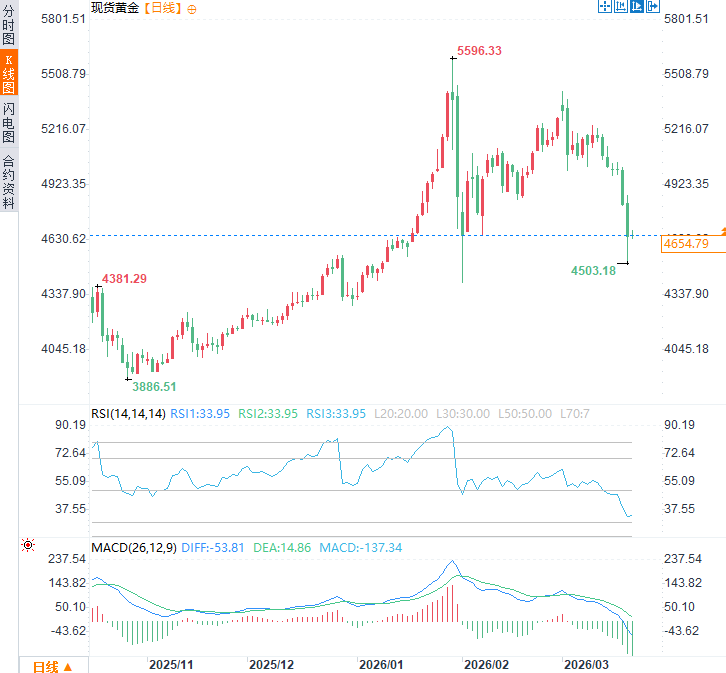
(Spot gold daily chart, source: FX678)
The escalation of the conflict with Iran has evolved from military confrontation into an energy war. Attacks on key facilities such as South Pars have directly disrupted global supply, and the sharp fluctuations in oil prices have amplified the dual risks of inflation and economic slowdown. Central banks in many countries have simultaneously shifted to hawkish policies, with the Federal Reserve delaying its rate-cutting path and expectations of rate hikes rising in Europe and the UK. Recent surges in bond yields, stock market declines, and gold price corrections all reflect the market's repricing of a long-term crisis. Although some signs of de-escalation have emerged (such as Israel's temporary halt to the attack on South Pars), the vulnerability of energy infrastructure has been exposed. If the conflict continues, the global economy will face even more severe challenges, and investors need to be wary of the combined impact of renewed inflation and slowing growth.
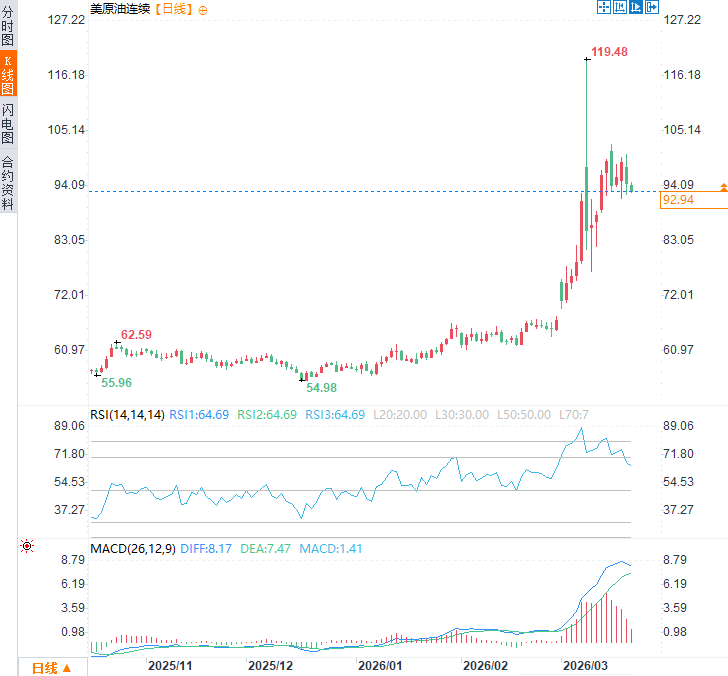
(US crude oil daily chart, source: FX678)
At 9:36 AM Beijing time, US crude oil futures were trading at $92.84 per barrel.
Brent crude oil prices surged to $119.11 per barrel on Thursday (March 19) before falling back due to conciliatory remarks from Israeli Prime Minister Netanyahu and the easing of some restrictions on Russian oil sales by the United States. The price spread between WTI and Brent crude widened to $12.05 per barrel, the largest since 2015, reflecting the severe impact of supply disruptions on the international market.
On Friday during Asian trading hours, US crude oil prices fluctuated downwards, currently trading around $92.95 per barrel, down about 2.7% on the day.
Global asset sell-off and market concerns
Investors reassessed the potential deep economic shock of a potential war with Iran, leading to a widespread sell-off across global assets. Market panic intensified, affecting everything from government bonds and stocks to gold. U.S. stocks closed slightly lower on Thursday, while stock indices in many other countries fell sharply. The rare simultaneous meetings of all G7 central banks within less than 24 hours further pressured markets.
Analysts point out that the market previously viewed the risk as a short-term price shock rather than a long-term crisis; if energy prices remain high, the sell-off will be more severe.
David Rees, global head of economics at Schroders, recently stated, "It feels like the market was reacting to a relatively short-term price shock rather than a long-term crisis. If prices rise and stay at higher levels for longer, then a wider sell-off will naturally be more painful."
Hawkish signals from the central bank and changes in interest rate hike expectations
The Federal Reserve's hawkish signals further exacerbated the decline. Traders no longer expect a Fed rate cut this year, instead betting on a more swift response from the European Central Bank to rising energy prices. The market estimates a roughly 60% probability of an ECB rate hike in April and has fully priced in two rate hikes this year, with a high probability of a third by the end of the year.
Three sources revealed that unless the conflict is resolved quickly, the European Central Bank may begin discussing interest rate hikes in April and tighten policy in June. The Bank of England kept interest rates unchanged on Thursday, but some officials raised the possibility of a rate hike, a stark contrast to pre-war expectations of rate cuts.
Uto Shinohara, senior investment strategist at Mesirow Currency Management, points out that the dollar's support is weakening due to expectations of interest rate hikes by other major central banks. The Federal Reserve is keeping interest rates at 3.5%-3.75%, and most officials still expect at least one rate cut this year, but the risk of inflation driven by the war is complicating the outlook.
Dual risks of inflation and economic growth
Supply disruptions triggered by the conflict are exacerbating inflationary pressures and threatening economic growth. High oil prices are driving imported inflation, and Europe, with its fresh memory of the energy crisis, is more inclined to react quickly. Federal Reserve Chairman Powell emphasized that it is difficult to "see through" the temporary nature of energy price shocks.
Bond market yields surged, with the yield on UK two-year government bonds rising by more than 30 basis points at one point. Although it partially retreated in the afternoon, the overall trend indicates a sharp shift in interest rate expectations.
Zachary Griffiths, head of macro strategy at CreditSights, said on Thursday: “We are more focused on the impact of the Middle East situation on demand destruction and economic growth. And I think even today, you can see these two forces pulling against each other, and it’s quite difficult to judge which side is winning every minute of trading.”
Gold and other safe-haven assets have shown unusual performance.
Gold, as a traditional safe-haven asset, should have benefited from geopolitical risks, but it performed poorly in this conflict, closing down 3.5% on Thursday and hitting a one-and-a-half-month low of $4,503.18 per ounce.
Analysts believe that well-performing instruments were used to offset losses in other assets, coupled with the short-term high of the US dollar and pressure from closed out crowded trades. The broad-based sell-off indicates that investors are worried about a double whammy of inflation and recession, rather than simply driven by safe-haven demand.
(Spot gold daily chart, source: FX678)
Editor's Summary
The escalation of the conflict with Iran has evolved from military confrontation into an energy war. Attacks on key facilities such as South Pars have directly disrupted global supply, and the sharp fluctuations in oil prices have amplified the dual risks of inflation and economic slowdown. Central banks in many countries have simultaneously shifted to hawkish policies, with the Federal Reserve delaying its rate-cutting path and expectations of rate hikes rising in Europe and the UK. Recent surges in bond yields, stock market declines, and gold price corrections all reflect the market's repricing of a long-term crisis. Although some signs of de-escalation have emerged (such as Israel's temporary halt to the attack on South Pars), the vulnerability of energy infrastructure has been exposed. If the conflict continues, the global economy will face even more severe challenges, and investors need to be wary of the combined impact of renewed inflation and slowing growth.
(US crude oil daily chart, source: FX678)
At 9:36 AM Beijing time, US crude oil futures were trading at $92.84 per barrel.
- Risk Warning and Disclaimer
- The market involves risk, and trading may not be suitable for all investors. This article is for reference only and does not constitute personal investment advice, nor does it take into account certain users’ specific investment objectives, financial situation, or other needs. Any investment decisions made based on this information are at your own risk.