Institutions: With debt risks continuing to rise, gold's pullback presents a buying opportunity.
2026-03-20 10:31:01
The gold market continues to frustrate investors, marking its second single-day drop of 4% since the US-Israel war against Iran. This event is creating significant economic uncertainty and pushing up energy prices and inflation.
Spot gold is currently trading around $4,680 per ounce.
While gold prices may continue to decline in the short term, one fund manager said that these pullbacks and short-term fluctuations are the perfect opportunity for investors to profit, as rising government debt and limited central bank action will continue to support higher gold prices in the long run.
Tavi Costa, founder and CEO of Azuria Capital, believes the current pullback in gold prices is just noise, and the precious metals market is still in the early stages of a major bull market, which is increasingly being driven by structural forces reshaping the mining industry and the global economy itself.
Despite pressures from tightening liquidity and shifting interest rate expectations, Costa said the macroeconomic backdrop remains a strong support for gold.
He said, "This is by no means the end of the cycle."
He believes the key driver of gold's long-term upward trend is not short-term market sentiment, but rather the unsustainable nature of global debt . Governments, especially the US government, are facing rising interest costs, which are squeezing spending in other areas. Therefore, he expects policymakers to prioritize lowering interest rates, regardless of inflation data or traditional economic signals, to alleviate the debt repayment burden. He believes this shift will be a strong driver for gold.
Costa made these remarks as the U.S. government debt has now exceeded $39 trillion. Due to the cost of a war with Iran, there are growing expectations that the U.S. debt could reach $40 trillion by the fall.
This macro framework was also the core theme of Costa's speech at the Prospectors and Developers Association of Canada (PDAC) 2026 conference, in which he elaborated on what he sees as a historic turning point for hard assets.
Even with gold's strong performance last year, Costa maintains that the sector remains underweighted and undervalued relative to the size of its potential opportunities. He points out that U.S. gold reserves today account for only about 3% of federal debt, compared to about 51% in the 1940s.
He pointed out that this imbalance highlights how much room there is for gold prices to rise if governments set about rebuilding their gold reserves or restoring their balance sheets.
At the same time, he noted a significant structural shift in global reserve management. Many countries, particularly emerging market nations, are gradually reducing their holdings of US Treasury bonds and increasing their gold reserves. This trend, coupled with the possibility of a prolonged weakening of the US dollar, further reinforces his optimistic outlook for precious metals.
He said, "In such situations, many people tend to be short-sighted, thinking that the argument has changed, but it is precisely at times like these that wealth can be accumulated. When the market is down, you should increase your holdings, not decrease them. At such times, steadfast people will buy , not sell, and I am one of those steadfast people."
However, Costa believes the outlook for mining stocks is also very bright. He stated that the industry is in the "early stages of a major cycle," and capital inflows are expected to accelerate.
He stated that one of the most striking aspects of the current market landscape is the disconnect between metal prices and mining company valuations. Even with significant increases in gold and silver prices, many producers still have relatively low price-to-earnings ratios, and in some cases, some companies have profit margins comparable to those of technology companies, while their production costs are far below current metal prices.
Costa attributed this valuation gap to investor skepticism about the sustainability of the continued rise in precious metal prices, but he said such skepticism was unfounded. He explained that supply constraints across the mining industry are becoming increasingly severe and are unlikely to be resolved anytime soon.
Costa emphasized at the PDAC conference that, according to relevant data, the industry has made almost no major discoveries in the past two years, which is unprecedented in the history of modern mining.
After years of underinvestment in exploration and development, a shortage of new mineral deposits has emerged. Capital expenditure across the commodities industry has been significantly constrained since the last cycle, thus limiting future supply channels. Therefore, Costa believes the industry is facing a prolonged period of tight supply and structurally rising prices.
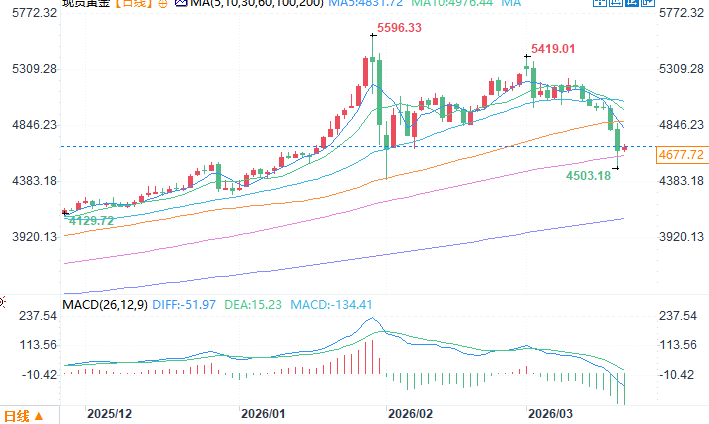
Spot gold daily chart source: EasyForex
At 10:30 AM Beijing time on March 20, spot gold was trading at $4682.72 per ounce.
Spot gold is currently trading around $4,680 per ounce.
While gold prices may continue to decline in the short term, one fund manager said that these pullbacks and short-term fluctuations are the perfect opportunity for investors to profit, as rising government debt and limited central bank action will continue to support higher gold prices in the long run.
Tavi Costa, founder and CEO of Azuria Capital, believes the current pullback in gold prices is just noise, and the precious metals market is still in the early stages of a major bull market, which is increasingly being driven by structural forces reshaping the mining industry and the global economy itself.
Despite pressures from tightening liquidity and shifting interest rate expectations, Costa said the macroeconomic backdrop remains a strong support for gold.
He said, "This is by no means the end of the cycle."
He believes the key driver of gold's long-term upward trend is not short-term market sentiment, but rather the unsustainable nature of global debt . Governments, especially the US government, are facing rising interest costs, which are squeezing spending in other areas. Therefore, he expects policymakers to prioritize lowering interest rates, regardless of inflation data or traditional economic signals, to alleviate the debt repayment burden. He believes this shift will be a strong driver for gold.
Costa made these remarks as the U.S. government debt has now exceeded $39 trillion. Due to the cost of a war with Iran, there are growing expectations that the U.S. debt could reach $40 trillion by the fall.
This macro framework was also the core theme of Costa's speech at the Prospectors and Developers Association of Canada (PDAC) 2026 conference, in which he elaborated on what he sees as a historic turning point for hard assets.
Even with gold's strong performance last year, Costa maintains that the sector remains underweighted and undervalued relative to the size of its potential opportunities. He points out that U.S. gold reserves today account for only about 3% of federal debt, compared to about 51% in the 1940s.
He pointed out that this imbalance highlights how much room there is for gold prices to rise if governments set about rebuilding their gold reserves or restoring their balance sheets.
At the same time, he noted a significant structural shift in global reserve management. Many countries, particularly emerging market nations, are gradually reducing their holdings of US Treasury bonds and increasing their gold reserves. This trend, coupled with the possibility of a prolonged weakening of the US dollar, further reinforces his optimistic outlook for precious metals.
He said, "In such situations, many people tend to be short-sighted, thinking that the argument has changed, but it is precisely at times like these that wealth can be accumulated. When the market is down, you should increase your holdings, not decrease them. At such times, steadfast people will buy , not sell, and I am one of those steadfast people."
However, Costa believes the outlook for mining stocks is also very bright. He stated that the industry is in the "early stages of a major cycle," and capital inflows are expected to accelerate.
He stated that one of the most striking aspects of the current market landscape is the disconnect between metal prices and mining company valuations. Even with significant increases in gold and silver prices, many producers still have relatively low price-to-earnings ratios, and in some cases, some companies have profit margins comparable to those of technology companies, while their production costs are far below current metal prices.
Costa attributed this valuation gap to investor skepticism about the sustainability of the continued rise in precious metal prices, but he said such skepticism was unfounded. He explained that supply constraints across the mining industry are becoming increasingly severe and are unlikely to be resolved anytime soon.
Costa emphasized at the PDAC conference that, according to relevant data, the industry has made almost no major discoveries in the past two years, which is unprecedented in the history of modern mining.
After years of underinvestment in exploration and development, a shortage of new mineral deposits has emerged. Capital expenditure across the commodities industry has been significantly constrained since the last cycle, thus limiting future supply channels. Therefore, Costa believes the industry is facing a prolonged period of tight supply and structurally rising prices.
Spot gold daily chart source: EasyForex
At 10:30 AM Beijing time on March 20, spot gold was trading at $4682.72 per ounce.
- Risk Warning and Disclaimer
- The market involves risk, and trading may not be suitable for all investors. This article is for reference only and does not constitute personal investment advice, nor does it take into account certain users’ specific investment objectives, financial situation, or other needs. Any investment decisions made based on this information are at your own risk.