Goldman Sachs issues a major warning: $100 oil prices are just the beginning! Supply shocks may continue until 2027.
2026-03-20 10:37:53
Goldman Sachs reported on Thursday (March 19) that the risks to oil prices are skewed significantly to the upside in the short term, up to 2027. The bank emphasized that historically, major supply shocks have shown strong persistence, and the current disruption to energy infrastructure caused by the Iran war is highly likely to keep oil prices above $100 per barrel for an extended period.
The baseline scenario assumes a gradual recovery in oil supply starting in April, with Brent crude falling back to the $70 range in the fourth quarter of 2026. However, Goldman Sachs specifically warns that the actual path is much longer than the baseline due to the duration of the Iranian conflict, uncertainty surrounding the reopening of the Strait of Hormuz, and the risk of permanent damage to production capacity, resulting in significantly higher long-term outlook risks.
Brent crude oil prices fluctuated downwards during Friday's Asian trading session, currently trading around $105.60 per barrel, down about 2% on the day. On Thursday, Brent crude oil prices surged to $119.11 per barrel before falling back due to conciliatory remarks from Israeli Prime Minister Netanyahu and the easing of some restrictions on Russian oil sales by the United States.

Brent crude futures surged above $119 a barrel on Thursday, mainly due to Iran's large-scale retaliatory attacks on energy facilities in many parts of the Middle East following Israel's airstrike on Iran's South Pars gas field, causing widespread production shutdowns in the Gulf countries.
The escalating conflict has directly impacted the global oil and gas supply chain, with market panic fueling safe-haven demand and inflation expectations. Although prices retreated somewhat in the afternoon, they remained high, reflecting that concerns about supply disruptions are unlikely to subside in the short term.
Goldman Sachs reviewed five major supply disruptions over the past 50 years (including the 1973 Arab oil embargo, the 1979 Iranian Revolution, the 1990 Gulf War, the 2003 Iraq War, and the 2011 Libyan Civil War) and found that these shocks, on average, lasted a long time and often had a greater impact on oil prices than initially expected.
In most cases, oil prices remained in the single digits for several years after supply recovered. This war with Iran involves the Strait of Hormuz, the world's most important oil route, with potential damage far exceeding historical precedents, and the path to supply recovery is even more uncertain.
The Strait of Hormuz is the lifeline for approximately 20% of the world's oil and 30% of its liquefied natural gas transport. If Iran blocks it or facilities continue to be damaged, the scale of the supply disruption will be the largest in history.
Goldman Sachs analysts believe that if production capacity suffers permanent damage (such as the 3-5 year repair time required for Qatar's LNG facilities), global supply will be constrained in the long term; conversely, if OPEC+ quickly utilizes its spare capacity (approximately 5 million barrels per day from Saudi Arabia and other countries), production is expected to partially recover.
However, the current widespread production shutdowns in Gulf countries, coupled with uncertainties in the recovery process, make it difficult to quickly fill the short-term supply gap, and oil prices are likely to remain high .
Goldman Sachs points out that oil prices may continue to rise in the short term during periods of restricted oil flows. If supply risks persist, Brent crude could potentially break through the historical peak of $147 per barrel in 2008. Meanwhile, if the market perceives that the US will further tighten crude oil exports (to ensure domestic supply or for geostrategic reasons), the price difference between Brent and WTI crude will widen further. Currently, the discount of WTI to Brent is at an 11-year high, and this trend may exacerbate the global energy cost divergence and the transmission of inflationary pressures.
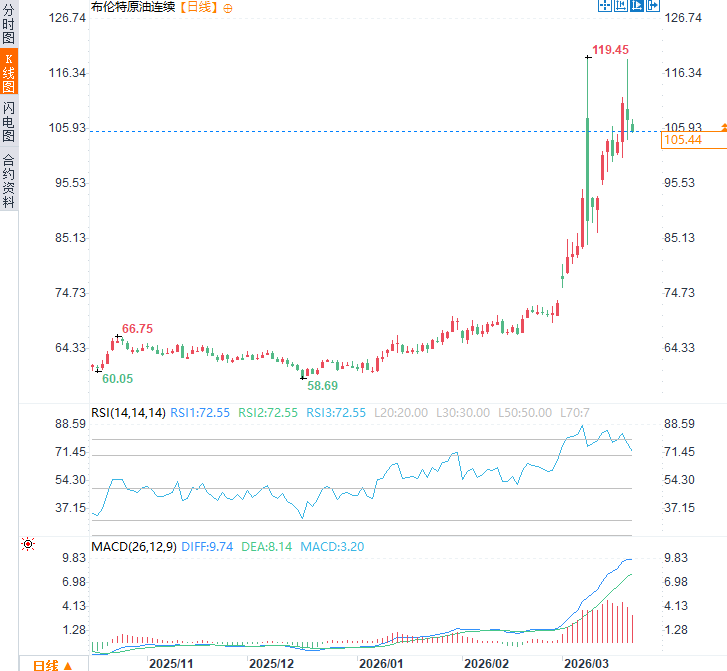
(Brent crude oil daily chart, source: EasyForex)
A Goldman Sachs report highlights that the current Middle East conflict has escalated from regional military confrontation to a global energy supply crisis. Iran's retaliatory strikes have led to widespread shutdowns of energy facilities in the Gulf, and the uncertainty surrounding the Strait of Hormuz makes the path to supply recovery exceptionally unclear.
In the baseline scenario, Brent crude oil prices will fall back to $70 by the end of 2026, but the upside risks are significantly outweighed, and it is not an extreme assumption that prices will remain above $100 or even challenge historical peaks in the long term.
OPEC's spare capacity, recovery speed, and diplomatic maneuvering will be key variables. The global economy faces the dual pressures of renewed imported inflation and slowing growth, and energy market volatility will remain high.
At 10:37 Beijing time, Brent crude oil futures were trading at $106.46 per barrel.
The baseline scenario assumes a gradual recovery in oil supply starting in April, with Brent crude falling back to the $70 range in the fourth quarter of 2026. However, Goldman Sachs specifically warns that the actual path is much longer than the baseline due to the duration of the Iranian conflict, uncertainty surrounding the reopening of the Strait of Hormuz, and the risk of permanent damage to production capacity, resulting in significantly higher long-term outlook risks.
Brent crude oil prices fluctuated downwards during Friday's Asian trading session, currently trading around $105.60 per barrel, down about 2% on the day. On Thursday, Brent crude oil prices surged to $119.11 per barrel before falling back due to conciliatory remarks from Israeli Prime Minister Netanyahu and the easing of some restrictions on Russian oil sales by the United States.
Current escalation of conflict and sharp fluctuations in oil prices
Brent crude futures surged above $119 a barrel on Thursday, mainly due to Iran's large-scale retaliatory attacks on energy facilities in many parts of the Middle East following Israel's airstrike on Iran's South Pars gas field, causing widespread production shutdowns in the Gulf countries.
The escalating conflict has directly impacted the global oil and gas supply chain, with market panic fueling safe-haven demand and inflation expectations. Although prices retreated somewhat in the afternoon, they remained high, reflecting that concerns about supply disruptions are unlikely to subside in the short term.
Lessons from Five Major Supply Disruptions in the Past 50 Years
Goldman Sachs reviewed five major supply disruptions over the past 50 years (including the 1973 Arab oil embargo, the 1979 Iranian Revolution, the 1990 Gulf War, the 2003 Iraq War, and the 2011 Libyan Civil War) and found that these shocks, on average, lasted a long time and often had a greater impact on oil prices than initially expected.
In most cases, oil prices remained in the single digits for several years after supply recovered. This war with Iran involves the Strait of Hormuz, the world's most important oil route, with potential damage far exceeding historical precedents, and the path to supply recovery is even more uncertain.
The impact on the Strait of Hormuz may be the largest in history.
The Strait of Hormuz is the lifeline for approximately 20% of the world's oil and 30% of its liquefied natural gas transport. If Iran blocks it or facilities continue to be damaged, the scale of the supply disruption will be the largest in history.
Goldman Sachs analysts believe that if production capacity suffers permanent damage (such as the 3-5 year repair time required for Qatar's LNG facilities), global supply will be constrained in the long term; conversely, if OPEC+ quickly utilizes its spare capacity (approximately 5 million barrels per day from Saudi Arabia and other countries), production is expected to partially recover.
However, the current widespread production shutdowns in Gulf countries, coupled with uncertainties in the recovery process, make it difficult to quickly fill the short-term supply gap, and oil prices are likely to remain high .
Potential extreme scenarios for oil prices and widening price spreads
Goldman Sachs points out that oil prices may continue to rise in the short term during periods of restricted oil flows. If supply risks persist, Brent crude could potentially break through the historical peak of $147 per barrel in 2008. Meanwhile, if the market perceives that the US will further tighten crude oil exports (to ensure domestic supply or for geostrategic reasons), the price difference between Brent and WTI crude will widen further. Currently, the discount of WTI to Brent is at an 11-year high, and this trend may exacerbate the global energy cost divergence and the transmission of inflationary pressures.
(Brent crude oil daily chart, source: EasyForex)
Editor's Summary
A Goldman Sachs report highlights that the current Middle East conflict has escalated from regional military confrontation to a global energy supply crisis. Iran's retaliatory strikes have led to widespread shutdowns of energy facilities in the Gulf, and the uncertainty surrounding the Strait of Hormuz makes the path to supply recovery exceptionally unclear.
In the baseline scenario, Brent crude oil prices will fall back to $70 by the end of 2026, but the upside risks are significantly outweighed, and it is not an extreme assumption that prices will remain above $100 or even challenge historical peaks in the long term.
OPEC's spare capacity, recovery speed, and diplomatic maneuvering will be key variables. The global economy faces the dual pressures of renewed imported inflation and slowing growth, and energy market volatility will remain high.
At 10:37 Beijing time, Brent crude oil futures were trading at $106.46 per barrel.
- Risk Warning and Disclaimer
- The market involves risk, and trading may not be suitable for all investors. This article is for reference only and does not constitute personal investment advice, nor does it take into account certain users’ specific investment objectives, financial situation, or other needs. Any investment decisions made based on this information are at your own risk.