With offshore oil inventories dwindling to a mere 78 million barrels, the buffer layer is as thin as paper, and an oil price crisis is imminent.
2026-03-20 16:28:03
With supplies from the Persian Gulf severely constrained for the third consecutive week, global buyers have been forced to turn to alternative sources, leading to a sharp decline in floating oil inventories at sea. Currently, global offshore storage of crude oil and condensate totals approximately 78 million barrels, far below the peak of over 140 million barrels at the end of November last year.
This buffer layer is thinning rapidly, directly weakening the market's ability to cope with supply disruptions. Any rebound in demand will significantly amplify price volatility. On Friday (March 20th) during the European session, US crude oil prices fluctuated downwards, currently trading around $94.20 per barrel, a daily decline of approximately 1.4%.

According to the latest data from Vortexa, since the outbreak of the war between the US and Israel against Iran, the amount of crude oil and condensate stored at sea has decreased by an average of 1.8 million barrels per day, one of the fastest declines in recent years.
This extraction speed reflects buyers' panic in seeking alternative sources, and also indicates that the disruption of traditional supply channels in the Persian Gulf (especially to Iran and Qatar) has entered a prolonged phase.
Inventories have fallen rapidly from a peak of 140 million barrels to 78 million barrels, equivalent to less than two months of consumption buffer, and the market's resilience is facing a severe test.
Currently, about one-third of floating storage at sea consists of Iranian oil. This portion of the inventory mainly comprises Iranian crude oil stranded due to sanctions, and had already formed a large-scale floating storage facility before the escalation of the war.
With Iranian oil accounting for such a high percentage, this inventory will become the most direct variable in the market should the supply side deteriorate further or US policy change.
As a key OPEC member, Iran's export restrictions have significantly widened the global supply gap, and accelerated inventory depletion has further intensified upward pressure on oil prices .
U.S. Treasury Secretary Bessant previously suggested that sanctions on Iranian oil stranded on tankers might be lifted "soon" to increase global supply and curb oil prices. If this proposal is implemented, it will directly release this portion of Iran's floating inventory (approximately 26 million barrels), supplementing market supply in the short term and constituting a significant bearish factor.
However, given that the current conflict is still escalating and the timing and scale of the easing of sanctions are highly uncertain, the market views it more as a potential buffer than a certainty.
The Strait of Hormuz, a vital waterway for approximately one-fifth of the world's oil and one-third of its liquefied natural gas, remains under threat of conflict. If it cannot be reopened quickly or stability achieved, the buffer zone will continue to thin as maritime reserves continue to deplete at a rate of 1.8 million barrels per day.
Unless there is a diplomatic breakthrough or a significant increase in OPEC+ production, oil prices could accelerate their rise and even return to near recent highs of $119 per barrel. Analysts warn that with inventories at rock-bottom levels, any new supply-side disruptions will trigger a sharp reaction.
Three consecutive weeks of supply constraints in the Persian Gulf have caused global floating oil inventories to plummet from a peak of 140 million barrels to 78 million barrels, a daily loss of 1.8 million barrels, the fastest pace in recent years. Iranian oil, which accounts for about one-third of the total, has become the biggest uncertainty factor.
The US plan to lift sanctions on Iran may provide a short-term buffer, but escalating conflict and the continued absence of the Strait of Hormuz keep the risk of supply disruptions high. With the inventory buffer thinning, the market's tolerance for any new disturbances has significantly decreased, and the probability of a rapid rise in oil prices has increased substantially.
Investors need to closely monitor the dynamics of cross-strait navigation, changes in Iranian exports, and OPEC+ responses. Without a substantial recovery in supply, structurally high oil prices will dominate the global energy landscape for a long time.
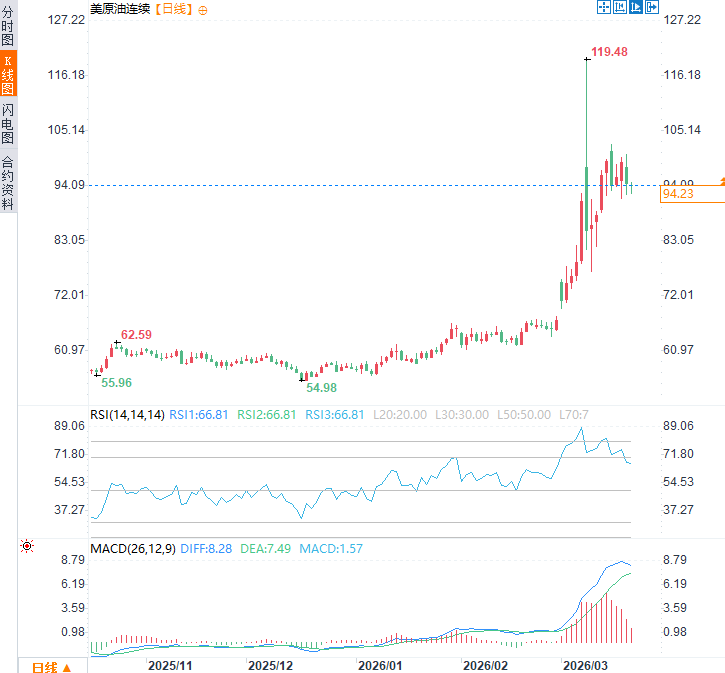
(US crude oil daily chart, source: FX678)
At 16:26 Beijing time, US crude oil futures were trading at $94.21 per barrel.
This buffer layer is thinning rapidly, directly weakening the market's ability to cope with supply disruptions. Any rebound in demand will significantly amplify price volatility. On Friday (March 20th) during the European session, US crude oil prices fluctuated downwards, currently trading around $94.20 per barrel, a daily decline of approximately 1.4%.
A reduction of 1.8 million barrels per day since the outbreak of war
According to the latest data from Vortexa, since the outbreak of the war between the US and Israel against Iran, the amount of crude oil and condensate stored at sea has decreased by an average of 1.8 million barrels per day, one of the fastest declines in recent years.
This extraction speed reflects buyers' panic in seeking alternative sources, and also indicates that the disruption of traditional supply channels in the Persian Gulf (especially to Iran and Qatar) has entered a prolonged phase.
Inventories have fallen rapidly from a peak of 140 million barrels to 78 million barrels, equivalent to less than two months of consumption buffer, and the market's resilience is facing a severe test.
Iranian oil accounts for about one-third of its seaborne reserves.
Currently, about one-third of floating storage at sea consists of Iranian oil. This portion of the inventory mainly comprises Iranian crude oil stranded due to sanctions, and had already formed a large-scale floating storage facility before the escalation of the war.
With Iranian oil accounting for such a high percentage, this inventory will become the most direct variable in the market should the supply side deteriorate further or US policy change.
As a key OPEC member, Iran's export restrictions have significantly widened the global supply gap, and accelerated inventory depletion has further intensified upward pressure on oil prices .
The US plans to lift sanctions on Iranian oil shipments.
U.S. Treasury Secretary Bessant previously suggested that sanctions on Iranian oil stranded on tankers might be lifted "soon" to increase global supply and curb oil prices. If this proposal is implemented, it will directly release this portion of Iran's floating inventory (approximately 26 million barrels), supplementing market supply in the short term and constituting a significant bearish factor.
However, given that the current conflict is still escalating and the timing and scale of the easing of sanctions are highly uncertain, the market views it more as a potential buffer than a certainty.
The risk of accelerated oil price increases if the Strait of Hormuz remains unreopened.
The Strait of Hormuz, a vital waterway for approximately one-fifth of the world's oil and one-third of its liquefied natural gas, remains under threat of conflict. If it cannot be reopened quickly or stability achieved, the buffer zone will continue to thin as maritime reserves continue to deplete at a rate of 1.8 million barrels per day.
Unless there is a diplomatic breakthrough or a significant increase in OPEC+ production, oil prices could accelerate their rise and even return to near recent highs of $119 per barrel. Analysts warn that with inventories at rock-bottom levels, any new supply-side disruptions will trigger a sharp reaction.
Editor's Summary
Three consecutive weeks of supply constraints in the Persian Gulf have caused global floating oil inventories to plummet from a peak of 140 million barrels to 78 million barrels, a daily loss of 1.8 million barrels, the fastest pace in recent years. Iranian oil, which accounts for about one-third of the total, has become the biggest uncertainty factor.
The US plan to lift sanctions on Iran may provide a short-term buffer, but escalating conflict and the continued absence of the Strait of Hormuz keep the risk of supply disruptions high. With the inventory buffer thinning, the market's tolerance for any new disturbances has significantly decreased, and the probability of a rapid rise in oil prices has increased substantially.
Investors need to closely monitor the dynamics of cross-strait navigation, changes in Iranian exports, and OPEC+ responses. Without a substantial recovery in supply, structurally high oil prices will dominate the global energy landscape for a long time.
(US crude oil daily chart, source: FX678)
At 16:26 Beijing time, US crude oil futures were trading at $94.21 per barrel.
- Risk Warning and Disclaimer
- The market involves risk, and trading may not be suitable for all investors. This article is for reference only and does not constitute personal investment advice, nor does it take into account certain users’ specific investment objectives, financial situation, or other needs. Any investment decisions made based on this information are at your own risk.