Gold prices plummeted as the US troop buildup in the Middle East triggered a chain reaction.
2026-03-21 00:43:37
On Friday (March 20), international gold prices plummeted in early trading, falling nearly 2%, primarily triggered by the sudden news of the US deploying additional troops to the Middle East, which directly impacted sentiment in the precious metals market. Spot gold fell 1.8% during the session, to approximately $4,566.26 per ounce; the price had rebounded by 1% at one point before quickly reversing course and falling further as the news continued to unfold, demonstrating a clear news-driven trend. The overall trading range for gold that day was locked between $4,550 and $4,740, with news-driven shocks becoming the core factor dominating the market.

Escalating geopolitical conflicts trigger a chain reaction in the market.
Three U.S. officials confirmed that the U.S. military is deploying thousands more Marines and sailors to the Middle East. This deployment is a key move in the escalating conflict in the region since the joint U.S.-Israel attack on Iran on February 28. The conflict has already resulted in thousands of deaths, and Iran's long-term interference and attacks on the Strait of Hormuz have disrupted approximately 20% of global oil supplies, keeping international oil prices high.
The deteriorating situation in the Middle East has directly exacerbated three major market concerns: first, rising oil prices are pushing up global inflationary pressures; second, a rebound in inflation is forcing the Federal Reserve to maintain high interest rate policies; and third, safe-haven funds are shifting to dollar assets, thereby suppressing gold prices. Although gold traditionally possesses safe-haven attributes, its decline in this round against the backdrop of escalating geopolitical risks stems primarily from the negative impact of a high-interest-rate environment on non-yielding gold.
A stronger dollar and higher US Treasury yields put pressure on precious metal valuations.
Geopolitical risks and rising inflation expectations have led to a simultaneous increase in the US dollar index and US Treasury yields, exerting downward pressure on gold prices. On the one hand, a stronger dollar has significantly reduced the attractiveness of dollar-denominated gold to non-dollar holders; on the other hand, rising US Treasury yields further highlight the disadvantage of gold holdings not yielding interest, causing funds to flow out of the precious metals market at an accelerated pace.
Independent metals trader Tai Wong commented that risk aversion continued to rise in the market ahead of the weekend, coupled with the recent surge in oil prices driving up the US dollar, putting pressure on precious metals assets such as gold and silver. Since the outbreak of the conflict related to Iran, although precious metal prices have been highly correlated with geopolitical risks, the high-interest-rate environment has significantly weakened gold's safe-haven appeal.
Federal Reserve policy expectations have shifted dramatically, with expectations for rate cuts continuing to be postponed.
The Federal Reserve announced its interest rate decision on Wednesday, maintaining the federal funds rate at 3.50%-3.75% while raising its inflation forecast. Fed Chairman Jerome Powell emphasized that uncertainty surrounding the path of monetary policy is exceptionally high due to the ongoing conflicts in the Middle East.
Federal Reserve official Christopher Waller further stated on Friday that the continued rise in oil prices is likely to have a lasting, rather than temporary, impact on inflation; he would only support a rate cut later this year if the labor market remains weak.
Market participants have generally revised their expectations, now anticipating that the Federal Reserve may only cut interest rates once (or even not at all) throughout 2026, with the earliest possible timing being the end of the year, or even later, mid-2027. Previously, the market had predicted at least two rate cuts by the Fed in 2026, but this expectation has been significantly postponed due to the impact of oil price shocks and upward revisions to inflation expectations. Short-term interest rate futures prices reflect the market's expectation that the Fed is likely to raise rates in December.
In addition, the probability of interest rate hikes by the European Central Bank and the Bank of England has increased simultaneously. The market is even pricing in a possible rate hike by the European Central Bank in July and another before the end of the year. The hawkish policy stance of global central banks is further suppressing the valuation of precious metals.
Technical Analysis
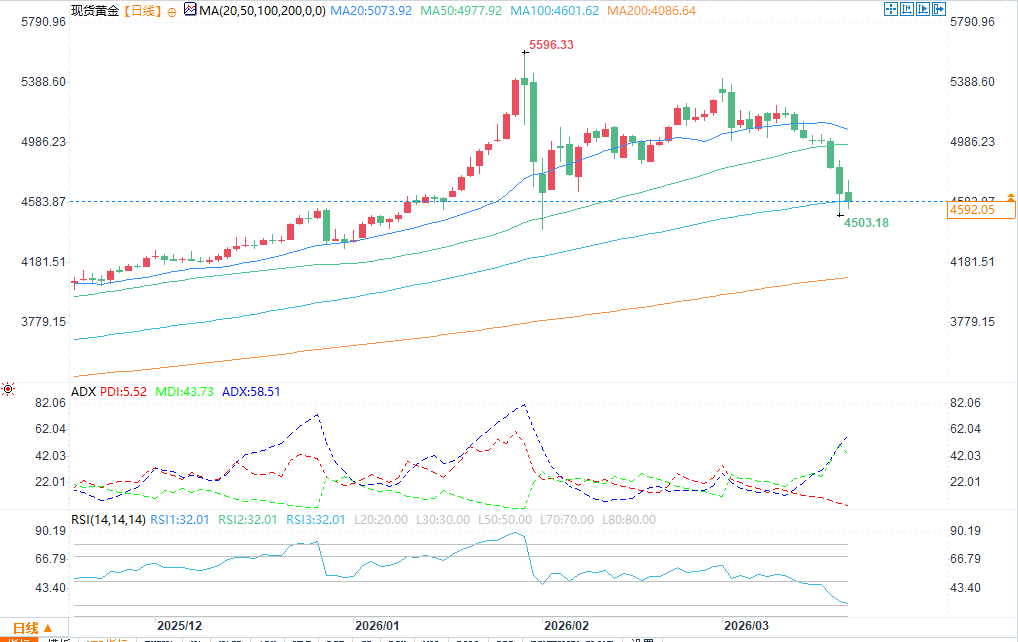
(Spot gold daily chart source: FX678)
Looking at the daily chart for gold, the price attempted to stabilize above the 100-day simple moving average (SMA) near $4,605, but earlier this week it broke below the 50-day SMA (around $4,979), signaling increased short-term selling pressure.
In terms of indicators, the Relative Strength Index (RSI) is hovering around 33, nearing the oversold zone, but the current bearish momentum remains strong; the Average Directional Index (ADX) is still rising, indicating that the bearish momentum has not been exhausted and a rapid reversal is unlikely in the short term.
If gold prices fall below the 100-day SMA and break below Thursday's low of $4,502, the next support level will test the April 2 low of $4,402. Further downside targets the 200-day SMA (around $4,091), which is a key medium- to long-term support level.
If gold prices can hold above the 100-day SMA, a technical rebound is expected. The first resistance level is the 50-day SMA ($4,979), and a break above this level would challenge the psychological level of $5,000. If gold prices stabilize above $5,000, the second short-term resistance level is $5,200, which is a key level for determining whether gold prices have reversed.
Escalating geopolitical conflicts trigger a chain reaction in the market.
Three U.S. officials confirmed that the U.S. military is deploying thousands more Marines and sailors to the Middle East. This deployment is a key move in the escalating conflict in the region since the joint U.S.-Israel attack on Iran on February 28. The conflict has already resulted in thousands of deaths, and Iran's long-term interference and attacks on the Strait of Hormuz have disrupted approximately 20% of global oil supplies, keeping international oil prices high.
The deteriorating situation in the Middle East has directly exacerbated three major market concerns: first, rising oil prices are pushing up global inflationary pressures; second, a rebound in inflation is forcing the Federal Reserve to maintain high interest rate policies; and third, safe-haven funds are shifting to dollar assets, thereby suppressing gold prices. Although gold traditionally possesses safe-haven attributes, its decline in this round against the backdrop of escalating geopolitical risks stems primarily from the negative impact of a high-interest-rate environment on non-yielding gold.
A stronger dollar and higher US Treasury yields put pressure on precious metal valuations.
Geopolitical risks and rising inflation expectations have led to a simultaneous increase in the US dollar index and US Treasury yields, exerting downward pressure on gold prices. On the one hand, a stronger dollar has significantly reduced the attractiveness of dollar-denominated gold to non-dollar holders; on the other hand, rising US Treasury yields further highlight the disadvantage of gold holdings not yielding interest, causing funds to flow out of the precious metals market at an accelerated pace.
Independent metals trader Tai Wong commented that risk aversion continued to rise in the market ahead of the weekend, coupled with the recent surge in oil prices driving up the US dollar, putting pressure on precious metals assets such as gold and silver. Since the outbreak of the conflict related to Iran, although precious metal prices have been highly correlated with geopolitical risks, the high-interest-rate environment has significantly weakened gold's safe-haven appeal.
Federal Reserve policy expectations have shifted dramatically, with expectations for rate cuts continuing to be postponed.
The Federal Reserve announced its interest rate decision on Wednesday, maintaining the federal funds rate at 3.50%-3.75% while raising its inflation forecast. Fed Chairman Jerome Powell emphasized that uncertainty surrounding the path of monetary policy is exceptionally high due to the ongoing conflicts in the Middle East.
Federal Reserve official Christopher Waller further stated on Friday that the continued rise in oil prices is likely to have a lasting, rather than temporary, impact on inflation; he would only support a rate cut later this year if the labor market remains weak.
Market participants have generally revised their expectations, now anticipating that the Federal Reserve may only cut interest rates once (or even not at all) throughout 2026, with the earliest possible timing being the end of the year, or even later, mid-2027. Previously, the market had predicted at least two rate cuts by the Fed in 2026, but this expectation has been significantly postponed due to the impact of oil price shocks and upward revisions to inflation expectations. Short-term interest rate futures prices reflect the market's expectation that the Fed is likely to raise rates in December.
In addition, the probability of interest rate hikes by the European Central Bank and the Bank of England has increased simultaneously. The market is even pricing in a possible rate hike by the European Central Bank in July and another before the end of the year. The hawkish policy stance of global central banks is further suppressing the valuation of precious metals.
Technical Analysis
(Spot gold daily chart source: FX678)
Looking at the daily chart for gold, the price attempted to stabilize above the 100-day simple moving average (SMA) near $4,605, but earlier this week it broke below the 50-day SMA (around $4,979), signaling increased short-term selling pressure.
In terms of indicators, the Relative Strength Index (RSI) is hovering around 33, nearing the oversold zone, but the current bearish momentum remains strong; the Average Directional Index (ADX) is still rising, indicating that the bearish momentum has not been exhausted and a rapid reversal is unlikely in the short term.
If gold prices fall below the 100-day SMA and break below Thursday's low of $4,502, the next support level will test the April 2 low of $4,402. Further downside targets the 200-day SMA (around $4,091), which is a key medium- to long-term support level.
If gold prices can hold above the 100-day SMA, a technical rebound is expected. The first resistance level is the 50-day SMA ($4,979), and a break above this level would challenge the psychological level of $5,000. If gold prices stabilize above $5,000, the second short-term resistance level is $5,200, which is a key level for determining whether gold prices have reversed.
- Risk Warning and Disclaimer
- The market involves risk, and trading may not be suitable for all investors. This article is for reference only and does not constitute personal investment advice, nor does it take into account certain users’ specific investment objectives, financial situation, or other needs. Any investment decisions made based on this information are at your own risk.