Gold Trading Alert: Escalating Tensions! Trump's 48-Hour Ultimatum Causes Gold Prices to Rebound After Hitting Bottom; Is a Major Price Movement About to Erupt at the $4,500 Level?
2026-03-23 07:29:40
On Monday (March 23) in early Asian trading, spot gold staged a dramatic V-shaped reversal. It initially plunged 1% to $4449.63 per ounce, its lowest point since February 2nd, before quickly recovering all losses and rising to around $4535 per ounce. Currently, gold is trading around $4500 per ounce, with market sentiment oscillating wildly between extreme panic and a safe-haven rush. This gold volatility, triggered by the Middle East conflict, reflects a sharp rise in global inflation expectations, a complete repricing of interest rate paths, and a life-or-death struggle between the safe-haven appeal of the US dollar and the hedging properties of gold.

Spot gold plunged 3.3% on Friday, closing at $4496.38 per ounce. During Monday's Asian session, bears briefly dominated the market, but this lasted only a few minutes. Investors began a buying spree at the $4449 low, pushing the price back up by more than $80, reaching a high of around $4535. This rebound, both in magnitude and speed, far exceeded market expectations, demonstrating gold's resilience as the ultimate safe-haven asset.
Although currently hovering around $4,500, the technical picture clearly indicates a short-term oversold condition, making the $4,500 level a crucial battleground between bulls and bears. If there are any further signs of escalation in the Middle East situation, gold prices could break through $4,535 at any time, initiating a new round of upward movement.
The conflict has entered its fourth week. Since the joint US-Israeli attack on Iran on February 28, the fighting has resulted in thousands of deaths in the Middle East and has spread throughout the region. The latest trigger was a shocking ultimatum issued by US President Trump on social media last Saturday (March 21): if Iran does not fully and non-threateningly reopen the Strait of Hormuz within 48 hours, the US will "completely destroy" Iran's largest power plant, starting with the Damavand power plant (2,868 megawatts) near Tehran. Trump's statement is a complete reversal of his remarks the previous day regarding "gradual de-escalation of the war." US Marines and large amphibious assault ships are still massing in the Middle East, and the situation is extremely tense.
Iran's response was equally strong. The Islamic Revolutionary Guard Corps stated explicitly that if the United States attacks Iranian power generation facilities, the Strait of Hormuz will be "completely closed" until reconstruction is completed; Iranian Parliament Speaker Ghalibaf warned that if Iranian infrastructure is attacked, all energy and oil facilities in the Middle East will become legitimate targets, and oil prices will soar in the long term.
Iran has launched a 4,000-kilometer-long-range missile at the Diego Garcia airbase in the Indian Ocean, increasing the risk of attack on European capitals. The southern Israeli cities of Dimona and Arad were also attacked by missiles, injuring dozens. The Israeli military has even warned that Iranian missiles are now within range of Berlin, Paris, and Rome. The blockade of the Strait of Hormuz, threats to power plants, and the upgrading of long-range missiles… each is like a ticking time bomb, potentially detonating global energy and financial markets at any moment.
The Middle East crisis has directly driven up energy prices. US crude oil opened 3% higher on Monday to $101.30 a barrel, a new high since March 9th; Brent crude closed at $112.19 a barrel on Friday, its highest since July 2022, and has risen nearly 50% since the beginning of the month. Iran's attack on a Kuwaiti oil refinery and its blockade of the Strait of Hormuz (a route for one-fifth of the world's oil transportation) caused European natural gas prices to surge 35% in a week. The US's plan to deploy thousands more Marines and sailors has further exacerbated market concerns about oil supply disruptions.
Inflation expectations subsequently surged. The US inflation swap rate rose to a six-month high of 3.3%, with the market anticipating an average CPI increase of over 3% in the next 12 months, far exceeding the actual figure of 2.4% in February. Soaring energy prices are being transmitted globally through the supply chain, with Europe, which is more reliant on imported energy, experiencing particularly intense inflationary pressures. Gold, as a traditional inflation hedge, should have shone brightly, but the "interest rate hike expectations" brought about by high oil prices have become the biggest negative factor suppressing gold prices.
The dollar index rose 0.3% to 99.50 on Friday, and although it is still down 1% this week, bets on interest rate cuts have significantly decreased. Before the war, the market expected the Federal Reserve to cut rates twice by 2026, but now it is widely believed that even one cut is unlikely, and a rate hike may even be the next possibility. The Federal Reserve kept interest rates unchanged on Wednesday, with Chairman Powell stating that the impact of the war has created "exceptionally high uncertainty." The European Central Bank, the Bank of England, the Bank of Japan, and the Reserve Bank of Australia have all released more hawkish signals: the Bank of England is prepared to take action, the Bank of Japan may raise rates as early as April, and the European Central Bank warned that energy prices are pushing up inflation.
U.S. Treasury bonds fell for the third consecutive day, with the two-year yield at 3.892% (up 5.9 basis points) and the ten-year yield at 4.388% (up 10.5 basis points), marking the largest single-day increase in recent times. The yield curve exhibited a typical bear market steepening, with long-term interest rates rising faster, indicating that the market has already priced in the risk of accelerating inflation. A stronger dollar directly reduces the attractiveness of gold to non-dollar holders, while rising interest rates significantly increase the cost of holding gold without yield. Independent precious metals trader Tai Wong bluntly stated, "Precious metals are being dragged down by habitual anxieties, and after the sharp correction triggered by this week's rate hike panic, the trend will be volatile."
Multiple institutions believe that the probability of interest rate hikes by the European Central Bank and the Bank of England in April is rising, and the Federal Reserve's policy path faces extremely high uncertainty. IG market analyst Tony Sycamore warned that Trump's 48-hour ultimatum has become a "48-hour uncertainty time bomb for global markets," predicting that stock markets will be under pressure at the opening on Monday, while risk aversion will support fluctuations in both the US dollar and gold.
Pepperstone strategist Michael Brown points out that traders are unable to price a specific path, and preserving capital will be the top priority. Juan Perez, trading director at Monex USA, emphasizes that central banks in many countries are more confident than expected about the impact of inflation, and policy pricing has completely shifted.
Despite a host of short-term negative factors, if the conflict in the Middle East continues to escalate—especially if the Strait of Hormuz is blocked for an extended period or power plants are attacked—oil prices may reach new highs, inflation will spiral out of control, and gold's safe-haven appeal will outweigh interest rate pressures, causing it to return to a strong upward trajectory.
The current gold price hovering above $4,500 demonstrates that the market's pricing in the severity of the Middle East crisis is far from over. If any party escalates its actions within the countdown to Trump's ultimatum, or if Iran launches another missile attack on targets across Europe, oil prices and inflation expectations will explode further, potentially pushing gold prices above $4,535 and even challenging the $4,600 mark.
Conversely, if the strait miraculously reopens within 48 hours, gold prices may fall back to around 4450 in the short term. However, given that the war has already caused more than 2,000 deaths and disrupted global supply chains, long-term uncertainty remains the biggest support for gold.
This gold price surge, ignited by the Middle East conflict, is far from ordinary volatility; it's a concentrated eruption of a triple storm of global inflation, interest rates, and geopolitical tensions. The battle for the $4,500 level has just begun, and investors need to closely monitor three key signals: the Strait of Hormuz, Trump's tweets, and oil price fluctuations. No matter how volatile the short-term fluctuations, gold's status as humanity's ultimate safe-haven asset will only become more unshakeable during this crisis.
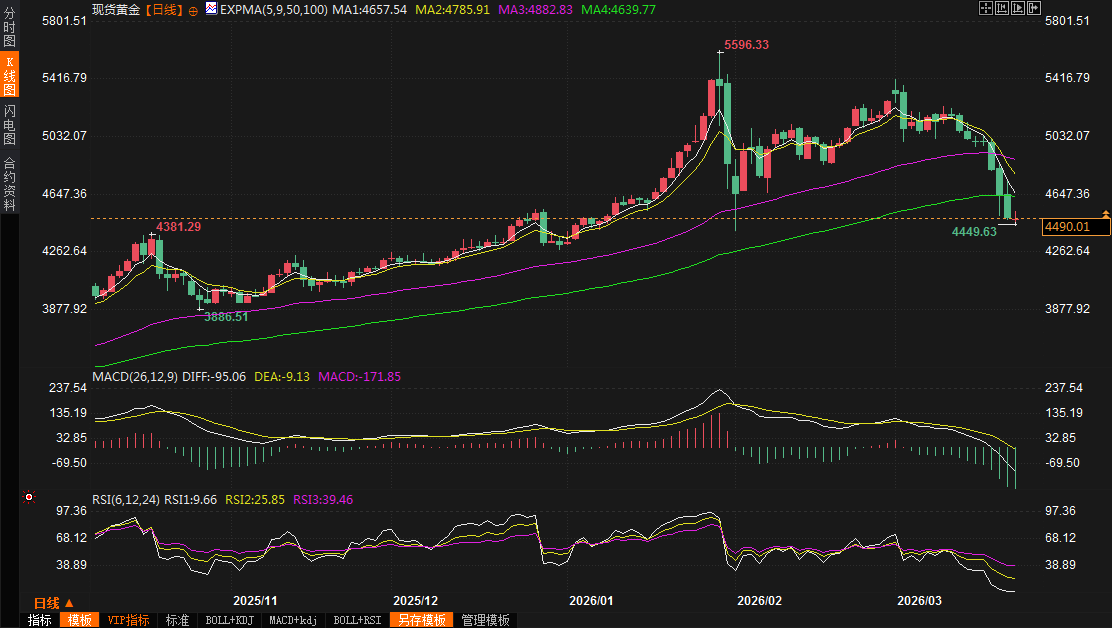
(Spot gold daily chart, source: FX678)
At 07:28 Beijing time, spot gold was trading at $4492.05 per ounce.
Latest Gold Price Update: The astonishing power of the V-shaped rebound from a new low of 4449 to a high of 4535.
Spot gold plunged 3.3% on Friday, closing at $4496.38 per ounce. During Monday's Asian session, bears briefly dominated the market, but this lasted only a few minutes. Investors began a buying spree at the $4449 low, pushing the price back up by more than $80, reaching a high of around $4535. This rebound, both in magnitude and speed, far exceeded market expectations, demonstrating gold's resilience as the ultimate safe-haven asset.
Although currently hovering around $4,500, the technical picture clearly indicates a short-term oversold condition, making the $4,500 level a crucial battleground between bulls and bears. If there are any further signs of escalation in the Middle East situation, gold prices could break through $4,535 at any time, initiating a new round of upward movement.
The situation in the Middle East is escalating rapidly: Trump's 48-hour ultimatum becomes a "time bomb" for global markets.
The conflict has entered its fourth week. Since the joint US-Israeli attack on Iran on February 28, the fighting has resulted in thousands of deaths in the Middle East and has spread throughout the region. The latest trigger was a shocking ultimatum issued by US President Trump on social media last Saturday (March 21): if Iran does not fully and non-threateningly reopen the Strait of Hormuz within 48 hours, the US will "completely destroy" Iran's largest power plant, starting with the Damavand power plant (2,868 megawatts) near Tehran. Trump's statement is a complete reversal of his remarks the previous day regarding "gradual de-escalation of the war." US Marines and large amphibious assault ships are still massing in the Middle East, and the situation is extremely tense.
Iran's response was equally strong. The Islamic Revolutionary Guard Corps stated explicitly that if the United States attacks Iranian power generation facilities, the Strait of Hormuz will be "completely closed" until reconstruction is completed; Iranian Parliament Speaker Ghalibaf warned that if Iranian infrastructure is attacked, all energy and oil facilities in the Middle East will become legitimate targets, and oil prices will soar in the long term.
Iran has launched a 4,000-kilometer-long-range missile at the Diego Garcia airbase in the Indian Ocean, increasing the risk of attack on European capitals. The southern Israeli cities of Dimona and Arad were also attacked by missiles, injuring dozens. The Israeli military has even warned that Iranian missiles are now within range of Berlin, Paris, and Rome. The blockade of the Strait of Hormuz, threats to power plants, and the upgrading of long-range missiles… each is like a ticking time bomb, potentially detonating global energy and financial markets at any moment.
Soaring oil prices and inflation fears: Gold faces a double-edged sword test
The Middle East crisis has directly driven up energy prices. US crude oil opened 3% higher on Monday to $101.30 a barrel, a new high since March 9th; Brent crude closed at $112.19 a barrel on Friday, its highest since July 2022, and has risen nearly 50% since the beginning of the month. Iran's attack on a Kuwaiti oil refinery and its blockade of the Strait of Hormuz (a route for one-fifth of the world's oil transportation) caused European natural gas prices to surge 35% in a week. The US's plan to deploy thousands more Marines and sailors has further exacerbated market concerns about oil supply disruptions.
Inflation expectations subsequently surged. The US inflation swap rate rose to a six-month high of 3.3%, with the market anticipating an average CPI increase of over 3% in the next 12 months, far exceeding the actual figure of 2.4% in February. Soaring energy prices are being transmitted globally through the supply chain, with Europe, which is more reliant on imported energy, experiencing particularly intense inflationary pressures. Gold, as a traditional inflation hedge, should have shone brightly, but the "interest rate hike expectations" brought about by high oil prices have become the biggest negative factor suppressing gold prices.
A stronger dollar and repricing of interest rate expectations severely weaken gold's appeal.
The dollar index rose 0.3% to 99.50 on Friday, and although it is still down 1% this week, bets on interest rate cuts have significantly decreased. Before the war, the market expected the Federal Reserve to cut rates twice by 2026, but now it is widely believed that even one cut is unlikely, and a rate hike may even be the next possibility. The Federal Reserve kept interest rates unchanged on Wednesday, with Chairman Powell stating that the impact of the war has created "exceptionally high uncertainty." The European Central Bank, the Bank of England, the Bank of Japan, and the Reserve Bank of Australia have all released more hawkish signals: the Bank of England is prepared to take action, the Bank of Japan may raise rates as early as April, and the European Central Bank warned that energy prices are pushing up inflation.
U.S. Treasury bonds fell for the third consecutive day, with the two-year yield at 3.892% (up 5.9 basis points) and the ten-year yield at 4.388% (up 10.5 basis points), marking the largest single-day increase in recent times. The yield curve exhibited a typical bear market steepening, with long-term interest rates rising faster, indicating that the market has already priced in the risk of accelerating inflation. A stronger dollar directly reduces the attractiveness of gold to non-dollar holders, while rising interest rates significantly increase the cost of holding gold without yield. Independent precious metals trader Tai Wong bluntly stated, "Precious metals are being dragged down by habitual anxieties, and after the sharp correction triggered by this week's rate hike panic, the trend will be volatile."
Major global brokerages and analysts agree: A major market rally is brewing amidst consolidation.
Multiple institutions believe that the probability of interest rate hikes by the European Central Bank and the Bank of England in April is rising, and the Federal Reserve's policy path faces extremely high uncertainty. IG market analyst Tony Sycamore warned that Trump's 48-hour ultimatum has become a "48-hour uncertainty time bomb for global markets," predicting that stock markets will be under pressure at the opening on Monday, while risk aversion will support fluctuations in both the US dollar and gold.
Pepperstone strategist Michael Brown points out that traders are unable to price a specific path, and preserving capital will be the top priority. Juan Perez, trading director at Monex USA, emphasizes that central banks in many countries are more confident than expected about the impact of inflation, and policy pricing has completely shifted.
Despite a host of short-term negative factors, if the conflict in the Middle East continues to escalate—especially if the Strait of Hormuz is blocked for an extended period or power plants are attacked—oil prices may reach new highs, inflation will spiral out of control, and gold's safe-haven appeal will outweigh interest rate pressures, causing it to return to a strong upward trajectory.
Gold Outlook: After the crucial battle at the $4,500 level, a super safe-haven bull market may be on the horizon.
The current gold price hovering above $4,500 demonstrates that the market's pricing in the severity of the Middle East crisis is far from over. If any party escalates its actions within the countdown to Trump's ultimatum, or if Iran launches another missile attack on targets across Europe, oil prices and inflation expectations will explode further, potentially pushing gold prices above $4,535 and even challenging the $4,600 mark.
Conversely, if the strait miraculously reopens within 48 hours, gold prices may fall back to around 4450 in the short term. However, given that the war has already caused more than 2,000 deaths and disrupted global supply chains, long-term uncertainty remains the biggest support for gold.
This gold price surge, ignited by the Middle East conflict, is far from ordinary volatility; it's a concentrated eruption of a triple storm of global inflation, interest rates, and geopolitical tensions. The battle for the $4,500 level has just begun, and investors need to closely monitor three key signals: the Strait of Hormuz, Trump's tweets, and oil price fluctuations. No matter how volatile the short-term fluctuations, gold's status as humanity's ultimate safe-haven asset will only become more unshakeable during this crisis.
(Spot gold daily chart, source: FX678)
At 07:28 Beijing time, spot gold was trading at $4492.05 per ounce.
- Risk Warning and Disclaimer
- The market involves risk, and trading may not be suitable for all investors. This article is for reference only and does not constitute personal investment advice, nor does it take into account certain users’ specific investment objectives, financial situation, or other needs. Any investment decisions made based on this information are at your own risk.