Oil prices are locked in a fierce battle between bulls and bears! On one side, there's the threat of energy self-destruction; on the other, there's the easing of oil price sanctions.
2026-03-23 13:59:43
International oil prices remained generally stable during the Asian session on Monday (March 23). US crude oil prices rose and then fell back, and are currently fluctuating around $98.30 per barrel. At the beginning of the session, it jumped 3% to $101.50 per barrel, a new high since March 16.
The market exhibits a clear hedging pattern: on the one hand, the US and Iran are threatening each other with attacks on energy infrastructure, and the risk of escalation continues to push up safe-haven premiums; on the other hand, after Washington temporarily lifted some sanctions, millions of barrels of Iranian seaborne crude oil stranded in the US have flowed back into the global market, constituting a direct increase in supply and alleviating short-term supply panic. These two forces offset each other, resulting in a tug-of-war between bullish and bearish forces in oil prices.
Iran issued a strong warning last Sunday: if Trump carries out his threat to strike Iran's power grid within 48 hours, the energy and water systems of the entire Gulf neighboring countries will be considered legitimate targets for retaliation and will suffer irreversible destruction.
The founder of Energy Aspects bluntly stated that this statement clearly indicates a further escalation of the situation, which will lead to a rise in oil prices. Trump is trying to demonstrate a "more confrontational" stance, which may ultimately push the Gulf infrastructure to a "scorched earth" state.
Iranian Parliament Speaker Ghalibaf had previously listed all Middle Eastern energy facilities as potential targets for retaliation, and the logic of mutual destruction of energy resources between the US and Iran has become the biggest source of uncertainty in the market.
International Energy Agency (IEA) Executive Director Fatih Birol reiterated that the Middle East crisis is "extremely severe," even exceeding the combined impact of the two oil crises of the 1970s and the Russia-Ukraine conflict on the natural gas market.
The IEA is negotiating with Asian and European countries to release more strategic reserves as needed. A record 400 million barrels were released on March 11, but Birol pointed out that the key to resolving the crisis lies in fully opening the Strait of Hormuz.
Although the strait is not currently "blocked," Iran's "conditional opening" rules limit the actual navigational altitude, making it difficult to quickly alleviate structural supply pressures.
The current price spread between Brent and WTI crude oil exceeds $13, the widest level in several years. This widening spread mainly reflects that supply disruptions in the Middle East have a far greater impact on European and Asian benchmarks (Brent) than on the US domestic market. The US is relatively resilient to price drops due to its domestic production elasticity and inventory levels, while the international market bears a heavier geopolitical risk premium.
The record price difference also means that the global energy cost gap is widening, with higher import costs in Europe and Asia, and more significant imported inflationary pressures.
KCM Trade's chief market analyst pointed out that the core reason oil prices failed to sustain their surge was that traders were asking themselves, "What if Trump's ultimatum works?"
The market is reluctant to be too far ahead of Trump's "strategic gamble" in case the Strait of Hormuz actually reopens and causes a rapid recovery in supply.
The CEO of Moomoo Australia believes that it is "quite realistic" for oil prices to test the recent high of nearly $120 this week. If Iran responds strongly or the US delivers on its threats, the probability of breaking through is extremely high; conversely, if diplomatic efforts take a turn for the better, prices may fall rapidly.
Oil prices held steady at high levels on Monday, reflecting the offsetting forces of the US-Iran energy conflict threat and the easing of sanctions. Iran's warning of retaliation against the Gulf's water supply system, Trump's threat to upgrade the power grid, and the International Energy Agency's characterization of the crisis as "extremely severe," exceeding all previous levels, fueled high risk aversion in the market. However, the resurgence of Iranian crude oil and the potential success of Trump's ultimatum limited upside potential.
The opening of the Strait of Hormuz remains a decisive variable. If there is no substantial breakthrough in the 48-hour countdown, it is highly likely that oil prices will test $120 or even higher, further pressuring the prospects for global inflation and economic growth.
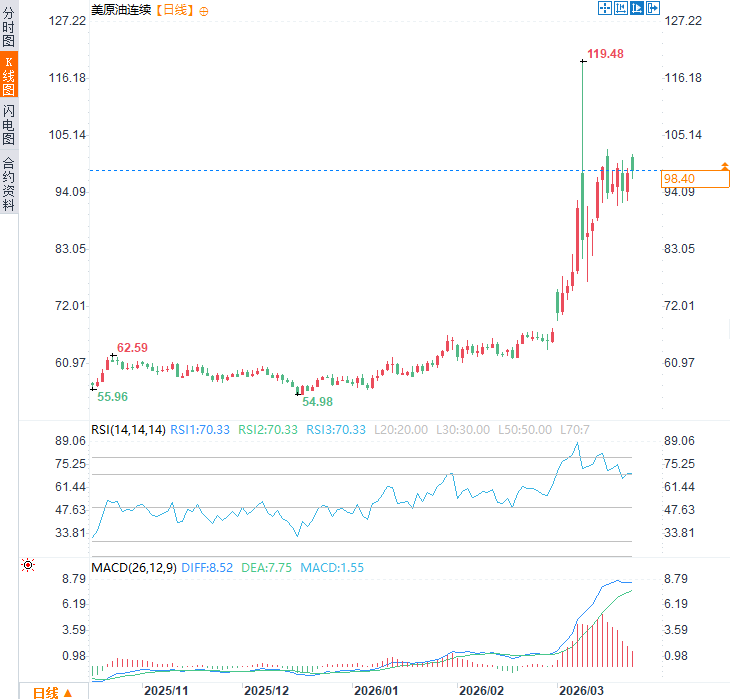
(US crude oil daily chart, source: FX678)
At 13:59 Beijing time, US crude oil futures were trading at $98.55 per barrel.
The market exhibits a clear hedging pattern: on the one hand, the US and Iran are threatening each other with attacks on energy infrastructure, and the risk of escalation continues to push up safe-haven premiums; on the other hand, after Washington temporarily lifted some sanctions, millions of barrels of Iranian seaborne crude oil stranded in the US have flowed back into the global market, constituting a direct increase in supply and alleviating short-term supply panic. These two forces offset each other, resulting in a tug-of-war between bullish and bearish forces in oil prices.
Iran warns of retaliation against Gulf energy and water supplies, US threatens to upgrade power grid.
Iran issued a strong warning last Sunday: if Trump carries out his threat to strike Iran's power grid within 48 hours, the energy and water systems of the entire Gulf neighboring countries will be considered legitimate targets for retaliation and will suffer irreversible destruction.
The founder of Energy Aspects bluntly stated that this statement clearly indicates a further escalation of the situation, which will lead to a rise in oil prices. Trump is trying to demonstrate a "more confrontational" stance, which may ultimately push the Gulf infrastructure to a "scorched earth" state.
Iranian Parliament Speaker Ghalibaf had previously listed all Middle Eastern energy facilities as potential targets for retaliation, and the logic of mutual destruction of energy resources between the US and Iran has become the biggest source of uncertainty in the market.
International Energy Agency: The Middle East crisis is extremely severe, exceeding the total of all previous crises.
International Energy Agency (IEA) Executive Director Fatih Birol reiterated that the Middle East crisis is "extremely severe," even exceeding the combined impact of the two oil crises of the 1970s and the Russia-Ukraine conflict on the natural gas market.
The IEA is negotiating with Asian and European countries to release more strategic reserves as needed. A record 400 million barrels were released on March 11, but Birol pointed out that the key to resolving the crisis lies in fully opening the Strait of Hormuz.
Although the strait is not currently "blocked," Iran's "conditional opening" rules limit the actual navigational altitude, making it difficult to quickly alleviate structural supply pressures.
The price difference between Brent and WTI crude oil exceeded $13, marking the widest spread in several years.
The current price spread between Brent and WTI crude oil exceeds $13, the widest level in several years. This widening spread mainly reflects that supply disruptions in the Middle East have a far greater impact on European and Asian benchmarks (Brent) than on the US domestic market. The US is relatively resilient to price drops due to its domestic production elasticity and inventory levels, while the international market bears a heavier geopolitical risk premium.
The record price difference also means that the global energy cost gap is widening, with higher import costs in Europe and Asia, and more significant imported inflationary pressures.
Traders are torn between the success or failure of Trump's ultimatum and the $120 test.
KCM Trade's chief market analyst pointed out that the core reason oil prices failed to sustain their surge was that traders were asking themselves, "What if Trump's ultimatum works?"
The market is reluctant to be too far ahead of Trump's "strategic gamble" in case the Strait of Hormuz actually reopens and causes a rapid recovery in supply.
The CEO of Moomoo Australia believes that it is "quite realistic" for oil prices to test the recent high of nearly $120 this week. If Iran responds strongly or the US delivers on its threats, the probability of breaking through is extremely high; conversely, if diplomatic efforts take a turn for the better, prices may fall rapidly.
Editor's Summary
Oil prices held steady at high levels on Monday, reflecting the offsetting forces of the US-Iran energy conflict threat and the easing of sanctions. Iran's warning of retaliation against the Gulf's water supply system, Trump's threat to upgrade the power grid, and the International Energy Agency's characterization of the crisis as "extremely severe," exceeding all previous levels, fueled high risk aversion in the market. However, the resurgence of Iranian crude oil and the potential success of Trump's ultimatum limited upside potential.
The opening of the Strait of Hormuz remains a decisive variable. If there is no substantial breakthrough in the 48-hour countdown, it is highly likely that oil prices will test $120 or even higher, further pressuring the prospects for global inflation and economic growth.
(US crude oil daily chart, source: FX678)
At 13:59 Beijing time, US crude oil futures were trading at $98.55 per barrel.
- Risk Warning and Disclaimer
- The market involves risk, and trading may not be suitable for all investors. This article is for reference only and does not constitute personal investment advice, nor does it take into account certain users’ specific investment objectives, financial situation, or other needs. Any investment decisions made based on this information are at your own risk.