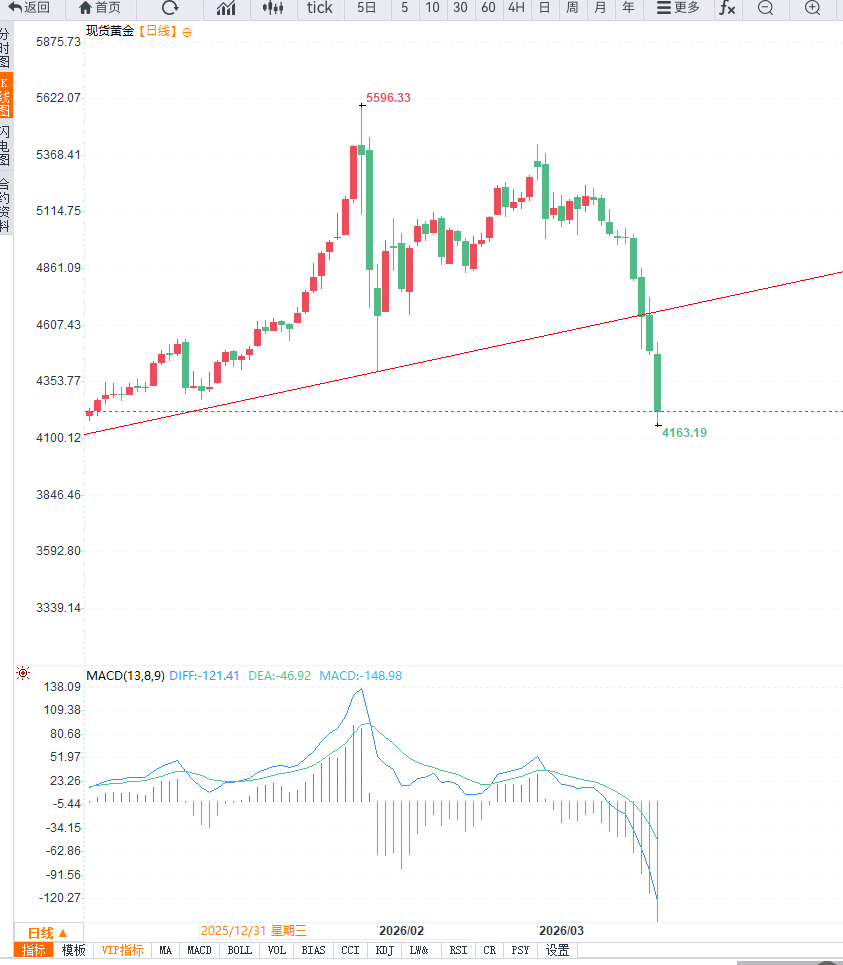
Soaring US Treasury yields suppressed safe-haven demand, and gold broke below the trendline, pointing towards the $4,100 support zone.
2026-03-23 14:59:03
The gold market has recently seen a significant correction, with prices retreating from their highs, primarily driven by the rapid rise in interest rates. The yield on the 10-year US Treasury note rose to 4.423% during Asian trading hours, a new high since July 2025. This change directly increases the opportunity cost of holding gold, causing funds to flow from non-interest-bearing assets to higher-yielding bond assets, thus significantly suppressing gold prices.

From a macroeconomic perspective, this round of interest rate increases is closely related to the market's "inflation trade" sentiment. Rising energy prices coupled with geopolitical tensions have led the market to repric the future path of inflation. In this process, investors are more inclined to bet on interest rates remaining high or even rising further, and this expectation has intensified downward pressure on gold. The resonance between rising interest rates and inflation expectations has become the core variable suppressing gold prices .
Nevertheless, the release of current market sentiment has not yet fully ended, and gold may still face downward pressure in the short term. However, as sentiment gradually reaches its peak, the downward slope of prices is expected to undergo a phase of correction. From a technical perspective, gold has broken below its previous upward trend line in the medium term, indicating a shift in the trend. Without significant improvement in fundamentals, any rebound is more of a corrective measure than a trend reversal.
From a support perspective, the market is generally focused on the area around $4,100 , which is both a previous area of dense trading and a potential psychological support level. If prices stabilize in this area, it could trigger short-term long covering, leading to a technical rebound. However, it should be emphasized that the sustainability of this rebound remains questionable until there are substantial changes in the current macroeconomic environment.
From a technical perspective, on the daily chart, gold has clearly broken below the upward trend line and formed a high-level pullback structure. The moving average system is weakening, indicating a shift to a bearish medium-term trend. In terms of momentum indicators, the RSI has rapidly fallen into the neutral-to-weak zone, suggesting a significant weakening of bullish momentum. A further break below $4100 could open up further downside potential.
From a 4-hour chart perspective, gold is showing a consolidation and recovery pattern after an accelerated decline, with signs of short-term oversold conditions. The MACD momentum is gradually converging, indicating a weakening of bearish pressure. If a short-term rebound occurs, the resistance level to watch is the $4200-$4250 range; if the rebound is weak, the downward trend may continue.
Editor's Summary:
The gold market is currently in a transitional phase, shifting from an "inflation-driven rally" to a "interest rate-driven correction." In the short term, market sentiment has not yet fully priced in, and gold prices still have room to fluctuate, but there is technical support around $4,100. In the medium term, the trend has weakened, and gold may only re-enter a bullish cycle after key conditions such as declining interest rates, cooling inflation expectations, and a policy shift emerge. Until then, investors are advised to adopt a cautious wait-and-see approach or engage in range trading.
From a macroeconomic perspective, this round of interest rate increases is closely related to the market's "inflation trade" sentiment. Rising energy prices coupled with geopolitical tensions have led the market to repric the future path of inflation. In this process, investors are more inclined to bet on interest rates remaining high or even rising further, and this expectation has intensified downward pressure on gold. The resonance between rising interest rates and inflation expectations has become the core variable suppressing gold prices .
Nevertheless, the release of current market sentiment has not yet fully ended, and gold may still face downward pressure in the short term. However, as sentiment gradually reaches its peak, the downward slope of prices is expected to undergo a phase of correction. From a technical perspective, gold has broken below its previous upward trend line in the medium term, indicating a shift in the trend. Without significant improvement in fundamentals, any rebound is more of a corrective measure than a trend reversal.
From a support perspective, the market is generally focused on the area around $4,100 , which is both a previous area of dense trading and a potential psychological support level. If prices stabilize in this area, it could trigger short-term long covering, leading to a technical rebound. However, it should be emphasized that the sustainability of this rebound remains questionable until there are substantial changes in the current macroeconomic environment.
From a technical perspective, on the daily chart, gold has clearly broken below the upward trend line and formed a high-level pullback structure. The moving average system is weakening, indicating a shift to a bearish medium-term trend. In terms of momentum indicators, the RSI has rapidly fallen into the neutral-to-weak zone, suggesting a significant weakening of bullish momentum. A further break below $4100 could open up further downside potential.
From a 4-hour chart perspective, gold is showing a consolidation and recovery pattern after an accelerated decline, with signs of short-term oversold conditions. The MACD momentum is gradually converging, indicating a weakening of bearish pressure. If a short-term rebound occurs, the resistance level to watch is the $4200-$4250 range; if the rebound is weak, the downward trend may continue.
Editor's Summary:
The gold market is currently in a transitional phase, shifting from an "inflation-driven rally" to a "interest rate-driven correction." In the short term, market sentiment has not yet fully priced in, and gold prices still have room to fluctuate, but there is technical support around $4,100. In the medium term, the trend has weakened, and gold may only re-enter a bullish cycle after key conditions such as declining interest rates, cooling inflation expectations, and a policy shift emerge. Until then, investors are advised to adopt a cautious wait-and-see approach or engage in range trading.
- Risk Warning and Disclaimer
- The market involves risk, and trading may not be suitable for all investors. This article is for reference only and does not constitute personal investment advice, nor does it take into account certain users’ specific investment objectives, financial situation, or other needs. Any investment decisions made based on this information are at your own risk.