Crude oil plunges over 10%, gold's V-shaped comeback: who is it buying time for?
2026-03-23 20:06:31
On Monday (March 23), during the Asian and European trading sessions, international crude oil and gold experienced a dramatic reversal. WTI crude oil opened higher in the morning but then trended downwards throughout the day, eventually experiencing a sudden sharp drop of over 10% from 0.31%, as geopolitical premiums quickly subsided.
Gold, after a sharp decline, rebounded strongly, exhibiting a "V-shaped" bottoming-out and recovery pattern. The dramatic fluctuations in both commodities were primarily driven by the dramatic shift in the Middle East geopolitical situation.
The standoff between the US and Iran escalated over the weekend, prompting a rapid realization of risk aversion in the market at the open. Oil prices opened higher, while gold prices opened lower and continued to decline.
US President Trump issued a 48-hour ultimatum to Iran, demanding that it fully open the Strait of Hormuz, or else he would strike and destroy several Iranian power plants, prioritizing the largest power station.
Iran responded strongly, with its Central Command of the Hatem Anbia Armed Forces emphasizing that if its fuel and energy infrastructure were attacked, all energy infrastructure, information technology systems, and desalination facilities of the United States and its allies in the Middle East would become targets of Iran's retaliation.
On the same day, Iran's Fars News Agency further released a target list including 11 key facilities, covering the Barakah nuclear power plant in the UAE, two power generation and desalination plants and thermal power plants in Kuwait, two similar facilities in Saudi Arabia, the Aqaba power plant and the Semra thermal power plant in Jordan, one facility in Bahrain, and two power plants in Qatar.
Analysts point out that these facilities are the core of the Middle East's energy and freshwater supply and are highly concentrated. Disruptions at key points could trigger a chain reaction, and the conflict's extension from energy transport routes to production terminals has further amplified market concerns about supply chain stability.
Just as geopolitical tensions were nearing a breaking point, diplomatic signals of easing tensions emerged one after another.
South Korea's Ministry of Foreign Affairs announced that Foreign Minister Cho Hyun-sung spoke by phone with Iranian Foreign Minister Abbas Araqchi. Cho requested that Iran ensure the safety of ships stranded in the Strait of Hormuz, expressed deep concern about the impact of the conflict on the global economy, and urged Iran to cease attacks on civilian facilities in Gulf countries and ensure the safety of navigation in the strait.
The Iranian Foreign Minister explained his country's position on the crisis and agreed to maintain ongoing communication with South Korea.
It is reported that due to the blockade of the Strait of Hormuz following the US-Israeli airstrikes on Iran, more than 20 South Korean ships and over 100 crew members are stranded in the Gulf region.
As a major global energy buyer, South Korea relies on imports from the Middle East for about 70% of its crude oil and 20% of its liquefied natural gas. This blockade directly threatens its energy supply chain and has become an important factor in pushing Iran to negotiate with other countries on a mechanism to open the Strait of Hormuz.
The more crucial turning point came from Trump's last-minute retreat after applying maximum pressure. Trump announced that the United States and Iran had had a "very good and productive conversation" over the past two days on a complete resolution of hostilities in the Middle East, and had instructed the Department of Defense to postpone all military strikes against Iranian power plants and energy infrastructure for five days.
Trump emphasized that the suspension of the strikes was contingent on the success of subsequent meetings and discussions. This decision opened a five-day window for diplomatic contact between the two sides, temporarily easing geopolitical tensions caused by the strait blockade.
Affected by this news, crude oil prices plunged by more than 10% during the session, while gold prices rebounded sharply.
The US faced a predicament of negotiations with Iran's top officials being repeatedly attacked by Israel, leaving it with no one to talk to. At the same time, the escalating geopolitical situation, with the US and Iran exchanging harsh words that threatened the energy and infrastructure security of the Gulf countries, pushed expectations for rising oil prices to a temporary peak. However, after opening high, oil prices began to fall back, showing a phenomenon where positive news did not lead to price increases.
Meanwhile, the primary objective and focus of these negotiations lies in the Strait of Hormuz and global oil prices, which are the most pressing and concrete issues to be resolved globally. This expectation has led to a rapid easing of concerns about continued oil price increases during the trading session.
The previous expectation of long-term supply disruptions caused by the blockade of the Strait of Hormuz had made the market overly tense, which had driven up prices to accumulate a certain geopolitical premium. With the opening of the US-Iran negotiation window, supply concerns eased, the premium was quickly cleared, and ultimately crude oil prices plummeted after opening higher.
In terms of gold, it was initially supported by safe-haven sentiment and geopolitical tensions, but it first fell sharply due to the waning of safe-haven demand and the pressure of US dollar interest rates. Later, as concerns about oil prices subsided and US Treasury yields plummeted, gold prices rebounded from their lows.
However, from a trading perspective, postponing the strike by five days may not be a real benefit, because the strait remains closed and the US has not yet achieved sufficient results. On the contrary, the rapid adjustment in oil prices has given major players an opportunity to shake out weak hands and accumulate shares. If there is no substantial mechanism to open the strait, oil prices are expected to reach new highs.
From a technical perspective, WTI crude oil futures contracts have repeatedly broken below the 0.500 level during trading sessions. If they subsequently close above 92, it can be considered a pullback during an uptrend. The current resistance level is around 95.
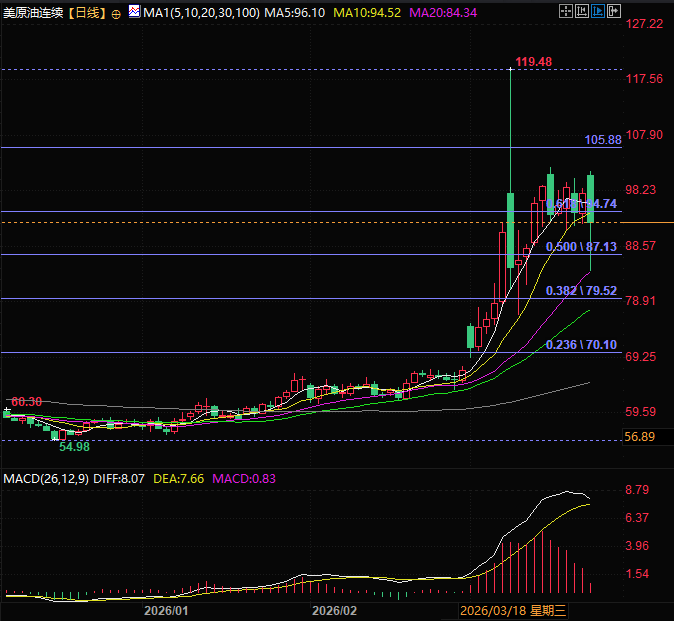
(WTI crude oil futures contract daily chart, source: FX678)
For spot gold, the resistance level is at the 0.500 level, around 4426.
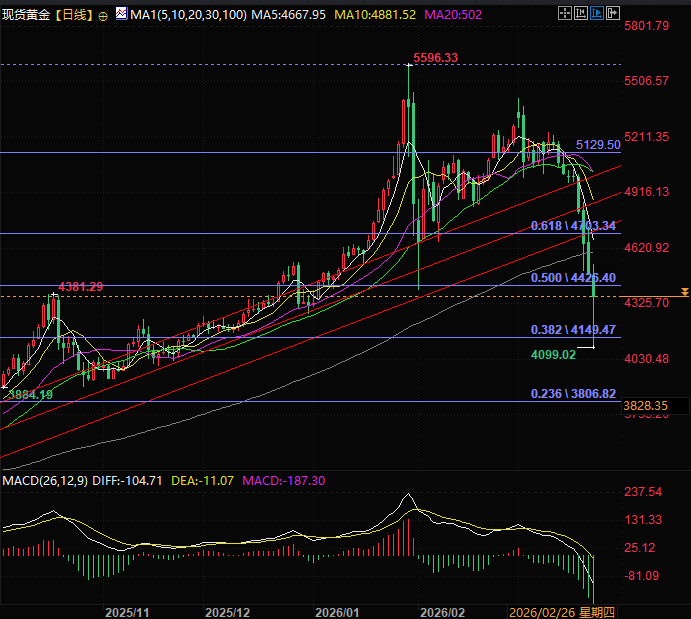
(Spot gold daily chart, source: FX678)
At 19:59 Beijing time, WTI crude oil futures were trading at $92.58 per barrel, and spot gold was trading at $4370 per ounce.
Gold, after a sharp decline, rebounded strongly, exhibiting a "V-shaped" bottoming-out and recovery pattern. The dramatic fluctuations in both commodities were primarily driven by the dramatic shift in the Middle East geopolitical situation.
Weekend conflict escalates: US and Iran exchange harsh words, geopolitical risks fuel market panic.
The standoff between the US and Iran escalated over the weekend, prompting a rapid realization of risk aversion in the market at the open. Oil prices opened higher, while gold prices opened lower and continued to decline.
US President Trump issued a 48-hour ultimatum to Iran, demanding that it fully open the Strait of Hormuz, or else he would strike and destroy several Iranian power plants, prioritizing the largest power station.
Iran responded strongly, with its Central Command of the Hatem Anbia Armed Forces emphasizing that if its fuel and energy infrastructure were attacked, all energy infrastructure, information technology systems, and desalination facilities of the United States and its allies in the Middle East would become targets of Iran's retaliation.
On the same day, Iran's Fars News Agency further released a target list including 11 key facilities, covering the Barakah nuclear power plant in the UAE, two power generation and desalination plants and thermal power plants in Kuwait, two similar facilities in Saudi Arabia, the Aqaba power plant and the Semra thermal power plant in Jordan, one facility in Bahrain, and two power plants in Qatar.
Analysts point out that these facilities are the core of the Middle East's energy and freshwater supply and are highly concentrated. Disruptions at key points could trigger a chain reaction, and the conflict's extension from energy transport routes to production terminals has further amplified market concerns about supply chain stability.
A sudden turning point: Iran offers a diplomatic mechanism for resolving the Strait issue.
Just as geopolitical tensions were nearing a breaking point, diplomatic signals of easing tensions emerged one after another.
South Korea's Ministry of Foreign Affairs announced that Foreign Minister Cho Hyun-sung spoke by phone with Iranian Foreign Minister Abbas Araqchi. Cho requested that Iran ensure the safety of ships stranded in the Strait of Hormuz, expressed deep concern about the impact of the conflict on the global economy, and urged Iran to cease attacks on civilian facilities in Gulf countries and ensure the safety of navigation in the strait.
The Iranian Foreign Minister explained his country's position on the crisis and agreed to maintain ongoing communication with South Korea.
It is reported that due to the blockade of the Strait of Hormuz following the US-Israeli airstrikes on Iran, more than 20 South Korean ships and over 100 crew members are stranded in the Gulf region.
As a major global energy buyer, South Korea relies on imports from the Middle East for about 70% of its crude oil and 20% of its liquefied natural gas. This blockade directly threatens its energy supply chain and has become an important factor in pushing Iran to negotiate with other countries on a mechanism to open the Strait of Hormuz.
A significant emotional shift: Trump reappears in taco.
The more crucial turning point came from Trump's last-minute retreat after applying maximum pressure. Trump announced that the United States and Iran had had a "very good and productive conversation" over the past two days on a complete resolution of hostilities in the Middle East, and had instructed the Department of Defense to postpone all military strikes against Iranian power plants and energy infrastructure for five days.
Trump emphasized that the suspension of the strikes was contingent on the success of subsequent meetings and discussions. This decision opened a five-day window for diplomatic contact between the two sides, temporarily easing geopolitical tensions caused by the strait blockade.
Affected by this news, crude oil prices plunged by more than 10% during the session, while gold prices rebounded sharply.
Market Logic Analysis: Geopolitical Premium Clearing and Uncertainty Game Dominate Market Trends
The US faced a predicament of negotiations with Iran's top officials being repeatedly attacked by Israel, leaving it with no one to talk to. At the same time, the escalating geopolitical situation, with the US and Iran exchanging harsh words that threatened the energy and infrastructure security of the Gulf countries, pushed expectations for rising oil prices to a temporary peak. However, after opening high, oil prices began to fall back, showing a phenomenon where positive news did not lead to price increases.
Meanwhile, the primary objective and focus of these negotiations lies in the Strait of Hormuz and global oil prices, which are the most pressing and concrete issues to be resolved globally. This expectation has led to a rapid easing of concerns about continued oil price increases during the trading session.
The previous expectation of long-term supply disruptions caused by the blockade of the Strait of Hormuz had made the market overly tense, which had driven up prices to accumulate a certain geopolitical premium. With the opening of the US-Iran negotiation window, supply concerns eased, the premium was quickly cleared, and ultimately crude oil prices plummeted after opening higher.
In terms of gold, it was initially supported by safe-haven sentiment and geopolitical tensions, but it first fell sharply due to the waning of safe-haven demand and the pressure of US dollar interest rates. Later, as concerns about oil prices subsided and US Treasury yields plummeted, gold prices rebounded from their lows.
However, from a trading perspective, postponing the strike by five days may not be a real benefit, because the strait remains closed and the US has not yet achieved sufficient results. On the contrary, the rapid adjustment in oil prices has given major players an opportunity to shake out weak hands and accumulate shares. If there is no substantial mechanism to open the strait, oil prices are expected to reach new highs.
From a technical perspective, WTI crude oil futures contracts have repeatedly broken below the 0.500 level during trading sessions. If they subsequently close above 92, it can be considered a pullback during an uptrend. The current resistance level is around 95.
(WTI crude oil futures contract daily chart, source: FX678)
For spot gold, the resistance level is at the 0.500 level, around 4426.
(Spot gold daily chart, source: FX678)
At 19:59 Beijing time, WTI crude oil futures were trading at $92.58 per barrel, and spot gold was trading at $4370 per ounce.
- Risk Warning and Disclaimer
- The market involves risk, and trading may not be suitable for all investors. This article is for reference only and does not constitute personal investment advice, nor does it take into account certain users’ specific investment objectives, financial situation, or other needs. Any investment decisions made based on this information are at your own risk.