A chart shows that the Baltic Dry Index has slightly declined, with freight rates for the three major ship types decreasing simultaneously.
2026-03-23 22:42:30
Latest data shows that on March 23, 2026, the Baltic Dry Index (BDI) stood at 2037 points, a four-day low, down 0.92% from the previous day, marking the largest drop since March 10, 2026, and the third consecutive day of decline (including zero growth). Looking at the short-term charts, the recent 11 BDI data points show: 6 positive increases, 5 negative increases, and 0 zero increases. Specifically, the Panamax Freight Index (BPI) was 1888 points, down 0.84% from the previous day; the Capesize Freight Index (BCI) was 2937 points, down 1.14%; and the Supramax Freight Index (BSI) was 1218 points, down 0.49%. For detailed 720-day and 10-year trend charts of the Baltic Dry Index and its three main sub-indices, please refer to the specially designed charts.
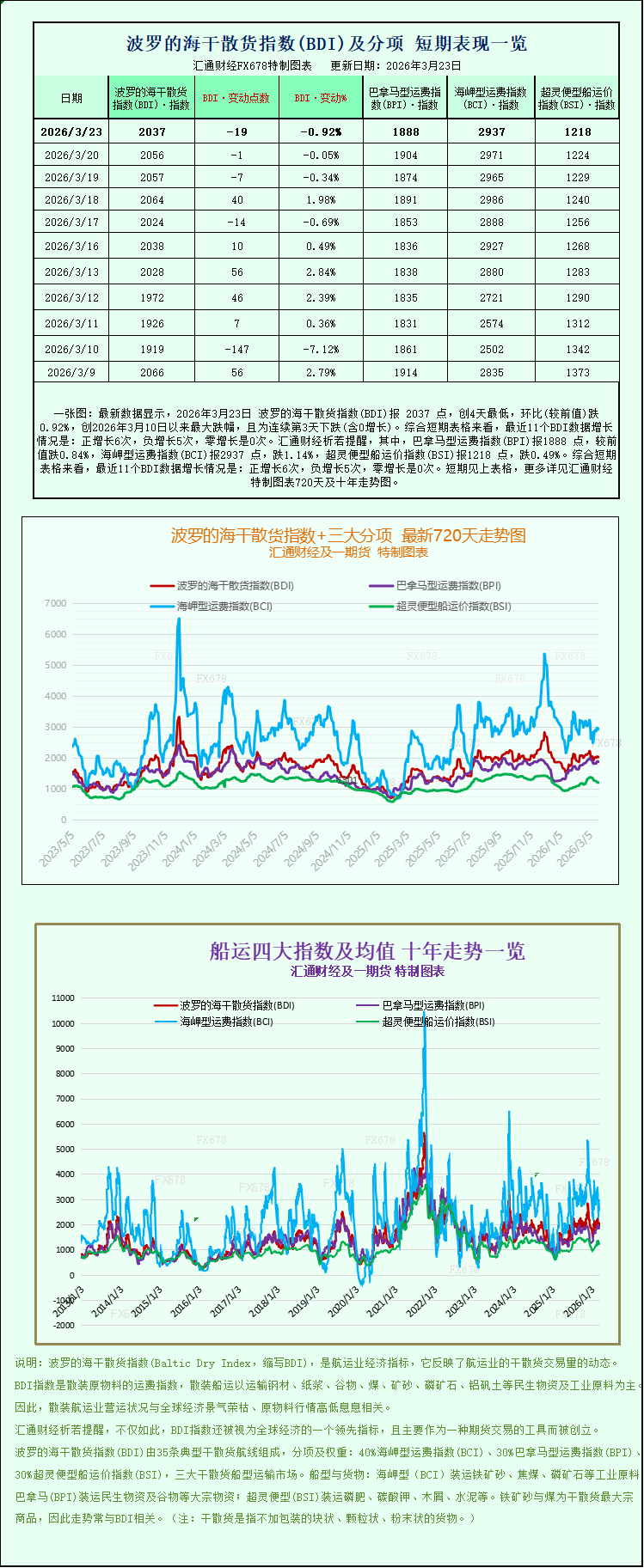
As a key indicator of the global dry bulk shipping market, the Baltic Dry Index (BDI) saw a slight pullback on Monday. This index specifically monitors freight rates for vessels transporting dry bulk commodities such as iron ore, coal, and grains globally, directly reflecting the supply and demand dynamics of the shipping market and the activity level of commodity trade. This decline was widespread across all vessel types, with freight rates for the three major bulk carrier types—Capesize, Panamax, and Supramax—falling in tandem, indicating a temporary halt to the previous upward trend in the overall market.
Looking at the performance of core indices, the composite Baltic Dry Index, which tracks freight rates for Capesize, Panamax, and Supramax vessels, fell 19 points in a single day, closing at 2037 points, a daily decline of 0.9%. Although this fluctuation was limited, it broke the previous upward trend of some ship type indices and made the market more cautious in its assessment of the short-term outlook for dry bulk shipping.
Capesize vessels: saw the largest decline, with daily yields falling significantly.
Among the three major ship types, the Capesize index saw the most significant adjustment, falling 34 points in a single day, a drop of 1.1%, closing at 2937 points. It is worth noting that just the previous week, this ship type index had recorded a weekly gain of 3.2%, and the abrupt halt to the short-term upward trend reflects the intensified supply and demand dynamics in the large dry bulk shipping market.
Capesize vessels, as the mainstay of dry bulk shipping, typically carry around 150,000 tons of bulk cargo per voyage, primarily transporting industrial raw materials such as iron ore and thermal coal. Their freight revenue is directly linked to the global trade demand in the steel and energy industries. Affected by this freight rate reduction, the average daily operating revenue of this vessel type decreased by $307, with daily earnings falling to $23,131, resulting in a slight compression of profit margins.
Market Interconnection: Commodities and Shipping Rates Affect Each Other
Recent fluctuations in the dry bulk market have consistently been closely linked to commodity prices. Previously, supported by steadily rising shipping rates, global iron ore futures prices rose accordingly, with strong market sentiment. Simultaneously, global oil and gas prices continued to soar, leading to increased energy supply demands in various countries. These countries significantly increased coal bookings to meet electricity and industrial energy consumption needs, which in turn drove up prices for coking coal and coke, key raw materials for steelmaking. This surge in commodity demand temporarily supported higher shipping rates.
Geopolitical situations are also a key variable affecting the shipping market. As the world's most important oil transportation artery, the Strait of Hormuz once faced the risk of passage due to geopolitical conflicts related to Iran. Previously, market concerns about the obstruction of shipping channels drove shipping and freight prices to continue to rise. The current decline in freight rates is also seen as a normal adjustment after a brief calm in market sentiment.
Small and medium-sized boats both weakened, resulting in a slight decline in profits.
The Panamax index, representing medium-sized bulk carriers, was also affected, falling 16 points, or 0.8%, to close at 1888 points. This type of vessel primarily transports 60,000 to 70,000 tons of bulk cargo such as coal and grain, and is a core shipping capacity in global food and energy trade. Fluctuations in its freight rates directly impact the cross-regional transportation costs of agricultural products and thermal coal. Affected by the freight rate reduction, the average daily revenue of Panamax vessels decreased by $138, with daily earnings falling back to $16,994.
The Supramax index (often referred to in the industry as a sub-index of very large bulk carriers) also declined, falling 6 points, or 0.5%, to close at 1218 points. This type of vessel is characterized by flexible transportation and is suitable for various small and medium-sized dry bulk cargo trades. This slight decline further confirms the overall downward trend in the dry bulk shipping market.
As a key indicator of the global dry bulk shipping market, the Baltic Dry Index (BDI) saw a slight pullback on Monday. This index specifically monitors freight rates for vessels transporting dry bulk commodities such as iron ore, coal, and grains globally, directly reflecting the supply and demand dynamics of the shipping market and the activity level of commodity trade. This decline was widespread across all vessel types, with freight rates for the three major bulk carrier types—Capesize, Panamax, and Supramax—falling in tandem, indicating a temporary halt to the previous upward trend in the overall market.
Looking at the performance of core indices, the composite Baltic Dry Index, which tracks freight rates for Capesize, Panamax, and Supramax vessels, fell 19 points in a single day, closing at 2037 points, a daily decline of 0.9%. Although this fluctuation was limited, it broke the previous upward trend of some ship type indices and made the market more cautious in its assessment of the short-term outlook for dry bulk shipping.
Capesize vessels: saw the largest decline, with daily yields falling significantly.
Among the three major ship types, the Capesize index saw the most significant adjustment, falling 34 points in a single day, a drop of 1.1%, closing at 2937 points. It is worth noting that just the previous week, this ship type index had recorded a weekly gain of 3.2%, and the abrupt halt to the short-term upward trend reflects the intensified supply and demand dynamics in the large dry bulk shipping market.
Capesize vessels, as the mainstay of dry bulk shipping, typically carry around 150,000 tons of bulk cargo per voyage, primarily transporting industrial raw materials such as iron ore and thermal coal. Their freight revenue is directly linked to the global trade demand in the steel and energy industries. Affected by this freight rate reduction, the average daily operating revenue of this vessel type decreased by $307, with daily earnings falling to $23,131, resulting in a slight compression of profit margins.
Market Interconnection: Commodities and Shipping Rates Affect Each Other
Recent fluctuations in the dry bulk market have consistently been closely linked to commodity prices. Previously, supported by steadily rising shipping rates, global iron ore futures prices rose accordingly, with strong market sentiment. Simultaneously, global oil and gas prices continued to soar, leading to increased energy supply demands in various countries. These countries significantly increased coal bookings to meet electricity and industrial energy consumption needs, which in turn drove up prices for coking coal and coke, key raw materials for steelmaking. This surge in commodity demand temporarily supported higher shipping rates.
Geopolitical situations are also a key variable affecting the shipping market. As the world's most important oil transportation artery, the Strait of Hormuz once faced the risk of passage due to geopolitical conflicts related to Iran. Previously, market concerns about the obstruction of shipping channels drove shipping and freight prices to continue to rise. The current decline in freight rates is also seen as a normal adjustment after a brief calm in market sentiment.
Small and medium-sized boats both weakened, resulting in a slight decline in profits.
The Panamax index, representing medium-sized bulk carriers, was also affected, falling 16 points, or 0.8%, to close at 1888 points. This type of vessel primarily transports 60,000 to 70,000 tons of bulk cargo such as coal and grain, and is a core shipping capacity in global food and energy trade. Fluctuations in its freight rates directly impact the cross-regional transportation costs of agricultural products and thermal coal. Affected by the freight rate reduction, the average daily revenue of Panamax vessels decreased by $138, with daily earnings falling back to $16,994.
The Supramax index (often referred to in the industry as a sub-index of very large bulk carriers) also declined, falling 6 points, or 0.5%, to close at 1218 points. This type of vessel is characterized by flexible transportation and is suitable for various small and medium-sized dry bulk cargo trades. This slight decline further confirms the overall downward trend in the dry bulk shipping market.
- Risk Warning and Disclaimer
- The market involves risk, and trading may not be suitable for all investors. This article is for reference only and does not constitute personal investment advice, nor does it take into account certain users’ specific investment objectives, financial situation, or other needs. Any investment decisions made based on this information are at your own risk.