Gold prices rebounded significantly after experiencing sharp fluctuations.
2026-03-24 00:37:13
On Monday (March 23), during the US trading session, gold and silver markets rebounded significantly after experiencing sharp fluctuations, suggesting that bearish forces may be waning. US President Trump's announcement on Truth Social Media of a delay in military strikes against Iranian energy infrastructure caused oil prices to plummet by approximately 10%-13%, and the dollar weakened, providing precious metals with a short-term respite. Although still influenced by high interest rates and dollar pressure, technical indicators show clear signs of oversold conditions, suggesting that bearish momentum may be nearing its end.

Spot gold plunged more than 8% in early trading, hitting a four-month low of around $4,099, before rebounding strongly and trading in a range of approximately $4,388-$4,442. Spot silver showed greater resilience, rebounding from its lows to near $67-$69, with some intraday gains of 0.6%-1.4%, and the gold-silver ratio narrowing to approximately 64.4:1-65:1.
Since the outbreak of the Middle East conflict on February 28, gold has fallen by more than 15%-17%, and is down about 20%-22% from its January high of about $5,595; last Friday saw its worst weekly performance since 1983. However, today's significant rebound from the lows indicates a shift in market sentiment, with short sellers taking profits, value buying, and some safe-haven covering entering the market.
Geopolitical catalyst
In his statement, Trump said the US and Iran had held "productive talks" over the past two days, and instructed the Department of Defense to postpone strikes against Iranian nuclear facilities, power plants, and energy infrastructure for five days, depending on the progress of further negotiations. He indicated the talks would continue throughout the week.
This news triggered a widespread market reversal: oil prices plummeted to around $86-92 per barrel (having fallen as low as around $84 intraday, a drop of over 13%), the dollar index weakened (around 99.0-99.8), global stock markets rebounded, and bond prices rose. Iran denied direct communication, suggesting that Trump's statement might be a tactic to ease market panic or "buy time."
In the short term, concerns about energy inflation have eased, reducing long-term bets on high interest rates. The weakening dollar has further supported demand for non-dollar-denominated gold, triggering short covering and bargain hunting.
Fundamental analysis
Today's dramatic V-shaped movement in precious metals directly reflects the rapid shift in market expectations regarding a "de-escalation" of the situation in Iran:
High oil prices in the early morning (driven by rising energy costs in the early stages of the conflict) and inflation concerns led to a further weakening of expectations for a Fed rate cut. The high real yield environment exacerbated the opportunity cost of non-yielding gold, triggering forced long liquidation and a "mismatch" of safe-haven demand. The war should have pushed up gold prices, but instead, it collapsed due to "oil prices absorbing safe-haven funds + stagflation fears".
After the afternoon plunge in oil prices, inflationary pressures eased in the short term, US Treasury yields fell slightly (10-year yield around 4.33%-4.39%), and the US dollar index declined, which directly opened a window for a rebound in precious metals.
High interest rates remain a core constraint, with the Fed's tightening expectations unchanged. The initial energy shock reinforced the "higher and longer" interest rate path, and a strong dollar suppressed non-US dollar demand. However, Trump's statement delaying the strikes altered the narrative, and the oil price collapse reduced the risk of stagflation, partially releasing pent-up demand for safe-haven assets and inflation hedging. Structural support for central bank gold purchases remains (continued accumulation in emerging markets), and silver's industrial properties showed relative resilience during the oil price decline (gold-silver ratio narrowed).
In the long term, high global debt, concerns about currency devaluation, and geopolitical uncertainties continue to support precious metals as a "repricing" tool. However, today's market highlights that the short-term driving force remains the tug-of-war between interest rates/the US dollar and energy inflation. The decline in oil prices has eased the pressure, but if negotiations stall or Iran retaliates, high volatility will continue.
Technical Analysis
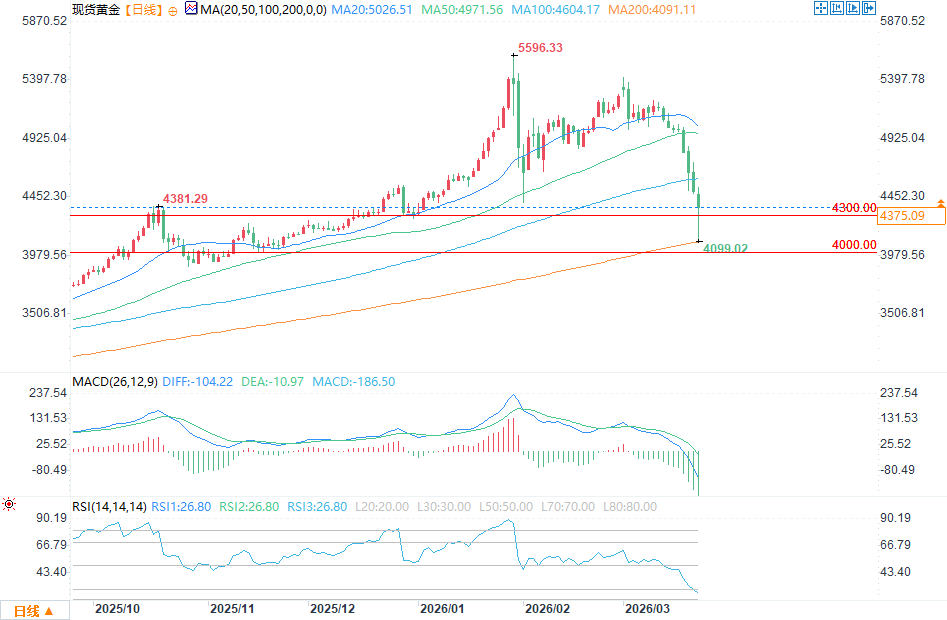
(Spot gold daily chart source: FX678)
The daily chart shows that prices plummeted to the strong support zone of $4,400-$4,500 last week, and rebounded after testing the key low of $4,098-$4,200 in the early morning. The RSI (14) has entered the oversold zone (around 26-30), indicating extreme selling pressure and a potential rebound signal. The MACD continues to decline, but the histogram is narrowing, suggesting that the bearish momentum is weakening and a bullish divergence may be emerging.
Key support: $4,200-$4,300. If this level is breached, the price may accelerate its decline toward the 200-day moving average around $4,100 and the psychological level of $4,000.
Resistance: $4,650-$4,700 (recent breakout zone), a break above this level could lead to $4,800-$5,000.
Overall: The market is in a short-term bearish correction, but oversold conditions and easing geopolitical tensions could trigger a dead cat bounce. However, caution is advised as a break below $4,400 would increase downside risk. Most moving averages are bearish (strong sell signal), but the long-term trend remains bullish.
Institutional Views
In his analysis today, Kitco senior market analyst Jim Wyckoff emphasized that the precious metals market is facing dual pressures from inflation concerns and rising interest rates, but geopolitical risks (such as the situation in Iran) and a weakening dollar are providing support. He pointed out that technical indicators show clear oversold signals. Wyckoff believes that when the market fails to rise significantly despite major positive news (such as a de-escalation of the conflict), it may indicate that the bulls are exhausted; conversely, in today's rebound, bearish momentum may have been exhausted, with value buying and short covering driving the rally. He is generally optimistic about the long-term prospects of precious metals, but believes that short-term volatility is high and dominated by Fed policy and geopolitical events. He suggests paying attention to whether support levels hold and whether technical indicators strengthen.
David Meger, Director of Metals Trading at Gaoling Futures, also stated, "The overnight sell-off continued as long positions were liquidated, driven by interest rate expectations. Trump's post triggered a dramatic reversal, with the entire market rebounding. Volatility will continue."
Spot gold plunged more than 8% in early trading, hitting a four-month low of around $4,099, before rebounding strongly and trading in a range of approximately $4,388-$4,442. Spot silver showed greater resilience, rebounding from its lows to near $67-$69, with some intraday gains of 0.6%-1.4%, and the gold-silver ratio narrowing to approximately 64.4:1-65:1.
Since the outbreak of the Middle East conflict on February 28, gold has fallen by more than 15%-17%, and is down about 20%-22% from its January high of about $5,595; last Friday saw its worst weekly performance since 1983. However, today's significant rebound from the lows indicates a shift in market sentiment, with short sellers taking profits, value buying, and some safe-haven covering entering the market.
Geopolitical catalyst
In his statement, Trump said the US and Iran had held "productive talks" over the past two days, and instructed the Department of Defense to postpone strikes against Iranian nuclear facilities, power plants, and energy infrastructure for five days, depending on the progress of further negotiations. He indicated the talks would continue throughout the week.
This news triggered a widespread market reversal: oil prices plummeted to around $86-92 per barrel (having fallen as low as around $84 intraday, a drop of over 13%), the dollar index weakened (around 99.0-99.8), global stock markets rebounded, and bond prices rose. Iran denied direct communication, suggesting that Trump's statement might be a tactic to ease market panic or "buy time."
In the short term, concerns about energy inflation have eased, reducing long-term bets on high interest rates. The weakening dollar has further supported demand for non-dollar-denominated gold, triggering short covering and bargain hunting.
Fundamental analysis
Today's dramatic V-shaped movement in precious metals directly reflects the rapid shift in market expectations regarding a "de-escalation" of the situation in Iran:
High oil prices in the early morning (driven by rising energy costs in the early stages of the conflict) and inflation concerns led to a further weakening of expectations for a Fed rate cut. The high real yield environment exacerbated the opportunity cost of non-yielding gold, triggering forced long liquidation and a "mismatch" of safe-haven demand. The war should have pushed up gold prices, but instead, it collapsed due to "oil prices absorbing safe-haven funds + stagflation fears".
After the afternoon plunge in oil prices, inflationary pressures eased in the short term, US Treasury yields fell slightly (10-year yield around 4.33%-4.39%), and the US dollar index declined, which directly opened a window for a rebound in precious metals.
High interest rates remain a core constraint, with the Fed's tightening expectations unchanged. The initial energy shock reinforced the "higher and longer" interest rate path, and a strong dollar suppressed non-US dollar demand. However, Trump's statement delaying the strikes altered the narrative, and the oil price collapse reduced the risk of stagflation, partially releasing pent-up demand for safe-haven assets and inflation hedging. Structural support for central bank gold purchases remains (continued accumulation in emerging markets), and silver's industrial properties showed relative resilience during the oil price decline (gold-silver ratio narrowed).
In the long term, high global debt, concerns about currency devaluation, and geopolitical uncertainties continue to support precious metals as a "repricing" tool. However, today's market highlights that the short-term driving force remains the tug-of-war between interest rates/the US dollar and energy inflation. The decline in oil prices has eased the pressure, but if negotiations stall or Iran retaliates, high volatility will continue.
Technical Analysis
(Spot gold daily chart source: FX678)
The daily chart shows that prices plummeted to the strong support zone of $4,400-$4,500 last week, and rebounded after testing the key low of $4,098-$4,200 in the early morning. The RSI (14) has entered the oversold zone (around 26-30), indicating extreme selling pressure and a potential rebound signal. The MACD continues to decline, but the histogram is narrowing, suggesting that the bearish momentum is weakening and a bullish divergence may be emerging.
Key support: $4,200-$4,300. If this level is breached, the price may accelerate its decline toward the 200-day moving average around $4,100 and the psychological level of $4,000.
Resistance: $4,650-$4,700 (recent breakout zone), a break above this level could lead to $4,800-$5,000.
Overall: The market is in a short-term bearish correction, but oversold conditions and easing geopolitical tensions could trigger a dead cat bounce. However, caution is advised as a break below $4,400 would increase downside risk. Most moving averages are bearish (strong sell signal), but the long-term trend remains bullish.
Institutional Views
In his analysis today, Kitco senior market analyst Jim Wyckoff emphasized that the precious metals market is facing dual pressures from inflation concerns and rising interest rates, but geopolitical risks (such as the situation in Iran) and a weakening dollar are providing support. He pointed out that technical indicators show clear oversold signals. Wyckoff believes that when the market fails to rise significantly despite major positive news (such as a de-escalation of the conflict), it may indicate that the bulls are exhausted; conversely, in today's rebound, bearish momentum may have been exhausted, with value buying and short covering driving the rally. He is generally optimistic about the long-term prospects of precious metals, but believes that short-term volatility is high and dominated by Fed policy and geopolitical events. He suggests paying attention to whether support levels hold and whether technical indicators strengthen.
David Meger, Director of Metals Trading at Gaoling Futures, also stated, "The overnight sell-off continued as long positions were liquidated, driven by interest rate expectations. Trump's post triggered a dramatic reversal, with the entire market rebounding. Volatility will continue."
- Risk Warning and Disclaimer
- The market involves risk, and trading may not be suitable for all investors. This article is for reference only and does not constitute personal investment advice, nor does it take into account certain users’ specific investment objectives, financial situation, or other needs. Any investment decisions made based on this information are at your own risk.