The bearish outlook for the natural gas market is now established: geopolitical premiums are gradually fading, and both supply and demand pressures, along with weather conditions, are exerting downward pressure.
2026-03-24 01:12:18
On Monday (March 23), during the US trading session, US April natural gas futures prices initially rose slightly in the morning, but subsequently experienced a sharp drop, closing lower across the board. This reversal was directly caused by US President Trump's latest decision. Trump officially ordered a five-day suspension of military strikes against Iran's core energy infrastructure, while simultaneously releasing conciliatory signals, stating that the US and Iran were engaged in efficient negotiations to end the nearly month-long conflict, thus abruptly reducing the risk of escalating geopolitical tensions.

Technical breakdown: Bulls collapse, downward channel begins
From a daily technical perspective, natural gas futures also suffered a major blow: the price had previously attempted to break through the 50-day moving average resistance level of $3.114/MMBtu and the short-term pullback range of $3.050-$3.135 multiple times, but all attempts failed. Subsequently, bullish funds quickly withdrew, and futures prices plummeted, completely breaking the previous weak rebound pattern.
As a new round of downward momentum continues to accumulate, short sellers are poised to strike, and the next key levels to test are the two interim support levels of $2.923 and $2.891. If these two key levels are decisively broken, it will further confirm that short sellers have a clear advantage, and the market focus will immediately shift to the low of $2.775 reached on February 26th.
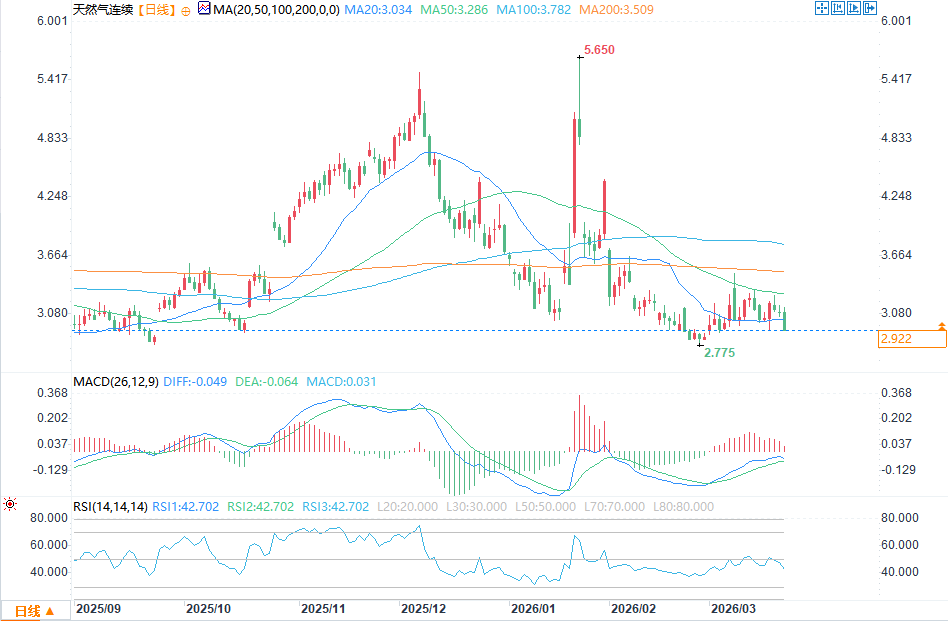
(COMEX natural gas daily chart source: EasyForex)
This low point is highly significant because it represents the last bottom price level before the full-blown conflict between the US and Iran on February 28th. If the price subsequently falls below this level, it means that all the war premium inflated by this round of geopolitical conflict will be completely wiped out, sending a clear signal to the market: even if the conflict is not completely over, the Strait of Hormuz remains closed, and there is no substantial risk to the supply of natural gas from the US mainland, the supporting effect of geopolitical disturbances on prices has failed.
A confluence of key negative factors: Four fundamental pressures solidify the bearish outlook.
With the technical outlook turning bearish across the board, four key negative fundamental factors have been amplified, directly pushing the near-month April natural gas futures contract into a deep bearish pattern, making a short-term rebound extremely difficult.
The previous shift in natural gas prices from a potentially bullish outlook to a rapid plunge was primarily triggered by a supply-demand mismatch: persistently weak demand and persistently high supply levels. In late March, temperatures across the United States were generally higher than usual for this time of year, coinciding with the seasonal off-season window, resulting in a much faster decline in heating demand than in previous years. Coupled with weather forecasts indicating a very low probability of a severe cold wave in the continental United States before the end of the month, there was little chance for a recovery in heating demand, further limiting upward price potential and pushing the supply-demand balance towards a more relaxed state ahead of schedule.
Oversupply worsens: High production levels coupled with prior inventory accumulation create significant pressure.
Currently, U.S. natural gas production is stable at around 113 billion cubic feet per day, with supply remaining high, while downstream demand has consistently failed to keep pace, exacerbating the supply-demand imbalance. According to the latest data released by the U.S. Energy Information Administration (EIA), U.S. natural gas inventories unexpectedly increased by 35 billion cubic feet last week, marking the first inventory accumulation this quarter, and the accumulation occurring significantly earlier than in previous years.
As of now, total U.S. natural gas inventories have reached 1.883 trillion cubic feet, 177 billion cubic feet higher than the same period last year and 47 billion cubic feet higher than the average level over the past five years, indicating a continued expansion of the inventory surplus. According to past market patterns, mid-March should have been the period of natural gas inventory depletion and continuous reduction; however, the market has entered an accumulation cycle ahead of schedule, prematurely plunging into a supply glut. This is clearly not a positive signal to support price increases.
For market traders, this premature inventory buildup sends a very clear bearish signal, confirming that the natural gas market has entered a surplus cycle ahead of schedule. Industry insiders generally believe that unless there are clear signs of a slowdown in natural gas production, any price rebound will be met with significant selling pressure. This is why traders consistently view high supply as the core factor suppressing price rebounds.
Limited support for LNG demand: Export bottlenecks unlikely to reverse overall bearish trend.
Traders are also closely monitoring the impact of the latest developments in the Middle East on global LNG (liquefied natural gas) demand. Over the weekend, US LNG feedstock demand remained stable at 19-20 billion cubic feet per day, primarily supported by global market demand, particularly restocking demand in Europe, which was one of the few bright spots on the demand side.
However, this support faces a significant bottleneck: US LNG export facilities are nearing capacity, limiting further increases in export volume and directly restricting demand-side growth. This means that even with strong global LNG demand, it cannot absorb excess domestic natural gas production, and the trend of inventory accumulation is unlikely to reverse. Contrary to previous bullish market expectations, LNG exports can only provide a minor safety net, failing to offset the dual pressures of high production and weak domestic demand. The overall market supply and demand dynamic remains bearish.
Extreme regional divergence: US domestic gas prices collapse, mired in negative territory
This round of geopolitical conflict has thoroughly exposed the supply disparities between the US and European natural gas markets, with the regional differentiation becoming increasingly apparent: on one hand, there is a severe oversupply of natural gas in West Texas, with prices plummeting into negative territory; on the other hand, there is a shortage of supply in the European and Asian markets, with prices reaching record highs.
According to a recent Bloomberg report, the spot price of natural gas at the Vaha hub in the Permian Basin in the United States plummeted to -$9.75 per million British thermal units (MMBtu) last week; if subsequent seasonal pipeline maintenance leads to further tightening of transportation capacity, the price at the hub could even fall to -$10.00. This is not a data error, but a true reflection of the extreme oversupply of natural gas in the region—producers are forced to pay buyers to take away the excess gas in order to dispose of it.
Supply constraints remain tight: Crude oil profits offset gas price losses, leaving little incentive to cut production.
The US natural gas surplus is unlikely to ease in the short term, but oil and gas producers are unconcerned because their core profit driver is not natural gas. Currently, producers' primary drilling target is crude oil; natural gas is merely a byproduct, a secondary outcome, of crude oil extraction.
With international crude oil prices nearing $100 per barrel, a 47% increase since the start of the US-Iran conflict, the huge profits from crude oil are enough to cover losses in natural gas. Driven by these exorbitant profits, no producer is willing to shut down oil wells due to weak natural gas prices. Small losses in natural gas are negligible compared to the gains from crude oil, meaning that the high supply of natural gas is unlikely to change in the short term.
Global Disruptions Diverge: Tightening Overseas Supply Fails to Change Bearish Outlook for the US Domestic Market
The ongoing conflict between the US and Iran has led to a significant increase in natural gas prices in other parts of the world. Iran not only closed the Strait of Hormuz natural gas shipping lanes but also launched an airstrike on Qatar's Ras Raffarin industrial city, directly forcing the suspension of approximately 17% of Qatar's LNG exports.
According to industry assessments, the repair work on the damaged facilities could take up to five years. This means that the supply disruption is not a short-term, temporary shock, but will have a long-term impact on the global LNG supply pattern and exacerbate the supply shortage in overseas markets. However, this positive effect on the US domestic natural gas market is extremely weak and is unlikely to change the bearish outlook in the domestic market.
Technical breakdown: Bulls collapse, downward channel begins
From a daily technical perspective, natural gas futures also suffered a major blow: the price had previously attempted to break through the 50-day moving average resistance level of $3.114/MMBtu and the short-term pullback range of $3.050-$3.135 multiple times, but all attempts failed. Subsequently, bullish funds quickly withdrew, and futures prices plummeted, completely breaking the previous weak rebound pattern.
As a new round of downward momentum continues to accumulate, short sellers are poised to strike, and the next key levels to test are the two interim support levels of $2.923 and $2.891. If these two key levels are decisively broken, it will further confirm that short sellers have a clear advantage, and the market focus will immediately shift to the low of $2.775 reached on February 26th.
(COMEX natural gas daily chart source: EasyForex)
This low point is highly significant because it represents the last bottom price level before the full-blown conflict between the US and Iran on February 28th. If the price subsequently falls below this level, it means that all the war premium inflated by this round of geopolitical conflict will be completely wiped out, sending a clear signal to the market: even if the conflict is not completely over, the Strait of Hormuz remains closed, and there is no substantial risk to the supply of natural gas from the US mainland, the supporting effect of geopolitical disturbances on prices has failed.
A confluence of key negative factors: Four fundamental pressures solidify the bearish outlook.
With the technical outlook turning bearish across the board, four key negative fundamental factors have been amplified, directly pushing the near-month April natural gas futures contract into a deep bearish pattern, making a short-term rebound extremely difficult.
The previous shift in natural gas prices from a potentially bullish outlook to a rapid plunge was primarily triggered by a supply-demand mismatch: persistently weak demand and persistently high supply levels. In late March, temperatures across the United States were generally higher than usual for this time of year, coinciding with the seasonal off-season window, resulting in a much faster decline in heating demand than in previous years. Coupled with weather forecasts indicating a very low probability of a severe cold wave in the continental United States before the end of the month, there was little chance for a recovery in heating demand, further limiting upward price potential and pushing the supply-demand balance towards a more relaxed state ahead of schedule.
Oversupply worsens: High production levels coupled with prior inventory accumulation create significant pressure.
Currently, U.S. natural gas production is stable at around 113 billion cubic feet per day, with supply remaining high, while downstream demand has consistently failed to keep pace, exacerbating the supply-demand imbalance. According to the latest data released by the U.S. Energy Information Administration (EIA), U.S. natural gas inventories unexpectedly increased by 35 billion cubic feet last week, marking the first inventory accumulation this quarter, and the accumulation occurring significantly earlier than in previous years.
As of now, total U.S. natural gas inventories have reached 1.883 trillion cubic feet, 177 billion cubic feet higher than the same period last year and 47 billion cubic feet higher than the average level over the past five years, indicating a continued expansion of the inventory surplus. According to past market patterns, mid-March should have been the period of natural gas inventory depletion and continuous reduction; however, the market has entered an accumulation cycle ahead of schedule, prematurely plunging into a supply glut. This is clearly not a positive signal to support price increases.
For market traders, this premature inventory buildup sends a very clear bearish signal, confirming that the natural gas market has entered a surplus cycle ahead of schedule. Industry insiders generally believe that unless there are clear signs of a slowdown in natural gas production, any price rebound will be met with significant selling pressure. This is why traders consistently view high supply as the core factor suppressing price rebounds.
Limited support for LNG demand: Export bottlenecks unlikely to reverse overall bearish trend.
Traders are also closely monitoring the impact of the latest developments in the Middle East on global LNG (liquefied natural gas) demand. Over the weekend, US LNG feedstock demand remained stable at 19-20 billion cubic feet per day, primarily supported by global market demand, particularly restocking demand in Europe, which was one of the few bright spots on the demand side.
However, this support faces a significant bottleneck: US LNG export facilities are nearing capacity, limiting further increases in export volume and directly restricting demand-side growth. This means that even with strong global LNG demand, it cannot absorb excess domestic natural gas production, and the trend of inventory accumulation is unlikely to reverse. Contrary to previous bullish market expectations, LNG exports can only provide a minor safety net, failing to offset the dual pressures of high production and weak domestic demand. The overall market supply and demand dynamic remains bearish.
Extreme regional divergence: US domestic gas prices collapse, mired in negative territory
This round of geopolitical conflict has thoroughly exposed the supply disparities between the US and European natural gas markets, with the regional differentiation becoming increasingly apparent: on one hand, there is a severe oversupply of natural gas in West Texas, with prices plummeting into negative territory; on the other hand, there is a shortage of supply in the European and Asian markets, with prices reaching record highs.
According to a recent Bloomberg report, the spot price of natural gas at the Vaha hub in the Permian Basin in the United States plummeted to -$9.75 per million British thermal units (MMBtu) last week; if subsequent seasonal pipeline maintenance leads to further tightening of transportation capacity, the price at the hub could even fall to -$10.00. This is not a data error, but a true reflection of the extreme oversupply of natural gas in the region—producers are forced to pay buyers to take away the excess gas in order to dispose of it.
Supply constraints remain tight: Crude oil profits offset gas price losses, leaving little incentive to cut production.
The US natural gas surplus is unlikely to ease in the short term, but oil and gas producers are unconcerned because their core profit driver is not natural gas. Currently, producers' primary drilling target is crude oil; natural gas is merely a byproduct, a secondary outcome, of crude oil extraction.
With international crude oil prices nearing $100 per barrel, a 47% increase since the start of the US-Iran conflict, the huge profits from crude oil are enough to cover losses in natural gas. Driven by these exorbitant profits, no producer is willing to shut down oil wells due to weak natural gas prices. Small losses in natural gas are negligible compared to the gains from crude oil, meaning that the high supply of natural gas is unlikely to change in the short term.
Global Disruptions Diverge: Tightening Overseas Supply Fails to Change Bearish Outlook for the US Domestic Market
The ongoing conflict between the US and Iran has led to a significant increase in natural gas prices in other parts of the world. Iran not only closed the Strait of Hormuz natural gas shipping lanes but also launched an airstrike on Qatar's Ras Raffarin industrial city, directly forcing the suspension of approximately 17% of Qatar's LNG exports.
According to industry assessments, the repair work on the damaged facilities could take up to five years. This means that the supply disruption is not a short-term, temporary shock, but will have a long-term impact on the global LNG supply pattern and exacerbate the supply shortage in overseas markets. However, this positive effect on the US domestic natural gas market is extremely weak and is unlikely to change the bearish outlook in the domestic market.
- Risk Warning and Disclaimer
- The market involves risk, and trading may not be suitable for all investors. This article is for reference only and does not constitute personal investment advice, nor does it take into account certain users’ specific investment objectives, financial situation, or other needs. Any investment decisions made based on this information are at your own risk.