Crude oil trading alert: The volatile situation in the Middle East has led to significant fluctuations in oil prices at high levels, further widening market divergence.
2026-03-24 09:29:35
Global financial markets experienced significant volatility yesterday, primarily driven by policy signals from US President Trump. Following his public announcement of a halt to strikes on Iranian energy infrastructure and hints of potential progress in negotiations, market risk expectations cooled rapidly, leading to a precipitous drop in oil prices within a very short period, with a single-day decline exceeding 13% . Simultaneously, risk aversion eased, causing US Treasury yields to decline rapidly, with the 2-year Treasury yield falling by approximately 22 basis points to 3.79% , marking one of the largest single-day fluctuations in recent times. Meanwhile, US stocks saw a clear recovery in risk appetite, with the S&P 500 index rising approximately 2.2% during the session. However, during Tuesday's Asian trading session, oil prices continued to rebound, and Nasdaq futures declined slightly, indicating that the market remains in a phase of sentiment release. Before a clear direction emerges, caution is advised to guard against further increases in volatility.

It's worth noting that this round of market rebound in risk assets was almost entirely based on "expectations of change," rather than improvements in actual fundamentals. Less than an hour later, Iran denied that any negotiations were taking place, casting doubt on the veracity of the event. Nevertheless, the overall market trend did not immediately reverse, reflecting that investors were more focused on the policy intentions themselves—that the US government might be inclined to avoid further escalation of the conflict, thereby reducing the impact on the global economy.
From a macroeconomic perspective, the situation in the Middle East has a decisive impact on global energy supply. The Strait of Hormuz handles approximately 20% of global seaborne crude oil transport; any disruption to this transport would rapidly push up energy prices and transmit to the inflation system. During the previous escalation of the conflict, the sustained rise in oil prices significantly increased global inflation expectations, prompting markets to reassess the monetary policy paths of major economies, and even leading to bets on further interest rate hikes.
However, this round of oil price plunges demonstrates the market's high elasticity in pricing "risk premiums." Once there's a possibility of easing tensions, the previously accumulated risk premiums will be quickly eliminated, leading to sharp price reversals. However, this adjustment doesn't necessarily indicate a trend reversal, but rather a temporary emotional correction. As time passes, without substantial diplomatic progress, oil prices may regain upward momentum.
From an asset correlation perspective, this round of market activity exhibits a typical characteristic of "synchronized recovery of risk assets": a weakening US dollar index, declining bond yields, and a rebound in the stock market. This structure suggests that the market has entered a short-term "inflation easing trade." However, significant divergences still exist within the market. On the one hand, investors hope for a swift end to the conflict to restore economic stability; on the other hand, ongoing military deployments and communications have repeatedly eroded policy credibility, making it difficult for the market to establish a consistent medium- to long-term expectation.
On the sentiment front, the market is undergoing a shift from "extreme risk aversion" to "cautious optimism," but this process is highly volatile. Some investors are beginning to question whether policy signals are merely for short-term market stabilization rather than a genuine strategic shift. Historical experience shows that when market movements rely on a single political signal, their sustainability is typically weak, and they are prone to reversals during subsequent information corrections.
From a technical perspective, the daily chart shows that oil prices formed a temporary top after a rapid surge, and a large bearish candle with high volume appeared following the news shock, indicating a shift from a strong to a weak short-term trend. The current key support level is around $85 ; a break below this level could lead to further declines towards the $80 area . Resistance is concentrated around $95 , which will act as significant resistance in the short term. Looking at momentum indicators, the daily RSI has rapidly retreated from overbought territory, indicating a significant weakening of bullish momentum.
On the 4-hour chart, oil prices exhibit a typical "waterfall-like decline" structure, with a death cross appearing in the short-term moving average system and the price trading below the moving averages, indicating that the bears are in control. The current rebound is more of a technical correction. The key resistance level to watch is $95 ; if this level cannot be broken, the market may continue its weak and volatile trend. Meanwhile, the MACD indicator is widening below the zero line, further reinforcing the short-term downside risk.
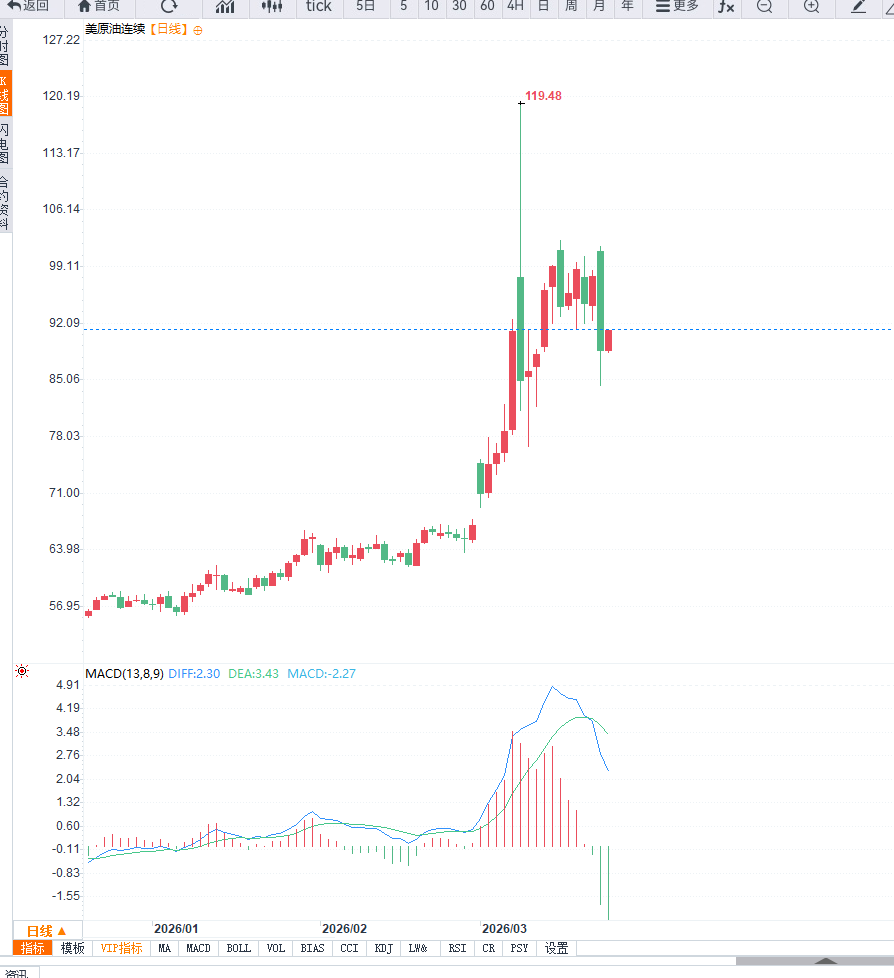
Editor's Summary <br/>Overall, this market rebound is more of a sentiment recovery than a trend reversal. The sharp drop in oil prices has released short-term inflationary pressures, but the uncertainty surrounding the Middle East situation remains the core variable dominating the market. Future market trends will heavily depend on whether there is a substantial easing of geopolitical tensions. If the conflict continues or escalates, oil prices and inflation expectations may rise again, thus suppressing the performance of risk assets. Conversely, if diplomatic progress is clear, the market is expected to enter a phase of recovery. However, given the current context of fluctuating information and high policy uncertainty, investors need to be wary of the risks brought by amplified short-term volatility, while also paying attention to inter-asset correlations to capture structural opportunities.
It's worth noting that this round of market rebound in risk assets was almost entirely based on "expectations of change," rather than improvements in actual fundamentals. Less than an hour later, Iran denied that any negotiations were taking place, casting doubt on the veracity of the event. Nevertheless, the overall market trend did not immediately reverse, reflecting that investors were more focused on the policy intentions themselves—that the US government might be inclined to avoid further escalation of the conflict, thereby reducing the impact on the global economy.
From a macroeconomic perspective, the situation in the Middle East has a decisive impact on global energy supply. The Strait of Hormuz handles approximately 20% of global seaborne crude oil transport; any disruption to this transport would rapidly push up energy prices and transmit to the inflation system. During the previous escalation of the conflict, the sustained rise in oil prices significantly increased global inflation expectations, prompting markets to reassess the monetary policy paths of major economies, and even leading to bets on further interest rate hikes.
However, this round of oil price plunges demonstrates the market's high elasticity in pricing "risk premiums." Once there's a possibility of easing tensions, the previously accumulated risk premiums will be quickly eliminated, leading to sharp price reversals. However, this adjustment doesn't necessarily indicate a trend reversal, but rather a temporary emotional correction. As time passes, without substantial diplomatic progress, oil prices may regain upward momentum.
From an asset correlation perspective, this round of market activity exhibits a typical characteristic of "synchronized recovery of risk assets": a weakening US dollar index, declining bond yields, and a rebound in the stock market. This structure suggests that the market has entered a short-term "inflation easing trade." However, significant divergences still exist within the market. On the one hand, investors hope for a swift end to the conflict to restore economic stability; on the other hand, ongoing military deployments and communications have repeatedly eroded policy credibility, making it difficult for the market to establish a consistent medium- to long-term expectation.
On the sentiment front, the market is undergoing a shift from "extreme risk aversion" to "cautious optimism," but this process is highly volatile. Some investors are beginning to question whether policy signals are merely for short-term market stabilization rather than a genuine strategic shift. Historical experience shows that when market movements rely on a single political signal, their sustainability is typically weak, and they are prone to reversals during subsequent information corrections.
From a technical perspective, the daily chart shows that oil prices formed a temporary top after a rapid surge, and a large bearish candle with high volume appeared following the news shock, indicating a shift from a strong to a weak short-term trend. The current key support level is around $85 ; a break below this level could lead to further declines towards the $80 area . Resistance is concentrated around $95 , which will act as significant resistance in the short term. Looking at momentum indicators, the daily RSI has rapidly retreated from overbought territory, indicating a significant weakening of bullish momentum.
On the 4-hour chart, oil prices exhibit a typical "waterfall-like decline" structure, with a death cross appearing in the short-term moving average system and the price trading below the moving averages, indicating that the bears are in control. The current rebound is more of a technical correction. The key resistance level to watch is $95 ; if this level cannot be broken, the market may continue its weak and volatile trend. Meanwhile, the MACD indicator is widening below the zero line, further reinforcing the short-term downside risk.
Editor's Summary <br/>Overall, this market rebound is more of a sentiment recovery than a trend reversal. The sharp drop in oil prices has released short-term inflationary pressures, but the uncertainty surrounding the Middle East situation remains the core variable dominating the market. Future market trends will heavily depend on whether there is a substantial easing of geopolitical tensions. If the conflict continues or escalates, oil prices and inflation expectations may rise again, thus suppressing the performance of risk assets. Conversely, if diplomatic progress is clear, the market is expected to enter a phase of recovery. However, given the current context of fluctuating information and high policy uncertainty, investors need to be wary of the risks brought by amplified short-term volatility, while also paying attention to inter-asset correlations to capture structural opportunities.
- Risk Warning and Disclaimer
- The market involves risk, and trading may not be suitable for all investors. This article is for reference only and does not constitute personal investment advice, nor does it take into account certain users’ specific investment objectives, financial situation, or other needs. Any investment decisions made based on this information are at your own risk.