Gold's rebound has stalled; in the short term, it remains driven by sentiment and awaits a correction.
2026-03-24 13:50:59
Gold prices rose and then fell during Asian trading hours on Tuesday, coming under renewed pressure after rebounding from the previous day's lows, indicating that selling pressure in the market remains significant. Gold prices had previously dipped to around $4,100, a level corresponding to key long-term moving average support and serving as a crucial technical watershed for the current market.

From a fundamental perspective, the ongoing conflict in the Middle East remains the core variable influencing gold prices. US President Donald Trump previously indicated a possible agreement with Iran, but Iran quickly denied this, emphasizing that the conflict would continue until full compensation was achieved. This divergence in statements exacerbated market uncertainty. Meanwhile, renewed disruptions to Iran's energy infrastructure, coupled with the risk of restricted shipping through the Strait of Hormuz, pushed crude oil prices higher again.
Rising oil prices have directly boosted global inflation expectations, prompting markets to reassess the policy paths of major central banks. The market has largely ruled out a Federal Reserve rate cut this year and is increasing its bets on rate hikes. This shift in expectations has led to a sustained rise in US Treasury yields, thereby enhancing the attractiveness of the US dollar and significantly suppressing gold prices. Since gold itself does not generate interest income, its investment value declines relatively in a high-interest-rate environment, with funds gradually flowing into income-generating assets.
Despite this, gold has not experienced a sharp, one-sided decline, as safe-haven demand continues to provide some support for prices. With the ongoing turmoil in the Middle East, market concerns about further escalation of the conflict have limited the downside potential for gold. Therefore, the current gold market exhibits a structural characteristic of "coexisting interest rate suppression and safe-haven support," leading to increased price volatility but unclear direction.
The market will now focus on PMI data from major global economies to assess economic momentum and its impact on inflation and policy paths. Meanwhile, geopolitical tensions remain a dominant short-term factor; a further escalation of conflict could provide safe-haven buying support for gold, while a de-escalation would likely see interest rates regain dominance in the market.
From a technical perspective, the daily chart shows that gold is still in a downtrend overall. The previous break below the 100-day moving average was a key signal of weakness, while the 200-day moving average near $4100 forms important medium-term support. Currently, the price is rebounding above this area, but upward momentum is limited. If the subsequent rebound breaks through $4450 , it may retest the $4500 resistance level; the support level to watch is $4305 , and a decisive break below this level could lead to further declines towards the $4100 area. Looking at the indicators, the MACD is below the zero line and the green bars are expanding, indicating increasing bearish momentum; the RSI is in oversold territory near 25 , suggesting a short-term technical rebound is possible, but the overall trend remains weak.
On the 4-hour chart, gold is exhibiting a slightly bearish consolidation pattern, with the short-term moving average system maintaining a bearish alignment. Price rallies have repeatedly been met with resistance from these moving averages. Current resistance is concentrated in the 4450-4550 range ; failure to break through this level will likely maintain the weakness. Support levels are at 4300 and 4100 USD ; a break below these levels would open up further downside potential. The MACD remains in negative territory, indicating that the short-term downtrend is not yet over, but a rebound after oversold conditions should be anticipated.
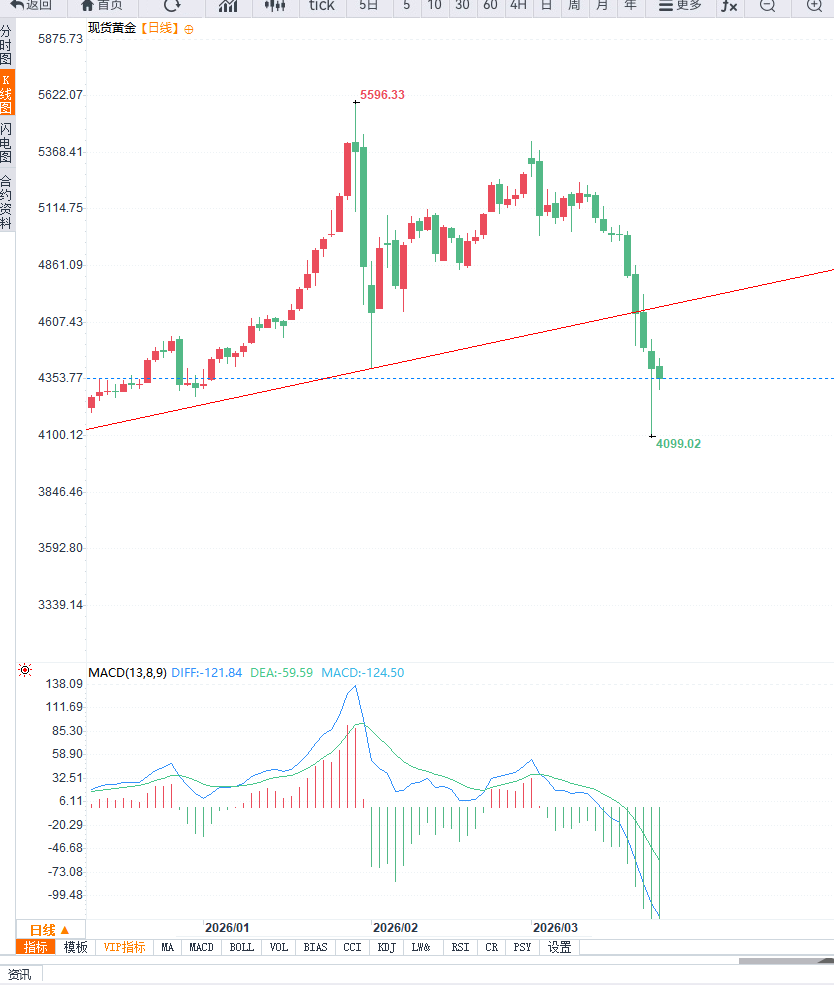
From both the daily and 4-hour charts, gold is currently in a phase of "medium-term downtrend + short-term oversold rebound". The daily trend has not yet reversed, with the key support level of $4100 acting as a dividing line between bullish and bearish sentiment. The 4-hour chart maintains a slightly bearish oscillating structure, limiting the upside potential. Overall, before breaking through the key resistance level of $4450, gold will likely continue to trade in a weak range, and in the short term, it is more likely to fluctuate between oversold correction and continuation of the downtrend.
Editor's Summary : The core logic of the current gold market lies in the interplay between interest rate expectations and geopolitical risks. Rising inflation fuels expectations of interest rate hikes, putting downward pressure on gold, while ongoing geopolitical conflicts provide some support. In the short term, interest rate factors dominate, keeping gold in a weak position; however, in the medium to long term, changes in safe-haven demand and central bank gold purchases still need to be monitored. Future trends will depend on the evolution of the Middle East situation and the global inflation path; investors should pay close attention to breakouts at key technical levels and changes in the macroeconomic environment.
From a fundamental perspective, the ongoing conflict in the Middle East remains the core variable influencing gold prices. US President Donald Trump previously indicated a possible agreement with Iran, but Iran quickly denied this, emphasizing that the conflict would continue until full compensation was achieved. This divergence in statements exacerbated market uncertainty. Meanwhile, renewed disruptions to Iran's energy infrastructure, coupled with the risk of restricted shipping through the Strait of Hormuz, pushed crude oil prices higher again.
Rising oil prices have directly boosted global inflation expectations, prompting markets to reassess the policy paths of major central banks. The market has largely ruled out a Federal Reserve rate cut this year and is increasing its bets on rate hikes. This shift in expectations has led to a sustained rise in US Treasury yields, thereby enhancing the attractiveness of the US dollar and significantly suppressing gold prices. Since gold itself does not generate interest income, its investment value declines relatively in a high-interest-rate environment, with funds gradually flowing into income-generating assets.
Despite this, gold has not experienced a sharp, one-sided decline, as safe-haven demand continues to provide some support for prices. With the ongoing turmoil in the Middle East, market concerns about further escalation of the conflict have limited the downside potential for gold. Therefore, the current gold market exhibits a structural characteristic of "coexisting interest rate suppression and safe-haven support," leading to increased price volatility but unclear direction.
The market will now focus on PMI data from major global economies to assess economic momentum and its impact on inflation and policy paths. Meanwhile, geopolitical tensions remain a dominant short-term factor; a further escalation of conflict could provide safe-haven buying support for gold, while a de-escalation would likely see interest rates regain dominance in the market.
From a technical perspective, the daily chart shows that gold is still in a downtrend overall. The previous break below the 100-day moving average was a key signal of weakness, while the 200-day moving average near $4100 forms important medium-term support. Currently, the price is rebounding above this area, but upward momentum is limited. If the subsequent rebound breaks through $4450 , it may retest the $4500 resistance level; the support level to watch is $4305 , and a decisive break below this level could lead to further declines towards the $4100 area. Looking at the indicators, the MACD is below the zero line and the green bars are expanding, indicating increasing bearish momentum; the RSI is in oversold territory near 25 , suggesting a short-term technical rebound is possible, but the overall trend remains weak.
On the 4-hour chart, gold is exhibiting a slightly bearish consolidation pattern, with the short-term moving average system maintaining a bearish alignment. Price rallies have repeatedly been met with resistance from these moving averages. Current resistance is concentrated in the 4450-4550 range ; failure to break through this level will likely maintain the weakness. Support levels are at 4300 and 4100 USD ; a break below these levels would open up further downside potential. The MACD remains in negative territory, indicating that the short-term downtrend is not yet over, but a rebound after oversold conditions should be anticipated.
From both the daily and 4-hour charts, gold is currently in a phase of "medium-term downtrend + short-term oversold rebound". The daily trend has not yet reversed, with the key support level of $4100 acting as a dividing line between bullish and bearish sentiment. The 4-hour chart maintains a slightly bearish oscillating structure, limiting the upside potential. Overall, before breaking through the key resistance level of $4450, gold will likely continue to trade in a weak range, and in the short term, it is more likely to fluctuate between oversold correction and continuation of the downtrend.
Editor's Summary : The core logic of the current gold market lies in the interplay between interest rate expectations and geopolitical risks. Rising inflation fuels expectations of interest rate hikes, putting downward pressure on gold, while ongoing geopolitical conflicts provide some support. In the short term, interest rate factors dominate, keeping gold in a weak position; however, in the medium to long term, changes in safe-haven demand and central bank gold purchases still need to be monitored. Future trends will depend on the evolution of the Middle East situation and the global inflation path; investors should pay close attention to breakouts at key technical levels and changes in the macroeconomic environment.
- Risk Warning and Disclaimer
- The market involves risk, and trading may not be suitable for all investors. This article is for reference only and does not constitute personal investment advice, nor does it take into account certain users’ specific investment objectives, financial situation, or other needs. Any investment decisions made based on this information are at your own risk.