Gold Trading Alert: Gold Prices Rebound Moderately After Plunge; Can Trump's "Ceasefire Gift" Turn the Tide?
2026-03-25 07:13:02
The gold market is undergoing a dramatic test. After a sharp pullback of over 20% from its year-to-date high, gold prices rebounded on Tuesday (March 25), closing up 1.5% at $4474.26 per ounce. This is not simply a trend reversal, but rather a microcosm of the intense struggle between bulls and bears in an extremely complex geopolitical and macro-financial environment. On one hand, there is the quiet diplomatic probing between the US and Iran under the cover of gunfire; on the other hand, there is the reset of inflation and interest rate expectations caused by sharp fluctuations in the energy market. Gold is standing at a critical crossroads.
The dramatic fluctuations in the gold market this week are firmly rooted in the rapidly changing situation in the Middle East. The conflict between the United States and Iran has entered its fourth week, and this conflict has not only reshaped the regional landscape but also stirred up huge waves in the financial markets.
The Paradox of Diplomatic Engagement and Military Action
The most striking contradiction lies in the undercurrent of diplomatic efforts amidst the ongoing military strikes. According to Dow Jones Newswires, mediators from Turkey, Egypt, and Pakistan are pushing hard to arrange a meeting between US and Iranian officials before Thursday (March 26), possibly in Islamabad. US President Trump has publicly declared that negotiations have made progress, that Iran is "very eager to reach an agreement," and that it has made "valuable concessions" related to the Strait of Hormuz and energy. He even described this as a "generous gift."
However, this optimistic stance contrasts sharply with the realities on the battlefield. The White House press secretary made it clear that Operation Epic Fury would continue. Meanwhile, media reports indicated that the U.S. was planning to redeploy thousands more troops from the elite 82nd Airborne Division to the Middle East, exacerbating concerns about a protracted conflict.
Trust gap and “absurd” demands
The vast differences in the two sides' positions make any diplomatic breakthrough seem exceptionally fragile. Iran has expressed deep suspicion of the United States, with officials complaining to the mediators that the US had launched two attacks during high-level diplomatic talks during the Trump administration, and that media leaks of information about the talks had also angered Tehran.
More problematic is the internal turmoil within the Iranian government following Israel's decapitation strike against the Iranian leadership, with power appearing to be concentrating further in the hands of the hardline Islamic Revolutionary Guard Corps. This force has made stringent demands of the United States, including the closure of all US military bases in the Gulf region or compensation, which US officials have dismissed as "absurd and unrealistic." This shift in internal power structure makes it difficult for the US to find a reliable and stable negotiating partner, undoubtedly increasing the difficulty of reaching an agreement.
Geopolitical uncertainties quickly spread to the macro-financial level, exerting a complex and contradictory influence on gold prices through three core variables: oil prices, inflation expectations, and interest rate paths.
Energy shock and the specter of inflation
The de facto blockade of the Strait of Hormuz, a vital global energy route, has disrupted approximately one-fifth of global oil and liquefied natural gas (LNG) transport, representing the most significant supply-side shock currently facing the market. Although oil prices plunged more than 10% on Monday due to Trump's comments about "productive" talks, crude futures rebounded by over 4% on Tuesday as optimism about a swift resolution to the conflict faded and news of a US troop buildup emerged. Major banks such as Goldman Sachs have already raised their 2026 oil price forecasts.
Rising energy prices are a double-edged sword for gold. On the one hand, as a traditional inflation hedge, persistent inflationary pressures should support gold prices. But more importantly, it triggers a repricing of market expectations regarding central bank, particularly the Federal Reserve's, policy responses. The head of commodity strategy at TD Securities points out that if the war continues and energy prices keep rising, this is not good news for gold. The underlying logic is that supply-driven inflation will force central banks to maintain a tight stance, and may even raise interest rates further, thus diminishing the attractiveness of gold as a zero-interest asset.
Interest rate expectations reset and the strength of the US dollar
Market expectations for interest rates are undergoing a dramatic shift. Before the outbreak of the Middle East conflict, the market widely expected two rate cuts this year. Now, traders have fully priced in no further rate cuts this year, and are even pricing in a greater than 30% chance of a rate hike before the end of the year. This hawkish shift is directly reflected in the bond market: weak demand in Tuesday's $69 billion two-year Treasury auction pushed the two-year Treasury yield up sharply to 3.944%, while the 10-year Treasury yield, a key market benchmark, also rose above 4.419%.
Rising interest rate expectations, coupled with its safe-haven appeal, have jointly pushed up the US dollar. The dollar index rose slightly on Tuesday, reversing some of the previous day's losses. One market strategist admitted that it's difficult to sell the dollar given the continued risk of escalation and the jump in US interest rates. For gold, which is priced in US dollars, the strengthening dollar undoubtedly poses additional downward pressure.
Under the combined influence of the aforementioned macroeconomic and geopolitical factors, the market performance of gold itself exhibits typical "dilemma" characteristics.
Temporary failure of risk avoidance function
In theory, escalating war risks should directly trigger safe-haven demand for gold. However, the current market reaction is more complex. Although gold prices rebounded 1.5% to $4,474 on Tuesday from their November lows, their previous sharp decline (a more than 21% pullback from January highs and nearly 17% drop since the start of the war) indicates that traditional safe-haven logic is being suppressed by other, more powerful forces. Analysts at Commerzbank believe that the recent plunge in gold prices may be an overreaction, just like the sharp rise at the beginning of the year, swinging from one extreme to another. This reveals that the market is being dominated by highly uncertain news and wildly volatile expectations.
Asset allocation pressure in a high-interest-rate environment
The current market is showing signs of stagflation, with rising energy prices driving up inflation while rising interest rate expectations threaten economic growth. In this environment, the stock market is suffering a double blow, and investor confidence is low. However, gold has not clearly benefited from the stock market turmoil.
Strategists at BMO Private Wealth point out that investors are glued to social media and every news headline, making the market highly short-sighted. No one is willing to significantly overweight risk assets in this environment. Similarly, for assets like gold that don't generate interest, there's a lack of sufficient incentive to increase holdings under high interest rate expectations. Funds may flow more towards assets offering certain yields, such as short-term government bonds, or they may choose to wait and see. This explains why gold's rebound remains sluggish despite the presence of safe-haven demand.
In conclusion, the gold market is currently in an extremely delicate and fragile position. In the short term, its trend is almost entirely determined by the next developments in the US-Iran situation.
On the one hand, if diplomatic efforts achieve a substantial breakthrough, even just facilitating a high-level meeting, it could quickly alleviate extreme market concerns about energy supply, leading to a decline in oil prices, a cooling of inflation expectations, and a decrease in the dollar and US Treasury yields. This could provide a window of respite and a rebound for gold. If Trump's "15-point plan," which includes a ceasefire, nuclear issues, proxy forces, and shipping lanes, is put on the agenda, it will become a key catalyst for a shift in market sentiment.
On the other hand, if the current stalemate continues, or even if the military conflict escalates further, gold will face a more complex test. Persistently high oil prices will solidify or even push up inflation expectations, forcing major central banks such as the Federal Reserve to maintain a hawkish stance. The "double high" environment of high interest rates and a high dollar will pose a formidable obstacle for gold. Although its safe-haven properties may provide temporary support during periods of extreme panic, it proves inadequate in combating the core contradiction of "high interest rates."
TD Securities' forecast for future gold price movements offers a clear line of reasoning: gold will face pressure in the second quarter, but by the end of the year, with inflation under control, central banks gaining greater policy freedom, the dollar may weaken, and interest rates may be lowered, at which point the outlook for gold will become optimistic again. This means that amidst the current turmoil and volatility, gold investors may need to take a longer-term perspective, navigating through the fog of geopolitics and interest rate expectations to find that final equilibrium.
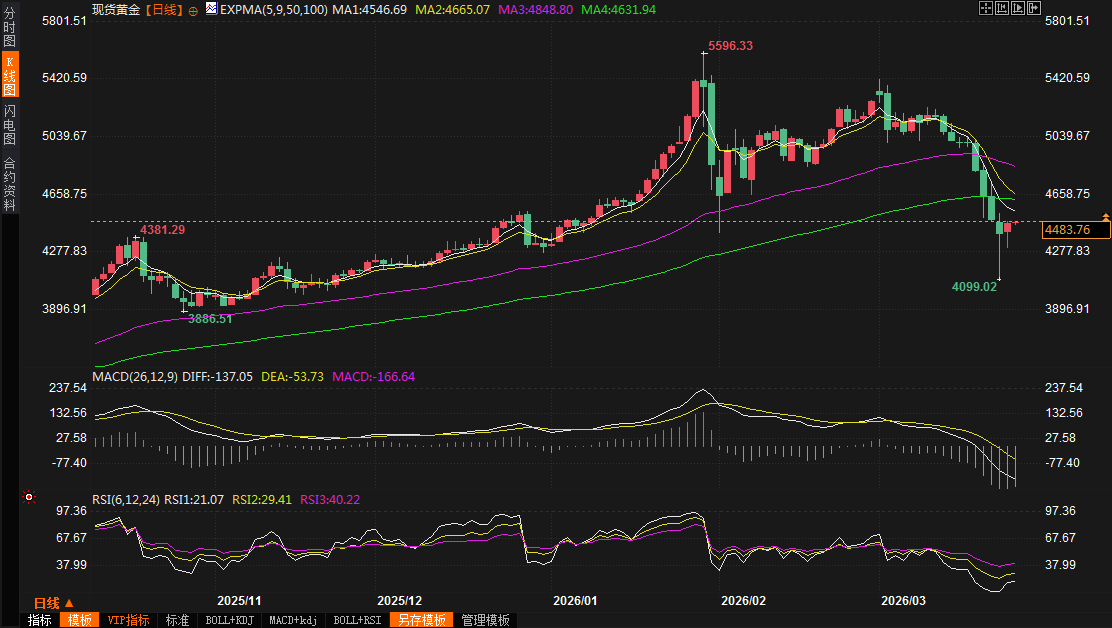
(Spot gold daily chart, source: FX678)
At 07:10 Beijing time, spot gold was trading at $4484.04 per ounce.
I. The Geopolitical Fog: Behind-the-Spot Gunfire and Suspicion
The dramatic fluctuations in the gold market this week are firmly rooted in the rapidly changing situation in the Middle East. The conflict between the United States and Iran has entered its fourth week, and this conflict has not only reshaped the regional landscape but also stirred up huge waves in the financial markets.
The Paradox of Diplomatic Engagement and Military Action
The most striking contradiction lies in the undercurrent of diplomatic efforts amidst the ongoing military strikes. According to Dow Jones Newswires, mediators from Turkey, Egypt, and Pakistan are pushing hard to arrange a meeting between US and Iranian officials before Thursday (March 26), possibly in Islamabad. US President Trump has publicly declared that negotiations have made progress, that Iran is "very eager to reach an agreement," and that it has made "valuable concessions" related to the Strait of Hormuz and energy. He even described this as a "generous gift."
However, this optimistic stance contrasts sharply with the realities on the battlefield. The White House press secretary made it clear that Operation Epic Fury would continue. Meanwhile, media reports indicated that the U.S. was planning to redeploy thousands more troops from the elite 82nd Airborne Division to the Middle East, exacerbating concerns about a protracted conflict.
Trust gap and “absurd” demands
The vast differences in the two sides' positions make any diplomatic breakthrough seem exceptionally fragile. Iran has expressed deep suspicion of the United States, with officials complaining to the mediators that the US had launched two attacks during high-level diplomatic talks during the Trump administration, and that media leaks of information about the talks had also angered Tehran.
More problematic is the internal turmoil within the Iranian government following Israel's decapitation strike against the Iranian leadership, with power appearing to be concentrating further in the hands of the hardline Islamic Revolutionary Guard Corps. This force has made stringent demands of the United States, including the closure of all US military bases in the Gulf region or compensation, which US officials have dismissed as "absurd and unrealistic." This shift in internal power structure makes it difficult for the US to find a reliable and stable negotiating partner, undoubtedly increasing the difficulty of reaching an agreement.
II. Macroeconomic and Financial Chain Reaction: The "Trio" of Inflation, Interest Rates, and the US Dollar
Geopolitical uncertainties quickly spread to the macro-financial level, exerting a complex and contradictory influence on gold prices through three core variables: oil prices, inflation expectations, and interest rate paths.
Energy shock and the specter of inflation
The de facto blockade of the Strait of Hormuz, a vital global energy route, has disrupted approximately one-fifth of global oil and liquefied natural gas (LNG) transport, representing the most significant supply-side shock currently facing the market. Although oil prices plunged more than 10% on Monday due to Trump's comments about "productive" talks, crude futures rebounded by over 4% on Tuesday as optimism about a swift resolution to the conflict faded and news of a US troop buildup emerged. Major banks such as Goldman Sachs have already raised their 2026 oil price forecasts.
Rising energy prices are a double-edged sword for gold. On the one hand, as a traditional inflation hedge, persistent inflationary pressures should support gold prices. But more importantly, it triggers a repricing of market expectations regarding central bank, particularly the Federal Reserve's, policy responses. The head of commodity strategy at TD Securities points out that if the war continues and energy prices keep rising, this is not good news for gold. The underlying logic is that supply-driven inflation will force central banks to maintain a tight stance, and may even raise interest rates further, thus diminishing the attractiveness of gold as a zero-interest asset.
Interest rate expectations reset and the strength of the US dollar
Market expectations for interest rates are undergoing a dramatic shift. Before the outbreak of the Middle East conflict, the market widely expected two rate cuts this year. Now, traders have fully priced in no further rate cuts this year, and are even pricing in a greater than 30% chance of a rate hike before the end of the year. This hawkish shift is directly reflected in the bond market: weak demand in Tuesday's $69 billion two-year Treasury auction pushed the two-year Treasury yield up sharply to 3.944%, while the 10-year Treasury yield, a key market benchmark, also rose above 4.419%.
Rising interest rate expectations, coupled with its safe-haven appeal, have jointly pushed up the US dollar. The dollar index rose slightly on Tuesday, reversing some of the previous day's losses. One market strategist admitted that it's difficult to sell the dollar given the continued risk of escalation and the jump in US interest rates. For gold, which is priced in US dollars, the strengthening dollar undoubtedly poses additional downward pressure.
III. The Dual Dilemma of Gold Prices: The Fading Safe-Haven Aura and Capital Flows
Under the combined influence of the aforementioned macroeconomic and geopolitical factors, the market performance of gold itself exhibits typical "dilemma" characteristics.
Temporary failure of risk avoidance function
In theory, escalating war risks should directly trigger safe-haven demand for gold. However, the current market reaction is more complex. Although gold prices rebounded 1.5% to $4,474 on Tuesday from their November lows, their previous sharp decline (a more than 21% pullback from January highs and nearly 17% drop since the start of the war) indicates that traditional safe-haven logic is being suppressed by other, more powerful forces. Analysts at Commerzbank believe that the recent plunge in gold prices may be an overreaction, just like the sharp rise at the beginning of the year, swinging from one extreme to another. This reveals that the market is being dominated by highly uncertain news and wildly volatile expectations.
Asset allocation pressure in a high-interest-rate environment
The current market is showing signs of stagflation, with rising energy prices driving up inflation while rising interest rate expectations threaten economic growth. In this environment, the stock market is suffering a double blow, and investor confidence is low. However, gold has not clearly benefited from the stock market turmoil.
Strategists at BMO Private Wealth point out that investors are glued to social media and every news headline, making the market highly short-sighted. No one is willing to significantly overweight risk assets in this environment. Similarly, for assets like gold that don't generate interest, there's a lack of sufficient incentive to increase holdings under high interest rate expectations. Funds may flow more towards assets offering certain yields, such as short-term government bonds, or they may choose to wait and see. This explains why gold's rebound remains sluggish despite the presence of safe-haven demand.
Conclusion: Finding direction amidst uncertainty
In conclusion, the gold market is currently in an extremely delicate and fragile position. In the short term, its trend is almost entirely determined by the next developments in the US-Iran situation.
On the one hand, if diplomatic efforts achieve a substantial breakthrough, even just facilitating a high-level meeting, it could quickly alleviate extreme market concerns about energy supply, leading to a decline in oil prices, a cooling of inflation expectations, and a decrease in the dollar and US Treasury yields. This could provide a window of respite and a rebound for gold. If Trump's "15-point plan," which includes a ceasefire, nuclear issues, proxy forces, and shipping lanes, is put on the agenda, it will become a key catalyst for a shift in market sentiment.
On the other hand, if the current stalemate continues, or even if the military conflict escalates further, gold will face a more complex test. Persistently high oil prices will solidify or even push up inflation expectations, forcing major central banks such as the Federal Reserve to maintain a hawkish stance. The "double high" environment of high interest rates and a high dollar will pose a formidable obstacle for gold. Although its safe-haven properties may provide temporary support during periods of extreme panic, it proves inadequate in combating the core contradiction of "high interest rates."
TD Securities' forecast for future gold price movements offers a clear line of reasoning: gold will face pressure in the second quarter, but by the end of the year, with inflation under control, central banks gaining greater policy freedom, the dollar may weaken, and interest rates may be lowered, at which point the outlook for gold will become optimistic again. This means that amidst the current turmoil and volatility, gold investors may need to take a longer-term perspective, navigating through the fog of geopolitics and interest rate expectations to find that final equilibrium.
(Spot gold daily chart, source: FX678)
At 07:10 Beijing time, spot gold was trading at $4484.04 per ounce.
- Risk Warning and Disclaimer
- The market involves risk, and trading may not be suitable for all investors. This article is for reference only and does not constitute personal investment advice, nor does it take into account certain users’ specific investment objectives, financial situation, or other needs. Any investment decisions made based on this information are at your own risk.