Stagflation alarm bells are ringing! PMIs in the US, Europe, UK, and Japan have all plummeted. How strong will the "stay" of high oil prices be?
2026-03-25 09:19:45
The preliminary S&P Global Flash Purchase Managers Index (PMI) released on Tuesday (March 24) showed that business activity declined in major economies including the United States, the Eurozone, the United Kingdom, and Japan. This is the most comprehensive preliminary evidence yet of the global economy being impacted by soaring energy prices and uncertainty since the outbreak of the conflict in Iran nearly four weeks ago.
The disruption to shipping in the Strait of Hormuz has led to a sharp rise in oil and gas prices, which has dealt a double blow to business costs, supply chains, and consumer confidence. Chris Williamson, chief global business economist at S&P Global, pointed out that Eurozone data is "sounding alarm bells for stagflation," while weak US business confidence also foreshadows a bleak employment outlook.
Preliminary PMI readings for March generally declined, indicating a significant slowdown in private sector expansion. The Eurozone composite PMI fell to a 10-month low, the US composite output index hit an 11-month low, and growth rates in the UK and Japan also reached recent lows.
Eurozone manufacturing input and output price indicators fluctuated more sharply, French business confidence declined significantly, and German private sector growth slowed to a three-month low. The US service sector was the main drag, and UK manufacturing input costs grew at their fastest pace since 1992.
The conflict with Iran has led to a significant decrease in oil flow through the Strait of Hormuz, causing crude oil prices to fluctuate at high levels and natural gas prices to rise significantly. This disruption to energy supply directly increases business input costs and extends supply chain delivery times.
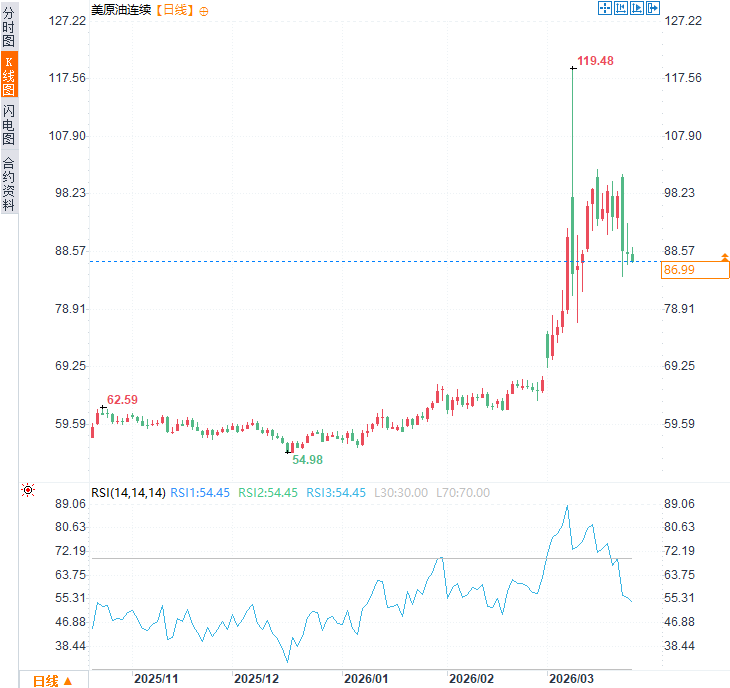
(US crude oil daily chart, source: FX678)
On Wednesday in Asian trading, US crude oil prices retreated somewhat due to expectations of US-Iran negotiations, but remained at a relatively high level, currently trading around $87.70 per barrel, down about 5% on the day.
Businesses have indicated they will attempt to pass on higher costs to consumers, leading to rising inflation expectations. Meanwhile, geopolitical uncertainty has dampened new orders and investment, dimming the employment outlook for the private sector. India, a major oil importer, has been particularly affected, with its input cost growth reaching its highest level since June 2022.
S&P Global Chief Business Economist Chris Williamson warned that Eurozone data is showing signs of stagflation: economic growth is nearing a standstill, while inflationary pressures are significantly increasing. The US and UK are facing similar predicaments—slower economic growth accompanied by rising costs.
However, many economists believe it is too early to declare a full-blown stagflation in the global economy. Nicola Nobile of Oxford Economics points out that the ultimate impact will depend heavily on the duration of the conflict and energy price trends.
The Organization for Economic Cooperation and Development (OECD) also stated that it is too early to quantify the impact of the conflict on global economic growth, but has pointed out significant downside risks.
In the short term, if the conflict with Iran continues, high energy prices will further suppress global economic growth and force central banks to make a difficult trade-off between curbing inflation and supporting growth. The Trump administration and other leaders have already felt the pressure, and several central banks around the world may consider tightening their policies.
In the medium to long term, if the conflict eases within weeks, the PMI is expected to gradually recover; however, if it drags on for more than 3-4 months, it will pose a systemic risk to global supply chains and economic growth. Investors need to closely monitor subsequent final PMI readings, oil price trends, and progress in diplomatic negotiations.
The collective decline in PMIs across major economies in March indicates that the Iranian conflict has rapidly spread from the energy market to the real economy, pushing up inflation expectations and suppressing business activity. The Eurozone is nearing a standstill, the US service sector is slowing, and growth in the UK and Japan has hit recent lows, raising early warning signs of stagflation.
While the likelihood of a full-blown recession remains low, the duration of the conflict will be a key variable determining the global macroeconomic outlook. Countries need to balance energy security with economic growth, and market uncertainty will continue to dominate short-term trends.
At 9:19 Beijing time, US crude oil futures were trading at $87.70 per barrel.
The disruption to shipping in the Strait of Hormuz has led to a sharp rise in oil and gas prices, which has dealt a double blow to business costs, supply chains, and consumer confidence. Chris Williamson, chief global business economist at S&P Global, pointed out that Eurozone data is "sounding alarm bells for stagflation," while weak US business confidence also foreshadows a bleak employment outlook.
Comparison of PMI data from major economies
Preliminary PMI readings for March generally declined, indicating a significant slowdown in private sector expansion. The Eurozone composite PMI fell to a 10-month low, the US composite output index hit an 11-month low, and growth rates in the UK and Japan also reached recent lows.
Eurozone manufacturing input and output price indicators fluctuated more sharply, French business confidence declined significantly, and German private sector growth slowed to a three-month low. The US service sector was the main drag, and UK manufacturing input costs grew at their fastest pace since 1992.
Iran conflict transmission mechanism
The conflict with Iran has led to a significant decrease in oil flow through the Strait of Hormuz, causing crude oil prices to fluctuate at high levels and natural gas prices to rise significantly. This disruption to energy supply directly increases business input costs and extends supply chain delivery times.
(US crude oil daily chart, source: FX678)
On Wednesday in Asian trading, US crude oil prices retreated somewhat due to expectations of US-Iran negotiations, but remained at a relatively high level, currently trading around $87.70 per barrel, down about 5% on the day.
Businesses have indicated they will attempt to pass on higher costs to consumers, leading to rising inflation expectations. Meanwhile, geopolitical uncertainty has dampened new orders and investment, dimming the employment outlook for the private sector. India, a major oil importer, has been particularly affected, with its input cost growth reaching its highest level since June 2022.
Discussion of stagflation risks
S&P Global Chief Business Economist Chris Williamson warned that Eurozone data is showing signs of stagflation: economic growth is nearing a standstill, while inflationary pressures are significantly increasing. The US and UK are facing similar predicaments—slower economic growth accompanied by rising costs.
However, many economists believe it is too early to declare a full-blown stagflation in the global economy. Nicola Nobile of Oxford Economics points out that the ultimate impact will depend heavily on the duration of the conflict and energy price trends.
The Organization for Economic Cooperation and Development (OECD) also stated that it is too early to quantify the impact of the conflict on global economic growth, but has pointed out significant downside risks.
Market Outlook and Risks
In the short term, if the conflict with Iran continues, high energy prices will further suppress global economic growth and force central banks to make a difficult trade-off between curbing inflation and supporting growth. The Trump administration and other leaders have already felt the pressure, and several central banks around the world may consider tightening their policies.
In the medium to long term, if the conflict eases within weeks, the PMI is expected to gradually recover; however, if it drags on for more than 3-4 months, it will pose a systemic risk to global supply chains and economic growth. Investors need to closely monitor subsequent final PMI readings, oil price trends, and progress in diplomatic negotiations.
Editor's Summary
The collective decline in PMIs across major economies in March indicates that the Iranian conflict has rapidly spread from the energy market to the real economy, pushing up inflation expectations and suppressing business activity. The Eurozone is nearing a standstill, the US service sector is slowing, and growth in the UK and Japan has hit recent lows, raising early warning signs of stagflation.
While the likelihood of a full-blown recession remains low, the duration of the conflict will be a key variable determining the global macroeconomic outlook. Countries need to balance energy security with economic growth, and market uncertainty will continue to dominate short-term trends.
At 9:19 Beijing time, US crude oil futures were trading at $87.70 per barrel.
- Risk Warning and Disclaimer
- The market involves risk, and trading may not be suitable for all investors. This article is for reference only and does not constitute personal investment advice, nor does it take into account certain users’ specific investment objectives, financial situation, or other needs. Any investment decisions made based on this information are at your own risk.